


On the eve of Holocaust Remembrance Day, the global Jewish population stands at 15.8 million, according to data released Sunday by Israel’s Central Bureau of Statistics (CBS), a figure that remains below pre-World War II levels.
Of the total, about 7.2 million Jews, roughly 45% of the global Jewish population, live in Israel, while approximately 6.3 million, about 40%, reside in the United States. Together, the two countries are home to about 85% of Jews worldwide.
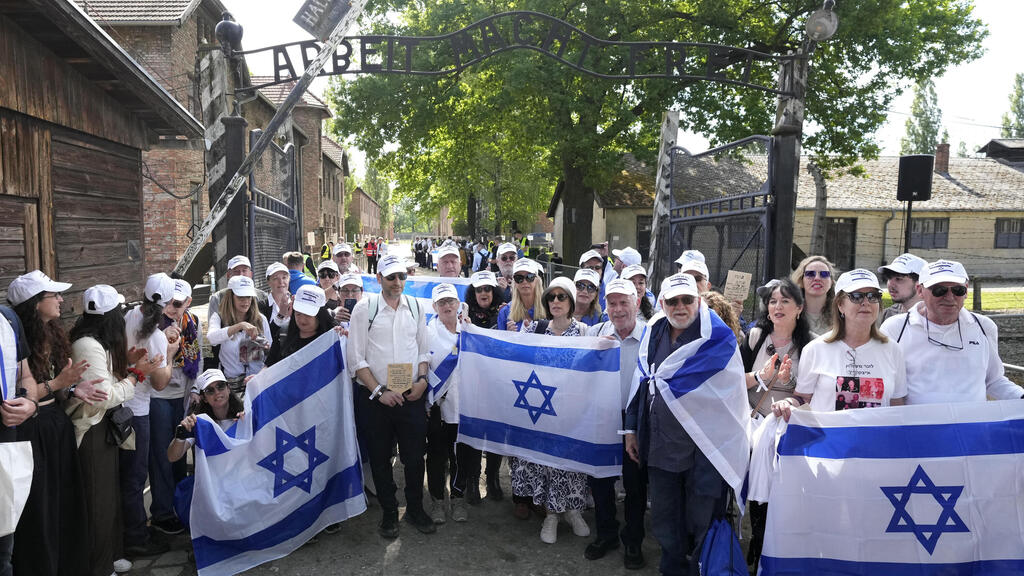
The March of the Living at the Auschwitz extermination camp
(Photo: Czarek Sokolowski/ AP)
By comparison, in 1939, on the eve of World War II, the global Jewish population was estimated at 16.6 million, with only 449,000, about 3%, living in what would later become the State of Israel.
Distribution around the world
Beyond Israel and the United States, Jewish communities are spread across several countries, though in significantly smaller numbers.
France has about 436,000 Jews, Canada 407,000, the United Kingdom 315,000, Argentina 168,000, Germany 126,000, Russia 120,000 and Australia 117,000.
Compared with data published two years ago, the Jewish population has declined in several countries. France saw a slight drop from 440,000 to 436,000, while Russia experienced a sharper decline from 132,000 to 120,000, nearly 10% over two years. Argentina also recorded a decrease, from 171,000 to 168,000.
In contrast, Canada saw an increase despite a rise in reported antisemitic incidents, growing from 398,000 in 2023 to 407,000 in the latest report.
Holocaust survivors in Israel
According to the CBS, about 111,000 Holocaust survivors and victims of antisemitic persecution during the Holocaust era are currently living in Israel.
Women make up 63% of survivors, while men account for 37%.
Approximately 6% of survivors immigrated to Israel before the establishment of the state. About 30.2% arrived during the major immigration wave between 1948 and 1951, another 30.2% between 1952 and 1989, and roughly one-third, 33.6%, immigrated since the 1990s, mainly from former Soviet Union countries.
Aging population
The data highlights the advanced age of Holocaust survivors.
About 37% were born between 1939 and 1945 and are now between 80 and 85 years old. Around 35% are aged 86 to 89, while approximately 28% are aged 90 or older.
Nearly half, 49.3%, are widowed, while 38.2% are married, 10.6% divorced and about 2% single. Of the married survivors, 18,700 are married to another survivor, meaning there are currently about 9,300 households in Israel where both partners are Holocaust survivors.
Where survivors live
Around 95% of Holocaust survivors in Israel live in urban areas, with only about 5% residing in rural communities, a distribution similar to the general population.
About 42% live in large cities with populations exceeding 200,000. Approximately 7,500 reside in Haifa, 7,100 in Jerusalem, 6,000 in Tel Aviv-Yafo, 5,500 in Ashdod, 5,400 in Netanya, 4,700 in Petah Tikva, and about 4,600 each in Beersheba and Rishon Lezion.
The data, compiled using information from the Authority for the Rights of Holocaust Survivors, underscores both the global distribution of Jewish communities and the aging population of survivors, as the world marks Holocaust Remembrance Day.