

Nazi cruelty is well documented, and the understanding that it was deployed as a planned system, not an uncontrolled outburst of violence, is not new. Less widely known is how far that system extended into detail, down to procedures, approvals and daily implementation, and even to the way instruments of terror themselves were built, managed and integrated as an inseparable part of a method designed for destruction.
In March 1943, six Soviet prisoners of war escaped from a factory in Germany. German authorities sent two SS men to search for them, accompanied by dogs from the canine unit of Flossenbürg concentration camp. As a reward for successfully capturing the escapees, one of the dog handlers received three days of leave. This detail, preserved in the archives, became the starting point for a new and compelling study by Barnabas Balint, a young British researcher of Hungarian origin, who set out to examine a chapter pushed to the margins of historiography: the Nazi dog units (Hundestaffeln) that operated in notorious concentration camps.
Gallery
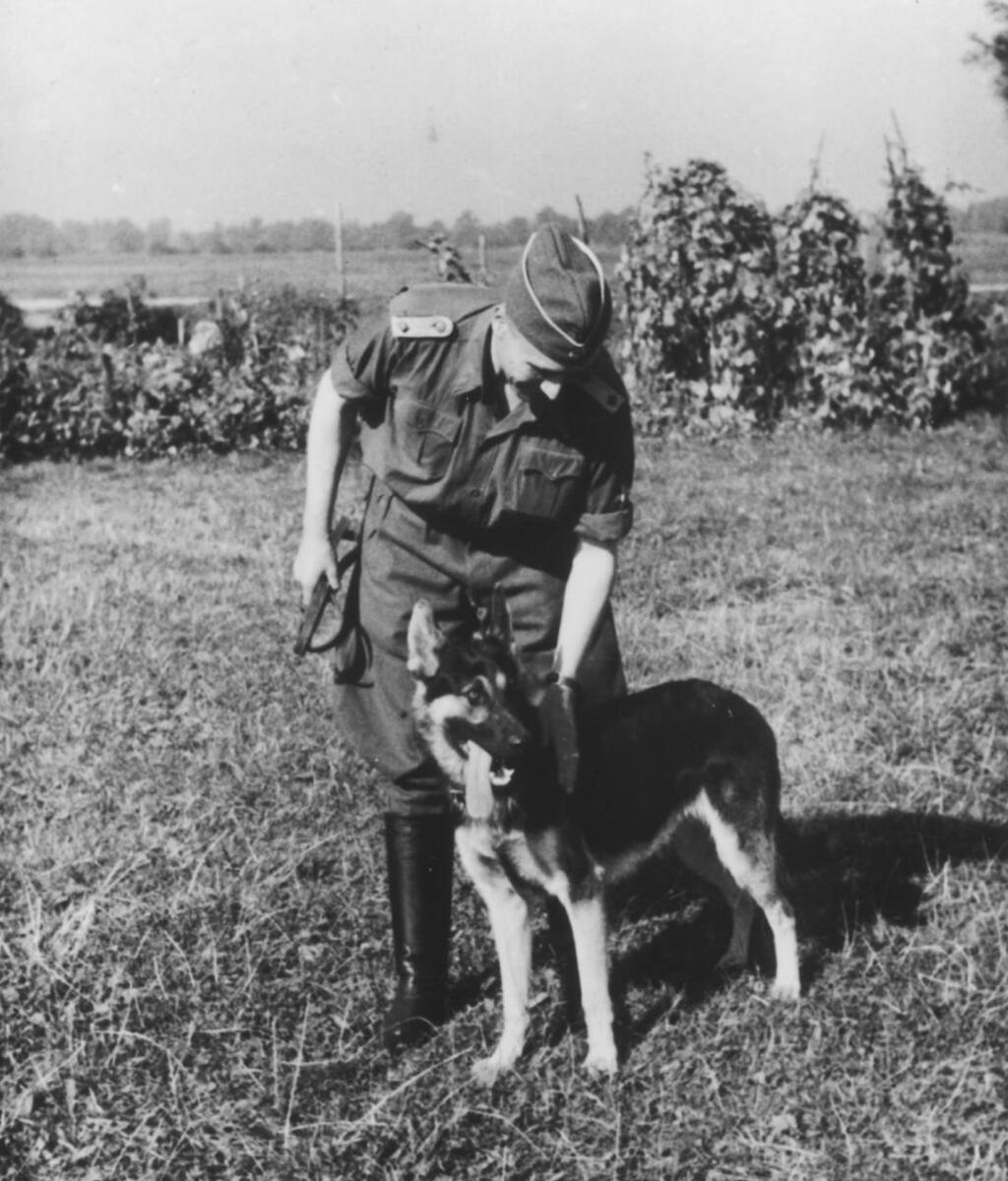
What appears to be savage violence is revealed as an organized practice
(Photo: United States Holocaust Memorial Museum)
The dog as a bureaucratic instrument
The focus on dog units is not incidental. It offers a way to examine one of the Nazis’ most brutal tools not only through victims’ memories, but through the system that deployed it. What appears to be savage violence is revealed as an organized practice, complete with procedures, hierarchy and the transfer of knowledge.
Many people are familiar with the presence of dogs in Nazi camps from Holocaust survivors’ testimonies, which describe them as frightening, threatening animals that accompanied prisoners at every moment — during selections (the process of determining forced labor or death), marches and forced labor, as part of daily camp life. These memories are deeply embedded in public consciousness and recur in personal testimony, family memory and historical documentation. Viewing them through the lens of Nazi bureaucracy expands the picture and adds another layer of understanding: the dogs were not a marginal element but part of an organized, planned and comprehensive system.
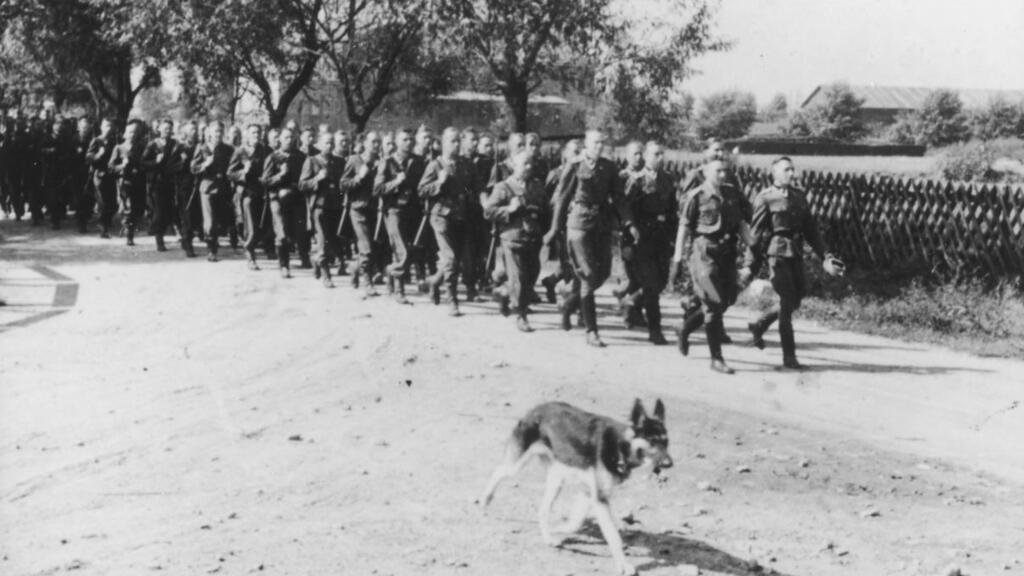
Nazi dog units operated in at least nine camps
(Photo: United States Holocaust Memorial Museum )
In July 1942, the Central Construction Office at Auschwitz drafted plans to build kennels for about 250 dogs at Birkenau. The plans were sent for approval to the SS Main Office in Berlin, which approved them. Due to construction problems, the planners were forced to revise the plans and resubmit them. The commissioner for the construction industry in Katowice approved the revised plans on the condition that the work be carried out by prisoners themselves, without the use of external resources. The chain of correspondence between Auschwitz, Berlin and Katowice shows how the camp was linked to outside offices that transmitted knowledge about approved construction processes.
The significance of such documentation goes far beyond the technical question of building kennels. It exposes deeper layers of the Nazi system, including the transformation of dogs into a regulated and coordinated component. Prisoners themselves built the kennels for the animals meant to pursue them. This stands as one of the starkest symbols of Nazi methods of humiliation: forcing victims to participate in constructing and preparing the tools used to oppress them.
Balint’s research shows that Nazi dog units operated in at least nine camps: Auschwitz, Gross-Rosen, Flossenbürg, Sachsenhausen, Stutthof, Dachau, Buchenwald, Majdanek and Neuengamme. Dog handlers were transferred from camp to camp. Names such as Albert Papendik, who began in Dachau and was later moved to Stutthof and then Buchenwald, or Oswald Hausmann, who appears in records from multiple camps, illustrate that these transfers were not random. They involved the movement of professional knowledge on how to use dogs as tools of control and terror. The use of dogs was not an arbitrary form of violence but a policy, with expertise, accumulated experience and systematic implementation.

The researcher Barnabas Balint
(Photo: Courtesy)
A particularly striking detail emerges from Gross-Rosen: in December 1944, the camp commander ordered eight female guards to undergo training as dog handlers. Concentration camps were overwhelmingly male environments, with power and violence largely in the hands of men. The dog altered that equation. With a trained dog at her side, a female guard could instill fear in dozens of prisoners at once, regardless of physical strength. Evidence shows that the connection between female guards and dogs appears repeatedly across camps, in testimonies and archival records. Survivor accounts suggest that female guards were sometimes perceived as especially cruel, perhaps because of the gap between expectations of femininity and the violent reality. In this context, the dog was not only a tool of control but also a symbol of a distorted social order.
Survivor memory and suppressed knowledge
As a Holocaust historian, one of the most compelling questions raised by research on Nazi dog units is why the subject has been so little studied. Part of the answer lies in an academic scandal: in 2016, it emerged that a paper on Nazi guard dogs was based on fabricated evidence. The scandal discouraged further research and created a gap in which little reliable historical work was produced.
Survivors, however, remember the dogs clearly, repeatedly describing them as a terrifying and traumatic part of daily life. What survivors recall is precisely what bureaucratic documentation cannot convey: fear. Dogs were present at key moments of camp life — during selections, in managing work groups and at moments when life and death decisions were made. No document can capture the terror a prisoner felt when an SS dog approached.
At the same time, the documents tell an equally important story: that of a calculated, systematic and coordinated mechanism. Dogs were not an adjunct to Nazi violence but an integral part of it. The tension between human memory and bureaucratic documentation allows for a fuller understanding — of both the experience and the system.
The effects of those experiences did not end with the camps’ liberation. Some survivors remained afraid of dogs for the rest of their lives, and in some cases the trauma extended to their children. Nazi dog units left scars that crossed generations — in the body, in the nervous system and in involuntary reactions to the sight of an otherwise harmless animal.

Dr. Daniela Ozacky Stern
(Photo: Courtesy)
More than 80 years after the Holocaust, there is a need to document not only the major events — the camps, the ghettos and the scale of the killing — but also the instruments of terror and control that were systematically bred and trained. Deeper understanding is often found in small details, in dry documents that reveal how a brutal system functioned and how it refined its methods.
Violence is often seen as a product of hatred and indoctrination, but it can also take root through order, hierarchy and procedures within a system that redefines what is permitted and what is forbidden.
Examining the camps’ dogs brings the discussion to an uncomfortable place: not only what was done, but how it was done. Not only who suffered, but how the mechanism that enabled that suffering was constructed. Animals were present at critical moments during the Holocaust, and the dogs of Auschwitz terrorized prisoners decades ago. They continue to appear in memory, in the body and in consciousness. Survivors always knew those dogs were there. It is time for history to fully acknowledge it.
Dr. Daniela Ozacky Stern is a historian of Nazi Germany and Jewish life during the Holocaust and a lecturer in the Holocaust studies program at Western Galilee College. Her research focuses on Nazi propaganda and Jewish resistance during the Holocaust, particularly the story of Jewish partisans.