

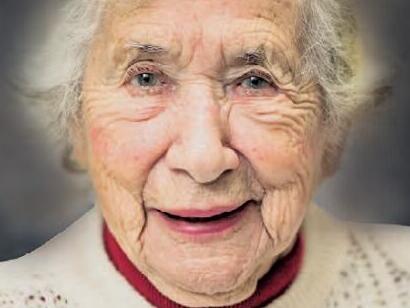
Selma van de Perre-Velleman, a Dutch-born Jewish resistance fighter who risked her life opposing the Nazi occupation and later became a journalist in Britain, has died in London at the age of 103, Dutch media reported this week.
Born Selma Velleman on June 7, 1922, in Amsterdam, van de Perre was 17 when World War II broke out. Her father, Barend Velleman, was a well-known Jewish actor and singer, and her mother, Fem Spier, managed the household. The family was liberal and not religiously observant.
In 1941, several months after the Nazi invasion of the Netherlands, her father was arrested and sent to Camp Westerbork. Her mother and sister, Clara, went into hiding in Eindhoven with Selma’s help, but they were betrayed in 1943 and deported to Sobibor, where they were murdered. Her father was later killed in Auschwitz.
Van de Perre narrowly escaped arrest several times and eventually joined the Dutch resistance under a false identity, Margareta (“Marga”) van der Kuit, later using the alias Wil Buter. For two years she served as a courier, carrying illegal leaflets, forged documents and messages across the Netherlands, often disguised as a non-Jewish Dutch woman with dyed blond hair.
“I started by delivering newspapers that the resistance printed,” she told Yedioth Ahronoth in a 2022 interview. “Very quickly I was carrying suitcases full of illegal papers, traveling to different towns as a courier — all under a false identity, with forged papers and a completely changed appearance.”
In June 1944, van de Perre was betrayed and arrested in Utrecht. Because the Gestapo did not know she was Jewish, she was registered as a political prisoner and sent via Camp Vught to the Ravensbrück concentration camp for women. She survived nine months there, partly by working in the Siemens & Halske factory, where conditions were marginally better.
“We were liberated on April 23, 1945, by the Swedish Red Cross,” she later recalled. “We were weak and terrified as we were taken out of the main camp.”
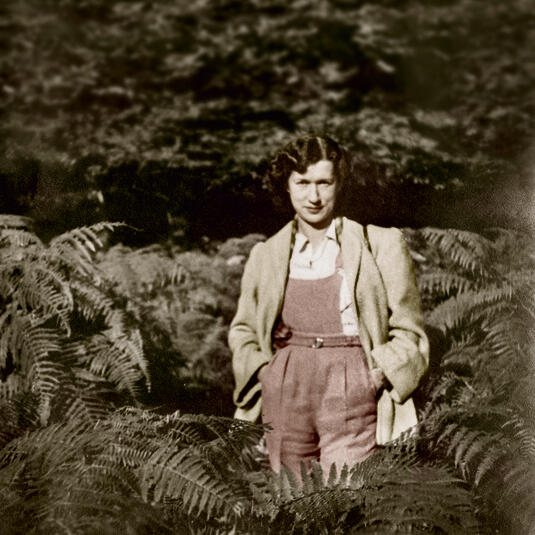
After the war, she revealed her real name and returned to the Netherlands, learning that her parents and sister had been murdered. In 1947 she moved to London, where she worked at the Dutch embassy before studying anthropology and sociology. She became a teacher at Sacred Heart High School in Hammersmith and later joined BBC Radio Netherlands as a journalist. There she met her future husband, Belgian journalist Hugo van de Perre, whom she married in 1955.
Van de Perre continued his work as a correspondent after his death in 1979 and later became a British citizen.
In 1983, she received the Resistance Memorial Cross, a Dutch decoration honoring those who fought the Nazi occupation, and in 2021 she was awarded the Order of Orange-Nassau.
From the mid-1990s, she visited Ravensbrück every year to speak with Dutch and German students about the war. Her memoir, My Name Is Selma — first published in Dutch in 2020 as Mijn naam is Selma — recounts her wartime experiences and her determination to resist.
“It was important for me to pass on one of the main lessons as a Holocaust survivor,” she said in 2022. “People follow dictators before they understand what is coming. These dictators don’t rise to power overnight. And when people finally want to rebel, it’s already too late. Never again.”