

My most recent work excursions were both similarly different from those of the past. At this point in my career, I’ve developed a system for travel. I use the same trolley and backpack, wear the same clothing and bring the same food for the duration of the trip. I take an early morning flight to the destination, perform the brit milah in the afternoon, stay the night and return the following morning. It’s become so regimented, I have trouble recalling all the places I’ve been.
On my way to Madrid, things began as normal — an early morning rise for a flight from Tel Aviv to France. The inspection of my tools at Ben Gurion garnered the usual skepticism that ultimately ended in permission to board my flight with all the non-sharp items. The family procures everything sharp I’ll need, eliminating the necessity to check a bag.
Upon landing in France, all seemed to be going according to plan, so I checked in with my children. “Did you hear what’s going on?” my son asked. At the time, I hadn’t heard anything out of the ordinary, so I requested an update.
As I stood in line to board my connecting flight, I saw the first images of the attempted Flydubai crash. A passenger with blood dripping down his forehead spoke to the camera, showing someone tied up on the floor, wearing a pilot's uniform. I struggled to decipher the Hebrew subtitles as French announcements blared over the loudspeakers. “It was the copilot, Aba. He tried to crash the plane because there were Israelis on board,” my son explained. “But the passengers got the plane back. Everyone’s ok.”
I later learned that my flight had taken off just moments before the crazed co-pilot intended to crash into Ben Gurion.
The sense of relief in knowing a crisis had been averted was fleeting. I was immediately brought back to the reality that I was boarding a non-El Al flight in a country whose citizens tend not to be on the best terms with the Jewish State. “Anyone could copy this style of terrorism,” I thought. We’ve all seen flight crews skip security on their way to the plane. And having subsequently learned of the Flydubai copilot’s overt hatred of Jews and Israel means background checks were not up to par.
Even before I became a traveling mohel, I did a fair share of flying; be it family vacations or surf trips. There were even tense moments on rare occasions, but I never shied away from the friendly skies.
On a return flight from the U.S. to Israel many years ago, my wife and I were seated in separate sections, each with one of our little ones. As we pulled back from the gate, I noticed a fire truck dousing the plane with water. Since it was mid-December, it seemed like the opposite of deicing. I later learned that it was the pilot’s final flight before retirement and this was the traditional send-off. The same was done when we landed in Israel, as his family greeted him with ‘Mazal Tov Saba’ signs on the runway.
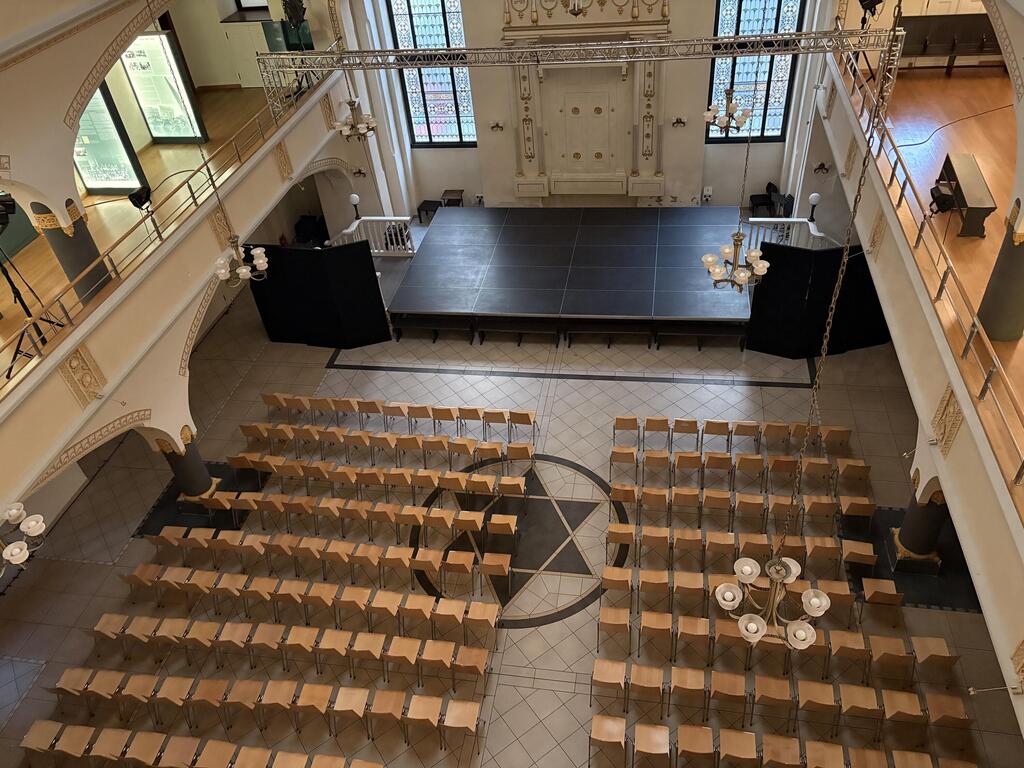
The main sanctuary of Wroclaw's historic synagogue
(Photo: Rabbi Hayim Leiter)
In the middle of the 10-hour journey, we hit some of the most violent turbulence I’ve ever encountered. Upon arrival, my wife and I recounted our separate experiences as we waited at the luggage belt. “I could see the headlines,” she said. “Pilot’s Final Flight Goes Down.”
I had the exact opposite response. “There’s no one better to navigate this than a veteran pilot on his last trip,” I told her. Luckily, I was right.
None of these experiences, not this one or any others, had ever deterred me from air travel. In fact, I’ve never been scared on a flight until my connection from France to Madrid. Being in transit on the same day as the Flydubai flight wearing a Kippah made me worry for my own safety and the safety of Jews around the world.
As we pulled back from the gate, I said Tefilat HaDerech (the traveler’s prayer) as I always do en route to the runway. There’s a line in the prayer that, even after all these years, has never made sense to me: "Rescue us from any enemy or ambush on the way.” Some versions even include the word "Listim," which translates to "bandits."
Until the Flydubai flight, I always imagined the Jews of antiquity, driving their horse-drawn carriages, being surrounded by thieves in the woods and thought to myself, this just doesn’t apply to airline travel. But that day, on that flight, I finally understood the meaning of those words. We never know where our enemies lie and, as we all learned from the miracles of that flight, God’s protection knows no limit — it can reach the highest of highs and the lowest of lows.
The following week, my work brought me to Poland for another Bris. En route to my hotel, conversing with my Uber driver who shockingly spoke perfect English, I mentioned how crazy the Flydubai flight had been. He had yet to hear the news.
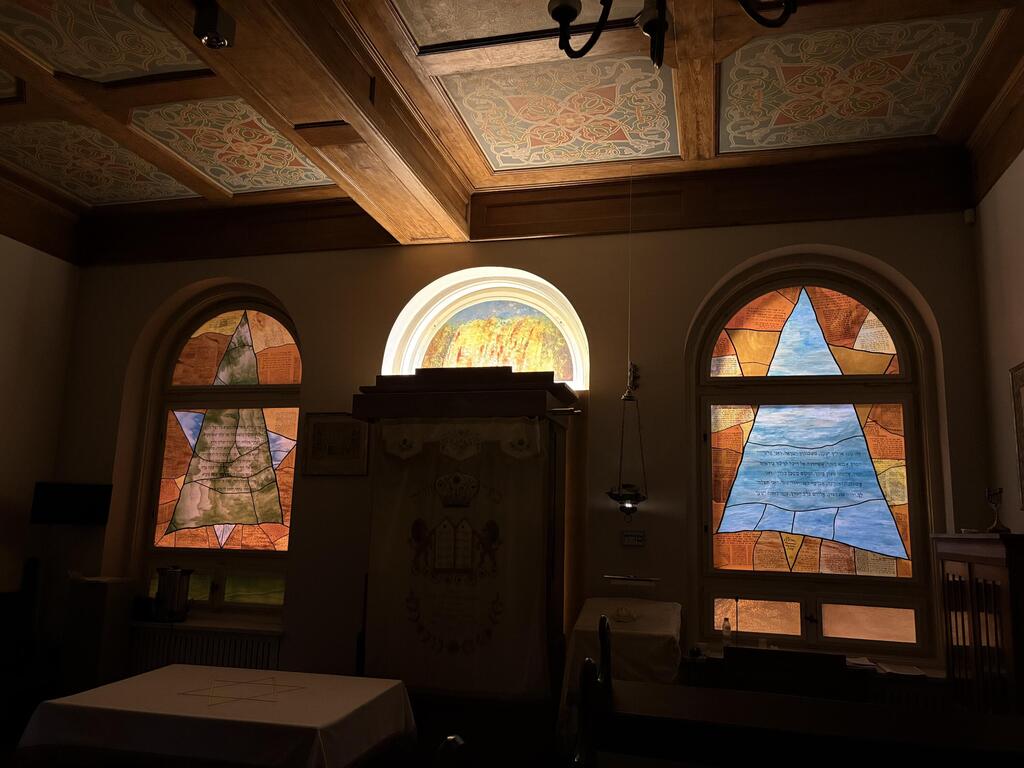
A dimly lit prayer room at a synagogue in Wroclaw, Poland
(Photo: Rabbi Hayim Leiter)
I recounted the tale to his astonishment. “I have goosebumps,” he told me. I felt like Moshe Rabbeinu regaling the Exodus to his father-in-law Yitro. The Torah uses a unique phrase to describe his reaction — VaYichad Yitro — which Rashi explains as goosebumps. I wondered if the driver’s reaction was independent of the greater non-Jewish world, or if our Jewish media echo chamber led to my astonishment at his ignorance. Either way, I felt far from home.
It turns out my hotel in Wroclaw was across from the synagogue. I was able to gain access to its museum in the last moments of the day. I zigged and zagged through the exhibits, inspecting antique Judaica and learning of one pogrom after another. I had a flashback to my experience on the March of the Living in high school. As we congregated after a museum visit that displayed tallitot and tefillin in glass cases, our tour’s rabbi let us know how he felt. “This is disgusting,” he had shouted. “Judaism is not meant to be on display; it’s meant to be lived!”
As I finished my tour in Wroclaw, I felt as the rabbi did years before. Where is the Jewish community? It felt as if it were dead. As it came time to pray the evening service, I snuck into the bowels of the synagogue, trying to make my way into the main sanctuary. I found a small chapel with a dimly lit ark. I felt compelled to pray in this place that might only be used a few times a year.
As I finished Aleinu, I heard noise drifting down the hall. It sounded like people singing. I snuck through the dark and arrived just outside a classroom where a choir was practicing. The acoustics bellowed like a Roman Cathedral, yet the words they sang were our own. In the breaks between the melodious sounds, the director spoke Polish to those in attendance. I felt reassured. The timing of my trip was well after the High Holidays. This choir was practicing for some other Jewish cultural event on the horizon.
Something about finding this choir felt akin to the Flydubai flight. As that plane had descended thousands of feet in mere moments, I’m sure all the passengers thought all was lost. But somehow, the plumber, with his limited documentary knowledge of flight, pulled the plane from certain death. As I made my way back to the hotel, the choir sounds still ringing in my ears, I felt certain that all was not lost in Wroclaw.
Judaism will survive — be it through pogroms or terror attacks. As the traveler’s prayer teaches us, God’s providence is with the Jewish people no matter what corner of the earth we find ourselves.
- The writer is a rabbi, a wedding officiant and a mohel who performs britot (ritual circumcisions) and conversions in Israel and worldwide. Based in Efrat, Israel, he is the founder of Magen HaBrit, an organization protecting the practice of brit milah and the children who undergo it.