

In 1990, Guillaume Ribot, a non-Jewish French cameraman, traveled with a delegation of journalists to the Auschwitz-Birkenau extermination camp. At the time, Ribot did not yet grasp the profound impact the visit would have on his life. The next day, he returned to France and went straight back to the newsroom.
"The visit lasted only one day. It was a short trip", Ribot recalls. "The following morning, during a meeting, someone asked me: 'How was Auschwitz?'. The question completely disoriented me. I didn't know what to answer. At that moment, I realized I had to go back to Auschwitz and focus on this subject".
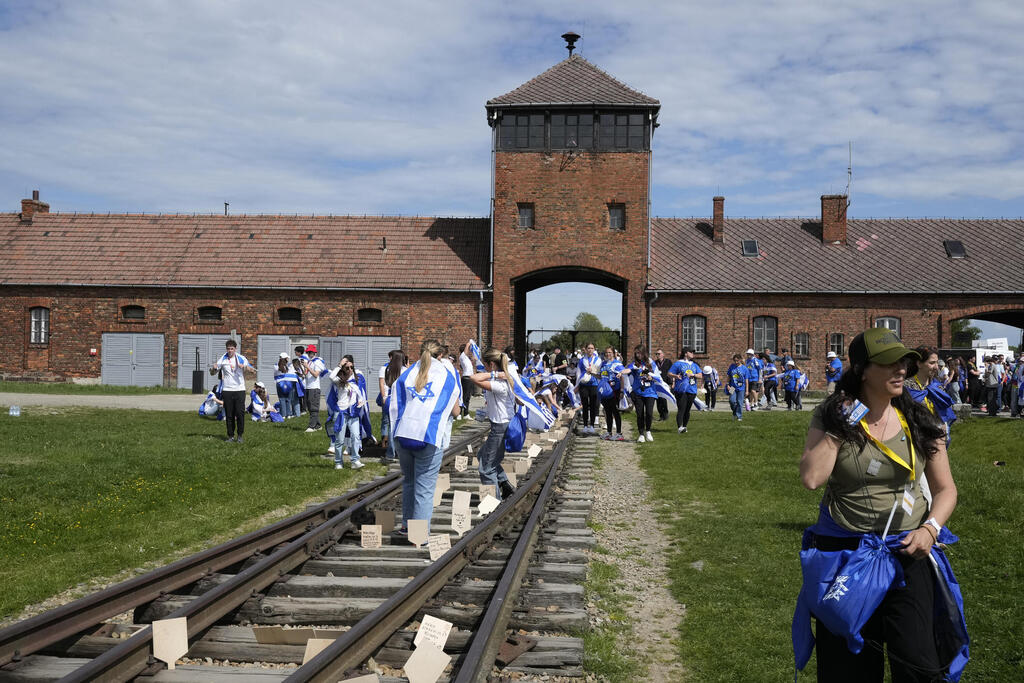
He returned to the camp and stayed there for two weeks, filming the site. Since that formative visit, the Holocaust has become a central focus of Ribot's work. He has published books, curated exhibitions, and directed documentary films on the subject.
"The Holocaust raises endless questions for me", he says. "From my first visit, I felt unable to understand what had happened there. I needed help, knowledge and guidance from historians, scholars, and documents. But documenting the camp alone was not enough. That is why I later decided to become a filmmaker and devote myself to this subject".
Only years later did Ribot discover that the Holocaust was also part of his own family history. "My grandmother, Paulette Morichon, told me that she had hidden Jewish children during World War II", he says. "She lived on a farm called La Petite Charlotte, in a small village in southern France, about 150 kilometers from Bordeaux."
"At the time, she was suffering from Alzheimer's, so I didn’t fully believe her", Ribot admits. "After she passed away, I returned to the village where she grew up. I spoke with her brother, who showed me a notebook that had belonged to a small Jewish girl named Suzy. That's when I understood that my grandmother's story was true.
"In 1943, during the Nazi occupation, my grandmother opened the farm to children from Bordeaux. Not all of them were Jewish. But those who were had to be hidden, and she was forbidden to speak about them", he continues.

Guillaume Ribot
(photo: Courtesy of Lev cinemas)
"Tragically, in 1942, little Suzy, her sister Élise, and other Jewish children my grandmother had hidden were deported to Auschwitz, where they were murdered in the gas chambers. I am extremely proud of what my grandmother did".
The interview takes place in Berlin, near the site of a former Gestapo detention center and just a few streets away from where the Reich Main Security Office once stood. As Ribot speaks, he takes out a photograph.
"This is Suzy", he says. "And this is her sister Élise. She was nine years old when they were murdered in Auschwitz".
Holding the photograph, it is impossible not to feel a chill. "That was when I decided to make my first documentary, Suzy's Notebook", Ribot says. "I am here today, at the Berlin Film Festival, thanks to my grandmother - and because I found this photograph in a box she kept".
Your grandmother deserves to be recognized as Righteous Among the Nations. Did you try to obtain that status for her?
"When I spent five years in Ukraine while working on one of my films, I met a Righteous Among the Nations who had been awarded the medal engraved with the words 'Whoever saves one life, it is as if they saved an entire world'. But I would never try to obtain that status for my grandmother - even though I know it would have been possible. Why not? Because it's clear to me that it's a very complicated process. That said, as I've mentioned, I am deeply grateful for what my grandmother did and immensely proud of her".
"If you could lick my heart, you would die of poisoning"
The 75th Berlin International Film Festival marked 100 years since the birth of Jewish filmmaker Claude Lanzmann, as well as 40 years since the release of "Shoah" in 1985. After twelve years of work, Lanzmann created a monumental nine-hour film that redefined the cinematic representation of the Holocaust, relying solely on interviews and contemporary footage of the sites themselves, without archival material. "Shoah" was later recognized by UNESCO as a work of world heritage.
As part of the tribute, Ribot presented his new documentary, "All I Had Was Nothingness", which explores the making of "Shoah". Ribot also serves as the film's narrator.

Claude Lanzmann
(photo: AP)
"When a filmmaker screens a film at the Berlinale, it is always significant", Ribot says. "But screening this particular film in Berlin was especially meaningful. Germans carry a unique responsibility to preserve the memory of the Holocaust".
"All I Had Was Nothingness" was also screened at the 2025 Jerusalem Jewish Film festival that took part last week. Ribot decided to direct the movie after reading, several years ago, "The Patagonian Hare", Lanzmann's autobiographical book. For Ribot, it was a "revelation". He set out on a journey in the footsteps of "Shoah". Through the website of the United States Holocaust Memorial Museum, he was exposed to all the material Lanzmann had filmed but never used - and thus plunged into 220 hours of raw footage. "I sat at home for several months; whenever something jumped out at me, I marked it. I knew where I wanted to go with the film, but even at the end of the process I wasn't sure it would work".
One particular scene was what ultimately compelled Ribot to make the film - the moment in which Lanzmann interviews Yitzhak (Antek) Zuckerman, one of the leaders of the Warsaw Ghetto uprising. Zuckerman insists that making a film about the Holocaust is, in fact, an impossible task, because it turns Holocaust survivors into heroes while ignoring the millions of others - faceless and nameless - who did not survive and were killed, thereby, in his view, taking part in their murder.
"If you could lick my heart, you would die of poisoning", Zuckerman tells Lanzmann. At that point, Lanzmann collapses into Zuckerman's arms and rests his head on his chest.
"'Shoah' is an investigation", Ribot believes. "It forces us to ask questions. We are not supposed to cry while watching it. I never cried when I saw it. I was shocked and awed, but it is not a film meant to elicit tears".

From the movie "Shoah"
(photo: screenshot)
The title of Ribot's documentary is taken directly from a sentence spoken by Lanzmann. "When Claude made Shoah, he said: 'I wanted to film, but I had nothing'. The challenge he faced was that most of the camps had been erased. There is nothing there - only ruins and barbed wire fences. And you cannot understand what happened in the camps simply by going to the places where they once stood. That difficulty pushed him to create a masterpiece in the face of emptiness, through the memories of his interviewees. Claude tried to awaken the witnesses' memories by having them reenact events from the past - for example, with barber Abraham Bomba, who was forced to cut women's hair before they entered the gas chambers, or with the train driver who transported Jews to the camps".
During your career as a photographer and director, did you ever meet Lanzmann in person?
"I never met him. I came to know him through his films. Thanks to making 'All I Had Was Nothingness', I got to know Claude as I never had before. In my film, we focus on Claude Lanzmann before he created the masterpiece 'Shoah'. Through the raw materials I was able to access, I came to know him as a person before 1985, before he became the legendary Claude Lanzmann of 'Shoah'. Beyond that, I did not make a biographical film about Lanzmann. All I wanted was to present him as a developing creator. I was also interested in his working methods. For example, it was fascinating to see him walking around shirtless in his hotel room, placing hidden microphones to record Nazis and capture them".

Claude Lanzmann
(photo: screenshot)
After October 7, in Israel and beyond, the terms 'Holocaust', 'genocide' and 'Nazis' have been used frequently. What do you think about the use of these terms today?
"I don't think my personal opinion holds any real significance here. I'm simply a filmmaker. Of course, I have my own views, but they are not the main point. There's a saying in France: if you compare things too much, you end up making mistakes. In other words, trying to equate past events with the present can make you lose the ability to observe events as they unfold - and that, I believe, is something we must be careful of. We must guard against losing ourselves in comparisons".
It’s hard not to make comparisons, especially given the rise of antisemitism in Europe.
"Again, I don't think I'm the right person to speak broadly on Jewish issues. I'm neither Jewish nor Israeli. But in France, where I live, I can say there are things that frighten me deeply: words and events that echo the horrors of the past. Today, with social media and the rise of the far right, the situation is very worrying. There is reason for concern".