

Russian strikes on Ukraine’s energy infrastructure have plunged much of the country into a deepening power crisis, with children and the elderly among the hardest hit.
In Kyiv, residents are enduring another winter under fire, but community leaders say conditions in the capital have never been this severe. Even a few hours of heat and light each day can mean the difference between comfort and danger. Freezing apartments without reliable electricity or heating pose serious health risks, particularly for seniors and young children.
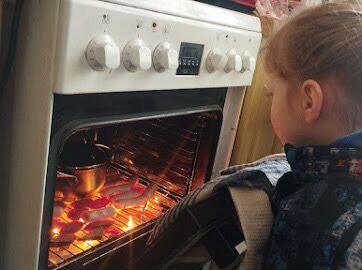
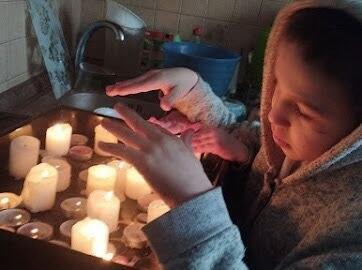
(Photo: Courtesy of Simcha Chabad Kyiv)
On the city’s left bank, the Jewish community center “Simcha” continues to operate around the clock — powered entirely by generators. Its kindergarten, school, synagogue, free cafeteria, student programs and welfare services have remained open despite rolling blackouts.
“Today, a generator in Kyiv is not a luxury, it’s a matter of life,” says Rabbi Mordechai Levengartz, a Chabad emissary who heads the center. Without it, he says, the community would not be able to teach children, feed the elderly or provide a warm refuge.
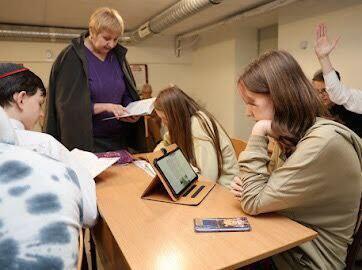
For the 500 students enrolled in Simcha’s school and kindergarten, the center has become far more than an educational institution. It is a stable environment amid uncertainty.
“This is very different from the early months of the war,” Levengartz says. “Back then schools were closed, classes were online and many families left the city. Since September 2022, the government has allowed schools with proper shelters to resume in-person learning.”

(Photo: Courtesy of Simcha Chabad Kyiv)
Simcha’s shelters were prepared in advance, enabling classes to continue face to face. Still, daily life remains shaped by air raid sirens.
“We live in a constant state of readiness,” Levengartz says. “Almost every day there are alerts. When the siren sounds, the children go down to the shelters and lessons continue there.”
Desks and chairs are moved into reinforced spaces, effectively turning them into underground classrooms. Some alerts last for hours. In the kindergarten shelter, mattresses are available so younger children can rest.
Dismissal can also be delayed. By law, children must be released directly to their parents. If a siren sounds at pickup time, school buses wait — sometimes for hours — until it is safe to travel.
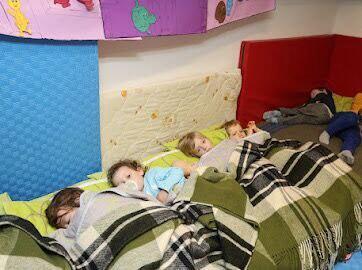
(Photo: Courtesy of Simcha Chabad Kyiv)
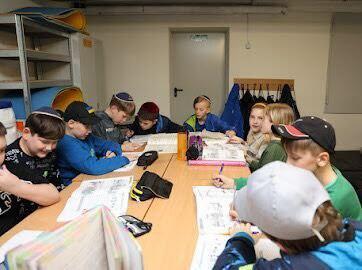
(Photo: Courtesy of Simcha Chabad Kyiv)
According to Levengartz, the current winter is the harshest since Russia’s invasion began. After the winter break, many Kyiv schools were closed by municipal authorities due to a lack of heating and electricity. Simcha, however, remained open.
“With generators, we still have internet, interactive boards and modern equipment,” he says. “Our physics and technology labs are functioning. The educational process didn’t stop even when most city schools were shut.”
Yet technology is secondary, he adds. “For many children, home is cold and dark. There is no way to cook or heat food. School has become a place where they can eat, warm up, feel safe and experience some joy.”
Psychologists provide counseling, and the center distributes blankets, power banks and food packages. “We try to preserve their emotional balance and give them a sense that life continues,” Levengartz says.
(Photo: Courtesy of Simcha Chabad Kyiv)
Elderly at risk
The impact on the elderly has been especially acute. Community volunteers prepare daily meals for about 200 pensioners, some of whom eat at the center while others receive deliveries at home.
“When someone has no electricity or heat for days, staying in the apartment becomes dangerous,” Levengartz says. In severe cases, the community arranges temporary relocation to warmer facilities, including the nearby village of Anatevka or local hotels.
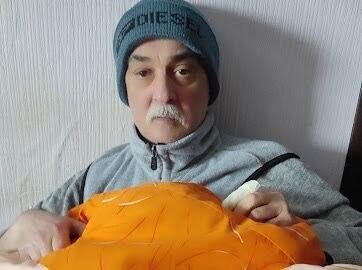
He recounts the case of a 91-year-old Jewish man who lived alone in an unheated apartment for nearly two weeks. “One morning he simply could not get out of bed,” Levengartz says. The man was hospitalized and died the following day. A similar case occurred elsewhere in the city.
Cold exposure is rarely listed as an official cause of death, he notes, but prolonged indoor temperatures below 6 degrees Celsius can be devastating for elderly people with weakened immune systems.
(Photo: Courtesy of Simcha Chabad Kyiv)
Expanding aid efforts
At Hesed Bnei Azriel, a Jewish welfare organization in Kyiv, director Grigoriy Kolodach says the energy crisis has forced an expansion of assistance programs.
“Severe frost combined with no heating is a deadly mix for seniors,” he says. Hesed distributes blankets, warm clothing, heaters, portable stoves, firewood, coal, sleeping bags and food, as well as helping cover utility costs.
Particular attention is given to those unable to leave their homes. “For people with limited mobility, losing electricity means losing contact with the outside world,” Kolodach says. Power banks, he adds, can directly affect their safety.
Amid war and uncertainty, Jewish institutions in Kyiv have resumed a familiar historical role — serving as hubs of solidarity and mutual aid. With support from Israeli and international Jewish organizations, schools remain open and assistance continues, ensuring that even in the depths of winter, the community is not left to face the cold alone.