

Lag B'Omer, the 33rd day of the Omer, is understood in Kabbalistic teaching not simply as a pause in mourning, but as a decisive shift in the work of the spirit. Rooted in the Kabbalist Rabbi Shimon bar Yochai (Rashbi), described in the sources as “butzina kadisha," or the holy spark, the day represents a moment when what was distant begins to reconnect. It is part of a larger process unfolding between Passover and Shavuot, where the spirit is gradually prepared to receive the Torah - not as information, but as a presence.
Central to this teaching is the idea of the vessel, the inner structure of desire within a person. The vessel first needs to recognize its state of separation - a movement away - before it can truly desire connection with God. This awareness is not theoretical; it is experiential, even uncomfortable. The vessel senses that it has moved away, yet also senses that it wishes to draw the higher presence into itself. This movement, from separation to summoning, is already purification, already the beginning of sanctification, where the presence of the higher can begin to dwell within.
Inner 'marriage'
Lag B'Omer is described as a kind of inner “marriage,” a moment of union, where the ascent of Rashbi creates what the teaching calls a “canopy of light.” This canopy does not belong to an individual, but to the collective consciousness. It opens a possibility for connection, for healing divisions, for restoring the ability to come together. In this sense, the day is not only about spiritual insight, but about relationship: the ability to “love thy friend” as a condition for revealing the higher power. Without this connection, the teaching suggests, the presence cannot be held.
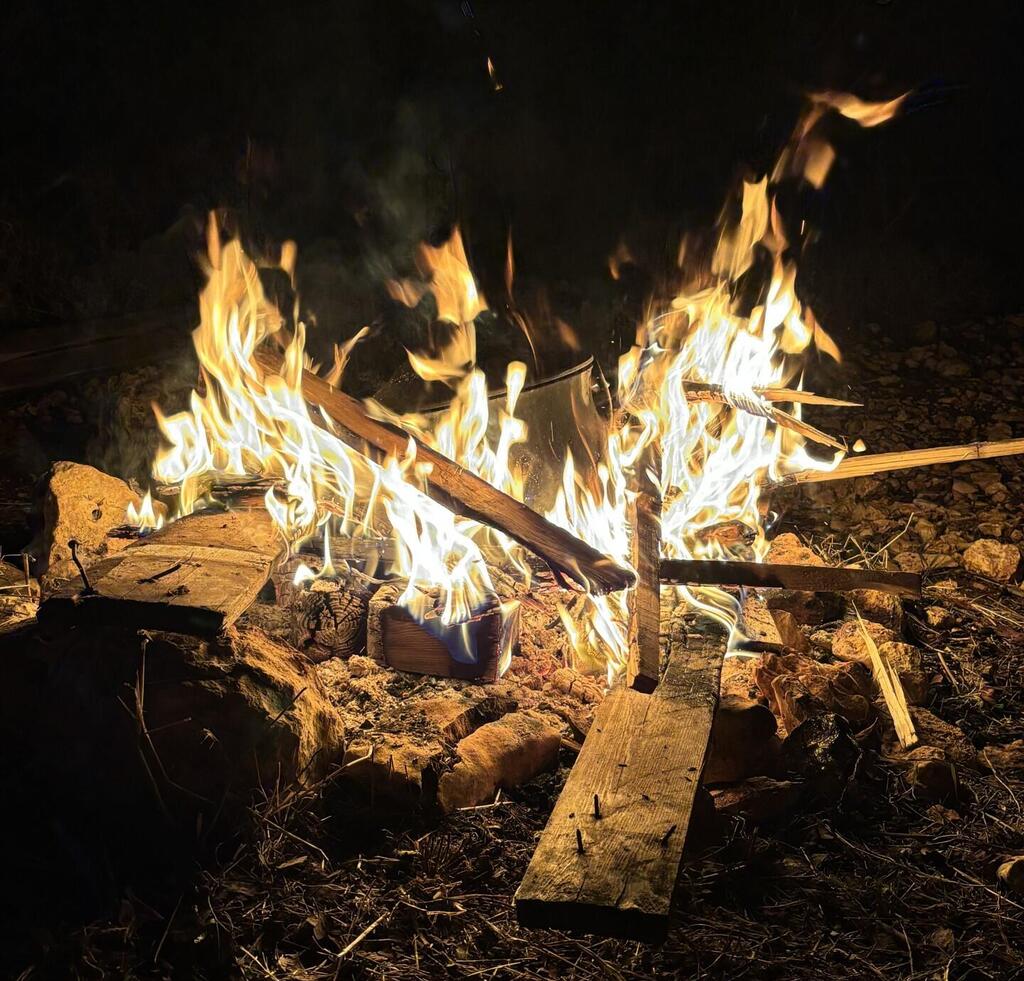
The bonfire becomes a metaphor for the spirit itself, which is called to reach toward something higher
Rashbi’s role is central to this shift. His teachings, particularly through the Zohar, are seen as opening a pathway for connection “from below to above,” allowing human consciousness to engage with divine wisdom. His death, marked on Lag B'Omer, is not framed as an end but as an ascension that creates an opening, an illumination that prepares the vessel to receive. Through this, the relationship between the human and the divine becomes something that can be perceived, approached and eventually held.
Another layer of Lag B'Omer, according to this teaching, is turning what was once hidden into revealed. What began as the possession of a small, closed group becomes permitted for a wider collective. The language itself begins to open, through the Zohar and through the transmission of inner wisdom, moving from something held within a limited circle to something that can be heard more broadly. What was once passed carefully from hand to hand, like a hidden treasure, is now given permission to emerge. Lag B'Omer marks this transition: from concealment to expression, from a guarded teaching to a language that begins to speak to a generation beyond the original circle.
Within the structure of the Omer, the number 33 marks a transition point. It is the stage where the higher qualities begin to extend into the lower ones, allowing the spirit to refine its perception and understand more precisely what needs to change. This is not yet completion, but it is a breakthrough - a point where the work becomes clearer and where the vessel begins to take on a form capable of holding light without losing itself within it.
The teaching also emphasizes that Lag B'Omer is not a single isolated moment, but an accumulation. It gathers everything that has been built from the beginning of the Omer into a new depth of need. The spiritual work is not defined by one action or insight, but by what has been formed gradually, an inner demand, a readiness that continues to grow toward the holiday of Shavuot. This is why the day is described as opening the possibility to “reenter” the Omer with a different capacity, a different awareness.
Fire as a purifying force, from potential to realization
Fire, often associated with Lag B'Omer, is given a distinctly inner meaning in the teaching. It is not about the external act, but about what fire represents: a movement that always aspires upward. Fire does not remain in place - it rises, it seeks beyond itself. In this sense, the bonfire becomes a metaphor for the spirit itself, which is called to lift beyond its current state, to reach toward something higher. It is an image of the inner aspiration required in the work, not a practice in itself.
The ascent is tied to the ability to connect to even the smallest “particle” of the higher power, to form a relationship that transforms separation into connection. Lag B'Omer, in this view, allows the vessel to purify itself from distance and return to connection, enabling the spirit to align more closely with the purpose of creation. It is a moment where the path becomes visible; not complete, but illuminated.
The Mishkan Hakavana center for Kabbalah study , led by Rabbah Saphir Noyman Eyal, focuses on these inner processes through the study of Kabbalah and the Zohar. The teachings emphasize conscious participation in spiritual development, guiding students to engage with these states as part of an ongoing journey toward alignment with the higher purpose.