


“We have a large menorah outside our home, and we became that home in Randwick that all the neighbors know. We leave it up all year, because since October 7, we feel the community needs that. We got so much positive feedback for it.”
“When we finally made it out of the beach and got home that night, our sons, our children, were crying. They said, ‘Please turn off the menorah. Our home is going to become a target.’ My husband and I looked at each other and said, ‘No way. We are not going down like this. We do not turn off menorahs. We do not hide our kippahs. We stand proud and loud.’ But our children were crying, and they begged. They said, ‘Please, Mom, Dad, turn off the menorah.’”
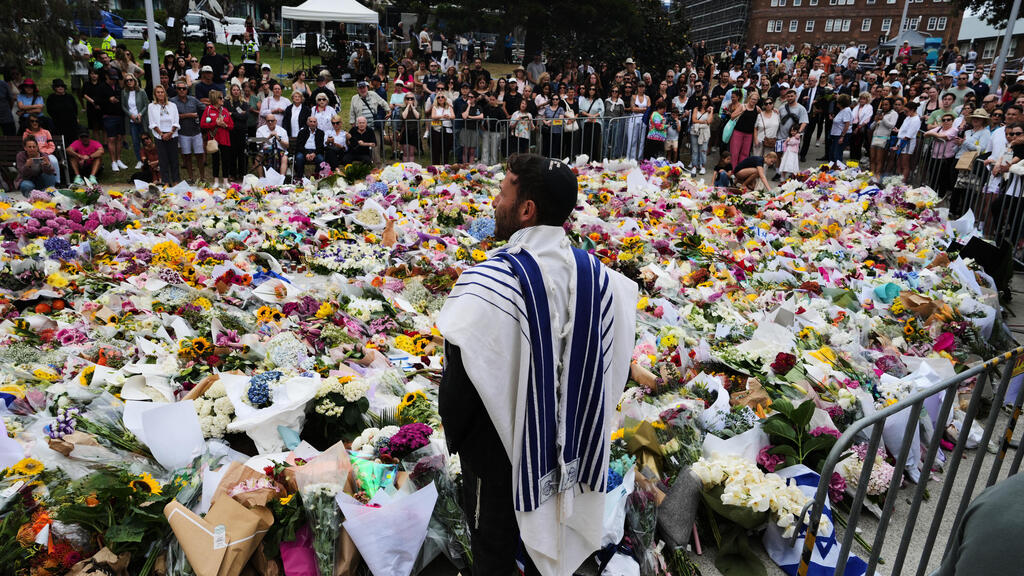
“So I looked at them and said, ‘As a mother, we are going to turn it off.’ The next day, a Christian neighbor passed by. ‘Yesterday my daughter drove past your house, and the menorah was off,’ she said, and burst into tears. ‘She said, no, Mom, they are turning off their menorahs. Evil cannot win.’ When she came and said that, my husband called me and I said, ‘No matter what, that menorah goes back on. We do not turn off menorahs. We don't stop shining light.’”
This painful monologue by Sydney-based Chabad emissary Sorala Abrams captures precisely what researchers have begun calling “Jewish fatigue.” The term encompasses everything experienced by Jewish communities in the diaspora since October 7, describing the emotional state of communities that increasingly feel persecuted and pushed out of the public sphere.
What does ‘Jewish fatigue’ mean?
According to Eran Shayshon, founder and director of the Atchalta Institute, which researches Jewish life in the diaspora, “Since October 7 there has been a systematic attack on Jewish visibility in the public space. This attack is often met with indifference, dismissal or lack of response by governments, and in Spain even with encouragement of violence by protesters.
“Often this is a slippery form of antisemitism that makes Jews uncomfortable and ultimately pushes them to confine their Jewish identity to the private sphere only. In other words, do not be Jewish when you go outside. These are the new Marranos.”
Among the many examples cited are bans on lighting menorahs at the University of Alberta in Canada, the cancellation of traditional Hanukkah events in city squares and other central locations around the world, the removal of Jewish symbols such as mezuzahs and kippahs from public view and even the hiding or changing of Jewish names.
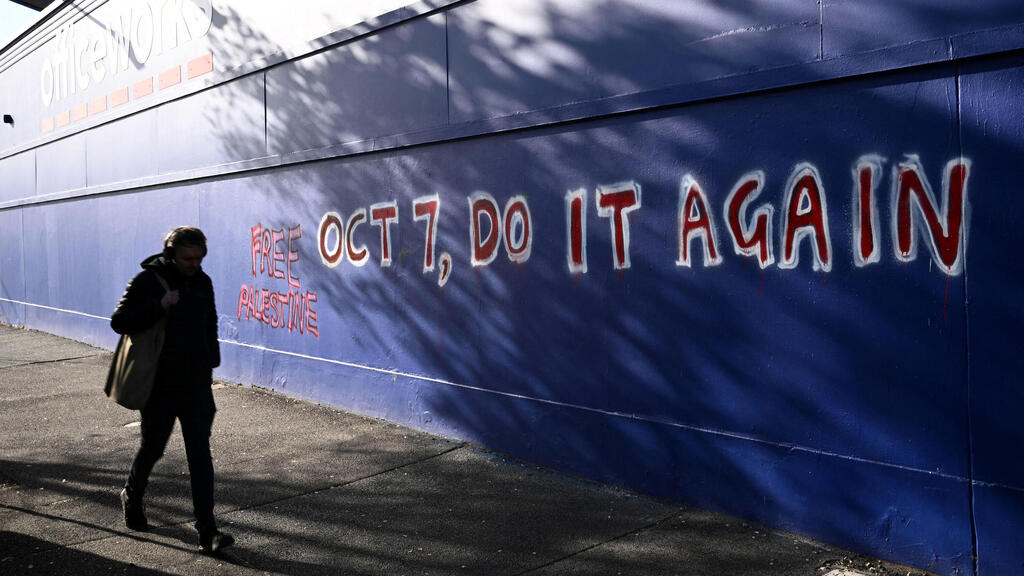
A graffiti in Melbourne, Australia
(Photo: Joel Carrett / AAP via Reuters)
Dor Lasker, deputy director of Atchalta, recounts the story of a Jewish student from Belgium named Hadassah who decided to conceal her name and adopt a local Belgian one. “She simply does not have the strength anymore to keep being Hadassah the Jew. Every time she opens her mouth, people immediately ask her about Israel. She is exhausted,” he says.
“I heard similar stories from a local leader in Italy who told me she ‘just wants to be an ordinary Jew,’ not an ambassador or a representative. A Jewish school principal in Australia told me he was invited to a professional conference to speak about education, but the moment he introduced himself, he could see the wheels turning in people’s heads about Israel and Gaza. He could not engage in the professional discussion he had planned. He was not given space between his personal identity and his Jewish background.”
According to Lasker, “What happened after October 7 was an intense experience of otherness for Jews. After many years of living integrated within broader societies, suddenly they felt what it means to be different. It is exhausting to live like this, with constant security at even the smallest events, with total identification and with a sense of being targeted.”
Are Jews trying to escape their identity altogether?
“The trend is not disconnection, but retreat into the private sphere,” Shayshon says. “Community life and events will continue, but in less central locations, with fewer symbols and a much more inward focus. It is important to understand that the fatigue is not only about organizing events. It is also deeply personal. The daily difficulty of maintaining a Jewish identity, of constantly absorbing comments, some supportive and some hostile, of always being marked. People want to go back to being like everyone else.”
Jews yes, Russians no?
The sense of Jewish fatigue is intertwined with the spirit of the times, a global anti-Israeli sentiment that expresses itself not only in boycotts of Israeli institutions, but also in hostility toward local Jewish communities.
Shayshon explains: “There is an attack on Jewish visibility in the public space. Sometimes antisemitism is blatant, sometimes subtle, but it is felt very clearly and creates a sense that there is nowhere to run. No safe place. We see this everywhere. There is a feeling that the world is closing in on Jews, and there is a physical and psychological price to being a visibly active Jew.”
While physical attacks make headlines, much of the fatigue comes from softer, cumulative experiences. Jews describe quiet boycotts, severed friendships, lack of understanding and absence of support for the Jewish perspective and for what they have endured over the past two years.
Lasker describes a Jewish community leader in Europe who continues attending conferences but has reduced his digital footprint. He asks not to be tagged or photographed at Jewish events, unsure of the consequences.

Rabbi Alexander Milstein beside the large menorah of the Synagogue for Russian Jews in Milwaukee after it was toppled
(Photo: The Synagogue for Russian Jews)
Shayshon adds: “For most Jews this feeling has awakened, and they are experiencing real distress. This is not a choice. They cannot escape. Suddenly there is a sense of siege on their identity that did not exist before. The main marker is not abandoning Judaism, although that exists too, but rather fatigue and the shrinking of Jewish life into the private sphere.”
One question that often arises is why protesters do not similarly target Russian immigrants, accusing them of representing Russia’s actions in Ukraine.
“There is a fundamental difference between an American Jew and a Russian immigrant in the United States,” Shayshon says. “The Russian immigrant is seen as someone trying to build a future in America, not as a representative of Putin’s regime. With Jews, there is a unique element, the suspicion that always hovers in antisemitic moments: dual loyalty.
“This is specific to Jewish identity. And it is intensified because most of these Jews are not immigrants. They are deeply rooted citizens. Canadian Jews who have lived in Canada for 200 years, Americans whose families go back generations, suddenly feel a sense of rejection. The foundations of the home begin to shake.”
A shaking world
Israel and the Jews may be at the center of the storm, but the instability of liberal democracies is a broader global phenomenon. “There is extreme polarization,” Shayshon says. “Terms like ‘American values,’ ‘Canadian values’ or ‘British values’ are losing meaning because there is no agreement on what those values are.
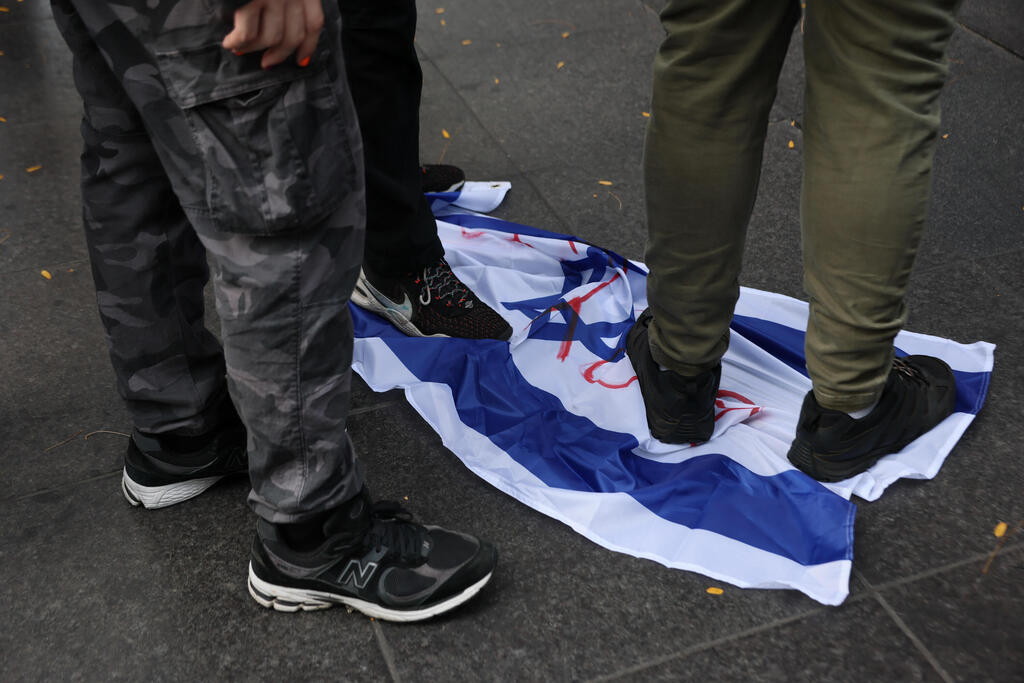
Pro-Palestinian activists trample an Israeli flag in New York on October 7, 2025
(Photo: Michael M. Santiago / Getty Images / AFP)
“I am not even talking about the Jewish community. Western societies as a whole are in crisis. Israel has unwillingly become a political litmus test, and the Jewish community is perceived as part of that package. Supporting Israel automatically places you in a specific camp.”
There was an expectation in Israel that a cease-fire in Gaza would calm tensions, but that has not materialized.
“I think those expectations misread reality,” Shayshon says. “The images from Gaza exacerbate the situation, but some processes are irreversible in the long term. This is a different world, not because of Israel and not because of the Jewish community. It is simply a different world.
“At the same time, I draw encouragement from surveys and sentiments showing this is not the majority view and not the whole world is against us. The situation is not good, but the numbers show it is far from lost. The central challenge is dismantling the mechanisms that create the impression that anti-Israel sentiment represents majority opinion.”
What about incitement on social media?
“Social networks trap us in echo chambers and create collective illusions that a certain view represents the majority,” Shayshon says. “The loudest minority dominates, while those who think differently self-censor out of fear of social consequences. Bots amplify this. The solutions must be technological and diplomatic.”
Another challenge is the silent Jewish majority. “This connects directly to Jewish fatigue. If we can empower Jewish communities to feel they have agency, to go out, speak up and not give up, the overall picture can change.”
An AI tool to push back against antisemitism
Atchalta is launching a new artificial intelligence tool within a Jewish community in the United States, in partnership with the Gevura Fund and the Tina Snider Foundation, to help address Jewish fatigue. Initially aimed at parents of children in public schools, the platform analyzes ambiguous situations.
“For example, if a Jewish child tells their parents that a teacher came to class wearing a ‘Free Palestine’ shirt, is that antisemitism or not?” Shayshon explains. “Our tool analyzes the situation and offers courses of action, including complaint letters. It also encourages unaffiliated Jews to reconnect with the community. It is a structured action plan for moments when Jewish identity is challenged.”
Would we be having this conversation without October 7?
“Antisemitism did not begin on October 7,” Shayshon says. “What happened then is that it escalated and became part of the spirit of the times. At the same time, people on the anti-Israel side feel they are on the ‘right side of history,’ which makes the position attractive and easy to market. Without October 7, antisemitism would still exist, but not at these levels.”
Is this just a trend?
“If it is a trend, it has lasted 2,000 years,” he says. “The antisemitism we are experiencing feeds off much larger global trends unrelated to us, rooted in the crisis of liberal democracies. I am not optimistic it will pass quickly.
“If we are making predictions, I think we will miss this period. At least in the United States, antisemitism is currently meeting institutional resistance. That support may weaken as administrations change, whether Democratic or Republican. So yes, winter is coming.”