


This week, we read the Torah portion of Nitzavim, which means standing, and is always read the Shabbat before Rosh Hashanah. It is one of the shortest portions in the entire Torah but it is jam-packed with fundamental lessons for life.
The very first verse in the portion answers a question I’ve struggled with my whole life.
Throughout the high holidays, on many occasions, we refer to Hashem (God) as our king. In many other instances, we refer to Him as our father.
How can those two things coexist?
Presumably a father has compassion and unconditional love for his child while a king is much more distanced and disciplinary.
If you think about the way a father treats his child and the way a king treats one of his subjects, they are most definitely not the same.
I’ve had this discussion with many friends over the years including just a few weeks ago. I asked my friends how they think of God. Is He more like your father or more like your king?
For me, I’ve always thought of Him as my king. That means that I’ve feared God and often avoided a Torah transgression so not to “anger” God.
My friend who I recently spoke to about this said that he thinks of God more like a father who is eager to forgive the mistakes his son makes as opposed to trying to “catch” the son and punish him.
So how does the first verse of the portion clear up this question?
The answer is in the juxtaposition of the end of last week’s portion and the beginning of this one.
Last week, we read about what’s called the tochecha or rebuke, which is a very detailed and frightening description of what will happen to the Jewish people if they abandon God. Quite frankly, it is depressing and scary.
In fact, the tochecha is so scary that we have a custom that the person reading the Torah, when they get to the tochecha, they lower their voice and read it more quietly.
Then this week’s portion begins with “You stand this day, all of you, before your God Hashem, your tribal heads, your elders and your officials, every householder in Israel, your children, your wives, even the stranger within your camp, from woodchopper to waterdrawer…”
The obvious questions here are, what is the significance of the “standing”? It could have just said “You’re all here today..” Why does the Torah specify the standing?
Furthermore, as mentioned many times, we believe we can learn lessons from every single word in the Torah and that there is not one extra word in the Torah.
In that case, why the long list of people? Again, why not just say “You’re all here today" in addressing the people?
Why specify “your tribal heads, your elders, and your officials, every householder in Israel, your children, your wives, even the stranger within your camp, from woodchopper to waterdrawer…”
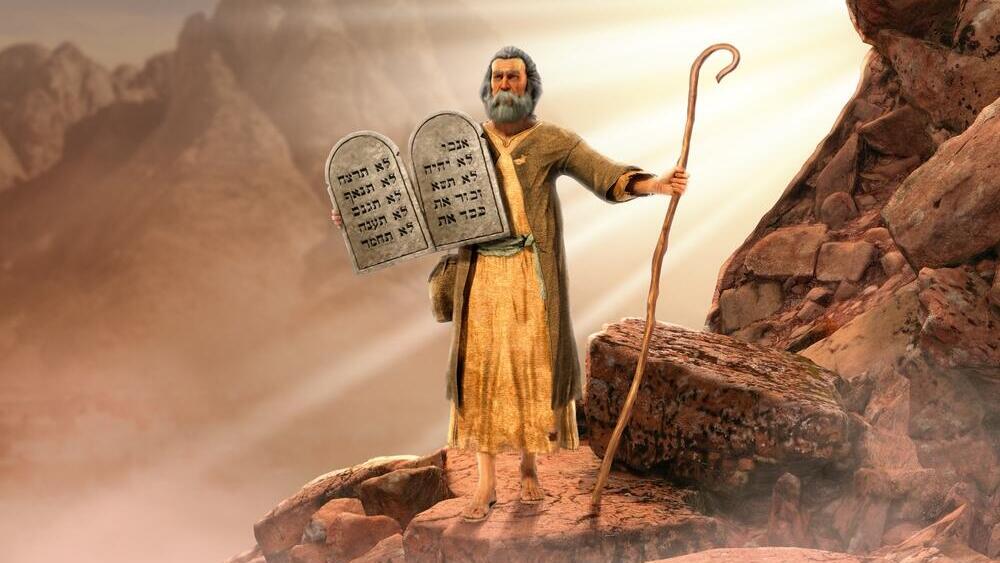
Moses receives the Ten Commandments at Mount Sinai
(Illustration: Shutterstock)
The answer is incredibly profound and could not be more relevant to the high holidays, hence we always read this portion before Rosh Hashanah.
After the end of last week’s portion, after any person is warned in such a frightening way, one might feel despair, which might lead to the thought many people have in the high holidays.
“What’s the point? There’s no way I’m going to be perfect so why even bother? God is like my king and if I screw up, terrible punishment is awaiting me. This whole God thing is just too scary. I have no chance.”
So this week’s portion begins by reassuring us “It’s ok. You’re here standing. You’ve got this. Don’t worry about the punishment so much. Focus on the fact that you’re here, you’ve made it this far, keep going.”
This week’s portion begins by balancing out the end of last week’s.
This very first verse reminds us that God is indeed our king as we saw last week, but He is also our father as we see this week.
The way I picture this idea is a young student getting in trouble and being sent to the principal’s office where the principal yells at the kid (Yeah, that used to be a thing. 😂) and reprimands him.
The student begins to cry and feel despair.
He then goes back to the classroom and the teacher sees how upset he is and realizes that he has to continue to teach this child, so he pulls him aside and tells him that it’s ok, that everything will be ok, that sure, he might have fallen and made a mistake, but now he can get up and move forward.
Without the comforting of the teacher, the child might feel so hopeless that that one mistake would send him into a spiral he can’t get out of. The teacher’s kind words might help the kid take the principal’s harsh words, put them on the side, get back up, and correct his ways to never make that mistake again.
That is what’s happening here. Last week, God was our king, the principal. This week, God is our teacher, our father.
This week, Moses reminds the people, all the people, that they got this, that they need to get back up, and move forward.
I believe the reason the Torah goes into such detail of who was there is to teach us a lesson that no one is immune to this feeling of despair.
Often times, we think that the problems and challenges we face are foreign to others. We think those who are successful, for example, have thicker skin, that they are not affected by things like we are.
The Torah teaches us that that is not the case and that we’re all human and we all need someone in our lives, or many someone’s to balance out the negative.
To take this analogy further, it’s as if, in last week’s portion God pushed us away from Him and in this week’s He pulls us back to him.
Perhaps that is precisely why we call the process of repentance we do on the high holidays Teshuva.
Teshuva means to return. What are we returning to? The answer is that we are born pure, with no sin, no mistakes. We are closer to God. But then life happens and we all make mistakes. We might think those mistakes, whatever they may be, are just too massive for us to repent from them.
This portion and the upcoming holiday of Rosh Hashanah remind us again that Hashem is indeed our father and, just like a kid who runs away from home and distances himself from his parents, when he does decide to come back home, of course his parents will welcome him with an open door and open arms.
The same is true for Hashem. He awaits our return to Him and that is what this holiday is about, coming back “home.”
Throughout the portion, we see this idea of returning several times.
Another word we see multiple times in the portion is the root of chaim, which means life:
- “See, I set before you this day life and prosperity, death and adversity.”
- “For I command you this day, to love your God Hashem', to walk in God's ways, and to keep God's commandments, God's laws, and God's rules, that you may live and increase, and that your God may bless you in the land that you are about to enter and possess.”
- “I call heaven and earth to witness against you this day: I have put before you life and death, blessing and curse. Choose life-if you and your offspring would live…”
- “By loving your God Hashem, heeding God's commands, and holding fast to [God]. For thereby you shall have life and shall long endure upon the soil that Hashem swore to your fathers Abraham, Isaac, and Jacob, to give to them.”
I’ll remind you, Moses is approaching his last moments on this earth. This monologue that he’s giving to the nation isn’t just another speech, it is THE speech.
What does Moses focus on in his last speech? Life.
What’s the lesson here?
If someone lived a hundred years ago, the commandment to choose life would have been strange. Isn’t it obvious that we should choose life over death, good over evil?
Not so today. Today, the fact that the Torah teaches us that Judaism is about life and not death is anything but trivial.
While other religions are death oriented, martyr oriented, shahid oriented, here Moses in practically his last words reminds us to choose life and not death.
This is not the first time we see this concept in the Torah. There is another verse that says “vechai bahem," which means that you should live by the Torah and not die for the Torah.
This manifests in many practical laws about the sanctity of life. For example, it teaches us that if someone puts a gun to your head and says: “Eat this non-kosher food or I’m pulling the trigger," we are commanded to eat that non-kosher food.
The importance of life is paramount in the Torah so much so that - with the exception of the three sins of murder, idolatry and illicit relationships, - if we have to choose doing some Torah transgression or dying, we are to choose life and commit that sin.
That is because the Torah teaches us how to live a more meaningful and fulfilled life. The Torah doesn’t teach us about death. That is simply not what Judaism is about.
And finally, one more beautiful idea in this week’s portion.
There are a few verses in the portion that are among my favorite in the whole Torah.
They read: “Surely, this Instruction which I enjoin upon you this day is not too baffling for you, nor is it beyond reach.
"It is not in the heavens, that you should say, 'Who among us can go up to the heavens and get it for us and impart it to us, that we may observe it?'
"Neither is it beyond the sea, that you should say, "Who among us can cross to the other side of the sea and get it for us and impart it to us, that we may observe it?"
"No, the thing is very close to you, in your mouth and in your heart, to observe it.”
The commentaries ask what these verses are referring to when they say “This instruction.”
They conclude that it’s referring to the whole Torah and again, as we said above, Moses is reminding the nation that they got this.
He’s reminding us that you might feel that fulfilling the entire Torah is out of our reach so what’s the point? He’s reminding us that it is not out of our reach but rather it is close to our heart.
This might apply to the Torah but it also applies to different aspects of life.
Sometimes we feel things are bigger than us, that we don’t stand a chance, so why even try?
For example, I hear that today about the information war: “They outnumber us so much that we can’t win this anyway, so why bother?”
The Torah here teaches us that it is not out of reach, that it is not in the sky or across the ocean but rather it, whatever the “It” is, is close to us and we just have to jump in.
In other words, in Moses’ last moments, he is teaching us two incredibly fundamental lessons:
- You got this. Sure, there are laws and rules that might scare you but you’re standing here and you can do this. It’s not in the sky or across the sea. It’s close and attainable. Jump in and come back to God.
- Live by the Torah and don’t die by it. The Torah is not about death and destruction. It’s about life and construction, about building. Building a meaningful life, building a just society, and building a better world.
And one last beautiful thought about teshuva, repentance.
There are two seemingly contradictory verses in the Torah about teshuva.
One is that God says to us “Come back to me and I’ll come back to you.”
In other words, it’s on us to make the first move.
Then another verse says “Bring us back to you, Hashem, and we will come back.”
In other words, God has to make the first move.
Which one is it? The answer is both.
This month is called Elul and some commentary say that it’s an acronym for the words “Ani L'Dodi V'Dodi Li”, loosely translated as “We are for God and God is for us.”
Meaning the relationship is in both directions. He wants us to come back to Him and we pray that He comes back to us.
We see this concept in other places too like Passover where God calls the holiday “The holiday of matzot” and we call it Passover.
He is praising us for eating the unleavened bread as we left Egypt and we are praising God that he passed over our houses in the plague of the first born. We praise Him. He praises us.
And that idea brings us back to the original point of God being our father. Like a father sees the best in his son and praises him, so too a son sees the best in his father and praises him.
If you want to know what Judaism is about, what life is about, a good place to look would be the final words of the greatest teacher in history, Moses.
If you want to know what Judaism is about, what life is about, a good place to look is this week’s Torah portion.