


Sharp criticism has emerged in recent days over a scene in the historical Turkish television series “Mehmed: Sultan of the Conquests,” broadcast on the state-run TRT1 network, with experts accusing it of promoting antisemitic narratives and distorting history.
The series, which centers on Mehmed II, the Ottoman sultan who conquered Constantinople, is now in its third season after first premiering in February 2024.
Dr. Hay Eytan Cohen Yanarocak, a Turkey expert at Tel Aviv University’s Dayan Center, said the scene presents a distinctly antisemitic narrative and a troubling rewriting of history.
According to his description, one of the central scenes features an imagined dialogue between the sultan and the king of Hungary, in which Jews are portrayed as being behind a plot to ignite war between Muslims and Christians.
During the exchange, the sultan tells the Hungarian king that the pope may be relying on “the gold of the Jews from the Dubrovnik area,” and asks who truly wants war: Christians, Muslims or Jews. Jews are further described as having “blood on their hands,” as traitors and as a cursed people.
Later in the scene, a supposedly incriminating letter bearing a menorah symbol is presented, reinforcing the conspiratorial message and persuading the king that Jews are acting behind the scenes to incite conflict between nations.
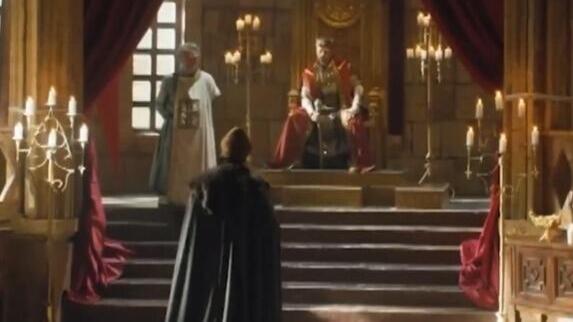
The scene from the series broadcast on TRT1
At that point in the series, the king looks at the letter stamped with the menorah seal and becomes convinced that Jews are plotting to make Muslims and Christians fight one another.
According to Yanarocak, the scene combines several classic antisemitic motifs: portraying Jews as bearing blood guilt and as betrayers of central religious figures, a charge associated with Christian antisemitism; suggesting that Jews are also regarded in Islam as cursed; and depicting them as a hidden force manipulating events and setting people against each other.
He said the supposed “proof letter,” signed with a menorah symbol, deepens the conspiratorial framing. He also stressed that the series uses television drama to rewrite history, lending legitimacy to antisemitic ideas by placing them in the mouths of admired historical figures.
The danger, he said, lies in the fact that series of this kind are often perceived by the broader public as reliable sources of knowledge and, at times, even replace the reading of history books.
“Sultan Mehmed II was not antisemitic at all,” Yanarocak said.
He warned that when historical fiction presents fabricated antisemitic claims as plausible political dialogue, it can normalize prejudice under the guise of period drama.