

Dr. Josef Mengele, the notorious Nazi doctor who carried out barbaric experiments on prisoners and Jews and sent Jews to their deaths in gas chambers, fled after the war to Argentina, where he lived quietly even though authorities knew his true identity. That is according to documents that were hidden for decades. The papers were released Sunday on orders from President Javier Milei.
Mengele, dubbed the “angel of death of Auschwitz,” oversaw the torture of prisoners at the extermination camp under the guise of medical research. He escaped from Germany to Argentina in 1949 and went into hiding there. Milei has now ordered the disclosure of how Argentine authorities tracked Mengele’s life across South America during the 1950s, yet never arrested him. After World War II, Argentina gave refuge to senior Nazis such as Mengele and Adolf Eichmann, who worked to annihilate the Jewish people and arrived in the country after Hitler’s regime fell. Eichmann was captured in Argentina by Israel’s Mossad in 1960, tried in Israel and executed. Mengele lived in Argentina, the documents indicate, but ultimately died in Brazil.
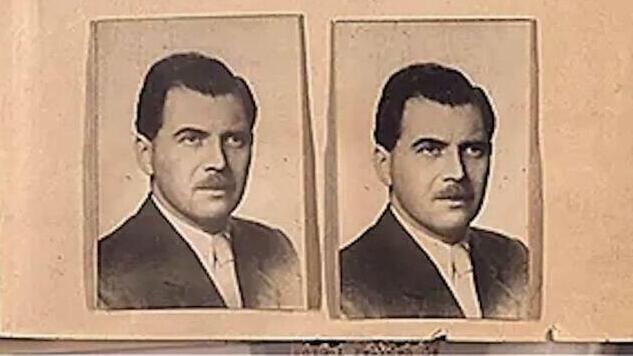
Mengele studied philosophy in Munich in the 1920s, where he came under the influence of Alfred Rosenberg, the Nazi Party ideologue, and became an ardent Nazi. He later studied medicine in Frankfurt. In 1933 he joined the SA and began working at the research institute the Nazi Party established to study heredity and so-called racial purity. At the start of the war he served as a medical officer in the Waffen SS.
From 1943 to 1945, he was chief physician at Birkenau, the extermination camp adjacent to Auschwitz. His main task was selecting detainees arriving by train either for forced labor or for the gas chambers. His victims called him the “angel of death.” He also conducted cruel medical experiments on prisoners. Mengele focused his monstrous research on twins as a means of studying heredity. Whatever scientific value his findings may or may not have had, his inhumane methods meant that no self-respecting researcher relied on them afterward.
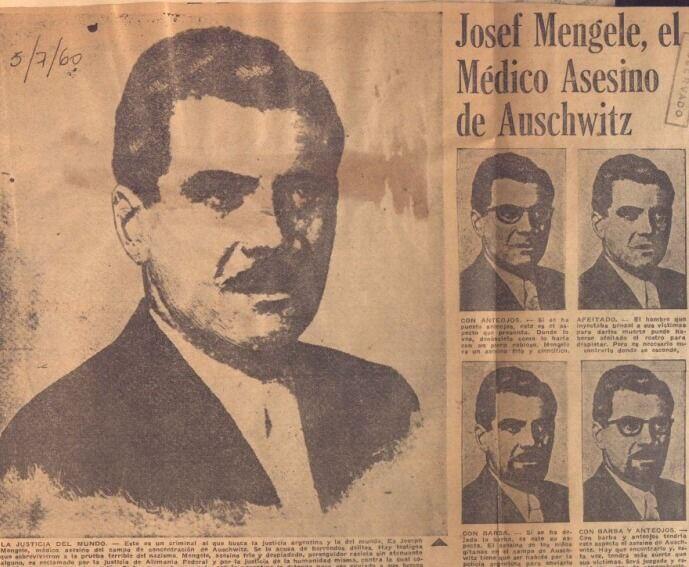
Newspaper clippings collected in Argentina
(Photo: Argentina’s National Archive)
After Auschwitz was evacuated, Mengele was transferred to the Mauthausen concentration camp, and when Mauthausen was liberated he vanished. After several years in Bavaria, he reached South America in 1949. According to the documents, Mengele entered Argentina in 1949 with an Italian passport under the name Helmut Gregor. He began a new life there.
By the mid-1950s, the files show, Argentine authorities knew that the man responsible for the deaths of masses of people was in their country. The New York Post reported that newspaper clippings in the newly opened dossier include an undated, chilling interview with one of Mengele’s victims, Jose Formanski. “He gathered twins of all ages in the camp and performed experiments on them that always ended in death. Children, elderly people and women, what horrors,” Formanski said.
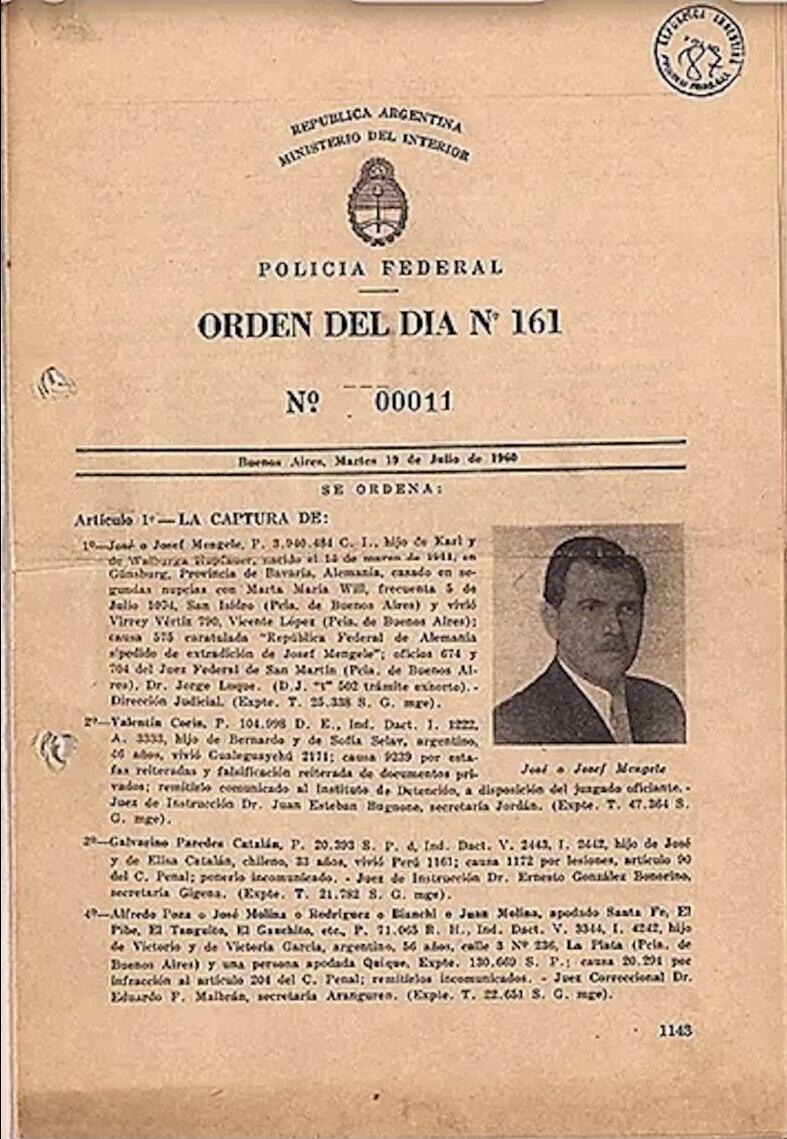
One of the documents that was released
(Photo: Argentina’s National Archive)
In 1956, Mengele asked the West German Embassy in Buenos Aires for his original birth certificate and, remarkably, began using his real name. He requested that his identity papers be reissued.
A document written by officials a year later recorded Mengele’s explanation for entering Argentina under an alias. “He said that during the war he served as a doctor in the German SS in Czechoslovakia, where the Red Cross called him a war criminal,” the document said.
The papers show that Argentine law enforcement agencies knew Mengele was living in Carapachay, a town on the outskirts of Buenos Aires, and that he had married his brother’s widow during that period. They also indicate authorities were aware that his father visited him, possibly to invest in Mengele’s new medical business.
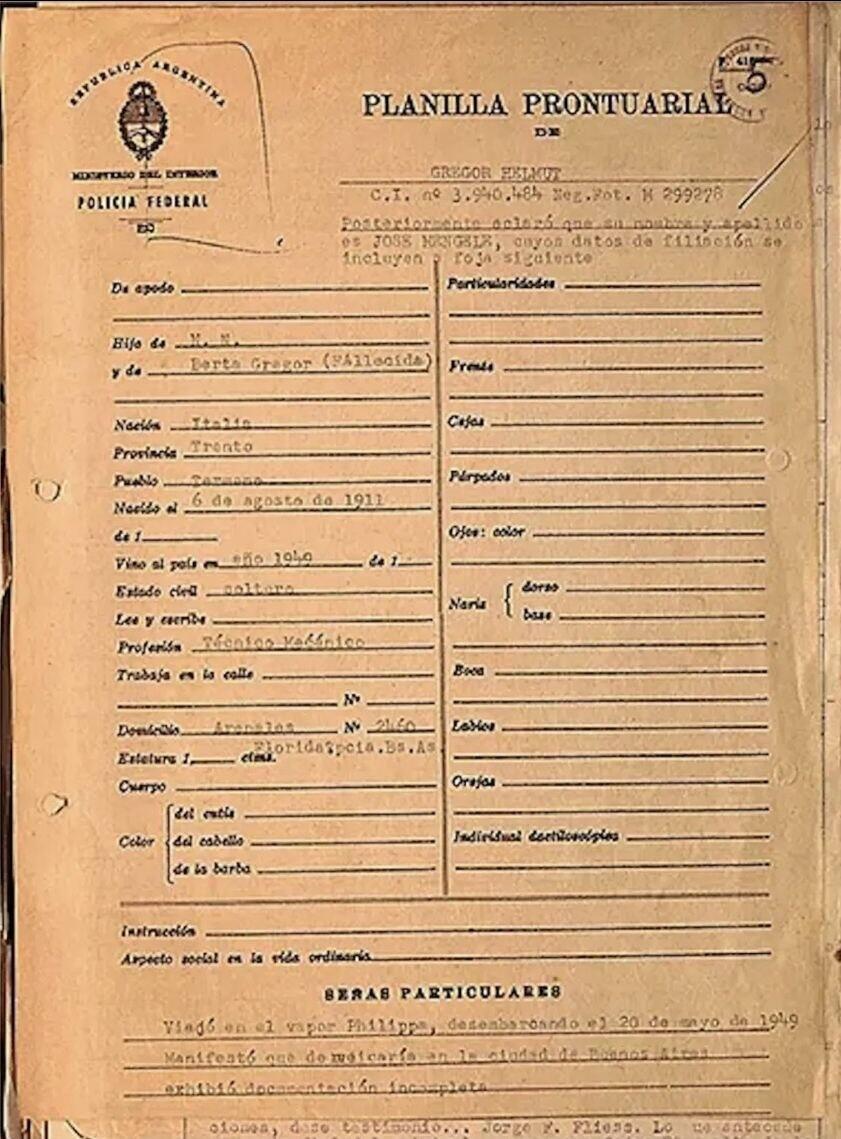
(Photo: Argentina’s National Archive)
In 1959, West Germany issued an arrest warrant for Mengele and sought his extradition, but a local judge rejected the request, claiming it was based on “political persecution.” The failed extradition attempt led to international pressure on Argentina, and Mengele fled to Paraguay, where he obtained citizenship. When Argentine authorities finally raided his medical laboratory in Buenos Aires, he was already gone.
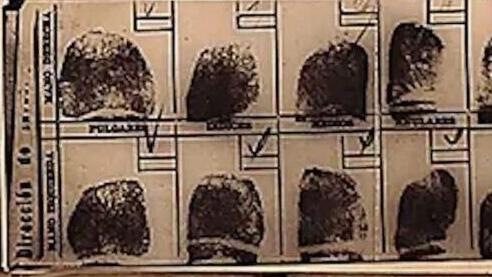
Even fingerprints were collected
(Photo: Argentina’s National Archive)
After his escape, Argentine authorities relied heavily on foreign news reports to track him. Around 1960, the murderous doctor reached Brazil, where he was sheltered by farmers of German descent.
Mengele died after suffering a stroke while swimming near the coastal town of Bertioga in 1979. He was 67. He was buried under a false name, but an investigation led to his exhumation in 1985. Today his bones are used for forensic medicine training at the University of Sao Paulo’s medical school.