

Less than two minutes had passed before the shouting began in the hall.
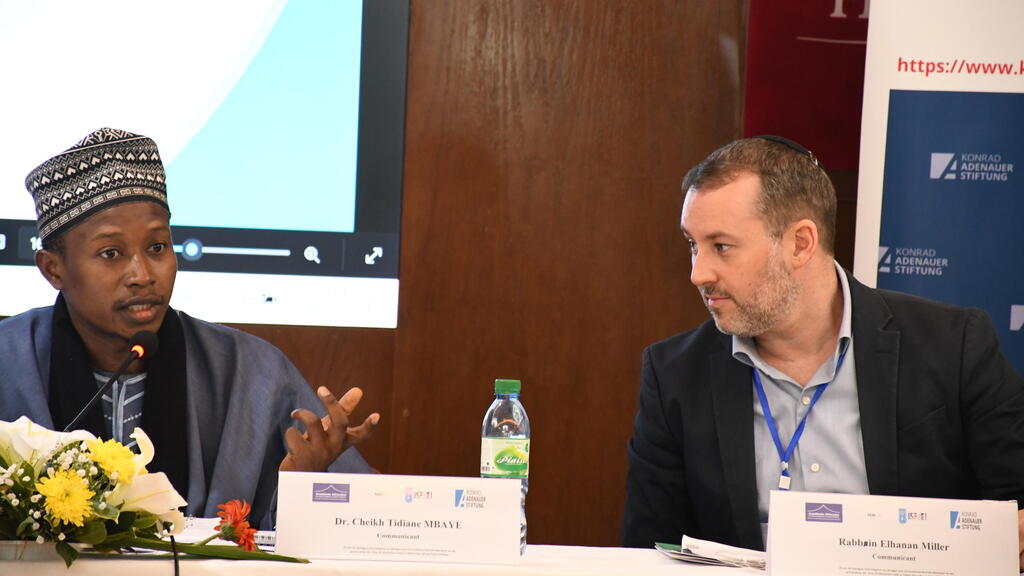
Last week, I had the privilege of representing Israel at an interfaith conference in Senegal, the West African country where 95% of the population is Muslim. The event was organized by our embassy in Dakar and the German Konrad Adenauer Foundation. The annual conference has been held for 25 years, 17 of them in partnership with Israel. But this year, things did not go exactly as planned.
Israel was one of the first countries in the world to recognize Senegal’s independence from French colonial rule in 1960. Golda Meir visited in 1964 as foreign minister, followed by Prime Minister Levi Eshkol two years later. Israel has long assisted Senegal in agriculture, though the relationship has gone through difficult periods. Ties were frozen for five years after the Yom Kippur War until the Camp David Accords. In 2016, Prime Minister Benjamin Netanyahu recalled Israel’s ambassador to Dakar after Senegal voted for UN Security Council Resolution 2334, which stated that Israeli settlements were illegal.
Given Senegal’s Muslim majority, I was not surprised when six or seven pro-Palestinian protesters began shouting that Israelis should not be present. One protester waved a Palestinian flag before security quickly removed him and the others.
On stage, Ambassador Yuval Waks remained calm. He told the audience that the war in Gaza has left both Israelis and Palestinians shocked and grieving. He recalled a recent visit to Senegal by Ali al-Ziadna, an Israeli Bedouin whose four relatives were kidnapped, two of whom were later killed. The ambassador noted that his security guard during the visit was also named Ali, also a Muslim Israeli. “I entrusted my life to Ali,” he said.
Soon after, representatives of local faith communities were invited on stage to open the conference with prayers for peace: a Muslim sheikh, a Christian priest and an animist priestess. At the last moment, I was called up as well. Standing alongside a sheikh, a Catholic cleric and a shaman, I tried to think how to translate into French the words of the traditional Jewish prayer: “He who makes peace in His heights, may He make peace for us and for all Israel and for all who dwell on Earth.”
The sheikh leaned toward me and whispered, asking if I also knew verses from the Qur’an.
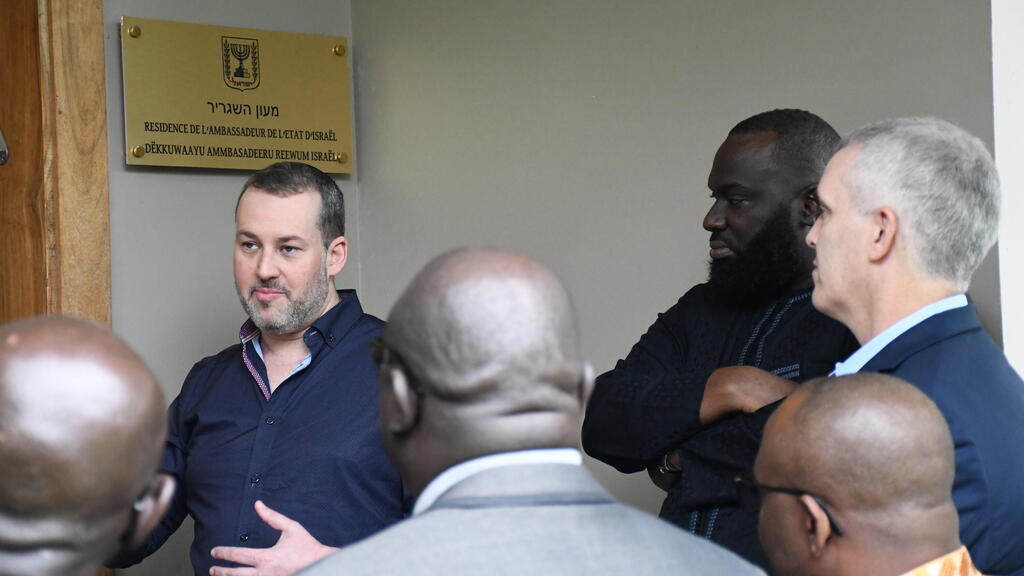
Miller explains about the mezuzah
(Photo: Albert Nango)
“I actually do,” I replied. My high school Arabic teacher, Mr. Hempler, was wise enough to require us to memorize short Qur’anic passages for the matriculation exam. He understood that the Qur’an is something one carries in memory, not just studies from a page. “It would be good to add that to your prayer,” the sheikh suggested.
And so, after the Jewish prayer, I recited the closing verses of the Qur’an from Surah 114, An-Nas (“Humankind”): “In the name of God, the All-Merciful, the Compassionate. Say: I seek refuge with the Lord of humankind, the King of humankind, the God of humankind, from the evil of the whisperer who withdraws, who whispers in the hearts of humankind, from jinn and humankind” (translated by Uri Rubin).
I could feel the tension in the room begin to dissipate. The words aligned perfectly with the theme of my lecture on religious dialogue during wartime, in which I quoted the anti-racist teaching from Tractate Sanhedrin (4:5): “For this reason humanity was created as one… for the sake of peace among people, so that no one may say, ‘My ancestor is greater than yours.’”
The embassy team in Dakar does remarkable work under difficult circumstances, far from public attention. Yet in a traditional society like Senegal, where deep anti-Israel sentiments persist, classical diplomacy has limits. That is why, at a reception the day before for academics and religious leaders at the ambassador’s residence, Ambassador Waks asked his guests to gather near the front door and invited me to explain the mezuzah.
I touched the beautifully crafted silver case and pointed out the similarity between the Hebrew letter shin and its Arabic equivalent. I compared the mezuzah to the Muslim misbaha, the prayer beads used to recite God’s 99 names, touching each bead one by one. The guests nodded silently. It turns out we share more than many realized.
Rabbi Elhanan Miller is a research fellow at the Hartman Institute in Jerusalem and founder of “People of the Book,” an initiative aimed at the Arab and Muslim world that produces educational materials on Judaism and Jews in Arabic.