

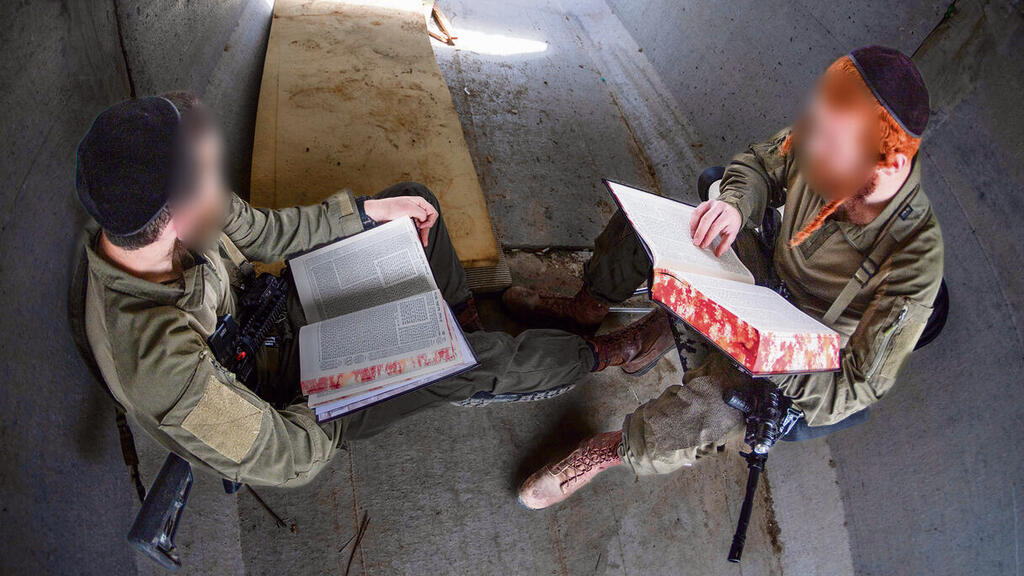
Amid the green hills along the seam line between Israel and Lebanon, with gunfire and the echoes of rocket launches in the background, two young men in army pants and T-shirts, their tzitzit fringes visible, sit studying Talmud together. Alongside routine IDF scenes of fitness drills and weapons maintenance, there is also a minyan for afternoon prayers in a tent used as a study hall, soldiers taking out religious books to learn and a Torah lesson led by a rabbi who has come from outside.
This is the new routine of the regular battalion in the Haredi Hasmonean Brigade, which is currently operating in Lebanon for the first time. After Hezbollah entered the fighting, the IDF launched a move to reinforce the forward defensive line along the border area. As part of the effort, combat forces entered new positions in southern Lebanon to strengthen protection for northern Israeli communities.
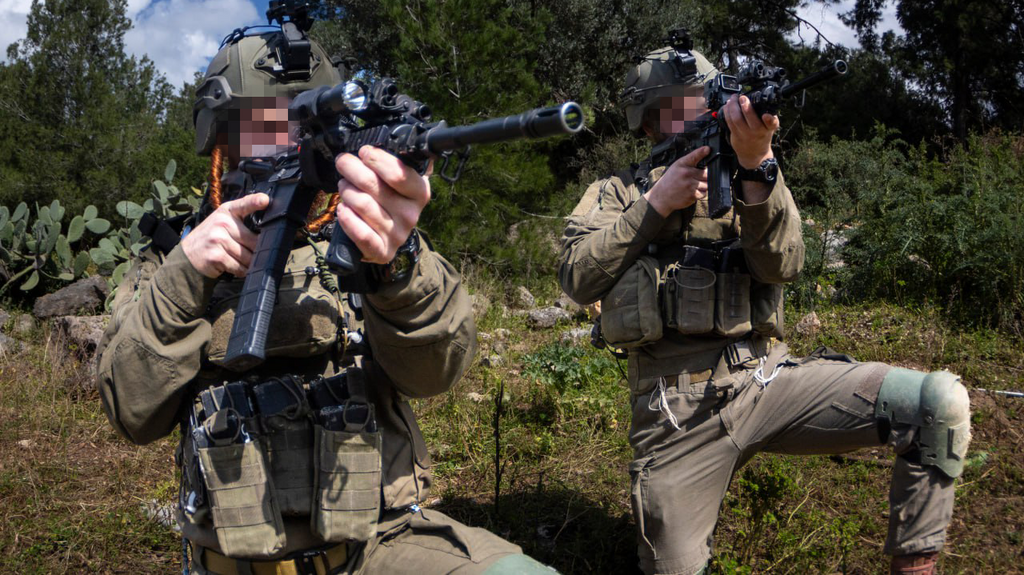
The forces are holding several positions within the security zone, while company combat teams are stationed ahead of the border towns. “You learn a page of Gemara and then go on guard duty,” explains Y., a soldier in the brigade. “It’s not a combination of two separate things. Both are part of what the Holy One, blessed be He, wants from us.”
About a year ago, we saw these soldiers during the first recruitment cycles for the brigade. Yesterday we saw them again after completing their training, now fighters at a border position between rounds of maneuvering operations inside the neighboring country.
“This is a very powerful and flexible battalion, and what drives its soldiers is a deep sense of pioneering spirit,” says Lt. Col. A., commander of the brigade’s regular battalion. “They see themselves as trailblazers — not only in the military sense but within two broader systems of life. One is the national system of the State of Israel, and the other is the social system.
“In both arenas, the soldiers are being tested: on one hand the state is examining them as professional and skilled fighters, and on the other hand society is examining them as people who manage to preserve their fear of Heaven and build around themselves something like a ‘holy camp.’
“Alongside their professionalism, what stands out is their great joy for life. They work hard day and night, go out on challenging operations and deal with cold weather and long days without sleep — but they do so with strength and joy,” the commander says.
‘Ready to do anything’
According to the battalion commander, “Anyone who comes to the battalion from the outside — from other units or different frameworks — feels that there is something special here.”
He describes the unique spirit of a framework that combines military professionalism with deep spirituality as something rarely seen since the days of King David. He says that during their most recent operational activity the soldiers experienced what he describes as major miracles, and because of this he believes the enemy should be very concerned: this is a new military framework that is not afraid of it and operates with deep faith and a strong sense of mission.
(Photo: Gil Nehushtan)
At the same time, he says the people of Israel should rejoice at the existence of such a framework.
“This is something pioneering that is still in the process of being built, and it may take another 20 or 30 years. But the goal is not to create something superficial or symbolic — it is to build real foundations, healthy and high quality, from which a great light will grow for the people of Israel and for the entire army.”
The possibility that the fighting could continue for many more weeks does not worry him.
“The soldiers feel a sense of purpose and are full of motivation to continue, even after long operations and nights without sleep,” he says. “This is not only the spirit of the battalion but the spirit of IDF soldiers in general. When the people of Israel have a clear goal and a sense of mission, they can withstand any challenge.”
Y., who grew up in Jerusalem and studied at a yeshiva in Bnei Brak, says proudly that “when it comes to the security of northern residents, we are ready to do whatever is required of us. If necessary — even cross a border and operate beyond it.
“If someone had told me five or seven years ago that I would be here in Lebanon as a fighter in this reality, it’s not something I really imagined. At 16 or 17 I began to think that maybe I would want to enlist, but I didn’t know about frameworks in the army like the Hasmoneans. I wondered whether it was really the right place.”
“Already during basic training, when I would return home people kept asking me, ‘Have you already been in Gaza? Have you already fought?’ It interests people because it seems exciting or unusual to them. But there were also those who were genuinely interested.
“They wanted to know that this wasn’t some kind of ‘fake basic training’ but real combat, and at the same time it was important for them to know that the spiritual side was real as well. For me, this brigade is not meant only to allow someone to ‘remain Haredi’ within a military framework, but to act מתוך faith that we are doing what God wants — something that also exists in the difficult moments, when you are tired and have no strength.”
‘A lot of interest’
B., a resident of Beitar Illit, agrees.
“Most of the time the work is routine and Sisyphean — doing the job properly — but there are moments when you suddenly stop for a second, look at the situation and at yourself from the side and realize where you are, and you can’t quite process it,” he says.
“There is great power in praying in the field, in making time for prayer or studying a mishnah in the little time you have between guard shifts. Sitting on your gear, knowing that at any moment you might be called into action, and opening a page of Gemara. Of course it’s not the same learning as in yeshiva — it’s harder to concentrate — but in terms of meaning and connection, it has a special intensity.
“The very fact that a person studies there as well expresses that Torah is not something you do only when it’s convenient, but part of life itself. Just as a person eats and sleeps, so he also studies. That’s why the moments when you see soldiers sitting at night, almost without light, with a small glow stick, studying — those are powerful moments.”
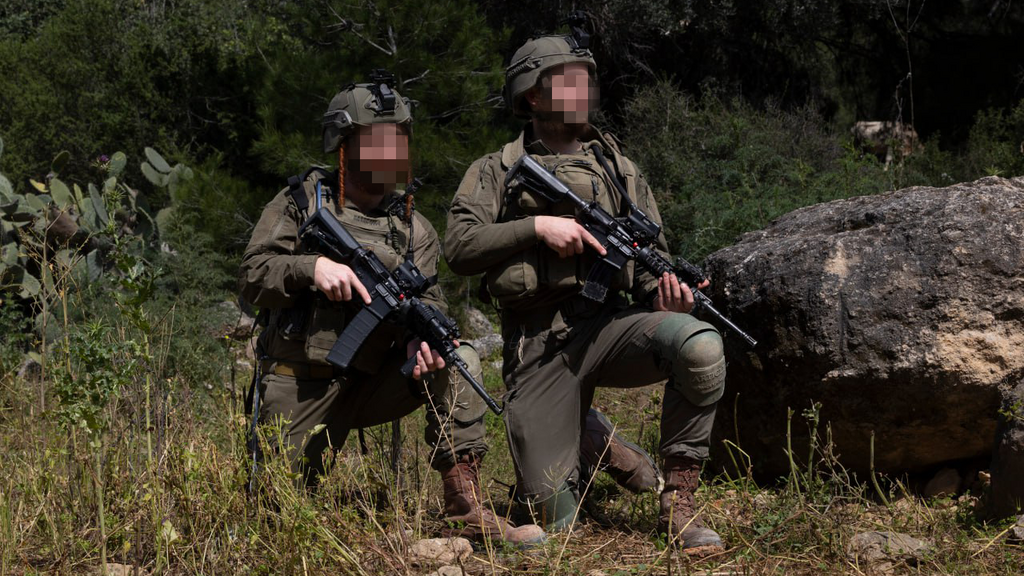
Between the study hall and the battlefield: Haredi soldiers in training
(Photo: Gil Nehushtan)
The step he took is unusual in the environment and family in which he grew up, but he says it has been met with support.
“There is the natural parental concern, which is obvious. Beyond that there is also a lot of interest. A Haredi young man who enlists is not alone — around him are circles of family, friends, the yeshiva and the community.
“It is important to me to stay connected with my yeshiva, and I try to go there whenever I have the time. That way the yeshiva experiences the story together with me. Sometimes when I’m called up from the yeshiva they see it, and I think it touches them.
“On one hand it is clear that the army changes a person, but in my view the change should take you to a better place, strengthening your ability to deal with challenges and complex situations. The idea is to remain the same person, with the same values and aspirations.
“Even during difficult periods of fighting and distance from home and your natural environment, a person can remain stable in his identity and his faith. That may be the central message: to be strong and steadfast in your path, even when the reality around you changes.”