


The weeks following Passover are typically a quiet period for events in Israel, with the wedding season only picking up later, after Lag BaOmer, a Jewish holiday celebrated on the 33rd day of the Counting of the Omer.
So if you’ve recently been invited to one, or even several weddings during this time, your sense that something is unusual is correct.
The period known as the Omer, the seven weeks between Passover and the holiday of Shavuot, is traditionally observed in many Jewish communities as a time of partial mourning. Weddings and other festive events are generally avoided, at least until Lag BaOmer.
The custom dates back to a rabbinic tradition from the early centuries of Judaism, which recounts a plague that killed 24,000 students of the sage Rabbi Akiva. In remembrance, many observe mourning practices such as avoiding haircuts, refraining from celebrations and limiting music.
At the same time, the restriction is not universally binding. It developed later in Jewish practice and exists in some tension with the spirit of the Hebrew month of Nisan, which follows Passover and is associated with joy and renewal. Over the centuries, some religious authorities have permitted weddings during this period, particularly before the Hebrew month of Iyar.
This year, the issue has taken on new urgency due to the war, which forced many couples to postpone weddings scheduled in the weeks leading up to Passover. In response, Israel’s Chief Rabbinate issued a temporary ruling allowing couples affected by the war, including those delayed by military reserve duty or home-front restrictions, to marry during the early part of the Omer, specifically during the month of Nisan.
In an official statement, the rabbis described the decision as an exceptional, one-time measure. “For couples who were forced to postpone their wedding due to security circumstances, the chief rabbis have determined, as a temporary ruling for this year, that weddings may be held until the start of the Hebrew month of Iyar,” the statement said. “This applies to all Jewish communities, with particular consideration for couples who have not yet had children.” The rabbinate emphasized that the ruling does not change standard practice in normal years.
On the ground, the decision is already being felt. “Just this week, I attended two weddings,” said Liel Harel, a social worker and relationship coach. “These were couples who had planned to marry in early March. As soon as Operation Roaring Lion began, the rabbinate announced that weddings would be allowed during the Omer this year. It gave couples a lot of breathing room.”
According to Harel, the ruling allowed couples to move forward with long-awaited plans without facing months of additional delay. “They could still have the wedding they dreamed of, without waiting until after the Omer, which is a long time,” she said. “It created a sense of openness.”
"One recent wedding carried added emotional weight. The bride was the granddaughter of Holocaust survivors, and the ceremony took place just after Israel’s Holocaust Remembrance Day. There was something very powerful about that,” Harel said.
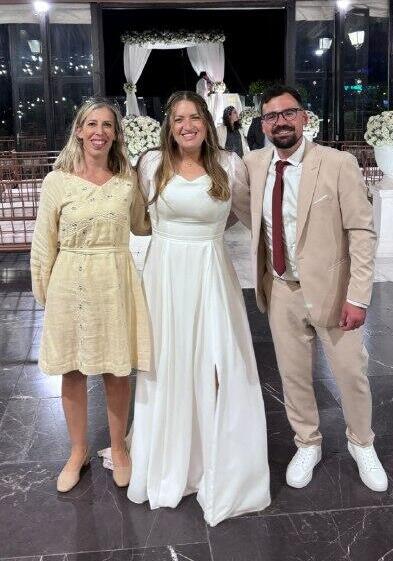
Liel Harel with the couple married last week
The unusual circumstances have also led to individual cases requiring special approval. At the start of the war, one couple requested to move up their wedding date because the groom, a soldier in an elite military unit, needed to return quickly to active duty.
The request was reviewed by local rabbinical authorities and eventually approved by Israel’s chief rabbi, who took into account the security situation and the unique challenges faced by soldiers. Officials said the decision allowed the couple to marry without further delay and enabled the groom to return to service focused and free of personal concerns weighing on him. Officials said the case was unusual, even in a predominantly religious community, but reflected the exceptional circumstances of the time.