

Parashat Mishpatim opens with a jarring transition. Having just experienced the earth-shattering revelation of the Ten Commandments, the Torah immediately pivots to the mundane.
For a nation of former slaves who had only recently tasted freedom, the choice of opening with the rules of slavery was a deliberate pedagogical tool.
It was designed to clarify the new world they were entering, a world where the very definition of a "slave" was being fundamentally rewritten.
The global disconnect: status vs. action
To understand the Torah’s innovation, we must first look at how the rest of the world viewed work and slavery. In almost every other language and culture, there is a sharp linguistic and conceptual divorce between "work" and the status of being a "slave".
• Akkadian: The word for slave (wardum) means "to descend" or "to submit," focusing on social hierarchy. Conversely, "work" (dullu) refers to a specific role or service.
• Ancient Greek: The Greeks separated the creative activity of the aristocrat (ergon) from the legal status of the slave (doulos), who merely performed tasks.
• Arabic: The word ʿabd (slave) denotes a total religious or social relationship, while ʿamal (work) refers to productive economic labor.
• Latin and Romance Languages: Here, work is often viewed through the lens of pain. The words travail or trabajo derive from the Latin tripalium, a three-legged instrument of torture. A slave (servus), meanwhile, is defined simply as a piece of property belonging to a master.
• English and Germanic: "Work" comes from the Proto-Germanic werka (doing/action), while "slave" is derived from the "Slavic" people, referring to an ethnic origin or a legal condition.
In all these cultures, a slave is an object, while work is an activity - something you do.
The Hebrew innovation: the root A-V-D
The Torah rejects this dichotomy. In Hebrew, the same three-letter root ע.ב.ד (A-V-D), is used for everything: the slave (Eved), the work we do during the week (Avodah), and the service of God (Avodat Hashem). This is not a linguistic accident; it is a normative claim.
In Hebrew, a slave is not defined by his essence as an object nor his social status. He is defined by his function: he is "the one who works". When the Torah says, "six years he shall work", it refuses to grant the man the identity of an object. He remains a human being who performs labor, much like a hired worker, only under a different contractual timeframe. The Torah even notes that in six years, he has given "double the service of a hired laborer" (Deuteronomy 15:18), reinforcing that he is a worker with a high output.
This functional definition is why the slave status must be temporary. If a slave refuses to go free after six years, declaring his love for his master, his ear is pierced. Why the ear? Because it heard at Sinai that "the Children of Israel are servants to Me”. By choosing to stay forever, he attempts to turn a temporary activity into a permanent essence, thereby acquiring a human master and rejecting his divine mission.
Work as a divine value
Because the Hebrew language uses the same root for slavery and work, it elevates the status of the worker rather than lowering the value of the work. We see that early in the Torah’s narrative. When God tells Abraham about the future exile in Egypt, He uses two separate terms: "they shall be enslaved" (root A-V-D) and "they shall be oppressed" (root A-N-A) (Genesis 15:13). This proves that in the Hebrew mind, "work" or "service" is not inherently "torture" or "oppression".
In the Garden of Eden, Adam was commanded "to till (work) it and to tend it" (Genesis 2:15) using the root A-V-D. Work is a primary human mission. Slavery, conversely, is a distortion of that mission. Later in the Torah, slavery is a curse, where a person stops being a subject who acts and becomes an object owned by another.
From slaves of pharaoh to workers for God
The exodus from Egypt was not a move from "work" to "idleness," but a move from one type of Avodah to another. When Moshe tells Pharaoh, "Let My people go that they may serve (work for) Me", he uses the same word of subjugation to describe the highest form of freedom.
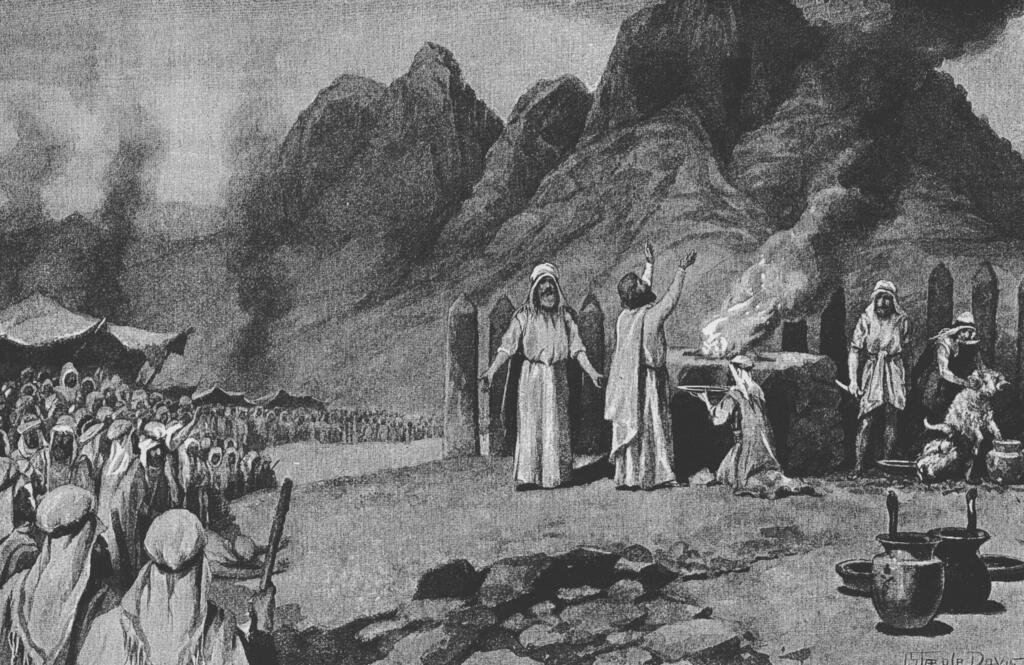
The Covenant Confirmed
(late 19th or early 20th Century illustration by John Steeple Davis)
A person cannot simultaneously be a slave to Pharaoh and a worker for God. The Hebrew root forces a choice: are you serving a human system, or are you directing your talents toward a divine purpose? Rather than having one's "quota of bricks" or rations dictated by a master, true freedom is the ability to work for oneself. By doing so you serve God as you advance your material prosperity and the world God had created for us.
Abraham, Isaac, and Jacob are called "servants of You" (Exodus 32:13), and yet they were among the freest people in history. They were not bound by a rigid daily schedule; they were entrepreneurs, shepherds, and warriors. They were servants of God precisely because they were free people committed to an idea greater than themselves.
Conclusion
The Sages of the Talmud took this Hebrew concept to its logical extreme, ruling that a master must provide his Hebrew slave with the same standard of living as himself. "Whoever buys a Hebrew slave," they famously said, "in fact buys a master for himself".
By tying the word for slave to the word for work, the Torah ensures that even in a state of servitude, a person’s humanity remains intact. They are not a "thing"; they are a "worker". This linguistic bond serves as a constant reminder that our labor is meant to be an expression of our freedom, our creativity and our success, and that is our service to the Almighty.