


A collection of poems written by a Jewish partisan during World War II has been preserved and revealed decades after being hidden from both the public and his family, offering a rare personal account of life among Jewish fighters in the forests.
Mordechai Dunitz, born in 1922 in the town of Zhetel, now in Belarus, survived the Holocaust with his sister, Pania, after the two escaped the Novogrudok ghetto and joined partisan fighters in the Naliboki Forest. Amid battles and daily struggles for survival, Dunitz found a way to express his thoughts and emotions by writing poetry.
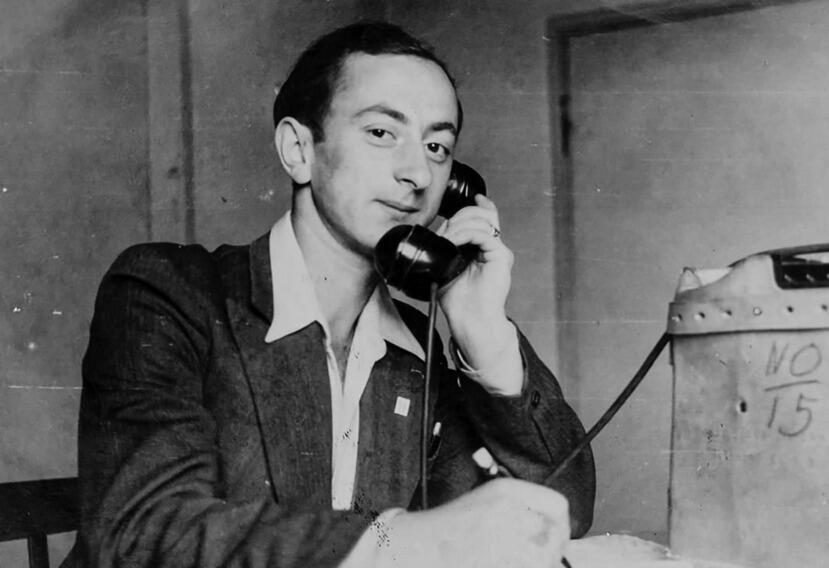
The poems were written in secret on thin, fragile scraps of paper and kept out of sight for decades, unknown even to his family. Only after Dunitz’s death in 2019 did his son, Roni, discover the collection among old documents that had already begun to deteriorate.
“I found the pieces of paper and the folder after his death, and I couldn’t understand the context or the story behind them,” Roni Dunitz said.
He later transferred the materials to Yad Vashem for professional preservation. As the restoration process progressed, the full scope of the collection gradually came to light.
“My father never shared these poems with us, even though he shared many other things through articles and photographs,” his son said. “Even his sister, who lived to 100, did not know about them. It’s very moving to see these poems being preserved so professionally. Who would have believed these documents would survive like this.”
At Yad Vashem’s conservation laboratory, specialists said the condition of the papers upon arrival was particularly poor. The pages were fragile, wrinkled, torn and stained with soot after being stored for years near a chimney. Some had also been previously repaired with adhesive tape, which over time caused additional damage.
Yuval Siton, a paper conservator at Yad Vashem, described the lengthy restoration process.
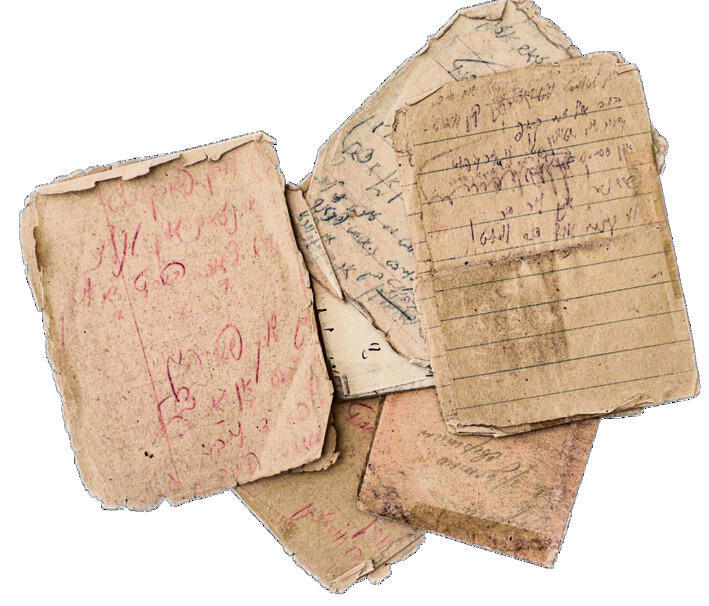
Some of the poems in the collection
“The documents arrived in very bad condition,” he said. “We began with delicate cleaning of soot particles using a special small vacuum, followed by manual cleaning with dedicated erasers. The soot removal process alone took more than a month.”
He added that removing remnants of adhesive tape required special materials and extreme care, as such substances are among the most damaging to paper over time.
Tears in the pages were repaired using extremely thin Japanese paper and reversible professional adhesive, with the goal of stabilizing the material without erasing signs of age.
“Our goal is to preserve the material and allow it to continue telling its story,” Siton said. “Sometimes the most fragile pieces of paper carry the strongest testimony.”
After the war, Dunitz lived in displaced persons camps in Germany, where he edited a Jewish newspaper titled “Tikvatenu,” or “Our Hope.” He later devoted much of his life to documenting and commemorating his community, including contributing to a memorial book for the town of Zhetel.