

Following the uproar over a plan by Dublin City Council to rename Herzog Park, which has since been halted, members of Ireland’s small Jewish community say the episode has exposed a deeper crisis of rising antisemitism and hostility toward Jews in the country.
In an interview with ynet, Oliver Sears — founder of the Holocaust Awareness organization and a London-born Jew who has lived in Ireland for 40 years — said hatred toward Jews and toward Israel has reached levels unseen in modern Irish history.
Interview with Oliver Sears and Morris Cohen
(Video: Lior Sharon)


“The past two years in Ireland have been very difficult for the Jewish community,” he said. The renaming attempt, he added, was nothing less than the most “pernicious attack” the community has faced. “There was no issue with the name for 30 years. This feels like collective punishment of Ireland’s Jews for the actions of Israel’s government. Irish Jews have never experienced antisemitism like this, and they are in deep shock.”
Herzog Park is named for Chaim Herzog, Israel’s sixth president, who was born and raised in Dublin and was the son of Ireland’s former chief rabbi. The park sits in the heart of the city’s small Jewish community.
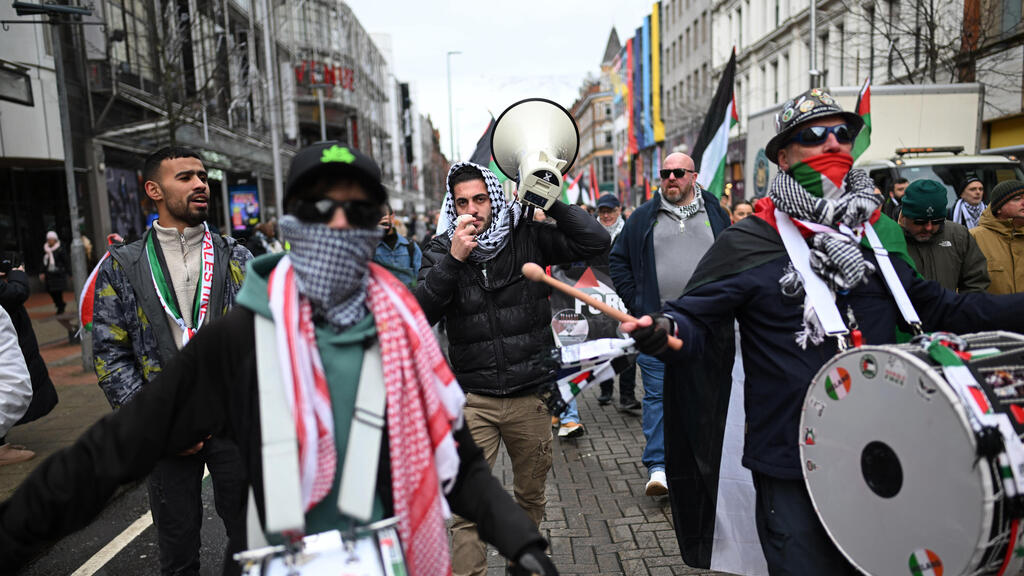
Pro-Palestinian protestors in Ireland
(Photo: Charles McQuillan/Getty Images)
Morris Cohen, president of the Jewish community in Ireland, said the attempt to strip the park of its name amounted to an erasure of Irish Jewish heritage. “This wouldn’t be done to any other small community in Ireland,” he said. “Not to people of color, not to the Traveller community, not to the LGBTQ community. We feel extremely aggrieved. Herzog is a child of the community. He lived here, went to school minutes from the park. This is our history.”
Cohen said that in the past 12 hours Dublin City Council had effectively acknowledged the move was unlawful. Under local law, the council cannot “de-name” a site, and renaming requires formal procedures that were not followed. After taking legal advice, the Lord Mayor referred the matter back to the council’s Names Committee, placing the entire process in limbo. Any future renaming would require a plebiscite, but legislation needed for such a vote — first proposed in 2019 — has not yet passed.
Even so, Cohen warned that political pressure may intensify, particularly as another renaming proposal — tied to a teenager who died in police custody 20 years ago — moves forward. “There will be huge pressure from opposition parties,” he said. “This is not going away.”
Sears said the legal wrangling misses the core issue. He argued that Irish officials have helped cultivate the atmosphere now surrounding the community. “They’re reaping what they sowed,” he said. “Officials were using really inappropriate language. Only now — after this attack — do a few understand what antisemitism looks like.” He described a pattern in which the community is told by non-Jews what antisemitism is, then “punished” if they disagree. “We are being gaslit,” he said.
Both Sears and Cohen said they watched the council’s debate online and were stunned. According to Sears, some councillors openly questioned Israel’s right to exist — something defined as antisemitism under the IHRA definition. “It was extraordinary,” he said. “A very low point here in Ireland.”
Asked whether rising hostility could push Irish Jews to emigrate, Cohen said the community has not reached that stage “thankfully,” but added: “We have to be cognizant of history. We need to be careful not to miss the signs.” While physical attacks have been few — “two or three incidents,” he said — the trend is deeply worrying, especially on university campuses, in schools and in the health system. Cohen said there have already been “egregious incidents” in which Jewish patients were treated offensively in hospitals.
Both leaders said the Herzog Park episode has become symbolic of a much larger question: whether Ireland’s Jewish minority will continue to feel safe and protected in a country where it has lived for more than a century. “The past two years have changed everything,” Sears said. “We are witnessing a shift that few of us ever imagined possible.”
Cohen added a final warning: “This is a time to stand up, not to look away. We will continue the fight against antisemitism. But we need Ireland’s leaders to act — not just speak.”