

A new legal front has opened in the dispute over the building housing the French Embassy in Iraq. A Jewish family of Iraqi origin is suing the French government for 21.5 million euros over its use of the property for 50 years without payment. The family says France cooperated in stripping them of their property rights.
Alongside the lawsuit now filed in a Paris court, family members are pursuing another case in the administrative courts, where their request has so far been rejected. Their lawyers say the case involves “Jewish property that was stolen,” including more than five decades of unpaid rent and compensation for moral damages.
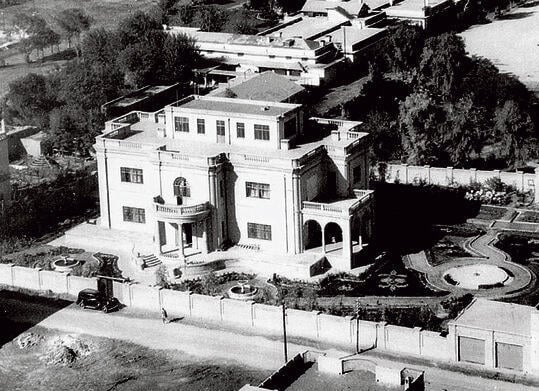
The case is rooted in the turbulent history of Iraq’s Jewish community. Brothers Ezra and Khedouri Lawee, members of the Jewish community and owners of the Baghdad building, known in the family as Beit Lawee and distinguished by ochre-colored walls and neoclassical columns, emigrated to Canada in the late 1940s amid the mass exodus of Iraqi Jews.
The property, however, remained in their ownership after they left the country. The French ambassador to Iraq signed an initial lease with the Lawee brothers in 1964, which took effect in 1965, for the 3,800-square-meter building and the 1,150-square-meter plot, according to an argument presented by the French Foreign Ministry and obtained by AFP.
But beginning in 1974, the French government stopped paying them rent and instead transferred equivalent sums directly to the Iraqi authorities. In its defense, the French Foreign Ministry argued that the French government signed leases with the Iraqi authorities because the historic owners had been stripped of their property under Iraqi legislation concerning Jews who had left Iraq.
“This dispossession of Jewish property was carried out with the cooperation of the Foreign Ministry. France bears responsibility,” attorneys Jean-Pierre Mignard and Imrane Ghermi argued in the civil lawsuit filed in Paris. The lawyers stressed that their clients were “dispossessed” as a result of “a unilateral measure of an antisemitic nature taken by the Iraqi authorities, which the French state complied with without raising any objection.”
'Abandoned, betrayed'
The plaintiffs’ lawyers also point to “the feeling that they were abandoned, even betrayed, by their tenant, the French Republic, which in their eyes was supposed to be entrusted with defending the highest principles of human rights.”
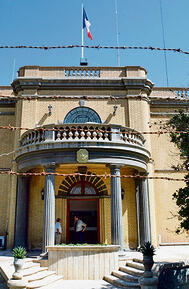
The house serves as the French Embassy in Baghdad
(Photo: Joe Raedle)
Mignard and Ghermi added that the family members had long maintained a deep affinity for and strong attachment to France and its culture and had “held discussions in complete secrecy with the French authorities” — but to no avail.
Descendants of the building’s owners, the Lawee and Khazam families, have also filed an appeal with the Paris Administrative Court of Appeal. “The two proceedings are therefore continuing in parallel,” their lawyers told AFP.
In early February, the Paris administrative court, where the compensation claim had been filed, ruled that France’s administrative justice system “does not have jurisdiction” to decide the case. In doing so, the court adopted the position of the public prosecutor, who echoed the Foreign Ministry’s arguments and concluded that the dispute fell under the jurisdiction of a court in Baghdad.
“The carrying out of public-service missions” in a building chosen by France “brings it under French administrative law,” attorneys Mignard and Ghermi argued at the time. “There must be a court with jurisdiction. Otherwise, what is already an injustice will become a denial of justice and therefore an absurdity,” the lawyers further argued ahead of filing the lawsuit against the state — a lawsuit that has now indeed been submitted.
“The French Republic is occupying a building that does not belong to it,” attorney Mignard again told the media.