

In November 1970, Israelis opened Yedioth Ahronoth to a story that seemed almost too extraordinary to be true. A Jewish boy believed to have died in the devastating earthquake that destroyed Agadir, Morocco, a decade earlier had miraculously survived, immigrated to Israel and found his parents after years of separation. The reunion was so emotional that family members fainted, neighbors wept and the young soldier at the center of the story reportedly collapsed while recounting his ordeal.
It had everything: a natural disaster, a missing child, a family shattered by grief, a chance encounter in the army and a reunion worthy of a Hollywood film. Israel embraced the story, and the reunited family was invited onto national television. There was only one problem. The soldier was not their son. The entire story of his miraculous survival and reunion was a lie.
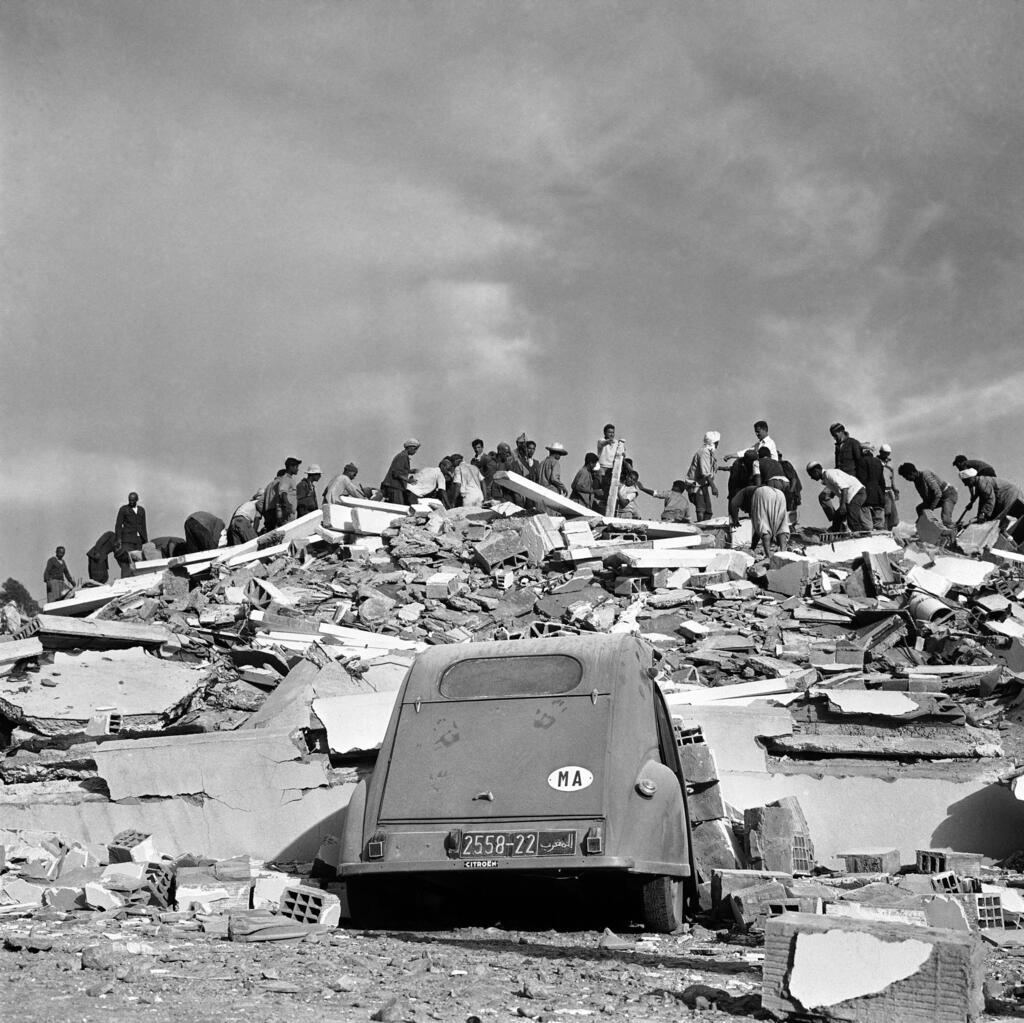
The ruins of Agadir, Morocco, following the devastating earthquake of February 29, 1960
(Photo: AP)
The boy who disappeared in Morocco's deadliest earthquake
The real tragedy began on February 29, 1960, when a powerful earthquake struck the Moroccan coastal city of Agadir, killing an estimated 15,000 people, with some accounts putting the death toll as high as 20,000. Among those buried in the rubble was Abraham Ohayon, a nine-year-old Jewish boy studying at a religious boarding school in the city.
Abraham came from a family of nine children living in Taroudant, Morocco. His parents, Moshe and Saada Ohayon, had decided to send him and his younger sister Fanny to the boarding school in nearby Agadir. But seven-year-old Fanny resisted, refusing to board the bus. Her parents eventually relented. Abraham, whom she remembers as an obedient child, went alone. She never saw him again.
When the earthquake struck, the building housing the school collapsed. Moshe searched desperately through the wreckage for three days, hoping to find his son alive. One of Abraham's classmates, who had slept in the same room in a bunk bed, was pulled out injured but alive. Of Abraham, however, there was no trace.
The family refused to abandon hope. In 1963, the Ohayons immigrated to Israel without Abraham, settling eventually in Ness Ziona. Moshe repeatedly contacted the Interior Ministry, hoping his son might have been rescued and brought to Israel by another family or through an organization assisting children orphaned by the disaster.
Officials even provided addresses of people named Abraham Ohayon. For years, Moshe traveled around the country, knocking on doors and asking strangers whether they knew anything about his missing boy. Every lead ended in disappointment.
A miraculous return captivates Israel
Then, in November 1970, two soldiers arrived in the Ohayons' neighborhood in Ness Ziona. One asked a woman where he could find the Ohayon family. When she identified them as the family that had lost a child in Agadir, the soldier replied that he was the missing son.
The family was overwhelmed. The young man claimed to have survived the earthquake, been taken in by another family and eventually brought to Israel. He said he had grown up believing his parents were dead and had only recently discovered they might still be alive.
The story became a national sensation. Yedioth Ahronoth published an emotional account of the reunion, written by journalist Uri Porat, who would later head the Israel Broadcasting Authority. Moshe described running frantically to meet the young man, who greeted him and his wife with cries of "Dad! Mom!" before the family embraced in tears.
Even a fortune teller entered the narrative. Moshe recalled visiting a woman in Tiberias who read coffee grounds and predicted that his missing son was alive. She reportedly told him that within three years, a handsome young man would appear and claim to be his son. By November 1970, precisely three years had passed.
The supposed survivor also told reporters an extraordinary story about his years in Israel. He claimed to have grown up at Kibbutz Afikim, joined the IDF and become a sergeant in a combat unit. According to his account, a soldier he had disciplined happened to hear about his past and revealed that his parents were alive in Israel.
There were inconsistencies, but few people seemed eager to challenge a miracle. The missing Abraham had become "Albert," and the soldier claimed to be 20 rather than 23, his actual age. Yet the family desperately wanted to believe. As Fanny would later recall, seeing a young man arrive in military uniform made his story seem credible.
The television appearance that exposed everything
The supposedly reunited son was invited to appear on Israeli television, then still in its infancy, alongside his younger sister Fanny, who was 18 at the time. The emotional interview captivated viewers across the country. But one family watching from Ofakim, about 104 kilometers (65 miles) from the television studios in Tel Aviv, reacted very differently.
Their surname was also Ohayon. And they recognized the young soldier immediately. He was their own son, Abraham, who had been out of contact with them for approximately three months.
The resemblance was no coincidence, and neither was the name. The soldier was indeed called Abraham Ohayon, but he was not the boy who had disappeared in Agadir. According to Fanny, his father had even worked at the same factory in Ofakim as one of her uncles.
The Ofakim family contacted the police, reporting that their son was impersonating someone else. Meanwhile, Fanny and the impostor were traveling back to Ness Ziona, completely unaware that the reunion story had begun to unravel.
By the time they returned, plainclothes officers were watching the family home. Fanny's uncle, who had rushed from Ofakim after learning the truth, quietly warned her not to enter the house. She initially refused to believe him. Only when he pointed out the police officers nearby did she begin to understand what was happening.
The family devised a way to get the impostor away from Moshe and Saada without alarming them. A relative in Haifa invited him to stay overnight, and he traveled there by bus. Police followed him and coordinated with the aunt, who welcomed him into her home and allowed him to go to sleep.
At approximately 2 a.m., officers entered the house, handcuffed the young man and arrested him. Israel's miraculous reunion was over.
A family loses its son for the second time
The deception devastated the Ohayons. For three months, they had welcomed the young man into their home, fed him, cared for him and introduced him to relatives as their long-lost son. Although they had repeatedly asked to see identification, he always found an excuse, claiming his documents were at his home in Haifa.
Fanny later learned that the impostor had a history of elaborate deceptions. In one incident, she said, he had arranged to marry a woman but failed to appear at the wedding, claiming he had broken his arm and gone to the hospital. According to Fanny, neither the injury nor the hospitalization had been real.
The impersonator was subsequently sentenced to two years in prison. Despite the fact that his father had worked alongside a relative of the Ohayon family, the two families never established contact afterward. Fanny said her family had no desire to meet or speak to those connected to the man who had exploited their grief.
More than five decades later, Fanny Marhum Cohen, now 74, is a mother of four and grandmother of 12. Her grandchildren have grown up hearing the extraordinary story, which has become part of the family's history. But for Fanny, the memory remains painful rather than entertaining.
She believes the ordeal took a lasting toll on her parents. Her father suffered a heart attack shortly afterward, while her mother developed diabetes, illnesses Fanny associates with the enormous stress and sorrow they endured. Both have since died without ever learning what happened to their real son.
The family has occasionally considered returning to the search. There is an association of former Agadir residents in Ashdod, and Fanny and her older brother have discussed approaching its members in the hope that someone might remember something about Abraham's disappearance. Yet each time, the search has stalled.
After losing her brother in the earthquake and then losing him all over again to an impostor, Fanny says the family struggles to believe that another lead could finally bring answers.
More than six decades after the earthquake, Abraham Ohayon's fate remains unknown. His parents died still wondering whether the boy they lost beneath the rubble of Agadir had somehow survived. And the reunion that once moved an entire country remains one of the most extraordinary deceptions in Israeli newspaper history.