

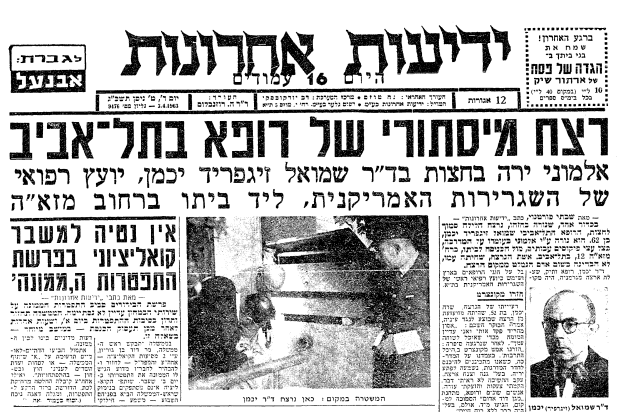
A mysterious murder in the heart of Tel Aviv dominated headlines in 1963. Dr. Shmuel Siegfried Yachman, an Israeli physician who worked with the U.S. Embassy, was walking late at night with his wife, Sarah, on their way home to their apartment on Mazeh Street.
As the couple reached the entrance to their building, a shot suddenly rang out. Dr. Yachman was struck in the neck and died on the spot. The killer disappeared into the darkness. No one, not even his wife, managed to see him.
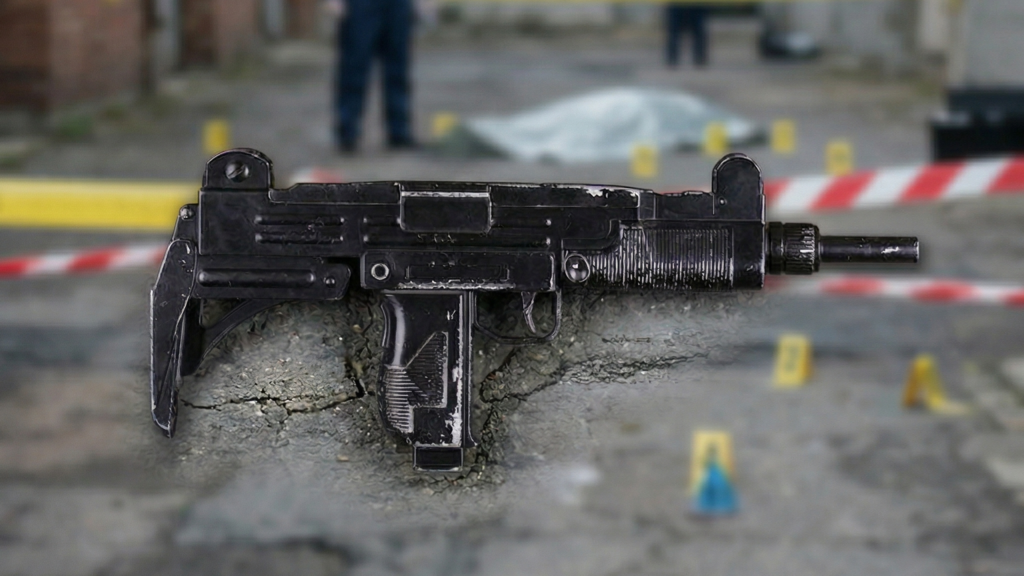
Police rushed to the scene in large numbers and launched extensive searches, but found nothing. The only clear fact was that Dr. Yachman had been killed with a Uzi submachine gun.
At first, investigators assumed it was a personal vendetta, perhaps involving a former patient, but they failed to substantiate the theory. Other leads were examined and also yielded nothing.
The Shin Bet, then still known as the Sh.B., joined the investigation to determine whether the murder was connected to Yachman’s work with the American Embassy. They, too, failed to solve the case.
The file was added to the police’s list of unsolved murders. And that might have been the end of the story, had it not been for another unsolved case on the same list, one that appeared unrelated except for one detail: it, too, involved an Uzi.
The murder in the heart of Ramat Gan
Six months before Yachman’s killing, on November 15, 1962, at around 7 p.m., Moshe Stolero locked up his family’s bookstore and household goods shop.
Stolero, a 32-year-old bachelor, lived with his parents in an apartment above the shop on Negev Street in Ramat Gan. As he climbed the stairs toward his home, an assassin was waiting. The gunman fired three shots from an Uzi and killed him on the spot.
The fact that the money from the shop’s cash register was still in Stolero’s pocket immediately ruled out a robbery gone wrong. But the killer vanished without leaving a trace, and the police investigation yielded nothing.
Two months later, there appeared to be a breakthrough, at least on paper. For the first time, police began searching for a specific individual. Not as a suspect, but as someone with “relevant knowledge.”
After months of no progress, this alone was considered an improvement.
The man police were looking for was Levi Neufeld, a gifted 19-year-old medical student at the Hebrew University. A Holocaust survivor who had been adopted by a family in Ramat Gan, Neufeld had struggled with personal and psychological difficulties.
In January 1963, he left his home, located near the Stolero family’s residence, and disappeared.
When his family reported him missing, someone in the police connected the dots: two young men from the same neighborhood, one murdered, one vanished.
Neufeld quickly became the focus of a nationwide search.
Media frenzy
The Israeli media closely followed the Stolero case and the search for Neufeld, turning it into a kind of serialized drama.
Again and again, reports surfaced: sightings of Neufeld, rumors, accounts of how he continued to evade capture.
Then came the connection that seemed impossible to ignore.
Three victims, in three different cities, with no apparent motive, all killed using the same weapon: an Uzi submachine gun.
The press began referring to a “series of murders,” and public anxiety grew. Police investigators searched for a link, while theories began to flourish.
The dominant theory was that Soviet intelligence, the KGB, was behind the killings.
After all, Dr. Yachman had worked with the Americans, and another victim, Shoshana Chachkes, had recently visited her ill mother in the Soviet Union.
Only the Stolero murder remained unexplained within this Cold War espionage theory.
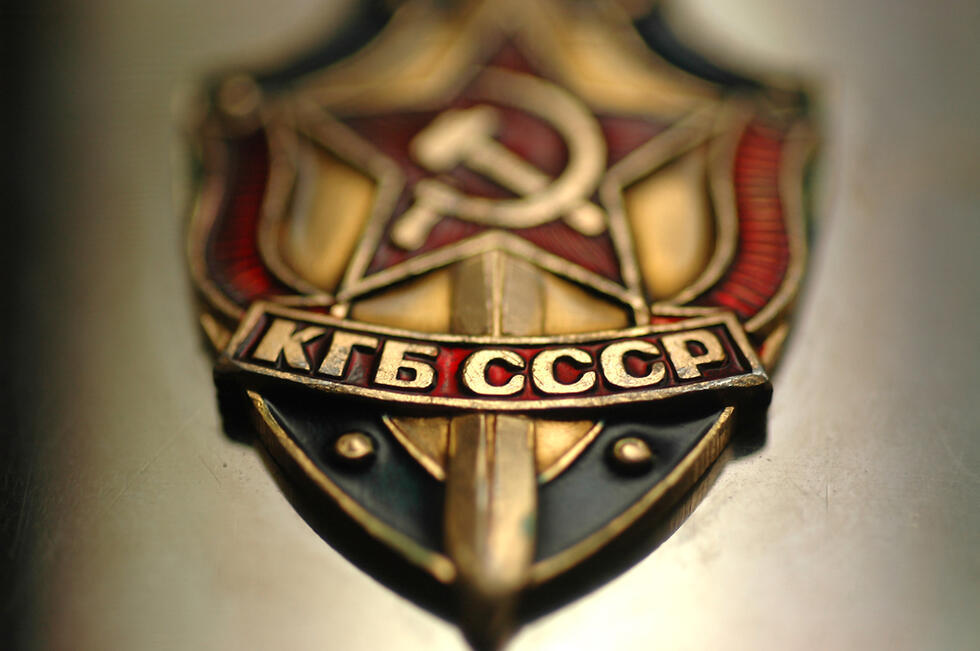
The dominant theory was that Soviet intelligence, the KGB, was behind the killings
(Photo: Shutterstock)
Was the KGB involved?
Pressure on the police intensified after Yachman’s murder in Tel Aviv. Now there were two unsolved killings involving a Uzi. Although police found no connection between the cases, the media treated them as linked and continued to highlight the failure to find Neufeld.
The murder in the orchards of Kfar Saba
The puzzle became even more complex and deadly in the summer of 1963.
In the early hours of July 17, an unknown assailant entered an isolated home near orchards on the outskirts of Kfar Saba.
Inside, Deborah Chachkes and her husband, Fishel, were asleep.
Through a bedroom window, the attacker fired a burst from an Uzi, killing Shoshana and critically wounding her husband. Once again, the killer disappeared without leaving any trace, no shell casings, no evidence.
Years later, Abraham, Shoshana’s son, revealed a detail that cast new light on the case. According to him, his father had been involved in underground escape networks in the Soviet Union and later continued working with Israeli intelligence.
This raises the possibility that a KGB assassin had actually been sent to target Fishel, with Shoshana killed simply because she was beside him.
The connection between the three cases now seemed undeniable: three different victims, in three cities, murdered without clear motive, all with the same weapon.
The media intensified coverage of the “murder series,” and public fear deepened. Police searched for links, while theories multiplied.
Again, the central assumption pointed to Soviet intelligence involvement.
The main suspect
Police decided to reexamine all the evidence.
They then discovered a connection between Neufeld, who until then had only been linked to the Stolero case, and Dr. Yachman.
Neufeld, it turned out, had been friendly with the doctor’s daughter.
From that moment, with strong backing from the media, Neufeld became the prime suspect in all three murders.
According to the police theory, the troubled student had been recruited by the Soviets and was operating as a one-man assassination squad.
Police launched an unprecedented manhunt, dubbed “Operation Field,” deploying around 1,000 officers across the country.
The press, for its part, amplified the narrative, creating an atmosphere in which Neufeld was effectively convicted in the court of public opinion before he was ever found.
A lone voice of dissent
Amid the public hysteria, one unexpected voice spoke out.
The poet Zelda, who rarely expressed opinions publicly, came to Neufeld’s defense, despite never having met him.
In a sharply worded letter, she criticized both the police and the media for what she called a “lynch trial,” making clear she refused to believe in his guilt without solid evidence.
The tragic discovery
In the end, Zelda proved right, and the outcome was deeply tragic.
On May 3, 1964, children hiking in Jerusalem’s Ein Kerem neighborhood found Neufeld’s remains inside an abandoned building. Next to him were a bottle of poison and a suicide note.
Pathological findings established beyond doubt that Neufeld had taken his own life before the murders of Yachman and Chachkes.
He could not have been the killer.
Police were forced to publicly clear his name and return the investigation to square one.
To this day, the identity of the killer in the “three murders” case remains one of Israel’s greatest unsolved mysteries.
Years later, Abraham Chachkes revealed the detail about his father’s intelligence activity, raising once again the possibility of a KGB link.
Although former Shin Bet chief Isser Harel expressed skepticism that a foreign assassin could have operated in Israel at the time without being caught, the son’s account leaves the door open.
The truth behind the bullets may still be hiding somewhere in the shadows.