

There is an observation point where we stop and listen to the signs of nature and of people, to what does not fit. A mile and a half from here is Kibbutz Be’eri. Nearby is the Paga outpost. Gaza is to the west.
We got here in a Humvee that jolted along dirt roads. Now, after the waves of dust have settled into the ground, you can tilt an ear to the rustle of the winter that is closing in. To the birds stuck in windbreakers at the terminal of the transition season. To Sahaf stream, carving its line east to west beside us without flowing. To the timeless cries of battle. To the radio chatter that has echoed among the eucalyptus leaves since that morning.
It is quiet and loud here. Loud and quiet. A seasonal wadi that does not know it disappoints. Birds in windbreakers. Eucalyptus trees that stare. A thread passing between leaves. And you take a breath and imagine.
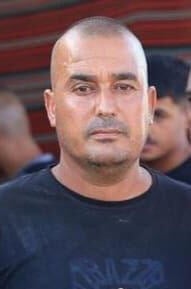
On this route, on October 7, dozens of terrorists sped through. Sergeant Major Muhammad el-Atrash, the veteran tracker of the Gaza Division northern brigade, did not climb into the armored personnel carrier like the other fighters. A few hundred meters from here, as would become clear later, he fought alone, a heroic battle from a jeep under heavy fire, was killed on the spot and his body was kidnapped. On October 16, 2025, as part of the most recent deal, he was brought home, no longer alive.
Above us, November clouds come and go through the remnants of summer skies that still heat to more than 100 degrees. “He is missing,” says the tracker Taleb, a relative of el-Atrash.
We reach the final point of the tour we are taking with several trackers from the northern brigade and Capt. Ali, the trackers’ officer. He feels the need to say a word or two. “The fighting is not over,” he says like a ship captain. “And even if Izz al-Din al-Haddad sings ‘Hatikvah,’ we will still be troubled by this border.”
Tell me, I ask, how did you trackers, the border guards, the fighters with the most developed sense of smell in the IDF, not smell October 7 coming?
It is an unfair question. The kind of question that dumps blame on the sentry. Also because the few who smelled disaster were not counted, and mainly because trackers do their work in another time dimension. October 7 happened in tunnels, in a concept, among those who did not look ahead. The trackers move in the opposite direction, following the past, tracing backward in time through a footprint in the ground, a twig pushed aside. It is not logical to expect them to foresee thousands of tracks that would cross a border.
I am dumping that question on you.
“And I totally accept it,” Ali smiles. “In the end we are not Unit 8200. But we were not calm for a second when they built the ‘hourglass’ fence,” the barrier close to Israel that forms the final element in the border obstacle system. “We said, guys, this will not help. You always need more forces.
“And still, of course you feel responsibility the moment terrorists cross. Could we have prevented it? No.”
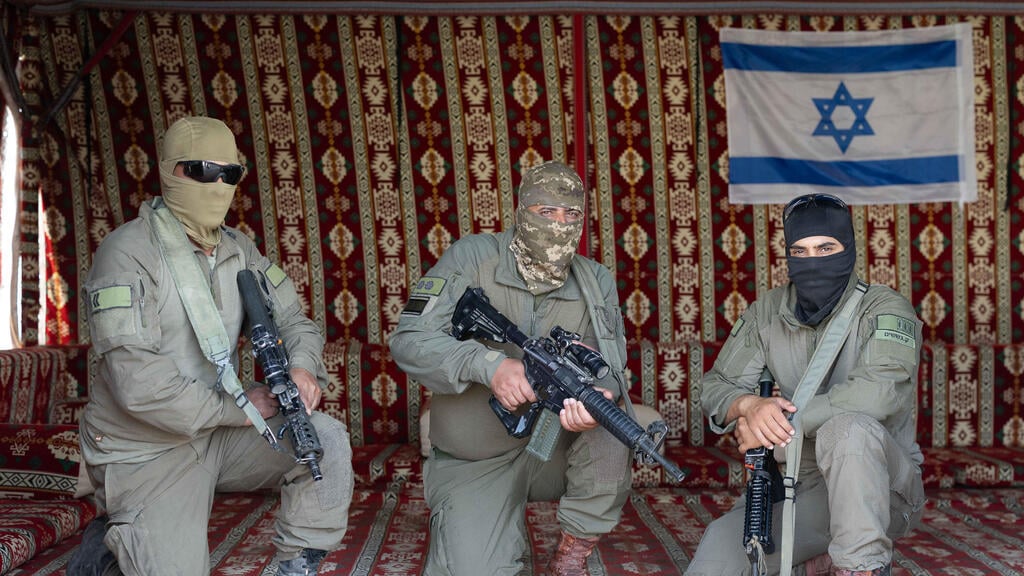
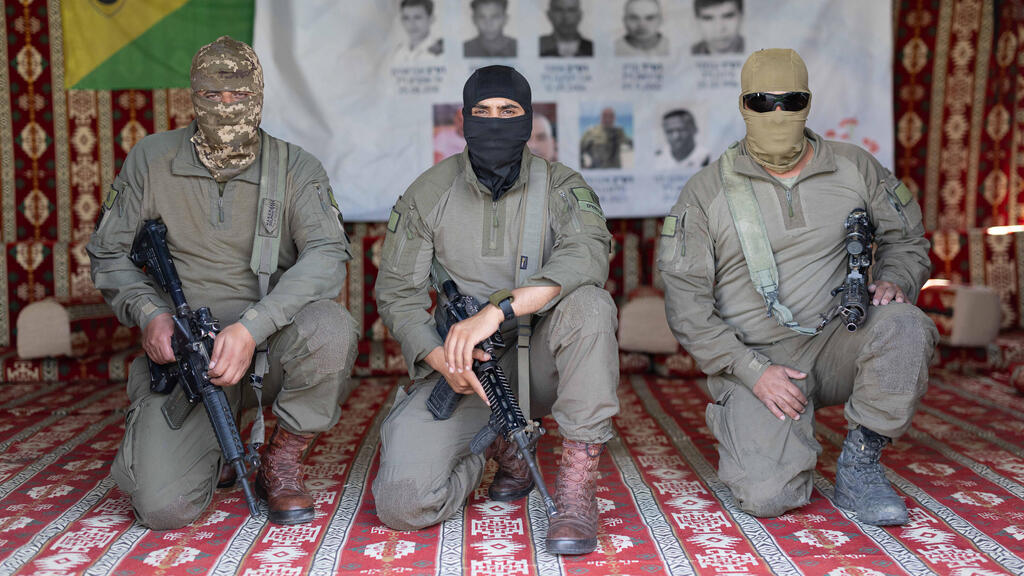
Two hours earlier, at the Re’im base. We are in the trackers’ company area, in the Bedouin encampment. This is not just any tent. There is a television, PlayStation, air conditioning, that kind of thing. The tent walls, floor and sofas are wrapped in red and white fabric with traditional colorful prints.
Sgt. Maj. Muhammad el-Atrash
Soon, black coffee will drip slowly from a finjan, then sweet tea, and cold water, and cakes. Full board. It could be pastoral if we did not also need to talk, and Lt. Col. Bassam, Capt. Ali, Master Sgt. Taleb and Master Sgt. Said, their names are pseudonyms, needed to each tell their piece about the past two years.
Taleb, married with no children, 36, lives in Muldah near Hura, an unrecognized and unprotected community. On the morning of October 7 a missile fell 500 meters from his house. “It did not scare me, only my family,” he says. “It makes you angry, it frustrates you. I demanded a shelter many times.”
Bassam, 43, a father of seven and the Gaza Division chief tracker, lives in the Bedouin diaspora near Dimona, in an unrecognized settlement. His home is tin, with no electricity in winter. During Iranian missile attacks, his family took shelter in cylindrical concrete pipes and had to stay there for long stretches because of the distance from home. Pillows, blankets, jerry cans of water, everything that can make the family of an IDF lieutenant colonel feel that in this business called defending the home, only one side fulfills its part. “The dogs barely survive there,” he says. “They gave us nothing. Nothing.”
On that Saturday morning, Bassam, then the commander of the trackers’ school, dashed from home to the Gaza border area without a weapon. “When I left, my wife asked, ‘How will you fight? You will die there.’ I said, we will catch a terrorist and take his gun.”
He picked up Sergeant Major Galeb Suleiman al-Nasasra, a tracker in the northern brigade, joined up with Said and three more trackers. At the gas station near Urim they began helping wounded people and those fleeing the Nova festival area.
Capt. Ali: 'We do not need to stay in the medieval period. I recently wrote a position paper saying trackers are an efficient and good force, but come on, let us adapt to the IDF of today. There is no room anymore for thinking technology is the enemy'
They treated, guided toward escape routes, hid people in bushes. “Even if I run into them, none of those we helped I remember today,” Said says. And there were those Galeb, who would be killed in battle in northern Gaza in April, loaded into the car, as many as he could, and drove away from danger.
At a certain point Bassam split from the group to lead Tal Ashour, the former commander of the Gaza Division southern brigade, to a side gate at Re’im via dirt tracks. Ashour was called up that morning to take command in place of Col. Asaf Hamami, who was killed.
That morning 30 terrorists infiltrated Re’im, killing six soldiers and one civilian. With others, Bassam began evacuating casualties. From one he took a weapon.
Then, on the base, as he moved between the trackers’ empty quarters, the closed club that would later be found to have civilians hiding inside, and the women’s quarters, where he tried to treat a bleeding soldier who could not be saved, he killed three terrorists.
The first appeared in the kitchen when Bassam and two other fighters opened the door. Three bullets, Bassam remembers hitting him.
IDF trackers
(Photo: Tal Shahar)
Then, near the vegetation, under a tree, a second terrorist lay in wait to surprise them. “I return fire. He falls backward, still firing into the air. I charge and kill him.”
The third hid in the gym. Big body, not a large beard, Bassam describes. A conversation develops between them in Arabic.
“He raises his hand and says, ‘Come up.’ I say to him, ‘You come,’ in Arabic. He raises his hands and says, ‘I have no weapon,’ and I say, ‘I am holding my weapon on me, I will not shoot you.’ I manage to get him out. He had a Kalashnikov. I shot him with a Shaldag fighter. He fell.”
Master Sgt. Said recalls an incident a few months ago in Beit Hanoun, around noon. Four command post fighters with him wanted to climb to a high point, a kind of hill. Do not go up, Said asked, there is a sniper. Moments later, the four other soldiers were hit by sniper fire
At the same time, Capt. Ali, 26, from Abu Tulul in the Negev, married with two children, who was on leave for business administration studies, arrived at the Re’im party site and began helping collect bodies. “Horrors, things that even at age 70 in a rocking chair I will remember,” he says. “As I lift bodies I tell myself, Ali, you were probably born for this mission. And you see beside you a commander, a strong man, with tears in his eyes. Two tracker friends who were with me then are no longer in the army today for mental reasons.
“After two days I went home, and every time I put my head down I remembered it. Then I read that writing helps unload. That is what I did. I wrote my feelings, what I saw, how it affects me. It helped. Paper absorbs everything.”
Back to the field.
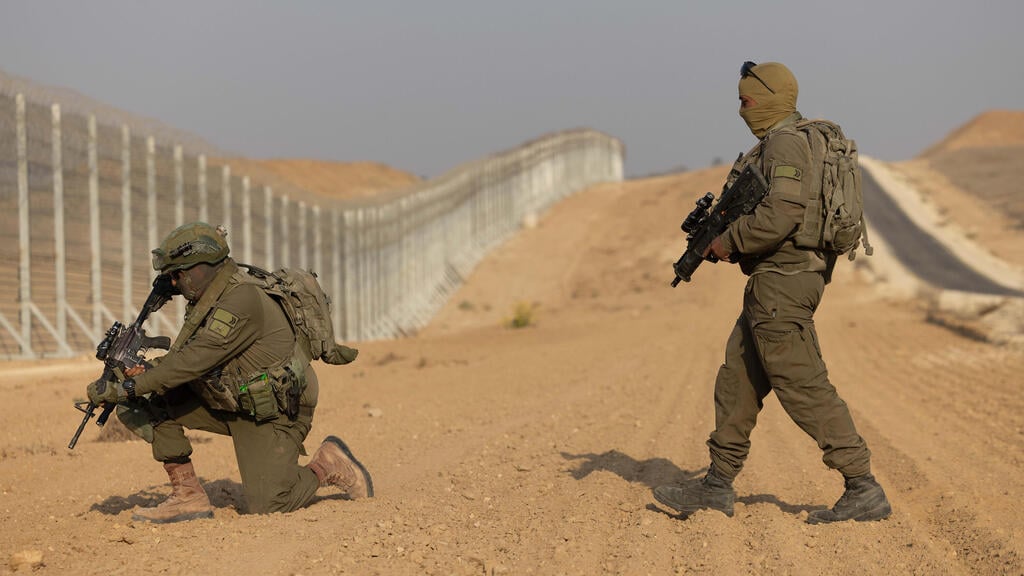
We move along the “Burma Road,” the security patrol route beside the border fence along a strip of rugged sand, plowed and leveled periodically by a tractor blade. Gaza is beside us like a fate, watching, gripping with its nails, wounded and wounding, not letting go. Thin smoke columns rise in places. Now and then, deterrent bursts of fire.
Footprints in the sand
(Photo: Tal Shahar)
Taleb studies the ground beneath his feet, lifts his eyes, sniffs. What is the universe telling him? The universe is huge and flooded with information. Still, it is the universe. It has its reputation. Yet from the endless flow he must pull his thread, the one that teaches danger. Sometimes a thread is just a thread, not a metaphor.
It could be a branch moved, a fiber on the fence, or a mark in earth that at first looks like an animal track. There have been infiltrators who tried to mislead by walking on stakes, or by strapping sponge or sheepskin to their soles. The sharpest trackers, one of them will say as we ride in the Humvee with wind hitting our faces, can identify even the movement of a stone on a road.
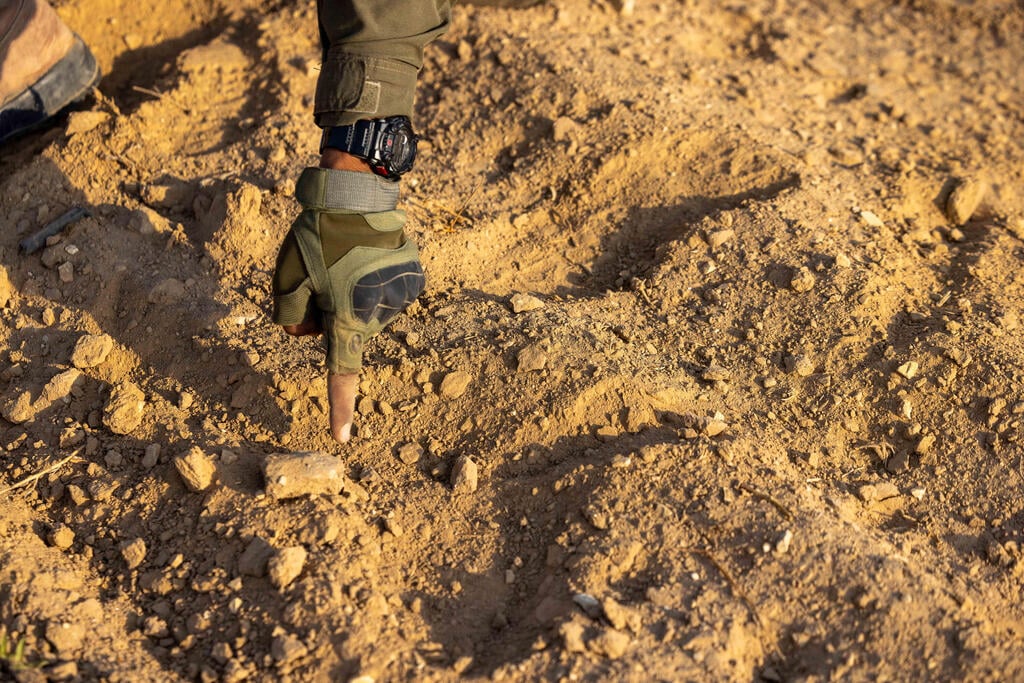
Taleb stops now. He sees human footprints in the rocky soil. Two people, he determines. Men. One with military shoes, the other without. One tried to deceive by stepping backward. By the heel impression here, Taleb crouches, studies closely, and says one of them carried weight.
That is only the beginning. From the footprint he can tell, for example, whether it was a man or a woman, whose movement resembles a V. Whether the person who crossed the fence was tall, heavy, walking or running, the pace and direction, and whether he carried a weapon. “An armed person ready for contact looks left and right, and so do the tips of his shoes,” he explains, adding that some shoes are characteristic of terrorists, a flat sole, imported from abroad.
Taleb follows the signs. From the sandy route along the fence they crossed to a road, then vanished into the open area. Weeds, fields, ravines. There, tracking becomes more complicated, and as time passes, more so. Winds, rain, fog.
Do not worry. This is not a real infiltration but a “Turkish horseman” drill, and the tracks here are meant to demonstrate how trackers work against the enemy. Over the past two years, during the war, tracking methods and the ability to feel terrain were carried into Gaza itself.
(Photo: Tal Shahar)
Bassam fought in Beit Hanoun, Shejaiya, Nuseirat, Rafah, Khan Younis, Tel Sultan, Daraj Tuffah. There is no place his feet did not step, he says.
He was, for example, with other trackers at the site where Yahya Sinwar was killed. He saw the body. “We knew there were signs there, many terrorist tracks jumping from place to place, but specifically for Sinwar there were no signs,” he says.
The trackers describe how during battles they identified tunnels, ambushes and bombs, found terrorists within crowds by body movement or walking style.
How do you identify signs of bombs, I ask. They say: a camera near a device, a different soil color showing digging, a new block in a peeling house wall, a garbage bag in a corner that looks suspicious, a flour sack by an entrance, wires emerging from ground, a bomb hidden in a tree, attached to a wall, inside a jar, or disguised in a trash heap by the road.
Sometimes, they say, it sticks out from afar. Sometimes morning dew on metal makes it glint in sunlight. And if a terrorist carried a bomb, you can identify the weight through the tracks, and that he moved quickly to get rid of the explosives.
Many trackers are attached to senior commanders at the front of a force, reading the ground, pointing to dangerous routes or areas suspected of being booby trapped. Said, for example, 39, from a moshav near Ashdod, married with one child, a tracker in the northern brigade, has been attached over the past two years to the brigade commander and fought across northern Gaza.
He recalls an incident a few months ago in Beit Hanoun, around noon. Four command post fighters with him wanted to climb to a high point, a kind of hill. Do not go up, Said asked, there is a sniper. Moments later, he says, the four soldiers were hit by sniper fire.
“A kind of feeling inside,” he says, then searches for an explanation, God, a sixth sense, a sign from the heart. But he knows to say it is something trackers have. “Suddenly you have a sense not to enter a certain building. Something says there is something here. A bomb, a tunnel, terrorists.”
Said remembers another story, from Jabalia. He leads a force of 50 fighters who want to enter a strongpoint, one they had used before and decided to return to.
He checks ahead and spots barefoot tracks. He follows them. They lead on one end to a tunnel shaft, and at the other end to a bomb waiting for the force inside the strongpoint. “I do not know why, I had a feeling,” he says.
“We know where to look,” Bassam adds, “and we try to get into the terrorists’ head. You think during a chase, which route would I run, where would I hide. We are not in a hurry. When we reach an incident we check slowly, patiently, but in the end we will get there, because we know where we are going.”
Taleb, wounded about a month before October 7, joined the fighting a bit later, maneuvering with the 79th armored battalion of the 14th Brigade.
He reconstructs a clash east of Beit Lahiya, on a route of ruined houses. While he rode in a Humvee, an anti tank missile hit an armored vehicle moving behind him, wounding several soldiers. The signs, he says, showed movement of people on the route overnight, and it should have been cleared of bombs. Signs of reverse walking on a route or crossing it should raise suspicion. But for that missile he saw no hint.
“I hear an explosion, I see black,” he recalls. “We fire to remove the threat, the terrorists flee. We identify signs of dragging a bomb and a barefoot walk. Tracks that pull toward one of the shafts. We took control of the shaft and cleared it.”
Shafts, they say, can be found by signs of soil collapse or by cues terrorists leave so they can recognize an entrance, a car wheel, a yellow jerry can, a pile of wood in an empty area, a pipe. Sometimes even animals give away a tunnel.
That happened to Taleb in Jabalia, at 4 a.m. They were operating in a cemetery. A terrorist fled there. “Dogs that ran toward the shaft and barked helped identify it and take control,” he says.
The sun is rising. Light warms, threads through the tent, blessing those present, touching a large memorial sign hanging inside, with photos of fallen trackers.
One of them is al-Atrash. His eyes pierce. His gaze is serious. Mohammed, 39 when he fell, left two wives and 13 children. The youngest was less than two months old when he died.
His fellow trackers did not give up on him quickly. Bassam remembers how after Mohammed disappeared, and they still did not know he had been kidnapped and killed, he enlisted nine reservists and for a month they searched every centimeter of the streams and preserves in the area where Mohammed’s phone was located. “We stitched up the entire Gaza Division,” he says. “We looked for a sign that showed Mohammed was here.”
Bassam was Mohammed’s direct commander. Between them there was a special bond. Bassam describes how they competed together in horse races.
“Mohammed had an unbeatable horse,” Ali says, then recalls a belief among horse breeders that an animal feels its owner. “After Mohammed was kidnapped many of us watched the horse. The horse stopped functioning, and then died.”
In their last conversation, Bassam says, he rebuked Mohammed for wearing nonstandard clothing in the field, a shirt over his head. “A rare incident not suited to him. He was one of the best trackers.”
Do you regret that being the last talk, I ask.
“I do not know,” he replies. “Discipline is part of values, and on the other hand, even if it was not personal, you regret it.”
Earlier, I remember, when we first met, Bassam told of his childhood as a shepherd, and how those with sharp senses for nature, the veterans, are the ones sought for the tracking corps. “If I live in a building in Tel Aviv I do not know what a porcupine track looks like, or how it differs from a boar or deer,” he said.
Then Ali, who also herded sheep as a teenager, spoke of his plan to upgrade the low-tech work of footprints in sand, with drones, tablets and systems. These are familiar tools used in wartime, but not considered the tracker’s best friend.
We do not need to stay in the Middle Ages, he said. “I recently wrote a position paper saying trackers are an efficient and good force, but come on, let us adapt to the IDF of today. There is no room anymore for thinking technology is the enemy.”
Meanwhile, with all respect to tablets and intelligence of every kind, outside it turns gray, cool. November decides to flip just as we began to believe in a concept of eternal summer.
Is nature on our side, I asked Taleb earlier as we walked near the border fence. He lifted his head to the approaching winter.
“Sometimes yes, sometimes no,” he said. “If there is rain, you probably have no tracks. But trackers manage in everything.”
Soon, on the way back, a roadside sign will say “together in pain, together in hope,” darkness will fall over the border communities and the Burma Road, birds in windbreakers, eucalyptus trees that stare, a thread passing between leaves. The heart will bless the men of signs, so the border stays locked to strangers.
So we are protected.