

When I arrived in Egypt as The New York Times’ Cairo Bureau Chief in the early 1980’s, I never imagined that I would be spending so much time in Israel.
I had barely unpacked when I found myself on a plane to Tel Aviv, not to cover a story in Israel, but the 1983 suicide truck bombing of the U.S. Marine Corps headquarters in Beirut, a terrorist attack that had killed 241 unsuspecting U.S. servicemen as they slept in their barracks.
Gallery
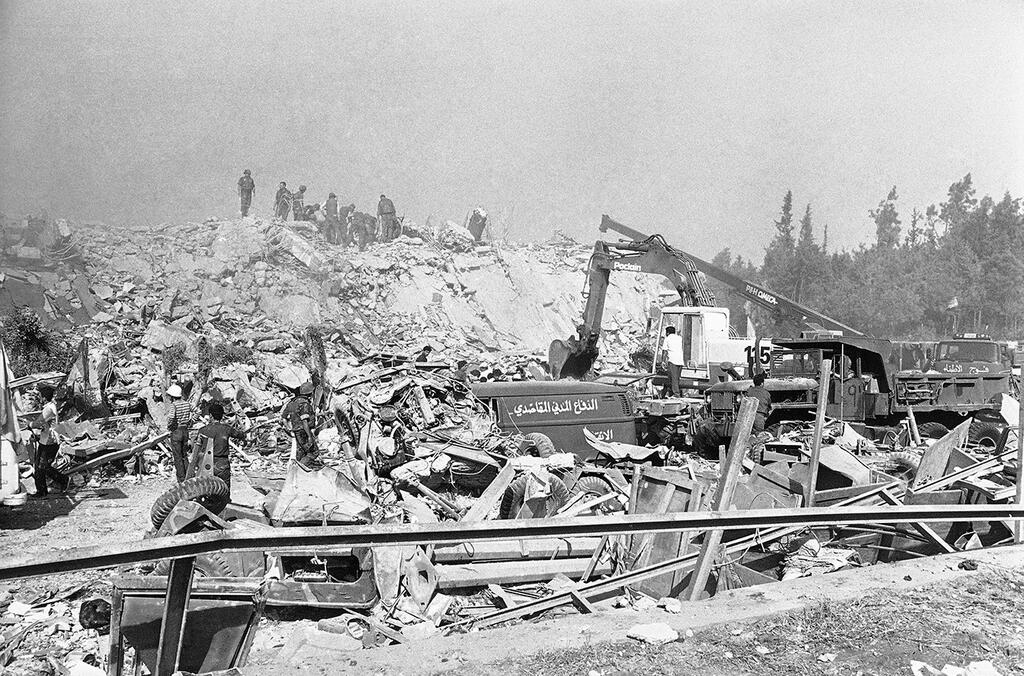
Rescue crews search the rubble after the 1983 suicide truck bombing of the US Marine Corps barracks in Beirut, which killed 241 American service members
(Photo: AP)
Lebanon had cancelled flights into the country. So I flew to Israel instead and drove north through the night to Beirut from Israel, or “Dixie,” as Beirut-based correspondents then called Israel to avoid the scrutiny of the Arab intelligence officials who often tracked our conversations and meetings with representatives of what many Arab officials insisted on calling the “Zionist entity,” refusing to dignify the Jewish state with a name.
Nothing in my relatively sheltered life had prepared me for the carnage I saw in Beirut. That bombing, the deadliest attack on Americans overseas since World War II, reinforced my longstanding concern about the surge of increasingly radical interpretations of Islam taking hold in so many Arab countries, including Egypt, and the threat to Americans, Israelis and other Westerners posed by militant Islamist groups and their state-sponsors.
En route back from Beirut, I stopped in Tel Aviv to talk to Israeli counterterrorism analysts about this worrisome trend. Since Israel’s ill-fated invasion of Lebanon in 1982, Israeli analysts were increasingly alarmed about the growth in Lebanon of the Iranian-backed “holy warriors”—Islamic Jihad, in particular—who were determined not only to expel Israelis from Lebanon, but from all the Middle East.
But after the Beirut bombing, Israelis were fixated on a newer group of militants, Shiite Muslims, who, though they comprised fewer than 10 percent of Arab Muslims, were the largest single sect in Lebanon.
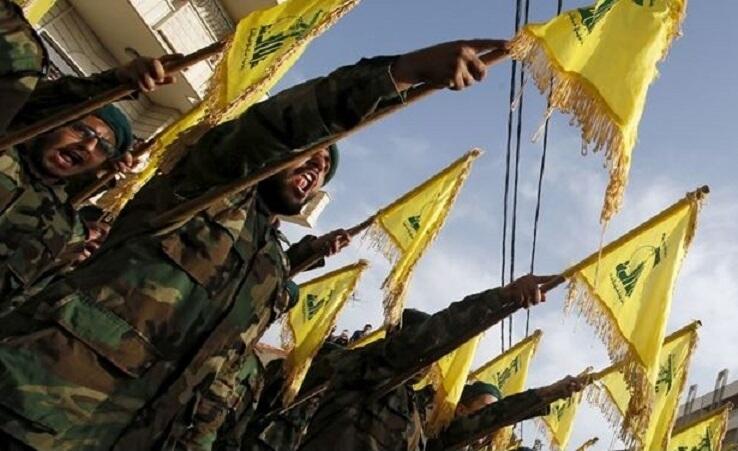
Hezbollah fighters wave the group’s yellow flags during a march in Lebanon
(Photo: Reuters)
Even though Israel was then withdrawing from Lebanon, Israeli intelligence officials were concerned that members of Hezbollah, the so-called Party of God, the latest group of Shiite militants formed at Iran’s behest after Israel’s invasion, were in Lebanon to stay. I was among those journalists who eventually reported that Hezbollah had been responsible for the Beirut bombing.
Despite the deadly attacks in Beirut and other Middle Eastern outposts, American officials were slow to recognize the Islamist threat. I had trouble getting stories about the surge of radical Islamism into my own newspaper. I increasingly felt like Cassandra howling warnings into the wind. But Israeli officials were well aware of the danger, especially one man I had known and admired for years: Prime Minister Yitzhak Rabin.
Though I had met him in 1971 during my first trip to Israel when I was a student and later during his first stint as prime minister between 1974 and 1977, I did not know him well and had not interviewed him until his re-election in 1992. But he and I bonded, or so I felt, one icy winter morning in the early 90’s during a heavy snowstorm in New York City.
I had braved a foot of snow and ice to get to the Waldorf Astoria to interview him. Due to the storm, the interview had been canceled, which he knew, but I did not. So at 8 a.m. sharp, surprised by the lack of the usual security in the hallway, I had knocked on his hotel room door. A startled Rabin, still in his bathrobe, quickly sensed my confusion and dismay, but politely ushered me into his suite.
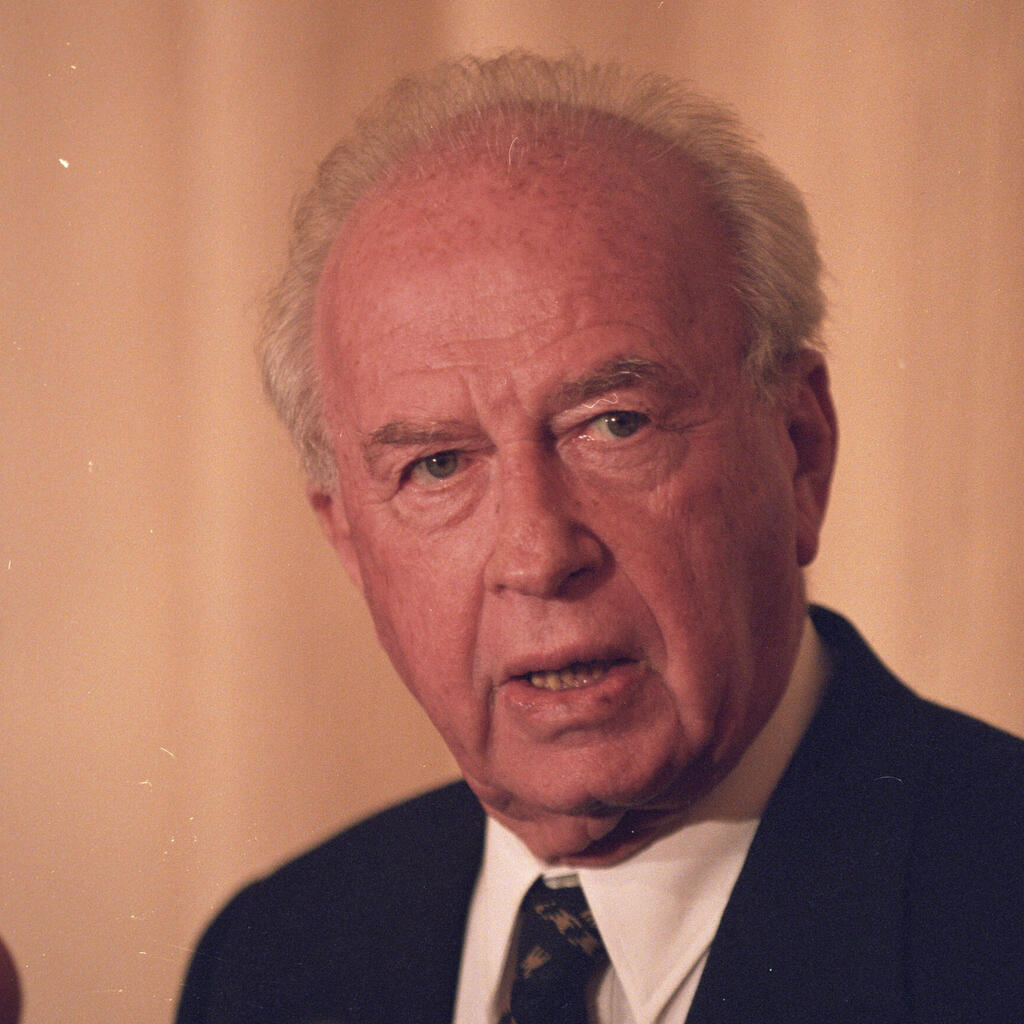
Yitzhak Rabin
(Photo: David Rubinger)
For an hour over coffee, we spoke on background about the danger to Israel and the West posed by the Islamic Republic of Iran and its proxies, Hezbollah, the Lebanese Shiite radicals, and Hamas, their Sunni Arab equivalent in Gaza and the West Bank, whom Tehran was nonetheless funding.
Though he had authorized back-channel discussions with Yasir Arafat’s Palestine Liberation Organization, which ultimately led to the 1993 Oslo peace accords between the PLO and Israel, Rabin spoke more that morning about the danger Iran posed to Israel.
Though he despised Arafat, with whom he would ultimately and reluctantly make peace, I had little doubt that he considered Iran and both Sunni and Shiite fanatical Islamism the greater long-term threat to Israel and the West.
Though I never published a story about our discussion that snowy morning, it helped reinforce my determination to continue reporting on the danger posed by such fanatical interpretations of Islam.
In 1994, Rabin would play a key role in another one of my front-page stories in The Times. Smadar Perry, my closest Israeli friend and a brilliant reporter on Arab affairs for Yedioth Ahronoth, had told me that Rabin was frustrated by Washington’s unwillingness to block American financing of Hamas for its terrorist attacks in Israel.
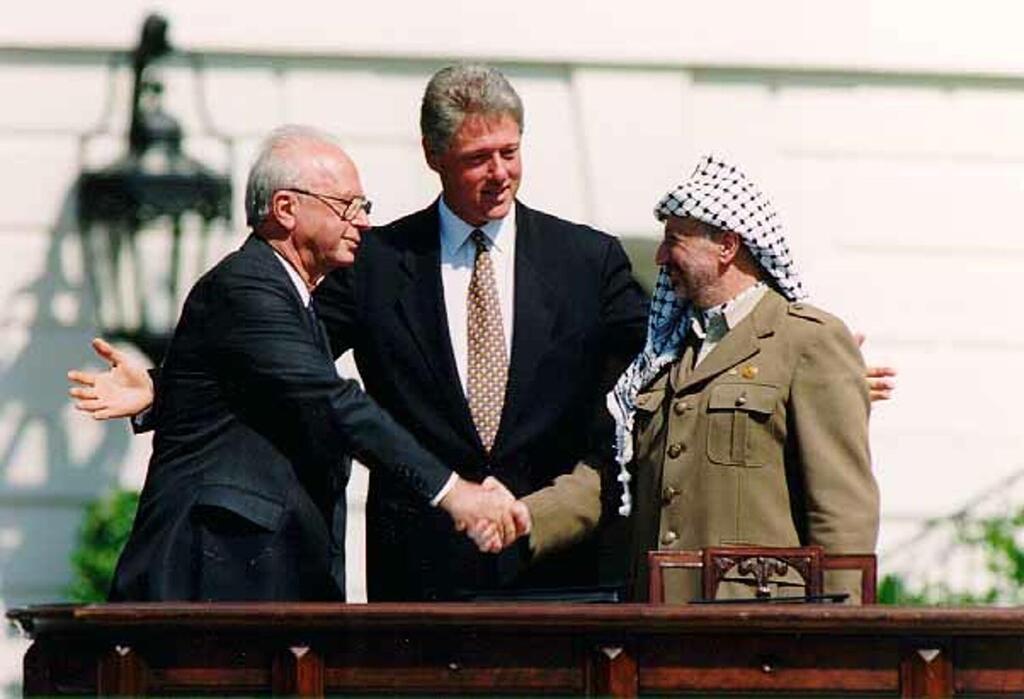
Prime Minister Yitzhak Rabin shakes hands with PLO Chairman Yasser Arafat as President Bill Clinton looks on at the White House after the signing of the Oslo Accords in 1993
(Photo: Reuters)
After Muhammad Salah, an Arab-American used-car salesman from Illinois, was arrested in Israel for funneling hundreds of thousands of dollars to the West Bank for terrorism, Rabin personally approved my access to evidence of his role as a courier for Hamas.
When the Times suggested that the evidence I had been shown — travel vouchers, telephone intercepts, checks and bank transfer records — might be fabricated, I told Rabin that I needed more evidence. He refused to let me interview Salah in jail, but eventually approved my request to witness an Israeli interrogation of him in a room next door to assure me that he was not being tortured into confessing a role in Hamas.
The controversial story, which supported Israel’s assertion that the U.S. was a major source of money and leadership for Hamas, finally ran on the front page. Only years after Rabin’s death did I hear Salah brag about his fundraising for Hamas.
Having been helped so often by Smadar Perry and other Israeli journalists, I was finally able to thank her a bit for her generous guidance and support. Because I had known King Hussein since I had first visited Jordan as a grad student and had interviewed him often when I was based in Cairo, I was able to ask him after the Oslo peace accords were signed about whether he would consider giving an interview to an Israeli journalist. He smiled and asked whether I had someone in mind. Indeed, I did. Smadar Perry’s front-page exclusive in October 1994 made headlines throughout the Middle East. So did the photo that I took of Hussein lighting Smadar’s cigarette.
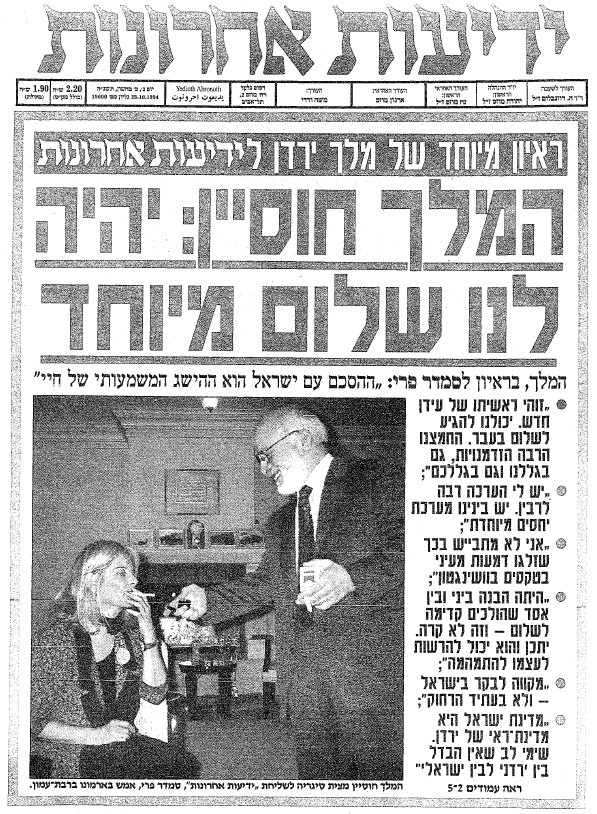
Yedioth Ahronoth front page from 1994 shows Jordan’s King Hussein lighting a cigarette for Israeli journalist Smadar Perry after granting her a rare interview following the Israel-Jordan peace breakthrough
Working as a journalist in Israel and in the Arab world were polar opposite experiences. Whereas most Egyptians and other Arabs tended to be careful about what they told an American journalist — a free, vibrant press not being a hallmark of Arab society — Israelis rarely stopped talking.
While only the elite in Cairo felt comfortable sharing their views on controversial subjects, the average Israeli seemed to have an opinion on just about everything that they were more than willing to share.
While Israeli reporters endured military censorship on sensitive national security issues, Israel took pride in having a dynamic, free-wheeling press espousing myriad points of view and biting criticism, unlike the far greater constrained, state-influenced and often directly controlled Arab media.
While getting interviews with President Hosni Mubarak and other senior Arab officials I covered took forever, access in Israel was much broader and faster. While most requests for interviews with senior Egyptian officials, sensitive sites or anything connected with the Egyptian military were greeted by Arab spokesmen with a steely “mishmumkin,” or “impossible,” Israelis tried hard to be transparent, even about sensitive, politically embarrassing issues.
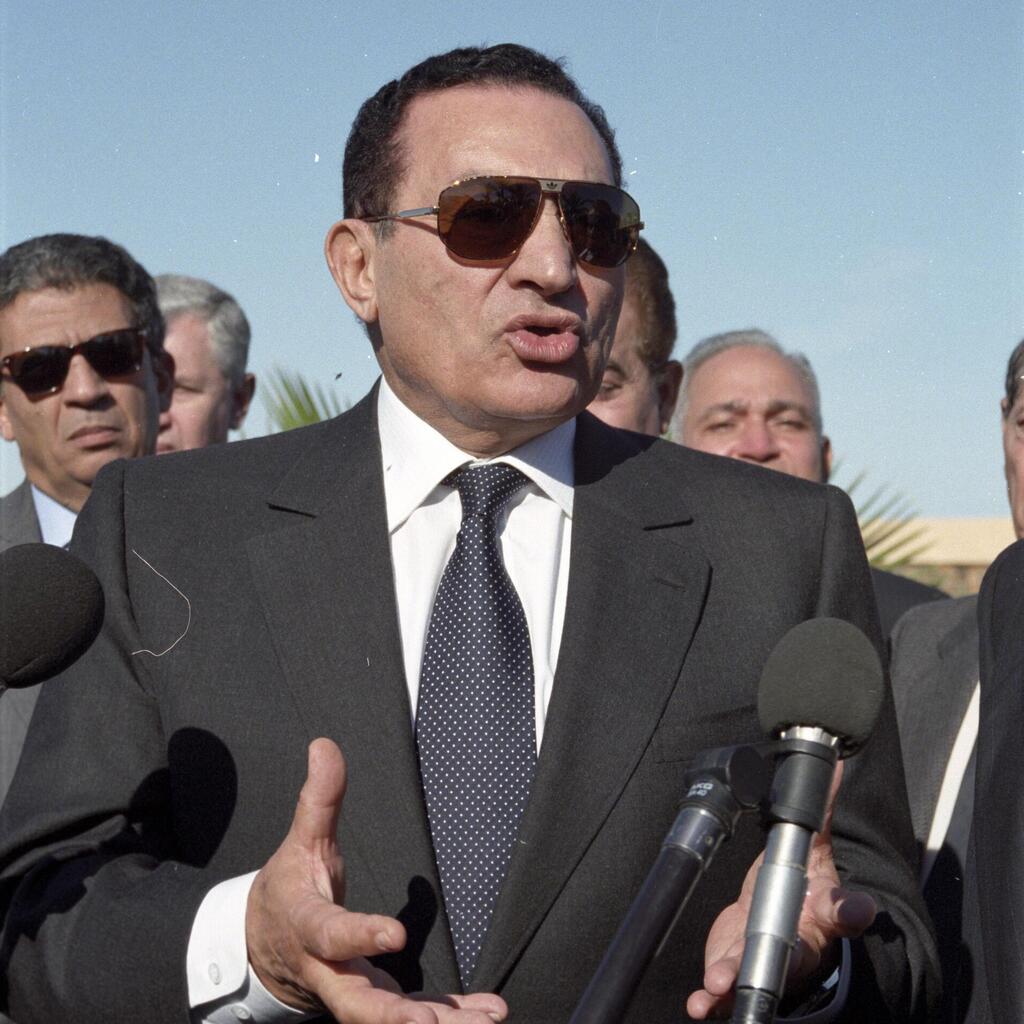
Hosni Mubarak
(Photo: David Rubinger)
While Arab officials often complained about the ostensible “bias” in the media toward them and their policies vis-a-vis Israel, I was unable to convince them that telling their side of a complex political story would only benefit them, as their Israeli counterparts had learned.
While I have always loved Egypt and remain thrilled with my decades of reporting there, working as a journalist in Israel was so much easier, and hence, often more fulfilling. No wonder so many Western media outlets chose to be based in Israel rather than the Arab world before financial constraints forced so many of them to close their overseas bureaus.
One of my great regrets as a journalist who has covered and supported the peace agreements between Israel and its Arab neighbors — first with Egypt, then Jordan and the Palestinians, and more recently the Abraham Accords — has been the fact that “peace” seems not to have led to greater mutual understanding.
Egypt’s peace with Israel was “cold” long before Israel’s devastation of Gaza in response to Hamas’ brutal, coordinated attack on Israel on October 7, 2023. Cairo has long refused to grant Israeli journalists visas to report independently in Egypt, while many Egyptian journalists have long boycotted Israel and refused to travel there.
Israelis now fear traveling to Egypt or Jordan, and vice versa. As a result, the gap between Israelis and their Arab neighbors grows ever wider and the ideal of true peace and mutual understanding far more elusive.