


“What happened is the sad result of a difficult and prolonged process that spared no area of our lives. Our real problem, painful as it may be, is to conduct a penetrating reckoning with ourselves. We all created this process. No one is blameless, and I do not exclude myself. Each of us contributed to it in his own field. If everyone now piles onto intelligence and turns it into the scapegoat, that will be a superficial and misguided approach. Intelligence may possess the most current and accurate information, but if the meaning attributed to it is wrong, that information is worth very little.”
Those words sound as though they were spoken after Oct. 7, 2023. In fact, former Mossad director Meir Amit said them shortly after the Yom Kippur War.
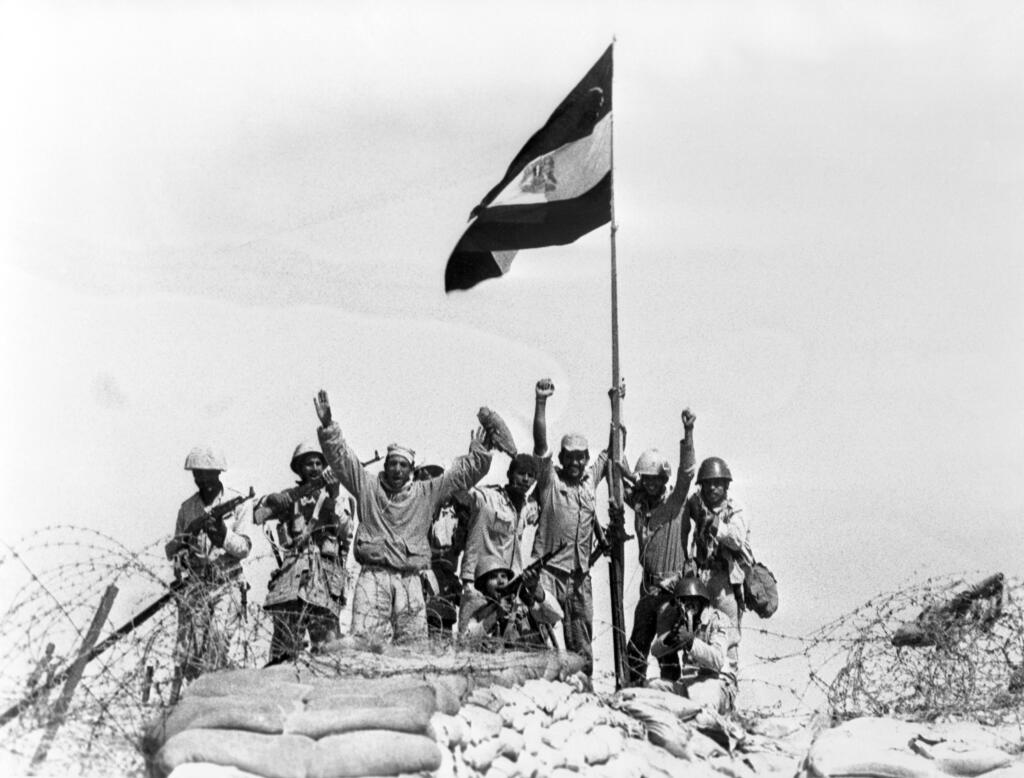
They capture the disturbing resemblance between what had been Israel’s defining national trauma for half a century and the catastrophe that eventually displaced it. The similarity lies not only in the surprise and devastating opening blow. In both cases, the failure extended beyond intelligence to decision-makers and reflected assumptions embedded more broadly across Israeli society.
That repetition is especially jarring because the trauma of 1973 never disappeared from Israeli memory. Quite the opposite. It became a foundational warning, particularly within the intelligence community, shaping doctrine, professional skills and generations of instructions about what analysts must and must not do.
For half a century, Israelis largely believed those lessons had been absorbed. Senior defense officials reinforced that confidence in speeches marking the 50th anniversary of the Yom Kippur War, only shortly before Oct. 7, insisting that both professional practice and ways of thinking, particularly within intelligence, had fundamentally changed.
Then came Oct. 7.
The comparison is not exact. In important respects, the failure of 2023 was even more severe. The Hamas-led attack brought a massacre, mass abductions, deep penetration into Israeli territory, destruction of communities and lengthy evacuations.
The nature of the surprise was also different. On the eve of the 1973 war, Israeli leaders were holding urgent discussions about the possibility of an attack, and by the final day the assessment that war might be imminent had become increasingly prominent.
On Oct. 7, by contrast, the attack itself came as a strategic surprise, not merely its timing. So did its scale, its principal theater and the central role played by Hamas, an enemy Israeli officials had widely regarded as relatively weak and deterred.
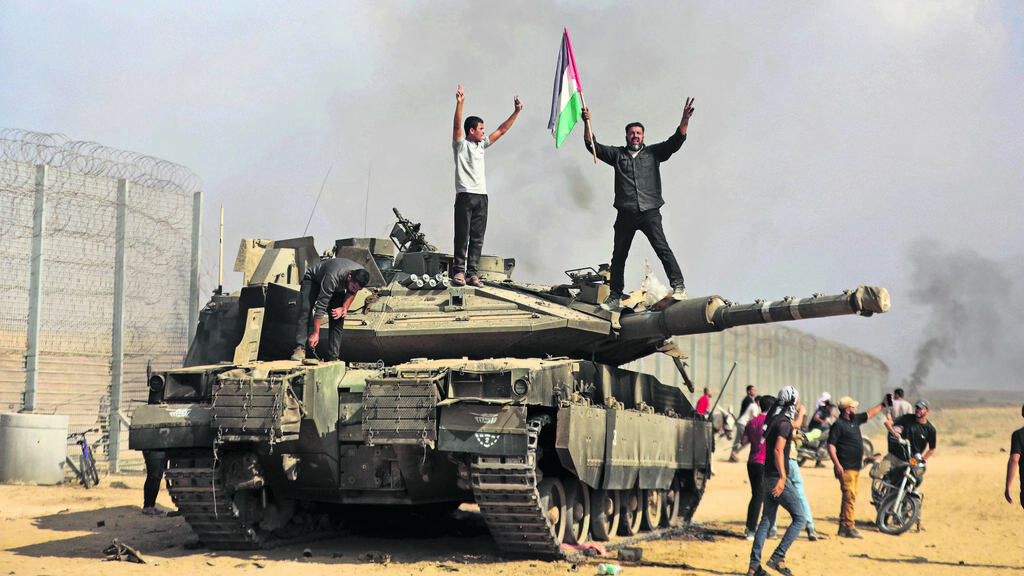
Hamas terrorists on an IDF tank near the Gaza border, Oct. 7, 2023
(Photo: Yousef Masoud/AP)
Prof. Uri Bar-Joseph, one of Israel’s leading scholars of the Yom Kippur War intelligence failure, draws a sharp distinction.
“In 1973, there were many voices inside Military Intelligence warning of the danger, and then-intelligence chief Eli Zeira ignored them,” he says. “On Oct. 7, it was not only the head of Military Intelligence who was wrong, but most of the directorate. This was intolerable conformity at the top of the military, and it apparently existed at lower levels as well.”
Israel is hardly the only country to have suffered more than one surprise attack. But the question remains unavoidable: How could so many familiar errors and weaknesses return after 50 years of agonized discussion?
One possible answer is that much of the lesson-learning after 1973 became ritual rather than genuine internalization, self-examination and reform.
“The Yom Kippur trauma should have created a protective belt against another warning failure,” Bar-Joseph says. “In practice, five decades later, it turns out the legacy of the war was largely ceremonial and that there was no deep study of the roots of the failure.”
The Agranat Commission, established by the government in November 1973 as a state commission of inquiry, was tasked with examining the intelligence available before the war, how it was assessed and the IDF’s preparedness.
Another possibility is that Israel learned the wrong lessons, or allowed crucial ones to fade.
One such lesson concerns intimate knowledge of the enemy’s culture. Over the five decades and one day separating the two October failures, the character of Israeli intelligence changed dramatically.
Skills once considered indispensable to understanding “the other,” above all command of the enemy’s language and culture, steadily lost status and were increasingly regarded as old-fashioned. As those capabilities eroded, analysts became more detached from the societies and movements they were supposed to understand.
In their place came increasingly abstract theoretical discourse, attempts to turn intelligence assessment into something resembling a systematic science governed by analytical models, a stronger focus on operational needs and, in recent years, growing faith in technology and the ability to process enormous quantities of information.
That problem surfaced again this year in the examination of the handling of “Jericho Wall,” the Hamas attack plan that had reached Israeli intelligence well before Oct. 7.
Maj. Gen. (res.) Roni Numa, who was appointed to examine the handling of the document, said in June that he was astonished by the belief that technological systems could replace human language expertise.
“I was quite amazed to discover that on Oct. 7 there were very serious people who thought you could replace signal-intelligence personnel with a technological device called STT, Speech to Text, which converts speech into text,” he said. “Instead of having an Arabist who understands the language, understands the culture and knows how to interpret what he hears, they thought a machine could replace him.”
The result recalls Henry Kissinger’s observation that it is possible to know far more while understanding far less.
Locked inside the conception
Three years after the Oct. 7 massacre, Israel has accumulated enough investigations to describe much of what went wrong.
The IDF’s own overarching review of its Oct. 7 inquiries identified six principal causes: a conceptual failure in how Gaza and Hamas were understood; an intelligence failure; failure to address the Jericho Wall plan; defective organizational and operational culture; a persistent gap between the threat and Israel’s response; and flawed decision-making on the night of the attack. The military also concluded that significant warning information had existed but was not properly analyzed.
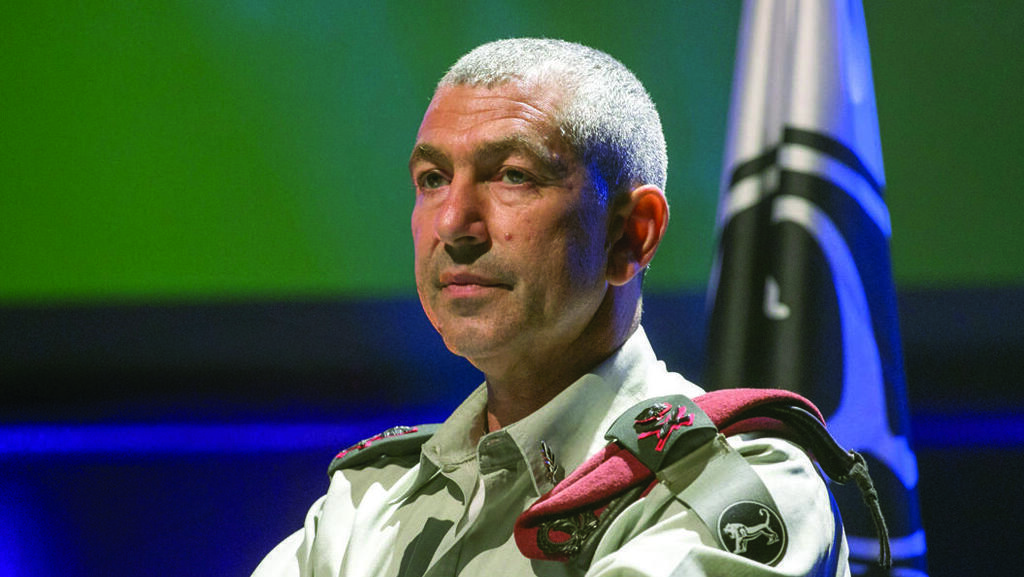
Maj. Gen. (res.) Roni Numa
(Photo: Ohad Zwigenberg)
Yet Israel still has no state commission of inquiry equivalent to the one created after the Yom Kippur War. As of September 2026, the government has declined to establish one, and in July told the High Court that such a commission should not be ordered before the coming election. The government instead pursued legislation for a differently constituted investigation, a model opposed by the parliamentary opposition.
In my view, the evidence accumulated so far shows that Oct. 7 was not merely an intelligence error. It was a broad national failure involving political leaders, senior defense officials and parts of the media and academic establishment, all participating in an echo chamber in which the prevailing conception about Hamas hardened over time.
The failure was not fundamentally about technical problems such as who received which update or which senior officer was awakened during the night. Its deepest source was a profound misunderstanding of the enemy.
Nor did it begin during the night between Oct. 6 and Oct. 7. It developed over years, becoming an intellectual lock so powerful that by the morning of Simchat Torah it may already have been almost impossible to break.
Journalist Amos Harel captured that lock-in in his book “06:29,” describing an intelligence system that kept digging for additional information during the night but failed to stop and interpret what it already possessed. The system was active, senior officers were awake and consultations were taking place, yet the outcome was paralysis and a return to familiar assumptions.
In both 1973 and 2023, Israel misread the enemy’s intentions, but in opposite directions.
Before the Yom Kippur War, intelligence failed to understand that Egyptian President Anwar Sadat was planning a more limited operation than Israel assumed, designed largely to break the diplomatic status quo.
Before Oct. 7, Israeli assessments assumed that if Hamas initiated a major move, it would probably remain relatively limited. What Israel failed to grasp was that the attack was conceived on a vastly broader scale and was rooted in an ideological worldview far removed from the rational restraints Israeli analysts had projected onto Hamas.
Both cases also featured severe underestimation of the enemy, sometimes bordering on contempt, combined with deep confidence in Israel’s ability to detect and defeat any attack.
In 1971, the Israeli comedy troupe Hagashash Hahiver mocked Egypt’s supposedly absurd plan to cross the Suez Canal. Half a century later, when the possibility of a Hamas attack from Gaza was raised with the head of Military Intelligence, his reported response was: “Let them come.”
The conception before Oct. 7 rested on several interconnected layers.
At the conceptual level was the failure to understand the logic of a radical organization that Israel increasingly believed was becoming more pragmatic because of the responsibilities of governing Gaza. That went hand in hand with an assumption that economic incentives could bend ideology to material interests, essentially projecting Israeli logic onto Hamas.
At the operational level came overconfidence in the border barrier and underestimation of the scale of any possible attack. Israeli planning envisioned a relatively limited infiltration and tended to assume that a major confrontation, if it came, would result from miscalculation rather than a deliberate strategic decision.
At the cultural and organizational level were groupthink, excessive confidence, intellectual rigidity and insufficient self-criticism.
At the strategic level, the analysis argues, political policy also played a central role through the effort to separate Gaza from the West Bank politically and the belief that normalization with Arab states could advance without resolving the Palestinian issue.
Brig. Gen. (res.) Yossi Kuperwasser, a former head of the Military Intelligence Research Division and now head of the Meir Amit Intelligence and Terrorism Information Center’s intelligence research institute, describes Oct. 7 as a “perfect storm.”
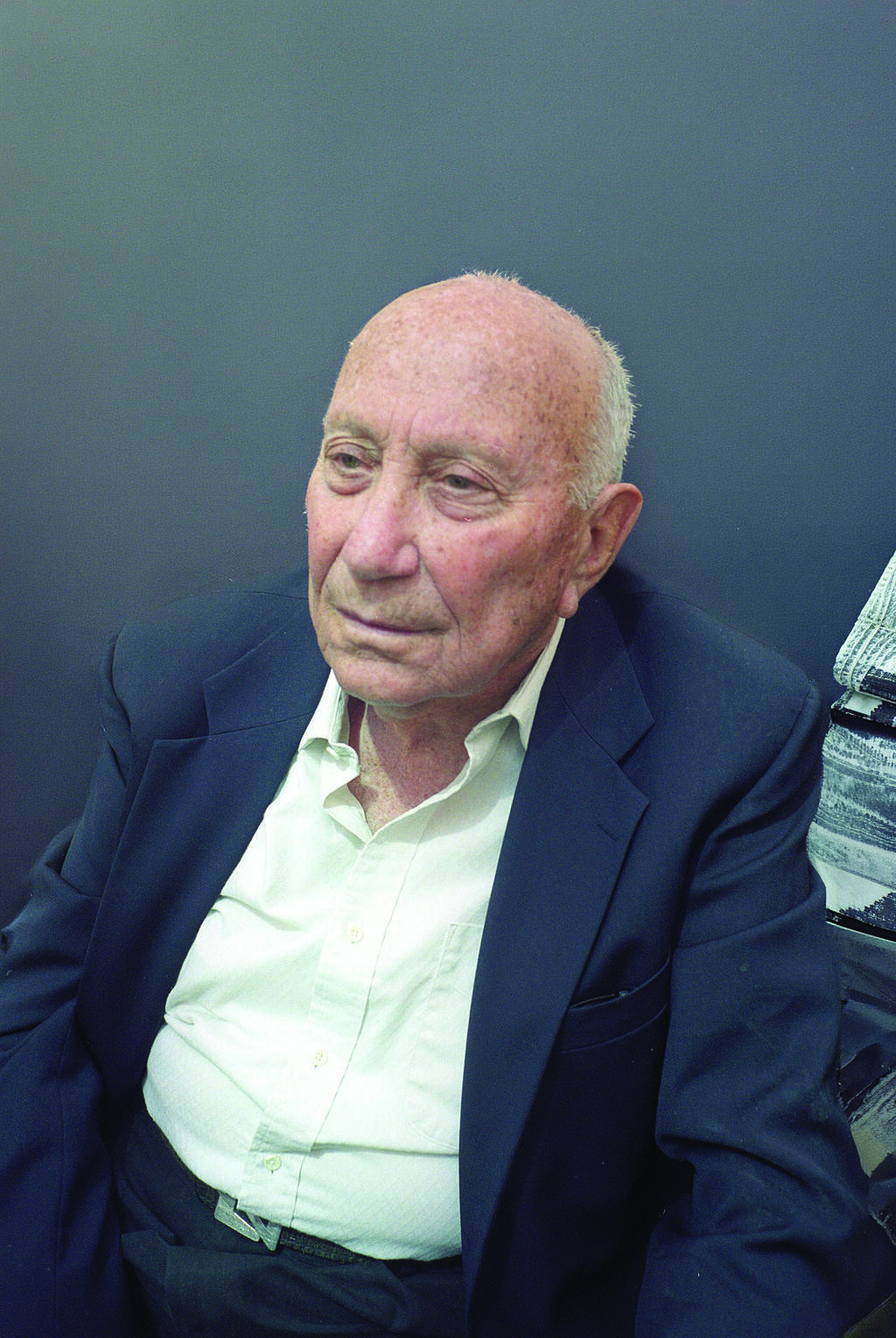
Meir Amit
(Photo: David Rubinger)
“The failure embodied the intersection of several deep processes,” he says, citing insufficient diversity between intelligence bodies, disregard for warnings from junior ranks, suppression of dissenting views, erosion of the warning mission, deficiencies in Gaza intelligence collection, reduced reliance on human and open-source intelligence and fewer researchers with deep knowledge of the language and culture they were studying.
The problem is not dissent, but whether commanders listen
The investigations into 1973 and 2023 developed in almost opposite ways.
After the Yom Kippur War, Israel created a state commission of inquiry, yet the intelligence establishment itself never fully dissected the deepest roots of its failure, partly on the grounds that rebuilding should take priority over dwelling on past mistakes.
Fifty years later, Military Intelligence and the Shin Bet conducted extensive internal investigations after Oct. 7, while no state commission has been established to examine the full interaction between the security establishment and political leadership.
The IDF’s later review of 25 internal inquiries itself found considerable variation in their quality. Some were comprehensive, some established a factual base without adequately identifying the necessary changes, some were incomplete and some were deemed unsatisfactory.
The existing investigations are often strong at explaining what happened and identifying gaps. They are less successful, however, when confronting the most difficult question: Why did it happen?
Part of the problem is structural. Internal reviews are conducted by people from inside the system, who will inevitably have personal and professional proximity to the people, organizations and doctrines under examination.
Some of the lessons also remain difficult to translate into action: “We must recognize that we will be wrong again,” “We must know that we do not know everything,” or “We must improve our ability to imagine.”
Others repeat methods that already existed before Oct. 7, including competing-hypothesis analysis and red teams intended to challenge prevailing assessments. A red team established only months before the attack under the Southern Command ultimately reached the same conclusion as the prevailing system: that Hamas was deterred.
Many of the conclusions after Oct. 7 also echo those drawn after 1973: humility, skepticism, pluralism, stronger warning mechanisms and greater institutional challenge.
Yet once again, one seemingly elementary conclusion remains relatively marginal: an intelligence analyst cannot properly study an enemy without deep familiarity with that enemy’s language and culture, the key to understanding the logic behind his actions.
Another lesson from 1973 deserves renewed attention: the need to identify commanders who suppress dissent or become intellectually rigid.
Col. (res.) Zusia “Zizi” Kanyazer, the Northern Command intelligence officer during the Yom Kippur War, once framed the problem precisely: “The question is not whether there is an officer capable of saying something different. The question is whether the person leading the discussion is capable of hearing arguments that contradict his own view.”
That raises a larger organizational challenge. Intelligence systems need mechanisms not only for producing alternative assessments but also for detecting patterns of behavior among analysts and commanders that make genuine challenge impossible.
Success after failure can itself become dangerous
Israel’s major military successes since Oct. 7, including displays of intelligence and technological superiority, create a paradox.
They may help restore deterrence and operational capability, but they can also obscure the need to understand how the original disaster became possible.
“The immediate immersion after Oct. 7 in a prolonged, intensive operational effort made it difficult for intelligence organizations to stop and conduct deep self-examination,” says Lt. Col. (res.) David Siman-Tov, deputy head of the Institute for the Research of the Methodology of Intelligence.
“The impressive military achievements can also cause damage by creating a sense that the previous flaws have been fixed, while the feeling of failure fades and becomes associated only with those who happened to be serving on Oct. 7.”
The warning is particularly haunting because Israel had heard it almost verbatim immediately before the attack.
In the weekend supplement published on Oct. 6, 2023, exactly 50 years after the Yom Kippur War, former Military Intelligence chief Maj. Gen. (res.) Aharon Ze’evi-Farkash wrote: “Israeli arrogance, contempt for the enemy and faith in our intelligence and operational capabilities contributed to the success of the Egyptian deception. Only if we investigate our failures can we draw lessons. And those lessons must be practiced, internalized and passed from generation to generation, from commander to commander and from leader to leader. It must be an integral part of our culture. Otherwise, we will be surprised again and caught unprepared.”
The following morning, at 6:29 a.m., his warning became reality.
Speaking this week, Farkash said he remains deeply concerned.
“The investigative effort is far from over and requires deeper work, along with ensuring that the lessons are learned and instilled, something we have always struggled to do,” he says.
“There was a strong beginning when it came to carrying out the investigations and adopting their lessons, but past experience shows the danger of things loosening over time, particularly in light of military achievements that damage the enemy and improve our strategic situation.”
A comprehensive examination, he argues, must return to the most fundamental question of warning: where the failures occurred and what must change.
But it should also examine concepts that shaped the war itself. What does “decisive victory” mean against today’s enemies? What does deterrence really mean when dealing with organizations committed to the idea of muqawama, resistance as a way of life, and prepared to absorb enormous costs in continuing their struggle against Israel?
‘Fist of the Free’
Israeli intelligence organizations have not limited themselves to examining the failure. They have also introduced reforms.
During the war, Military Intelligence established a dedicated unit for teaching Islamic culture, intended to guide instruction throughout the directorate. Courses dealing with warning have been strengthened. The department tasked with challenging dominant assessments, itself created after the 1973 failure, has been reinforced.
The human-intelligence network operated by Unit 504 in Gaza has been rebuilt, as has a unit devoted to open-source intelligence.
The previous open-source intelligence unit, Hatzav, was dismantled in December 2021. That decision may have made it more difficult to identify signals Hamas leader Yahya Sinwar was sending publicly.
Among them were “Fist of the Free,” a Hamas-produced Ramadan series broadcast in 2022, and highly publicized military exercises depicting in detail scenarios resembling the eventual attack. Hamas figures also repeatedly promised that a coming “flood” would overwhelm Israel while publicly deriding the economic arrangements that Israeli policymakers believed helped stabilize Gaza.
One senior Hamas military figure captured during the war was quoted in an Israeli interrogation as saying: “I am quite surprised by the Israelis. The problem was not that you failed to decipher Sinwar. You simply did not listen to him, because he said explicitly and publicly that he intended to advance a ‘world war’ against you.”
The wider echo chamber
The reckoning cannot be confined to intelligence organizations.
After the Yom Kippur War, Israeli journalists and academics engaged in painful self-criticism over the extent to which they had repeated the assessments of politicians and generals without sufficient skepticism, helping reinforce the prevailing conception.
Journalist Daniel Bloch said at the time: “We accepted the official assessments without challenge because we had not developed independent tools of examination, criticism and thought in the security sphere, and because we automatically trusted that someone knew what he was doing and that there was someone we could rely on with our eyes closed.”
Journalist Yigal Lev offered an equally harsh assessment: “The press became a worn and rusty instrument of a government that tried to hide behind the words printed in newspapers. We allowed leaders to use us. We forgot that our greatest role is to speak to those in power on behalf of the public.”
Despite the post-1973 promise of “never again,” similar weaknesses emerged five decades later. Too few question marks were raised.
That lesson extends beyond the media. Israeli society itself needs to challenge its leadership more consistently, cultivate dissenting voices and improve its familiarity with the region in which it lives, above all through language and cultural knowledge.
In my view, the absence of a state commission of inquiry remains the central institutional failure in the post-Oct. 7 reckoning. Without an independent examination of the full political, military and intelligence system, Israel risks repeating assumptions before they are even recognized as assumptions.
The same applies to policies adopted during the war. Several initiatives have been presented by their architects as solutions, while critics see them as further examples of wishful thinking: the Gaza Humanitarian Foundation aid distribution model, support for anti-Hamas armed groups inside Gaza, proposals encouraging Palestinian emigration and, more recently, expectations that military pressure, leadership strikes and internal unrest could bring down the Iranian regime.
Those are political and strategic judgments that remain contested. The point is not that every initiative necessarily flows from the same mistake, but that without a comprehensive independent inquiry, Israel lacks an agreed mechanism for distinguishing adaptation from another emerging conception.
Military Intelligence has itself made mistakes since Oct. 7, including in assessments of Iran’s likely response to the April 2024 strike on its consular compound in Damascus and in failing to anticipate the collapse of the Assad government.
At the same time, the intelligence system has demonstrated an ability to correct course. The source analysis points, for example, to Military Intelligence presenting a dissenting assessment regarding plans aimed at toppling the Iranian regime, evidence that some of the lessons about institutional challenge are being applied.
Three years after Oct. 7, Israel has dramatically changed its military and strategic behavior. It now uses force far more continuously across multiple arenas and has shown a growing willingness to hold territory.
But its understanding of its enemies and of the region has not necessarily advanced at the same pace.
That concern applies to the defense establishment, the public and, above all, policymakers.
If Israel is to break the destructive cycle exposed by the 50 years and one day separating the Yom Kippur War from Oct. 7, it needs an independent inquiry capable of reexamining every relevant institution, including those that have already investigated themselves, as well as the political echelon.
For a society determined to survive, such an investigation is not about ritual blame. Its value is more fundamental: understanding where the country went wrong, correcting those failures and preventing the next conception from becoming visible only after the next surprise.
Dr. Michael Milshtein is a senior researcher at Tel Aviv University’s Moshe Dayan Center for Middle Eastern and African Studies and is currently working on a study of the roots of the strategic conception that preceded Oct. 7