

Every morning, Iman and Faresah stand before a sign on the wall of the “Sons’ Tailor Shop” in Yanuh-Jat and look at it in silence.
“In memory of the heroes Lt. Col. Salman Imad Habaka and Lt. Col. Alim Saad Abdallah,” it reads, alongside photographs of the two officers, members of the Druze village in the Upper Galilee.
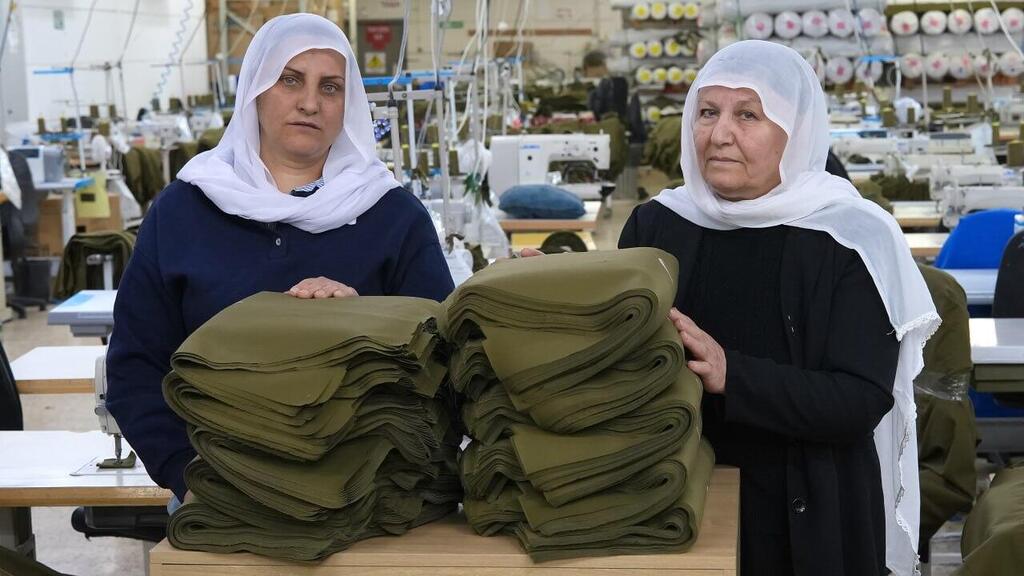
“We look at the pictures and it gives us the desire to come to work, by God,” says Faresah Habaka, the aunt of a tank battalion commander who fought in Kibbutz Be’eri on Oct. 7 and was killed in combat with militants in Gaza. Sitting beside her is Iman Shama, the sister of the deputy commander of the 300th Brigade, who was killed on the Lebanon border two days after the outbreak of the Swords of Iron war.
“After I got up from mourning, it was hard for me to work,” she says. “But Alim protected the north with his body, and that gave me the strength to come here to sew uniforms for soldiers. When I sit by the sewing machine, I think about them.”
Faresah adds: “We think about all the soldiers who wear the uniforms we sew. Druze and Jews, all of them are heroes. We have lost so many soldiers.”
“I also lost another relative: Amir Abdallah Saad, my cousin,” Iman says. Capt. Amir, a maintenance officer in the Golani Brigade, was killed in Khan Younis on July 27, 2025, the third fatality from Yanuh-Jat in the war.
200,000 uniforms a year
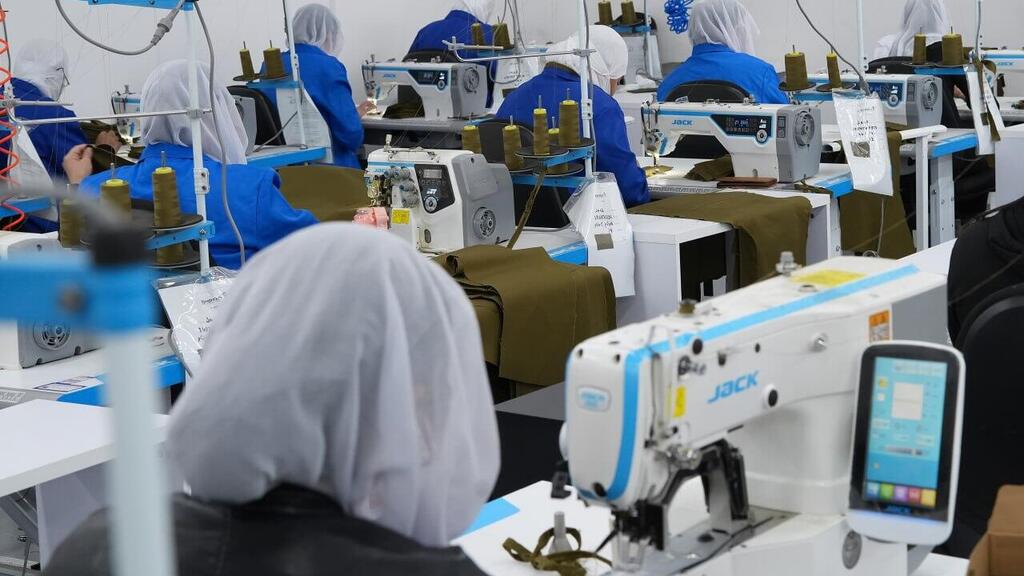
For the past decade, the two women have worked at the village workshop run by HaMeshakem, a company that employs people with disabilities. Since the deaths of Salman and Alim, it has been renamed the “Sons’ Tailor Shop” in their memory. About 110 women work there, and like most of their colleagues, Iman and Faresah wear white headscarves indicating they are religious.
HaMeshakem, owned jointly by the Welfare Ministry and the World Zionist Organization, employs about 2,700 people with disabilities in 27 sheltered workshops across Israel.
(Photo: Efi Sharir)
“All of them are employed as regular workers,” says CEO Ariel Levy. “They receive full social benefits and at least 70% of the minimum wage. Some earn more than minimum wage.” He says that in most sheltered workshops elsewhere, pay is significantly lower.
The company operates seven workshops that produce uniforms for the Israeli military, in Yanuh-Jat, the nearby Druze village of Kisra-Sumei, Safed, Acre, Nof HaGalil, Hadera and Jerusalem.
“Because there is no protected space here, and we are 12 kilometers (7.5 miles) from the Lebanon border, the workshop has not been operating since the start of the current escalation with Iran, and the workers have been sent on paid leave,” Levy says. The workshop in Kisra-Sumei, which has a protected space, continues to operate as usual.
Before Oct. 7, HaMeshakem workshops produced about 80,000 uniforms a year. “Today we produce 200,000,” Levy says.
Despite that, the workshops face possible closure.
“Because of the lower productivity of the workers, every sheltered workshop receives state funding,” he explains. “I receive 2,000 shekels (about $540) per worker from the Welfare Ministry. But now, as part of a reform in sheltered employment, two decisions were made: first, that every local authority must issue a tender for the workshops in its jurisdiction, and I will have to compete in it. Second, that municipalities must fund 25% of the cost out of their own budgets.
“How can I go to the head of a council like Yanuh-Jat, which ranks 4 out of 10 on the socioeconomic scale, and ask him to pay hundreds of thousands of shekels a year?”
Council head Wahib Saif says he will have no choice: “I would like to have 10 such factories, but to burden the council with money it does not have? We cannot put in a single shekel. So I told Ariel, ‘With all the sorrow, this factory will close.’”
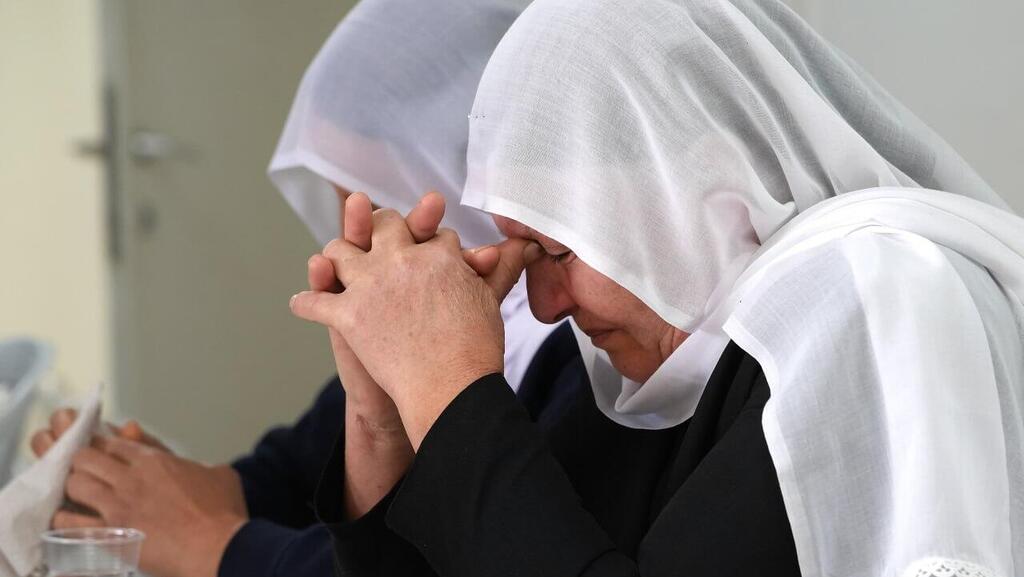
Iman and Faresah
(Photo: Efi Sharir)
Since then, Iman and Faresah have been worried.
“A young, secular Druze woman who drives can work wherever she wants,” Faresah explains, “but we, as religious Druze women, cannot go out to work outside the village.”
“This is the only place we can work,” says Iman, a mother of five daughters. “I’m afraid the day will come when they shut the workshop. I feel for all the women who work here, and especially because the workshop is named after my brother and Salman, who gave their lives for the country. We are not just sewing clothes; we are sewing uniforms for soldiers who are fighting now.”
Levy adds: “On Oct. 7, when everyone was afraid to leave their homes, the women here were working. They told me, ‘The soldiers are our children and nephews. I feel like I am sewing for my son.’ It’s an extraordinary Zionist story.”
'For every fallen soldier, a baby is born'
Iman, 48, grew up in a family of 13 children. Alim, four years younger, most recently served as deputy brigade commander in the western sector of the Lebanon border. He was killed Oct. 9, 2023, in an exchange of fire with Hezbollah.
“I had just come home from work when they called and said, ‘Your brother is seriously wounded,’” she recalls. “We went to the hospital, and after a few hours doctors came out and said, ‘We’re sorry, he is gone.’”
Her eyes fill with tears. “Our lives were turned upside down. My father died a year ago. He was on dialysis, and after the tragedy his condition deteriorated.
“But we go on with life because that is what Alim would have wanted. He loved life. Many Druze believe in reincarnation. Alim used to say, ‘For every soldier who falls, a baby is born in his place.’ And another thing he said: ‘No matter your rank, first be a human being.’”
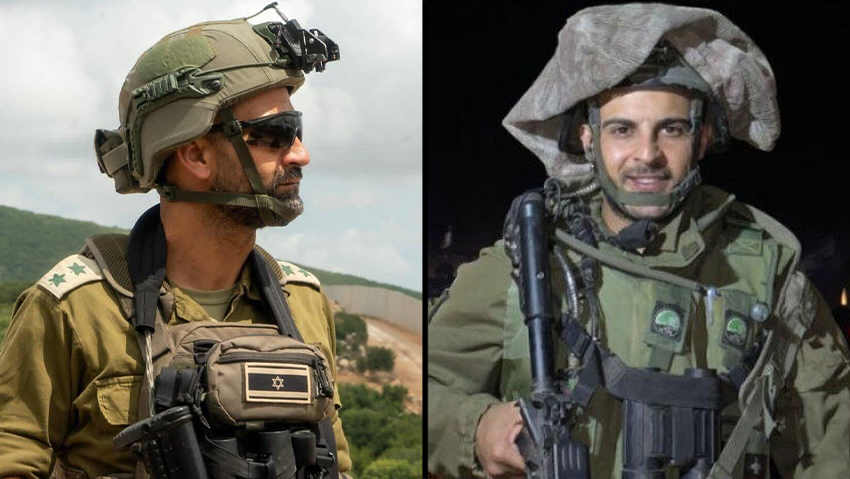
Lt. Col. Alim Abdallah and Lt. Col. Salman Habaka
(Photo: Courtesy of the families )
Faresah says: “Salman always said, ‘The soldiers are like my children.’ He loved his soldiers and cared for them like a father, but he also cared deeply for his family. He has four brothers, one of whom has been paralyzed since age 12. He would constantly take him on trips and tell him about the army. They were very close.”
Salman commanded the 53rd Battalion in the 188th Armored Brigade and was considered destined for greatness.
“I live next door to him,” his aunt says. “I got up in the morning, got ready to go to the workshop, and suddenly a car stopped and two officers got out. One said, ‘Salman is seriously wounded and is at Soroka Medical Center.’
“I went to Hussein, the paralyzed brother, helped him shower, changed his clothes and made coffee for his mother. After half an hour I saw one of the officers get a phone call. He finished the call and said, ‘I’m sorry to inform you that Salman has been killed.’” As she recounts those moments, Faresah also breaks down in tears.
'Without the workshop, they will stay home'
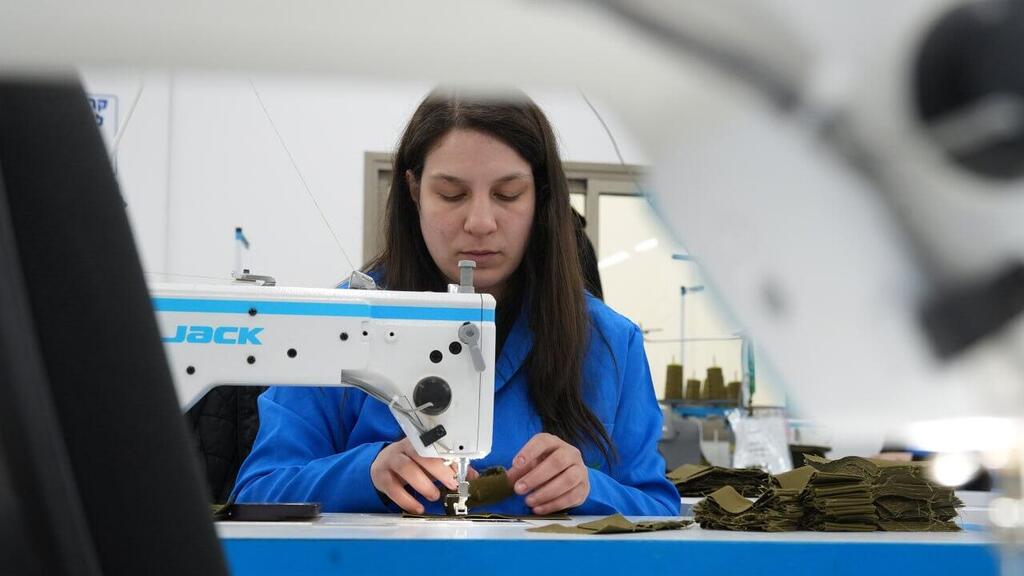
About a 15-minute drive separates the Yanuh-Jat workshop from the one established about a year ago in Kisra-Sumei. At the entrance to the hall are rolls of olive-colored fabric.
“We produce uniforms for our soldiers — may God protect them and bring them home safely,” says Dunia Abdallah, one of the seamstresses.
The work is done assembly-line style, with each worker responsible for one part of the garment. Currently, 80 women are employed there, and a second production hall is being built upstairs.
“We produce about 150 uniforms a day,” says manager Ata Karut. “When the upper floor is ready, I believe we will reach 300.”
(Photo: Efi Sharir)
But because of the reform, HaMeshakem is not currently hiring new workers.
Council head Yasser Gadban says he will not be able to fund the workshop’s continued operation.
“If I have to pay 25%, I will close the place. That’s it,” he says. “Look at them: religious women, most with disabilities. Without the workshop, they will stay home.
“Unemployment is rampant in the Druze community. In my village, 60% of women are unemployed. Orit, how many women are currently waiting to be accepted into the workshop?”
“I have interviewed 30,” says Orit Batish, the company’s regional rehabilitation director for the north. “Some of them are going out to work for the first time.”
“And because of this reform, I can’t take them in,” Gadban says. Gadban, 61, a reserve lieutenant colonel, served 25 years in the military and commanded the Netzarim sector during the most difficult years of the second intifada.
“If you cut my veins, blue and white will come out, like the flag,” he says.
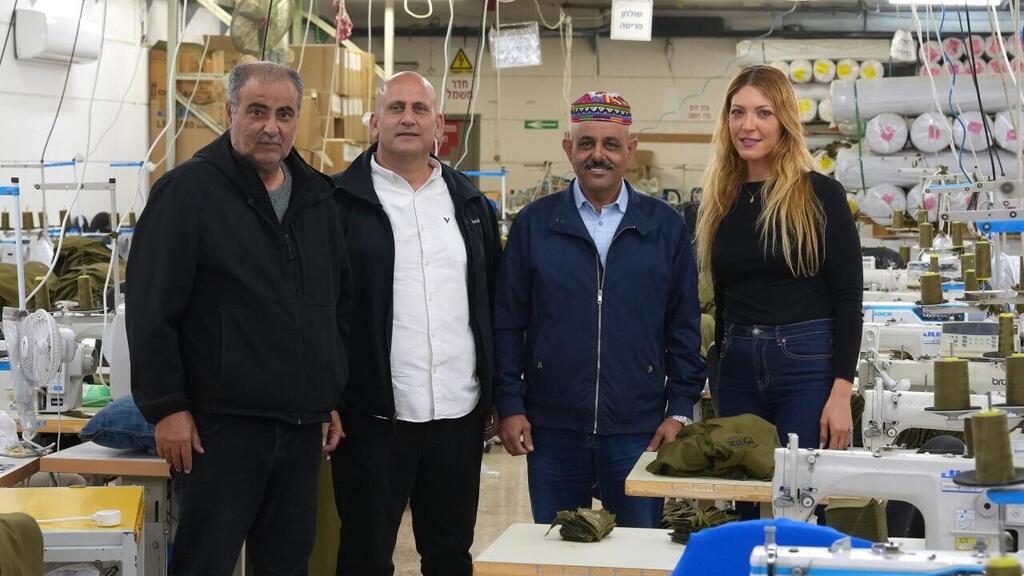
From right: Orit Batish, Yasser Gadban, Ariel Levy and Ata Rot
(Photo: Efi Sharir)
Gadban also serves as chairman of the forum of Druze and Circassian local authorities.
“They look at us, the Druze, only when we are killed,” he says. “Stop talking to me about a ‘covenant of blood’ — start talking about a ‘covenant of life.’”
The Welfare Ministry said in response: “The reform is part of implementing the Welfare Services Law for People with Disabilities, and its purpose is to create competition among providers to enable more people with disabilities to integrate into the open labor market, with fair wages and in accordance with the law. This represents a significant improvement over the current situation.
“The change in the model was made in cooperation with people with disabilities and their families, and we believe it will greatly contribute to their optimal integration into society.”