

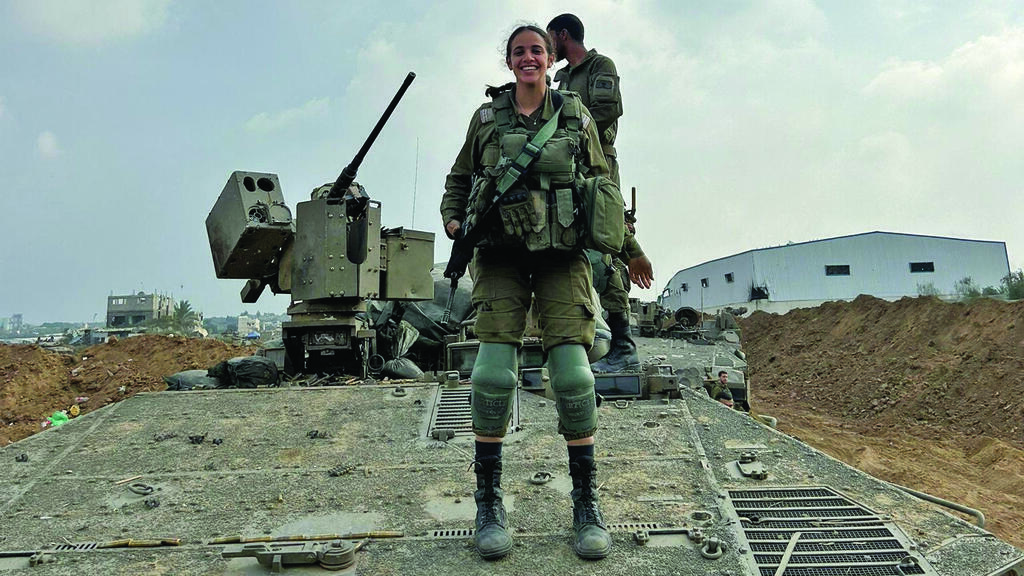
Gaya Tzuberi, 22, from Ramat Gan, was seriously wounded by gunfire in both legs while trying to rescue wounded soldiers under fire in Shijaiyah.
Role at time of injury: Paramedic with the IDF Armored Corps’ 53rd Battalion

On the final Saturday of the IDF’s prestigious paramedic course, just before the trainees were due to scatter to different units after a year and three months together, the young paramedics decided to spend the weekend together at Kibbutz Sufa near the Gaza border.
It was October 7.
“There were several girls from the course who had previously attended a pre-military academy at Kibbutz Sufa,” Tzuberi recalls. “They said the academy was away for the holiday and that we could sleep in their rooms. We had Friday night dinner together, everyone dressed in white, we made Kiddush. It was a great evening.”
“The next morning at 6:30, we woke up to the sound of Red Alert sirens. Most of us didn’t know what that was. There was huge panic. There were six to eight of us in each room. We went into safe rooms that had no locks and pushed beds against the doors and windows.”
“Think about it. There were more than 20 paramedics near the end of their training in the Gaza border area, and we couldn’t do anything because we had no weapons and no medical equipment.”
“It was a feeling of helplessness. We started tearing up clothes and breaking hangers to make improvised tourniquets, but they couldn’t bring wounded people to us. After 32 hours, a bus arrived, took us to Tze’elim and from there we went home.”
(Photo: Courtesy)
Immediately after being evacuated from Sufa, Tzuberi was assigned as a paramedic to the Armored Corps’ 53rd Battalion. On the morning of December 7, she joined a military force heading into an offensive operation in Shijaiyah. “We were a convoy of armored vehicles, tanks, D9 bulldozers and Namer armored personnel carriers,” she recalls.
“I was in a Namer with about 10 other people when suddenly a terrorist came out of one of the alleys with an RPG and hit the first tank, which started burning.”
“We wanted to run over and help them, but there was no way to reach them with the Namer. We stopped about 100 meters away. The doctor and I ran toward the tank, and they brought out the first wounded soldier. We put him on a stretcher and ran back toward the Namer, where another paramedic and a medic were waiting for us, and then we ran back toward the tank.”
“We treated another wounded soldier there who was in serious condition, unconscious and barely breathing. Then my medic called me back. I ran toward the tank for the third time, and then a burst of gunfire started coming toward me. I fell onto my stomach and stopped feeling my legs.”
“I was hit in my thighs, close to the pelvis. The medic tried to lift me, was hit by gunfire and ran for cover. I tried to put tourniquets on my own legs and couldn’t.”
“Out of the corner of my eye, I saw a reservist named Avi Baldasar in front of me. I shouted to him that he had to put a tourniquet on me. Even though he has four children at home, he decided to rescue me, an act that goes against every human instinct. He managed to get me to the doctor’s Namer.”
“I was in terrible pain, bleeding nonstop, and I was already looking up at the sky and asking God what this situation had to do with me. Then they evacuated me by helicopter to Soroka.”
How long were you there?
“Five months hospitalized, and then I moved to rehabilitation at Sheba and learned how to walk from scratch. All the movements you take completely for granted became so difficult and complicated. I’m still receiving treatment, and I’ll never be what I was before.”
Who was there to support you through all of that?
“My mother never left me for a moment, my sister and brother took care of me, and so did the whole extended family. I got tremendous support from the friends I met in rehabilitation. In the end, they were my anchor because we went through everything together, and we are the only ones who can really understand one another.”

(Photo: Tal Shachar)
What is the damage?
“I have a complex nerve injury. I danced for many years, and I can’t dance the way I used to. I’m also receiving psychological treatment. In the end, every physical injury is also emotional, but slowly you learn to live with it.”
“Today I have a brace on my leg that is hard to miss, and I have scars. If I wear a swimsuit, that alone draws strange looks.”
What is the biggest difficulty?
“That things don’t come easily anymore like they used to. Mainly accepting the physical damage.”
What do you miss most about your old life?
“Going back to being a normal person whose life isn’t only about rehabilitation, but other things too. I was a dancer, as I said. It’s what I love most and what I’m best at.”
What gives you strength?
“Mostly sports. A few months after the injury, I joined the PosSEAble nonprofit and started surfing. It was something I had never done before.”
“I didn’t choose to be injured, but I feel the injury taught me a lot about my own strength. I learned not to take anything for granted. And in the end, I also managed to change something. I changed the minds of some people who say, ‘Oh, you were wounded in Gaza? What? There are women there?’”
Do you feel wounded men and wounded women are treated differently?
“If I’m walking with a male friend and both of us are on crutches, they’ll tell him, ‘Hero of Israel,’ and they’ll ask me, ‘What happened? An accident?’”
“There are so many female combat paramedics in Gaza who have saved lives. People need to appreciate that and say thank you to the women who choose to do this.”