

The landscape of Uganda’s Karamoja region drifting past the window of Lior Sperandeo’s Toyota is monotonous. Like an old slide projector, frame after frame repeats a story that seems to have stopped moving, exhausted by its own ambitions.
An immense savanna. Withered cacti. Dust so dry you can feel it in your throat. A few lonely electricity poles that are not connected to any of the surrounding villages. In the distance, Mount Moroto rises proudly above it all. It is an ordinary family Toyota, but 11 people are crammed inside. Alongside Lior’s Ugandan wife, Napiok, and their one-year-old son Nevo, I count eight children. Benjamin, Joshua and Otiang are squeezed into the trunk. “A small load,” Lior remarks from the driver’s seat.
Gallery
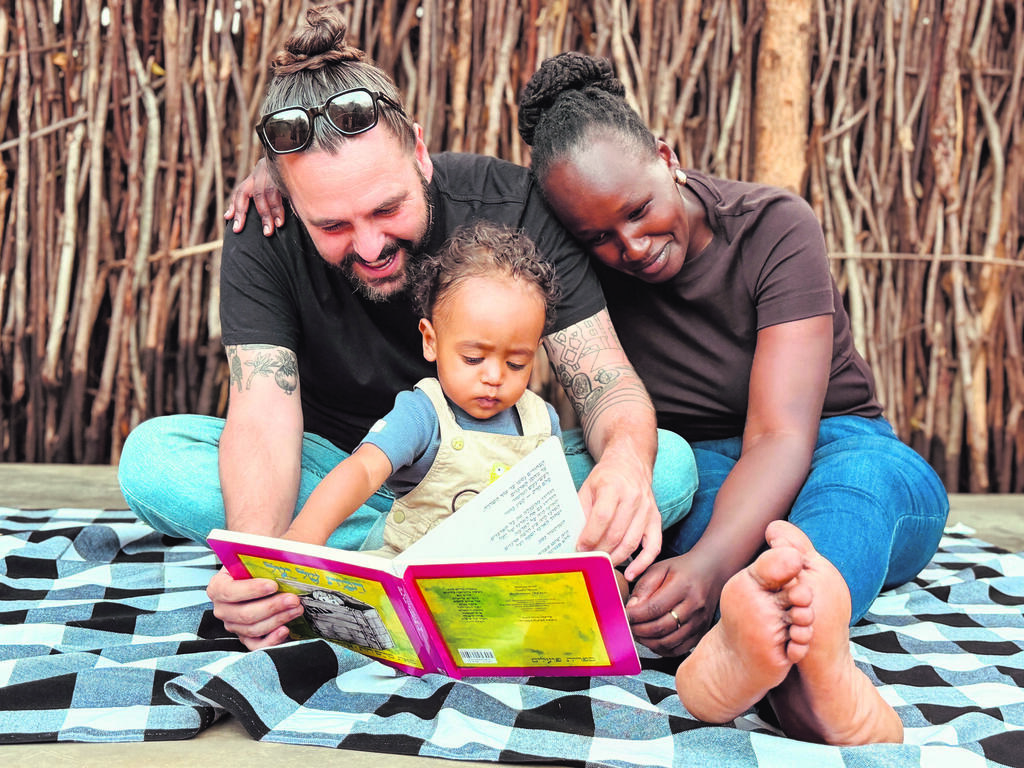
Lior Sperandeo with his wife Napiok, a member of the Karamojong tribe, and their son Nevo
(Photo: Richard Oyel)
The muzungu, the white foreigner as Ugandans call him, or “Luche,” meaning light, as those who know him call him, is heading back from the village of Kawotakwo. With him are several children who had returned home during the school break and now need to be brought back for a summer program.
Without Lior and the Shanita nonprofit he founded, these children would remain in a village with almost no infrastructure, where most residents cannot read or write.
The sky overhead is painted in deep African blue. The pearl-like clouds are beautiful, but dry. They have brought no rain for a long time. Karamoja is in drought. Karamoja is hungry.
Earlier, when Lior arrived in the village to collect the children, he surveyed the dried sunflower and sorghum fields. In the middle of one stood several children holding sticks. Among them was Nacho, cracking open dried seeds.
“Where is your bag?” Lior asked her. She quietly climbed into the car. Another child in the field, one who had not been fortunate enough to attend school, approached and asked for an empty water bottle lying on the seat. A bottle like that can be used to carry goat’s milk. Three seconds later, the child burst into tears. Someone had snatched it away.
Near a tree in the village, the schoolchildren had been waiting patiently. Locals do not generally use watches, so the pickup was arranged for “the morning,” meaning sometime between 7 and 11.
As the bags were loaded into the trunk, Lior breathed a sigh of relief. The children were intact, he said, not severely underweight or anything like that. “There was a time when we had to go looking for them to bring them back,” he said. “But this isn’t a season when it’s pleasant to stay here. There’s nothing to pick, nothing to eat.”
Before reaching the school in Moroto, the packed Toyota passes a Chinese cement factory and then a military checkpoint, where a tired soldier moves a tire being used as a barrier.
Then Nacho, the smiling girl from the sunflower field, begins talking about herself. She is 12, one of nine children, and the only one in her family who attends school.
When she grows up, she says, she wants to be a teacher. “So I can teach my family.” Then the children begin singing in the Toyota, one of the songs associated with Uganda’s Masaka Kids: a song about going to school, refusing to give up and continuing forward.
The lowest point of humanity
This may be the fourth time Lior Sperandeo, Luche of Karamoja, has tried and failed to explain exactly how he ended up here, in this wild and disaster-stricken region of northeastern Uganda, home to the nomadic cattle-herding Karamojong people. “Sorry, I have ADHD,” he apologizes. That is not the problem, I tell him. You would rather talk about the Ugandan children than about yourself. True, he concedes, and tries again.
The year is 2015. The place is the Greek island of Lesbos. He shows a collection of photographs. Refugees appear in them, people trying to cross from Turkey to Greece in small boats after fleeing a blood-soaked Middle East. In another image are several life jackets that would eventually grow into a mountain of discarded flotation vests, one of the saddest symbols of Lesbos.
The faces of the refugees, perhaps from Afghanistan, perhaps Syria, cry out from the images. Lior was a press photographer then, documenting the world’s most extreme places. And there, at what felt like the lowest point of the human condition, with voiceless people struggling against the waves, clutching rocks, gasping and trampling over one another, he found himself torn between two instincts.
Reach out a hand, or take the picture. “I got home and said, ‘I’m not happy with what I did,’” he recalls. “But I published the pictures.”
Within a short time, his photographs from Lesbos were circulating around the world. National Geographic bought rights to them. Organizations began commissioning his work. The dream he had chased as a photographer was suddenly coming true. But by then, he was already somewhere else emotionally. “I realized I couldn’t stand on the sidelines.”
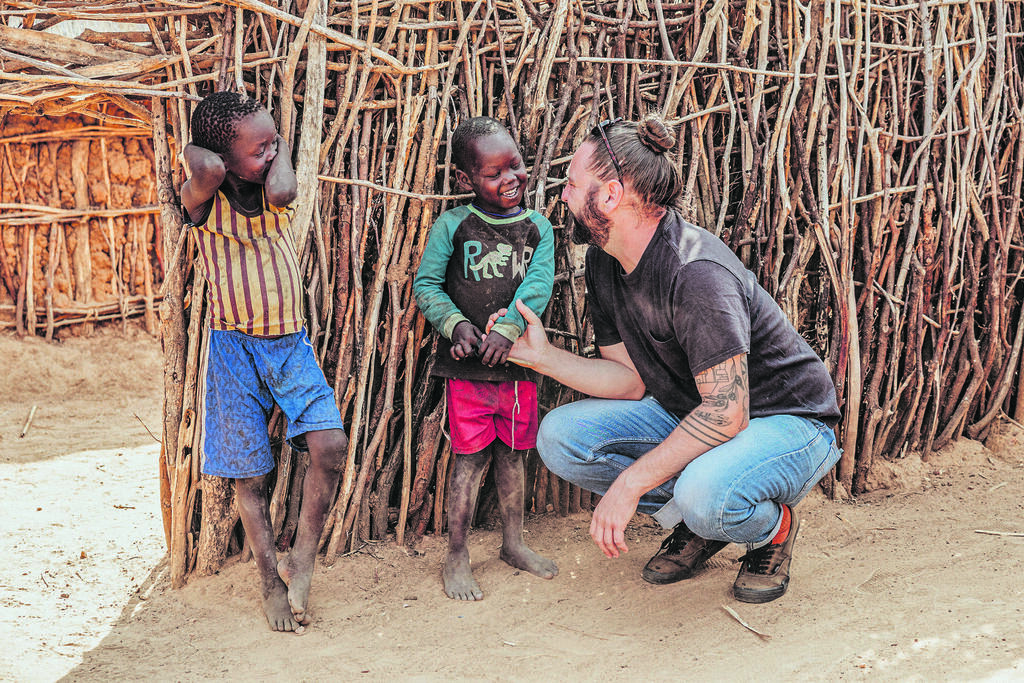
Lior Sperandeo with local children in Uganda
(Photo: Gil Kovalchuk)
In the period that followed, he worked as a photographer for various Israeli and international humanitarian organizations until one assignment brought him to Karamoja with an organization drilling wells, there to document the region’s water crisis.
Conditions then resembled those in Karamoja today: drought devastating crops and livestock, delivering a knockout blow to a place already suffering from chronic poverty.
He was traveling with a team when they stopped beside a remote village. A dry landscape. Straw huts. Mountains in the background. Photogenic poverty, perfectly composed.
“Why did we stop?” a representative of the organization asked. “It’s an interesting village,” their interpreter replied. “Thirty people died here this season.”
“What do you mean, died? How do people die?” Lior recalls thinking. “I didn’t understand. I started walking toward the village.”
And he kept walking, carrying his cameras, bags and microphones, as the people from the organization called after him to stop. He walked toward what would become his fate. Within moments he stepped onto a forgotten, broken and desperate patch of earth. Residents told him they had not eaten for days and were surviving on leaves from treetops.
He entered a hut where an elderly woman lay starving, somewhere between life and death. She had already lost her eyesight.
“And there’s nothing you can do to save her. It’s too late,” he says. “Then the representative of the organization starts pushing bananas into her mouth for the show. And it hurts, and you’re disgusted. You think, am I part of this?”
The photo shoot ended. Lior’s story with Karamoja did not. Something there, he says, remained unresolved. He began looking for excuses to return to Uganda.
‘I gave because I have more’
We are sitting at an Aroma café near La Guardia Street in Tel Aviv as Lior tells me all this. He is on a short visit to Israel after three years away. A staggering beggar appears from behind us and holds out his hand. Increasingly, those hands stay empty. Humanity has moved on to digital payments.
Fortunately for the beggar, sitting here is someone from a part of Africa where cash still rules, including banknotes decorated with gorillas.
Lior hands him 20 shekels. “Buy yourself a sandwich with that,” I suggest. It sounds a little naïve to me. “There’s an African saying,” Lior replies. “‘Once the arrow has left the bow, it no longer belongs to the bow.’ I gave because I have more. What happens next is his responsibility.”
Let’s talk about poverty in Uganda, I suggest. “It’s not the same definition,” he says. “Here, poverty is relative. A poor person will still have drinking water and survive the day. In Karamoja, people actually die. Parents have to decide whom not to feed. Elderly people tie a rope around their stomachs to signal: Don’t prepare food for me. Give it to the children. I’ll die.”
He has deep blue eyes, but for a moment something in them goes dark. His animated hand gestures stop. After a moment, he raises his head and looks around. Tel Aviv is rushing past us. Pedestrians are hot and impatient.
What are you thinking about? I ask. “I notice there are a lot of elderly people here,” he says. “In Karamoja, the population is young because of life expectancy.”
Meanwhile, the beggar returns and holds out his hand again. It takes him a moment to recognize Lior. “I bought a tuna sandwich,” he says.
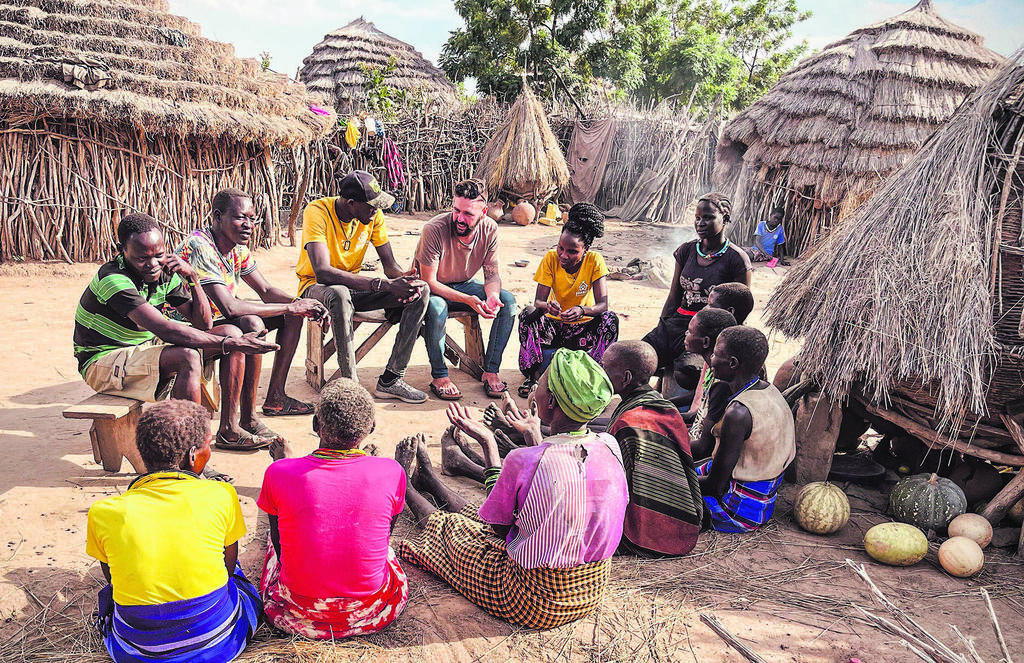
Lior Sperandeo in Uganda
(Photo: Adiaka Paul)
A week later, Lior is back in another universe, Uganda. Here he is Luche. Or muzungu. He sits alone at a picnic table at a travelers’ lodge in Moroto. Most people passing through stop for a night before continuing toward the vast safari country stretching between South Sudan, Kenya and Uganda, without lingering over the despair along the way.
A battered coffee pot sits on the table. This is one of the few places in the area that serves coffee. Uganda is one of the world’s major coffee exporters, but locals, in a legacy of colonial influence, tend to prefer tea.
I return him to the story of the beginning of his relationship with Karamoja. During that first visit, he reached a remote village called Nyanza and met a girl.
He still has a photograph from that moment: enormous eyes, a piercing stare. Photographers love photographs like this. He remembers the day and the time. Wednesday, 10 a.m. “And I’m thinking, why isn’t she in school?”
The girl was Shanita, whose name would later be given to the organization. Her family could not afford to send her to school. Lior decided to help. It cost less than $50 a month.
When he returned to Uganda and visited the village again, he discovered that she still was not attending school. “Her father explained that he used the money to buy a goat. It made sense. They had to survive. I asked him, ‘Do you still want her to study? Because if you do, I’ll pay the school directly, and you bring her there. That will be our deal.’”
“I don’t want the children just to survive school. I want them to become tomorrow’s leaders, to lift this place out of the poverty and suffering it is stuck in. When one of our students goes back to her village, you see neighbors coming to her with scraps of paper, saying, ‘Read what this says.’ Suddenly she has value”
The school registration deal came with what looked like a grocery list. Literally. A kilogram of sugar. A broom. Soap. Things Shanita was required to bring because in Uganda, students help maintain their schools.
On another visit to Nyanza, at Shanita’s family home, Lior remembers hearing a cough. It belonged to her brother, Shafik. He had not known she had a brother.
“I called my childhood friend Uriel. He was in New York, in the middle of things. I quickly tell him: There’s a boy here. Fifty dollars a month. And he says, ‘I sent $600 for a year on PayPal. Bye.’ It was a two-minute conversation, and we changed a child’s life.”
From there, something began to grow. Lior moved his life to Uganda, founded the nonprofit with his friend Shiri Shem Tov and began recruiting donors, mostly Israelis but not only. The model is simple: every supporter knows which child they are helping. Today, nearly a decade later, Shanita supports 300 children.
On the way to a bath in a basin
Images from Naitakwa school: A car wheel rim serves as a bell. Barefoot children chase a ball made from plastic bags and socks through a cloud of dust. Two enormous pots sit over a fire in the yard, preparing lunch. One contains beans. The other contains posho, the local cornmeal porridge.
And another image: a 12-year-old girl in an orange skirt and beaded necklace walks with a bucket balanced on her head, on her way to collect water for a bath in a basin.
“Nice hat,” Lior tells her. Then he compliments her report card. She nods beneath the bucket. The attention clearly embarrasses her. Her name is Naro. She comes from a small village on a mountainside. Four years ago, when members of the organization arrived to collect information about children living there, Lior recalls, she came running toward them from a field, crying and begging them to take her away.
“Our social worker asked what happened,” Lior says. “She said her mother wanted to marry her off. It’s a common problem in Karamoja. Her parents had already agreed on the payment. We immediately went to the police and managed to get her into our school. Meanwhile, there were two attempts to abduct her because an agreement had already been made with the future husband.
“Today, four years later, she is somewhere else entirely. You can see the light on her face. Her sister is here too. Once a month, their mother comes and sits with them. It’s a moment that’s hard to understand from the outside. It’s a survival moment, when the mother is basically saying: I have eight children. I will marry off one to save the rest.”
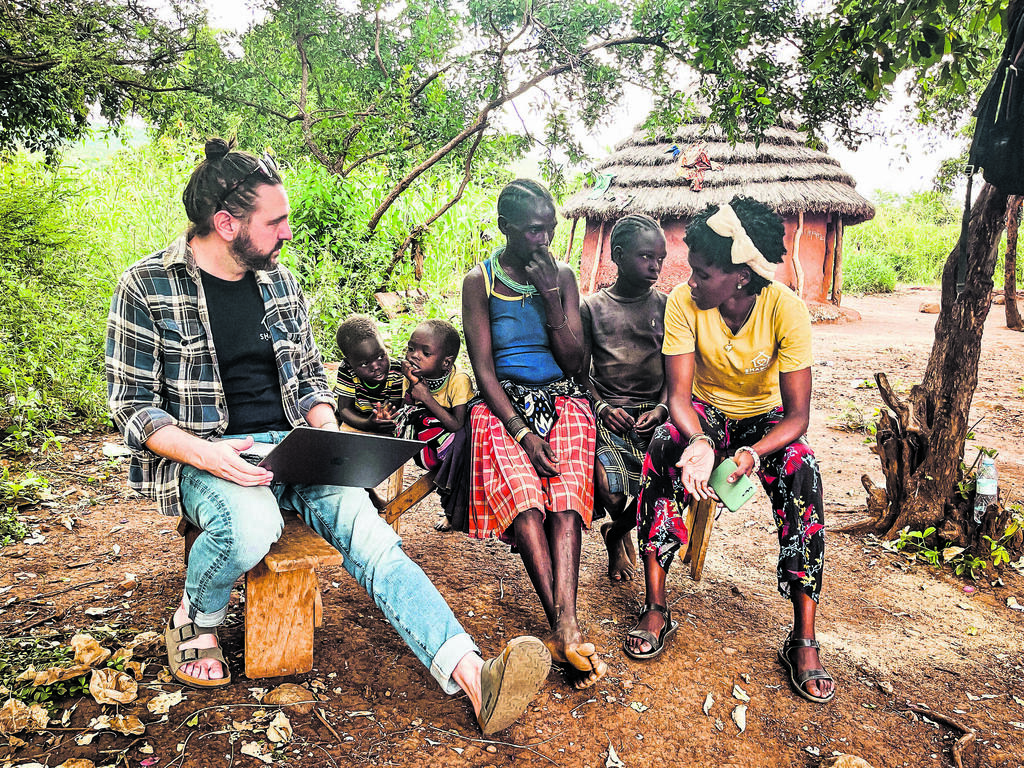
Lior Sperandeo in Uganda
(Photo: Adiaka Paul)
Members of the Karamojong community live in circular settlements known as manyattas, with cattle kept at the center for protection. Traditional dress, particularly among older residents, includes goatskins and beads made from ostrich eggshells.
Much of daily life revolves around finding water in open water sources and carrying it by hand. Some residents perform almost unimaginably grueling work, such as breaking stones into gravel.
About 1,000 children attend the government-run Naitakwa school. Most live nearby and return home in the afternoon. Around 300, however, are children in the Shanita project who board at the school. They come from remote villages, sometimes several hours away by road or mountain trails. All come from backgrounds of severe hardship.
Shanita helps operate the school alongside teachers and staff and is responsible for the boarding program.
“Someone brings you a girl from an area called Kaabong. Her mother has just committed suicide, her father left. Here is a girl in the middle of a village, standing there, looking right and left. And some nun says, ‘There’s an Israeli in Moroto. He’ll know what to do.’
“And we’re full. But these aren’t cases where you can say, my Excel sheet is full. So you start making calls. ‘Help me. There’s a girl here.’”
A date under a tree
Here is another picture. Three people, a family, sit on the wooden porch outside their home in Moroto. All three lean forward. Their toddler, Nevo, is holding a Hebrew children’s book, Yael’s House.
His father reads to him in Hebrew. His mother, Napiok, speaks to him in English. The world around him speaks Karamojong. When Lior, now 38 and originally from Kfar Saba, moved to Karamoja, he came with his first wife, an Israeli woman to whom he had been married for 10 years.
“In a privileged place, it’s easy to preserve things that aren’t working because you can say, let’s go to a movie, let’s go on vacation. Here, when there’s difficulty, it’s right in your face.”
He met Napiok four years ago. Her name means “guests” in the local language because she was born when visitors arrived. Lior calls her Buba, his nickname for her. She used to come on Saturdays to the kindergarten where Shanita also supports a group of children, bringing them Fanta and sweets.
Lior asked one of the house mothers who she was. Twenty years earlier, she replied, Napiok had been like the children here. “At first I got defensive. I said she should get permission. Then I asked to meet her. I thought maybe we could recruit her as an employee. She said, ‘I’m not going to work for anyone, certainly not for you.’
“I asked, ‘What about going out with me?’” Their date lasted four hours under a tree. Important things in Karamoja, including business meetings, happen under trees.
“And during that meeting, I realize I’m sitting across from someone I would never encounter anywhere else. On the one hand, her personal story comes from the bottom of despair. She was orphaned, her adoptive parents contracted AIDS, she grew up in a hospital. And on the other hand, today she’s a businesswoman, she has degrees, and she dreams of building a hospital in Karamoja.”
Living with a Karamojong woman comes with cultural complexities. It begins with marriage. Traditionally, the bride’s parents are paid in cattle. It could be 50, 100 or 200 cows. It is a negotiation.
“I chose someone worth so many cows that she doesn’t want cows,” Lior says. “She said, ‘If you want to look at it from a cultural and traditional perspective, convert the cows into money and build a house that will belong to me and our children.’”
When Nevo was born, he was also given the local name Moru, after the mountain beside the home where he came into the world. When his parents brought him back from the hospital wrapped in a blanket, members of the community wanted to smear him with mud. That is the tradition: dipping the newborn in the soil of Karamoja, the earth from which he comes.
Another custom is to sprinkle salt on the umbilical stump so it falls off faster, then bury it in the yard so the child will not run away from you in the future. “Smear him?” Lior remembers. “He was born two days ago. Not happening. You want to bury the umbilical cord? Wait until it falls off, without the salt.”
What about the cultural differences between you and Napiok, I ask. “I could tell you stories that would make you faint,” Lior says. “A week ago Nevo didn’t want to eat. His teeth hurt. So you do the spoon thing, here comes the airplane. She looks at me, grabs him from behind and starts feeding him by force. I say, ‘What are you doing?’ And she says, ‘I don’t have time for airplanes. Your child is half African. Don’t forget that.’”
I tell Lior I get the impression that he intends to remain in Uganda for the rest of his life. “Yes,” he says decisively. His certainty makes me laugh. It does not make him laugh. “I have too much on my shoulders to get up and leave,” he says. “I’m tied here. And I want to build something here.”
Breaking out of poverty and suffering
A laptop sits on the desk in his Karamoja home. Family photographs hang on the orange wall behind it, alongside words in the local language that Lior is trying to memorize. But the eye is drawn to something else: a sheet bearing the names of Israeli children murdered on October 7.
Lior was here, in Karamoja, on that terrible morning. “When the children saw me looking pale, we shared what had happened. Then something interesting happened. They started crying and said, ‘We’ll pray for them.’”
He shows a video from that time. Ugandan children hold drawings they made for children their own age who had been abducted in Israel, together with their names. He remembers another moment. Timothy, 11, an orphan and former shepherd, raises his hand in class and asks about two Israeli children he once met when they visited Karamoja.
“We heard there are children in Israel who are not OK,” Timothy says.
“In Israel, poverty is relative. A poor person will still have drinking water and survive the day. In Karamoja, people actually die. Parents have to decide whom not to feed. Elderly people tie ropes around their stomachs to say: Don’t bring me food. Give it to the children. I’ll die”
“That was a turning point for me,” Lior says. “Suddenly the community that needs help becomes the community taking responsibility, caring, praying. It was as if they had broken free of the chains of despair and realized they had something to give. Since then, I don’t look at these children as needy or weak.”
When we met in Israel, Lior at one point opened his phone and showed me an architectural plan. It is for an educational complex to be built in Nakapiripirit district, an isolated and impoverished natural area in southern Karamoja, designed for about 1,000 children.
The 300 Shanita children currently at Naitakwa school will be the first to move there. The nonprofit has purchased 100 dunams, about 25 acres, for the project and has already begun fundraising. The target for the initial construction phase is $600,000.
Construction of three buildings, including classrooms, is due to begin next month. Residential facilities, solar power infrastructure and water systems will follow.
The educational model, Lior says, will draw on Israel’s agricultural boarding schools. Students will learn to grow mangoes and avocados and produce food that can sustain the school, reduce dependence on donations and ultimately teach them to become food producers themselves.
“I don’t want the children just to survive school. I want them to become tomorrow’s leaders, to lift this place out of the poverty and suffering it is stuck in,” Lior says.
“When one of our students goes back to her village, you see neighbors coming over with all kinds of pieces of paper, saying, ‘Read what it says.’ They receive medication prescriptions for free but don’t know how to take them. “Suddenly, a girl who is worth less than a cow in the village has value. She can bring opportunities.”
There is one more thing. The classrooms at the new school in Nakapiripirit are planned to be named after several of the Israeli children murdered on October 7. That is why the list hangs in the study of the Israeli who moved to Uganda.
People who survive on nothing
Faced with stories of extraordinary giving like that of Lior Sperandeo, Luche of Karamoja, it is easy to feel that our own daily lives do not generate quite enough meaning. There are children in Africa receiving life-changing opportunities, and then there is the Excel spreadsheet waiting for us at work.
Lior himself says there is an illusion in giving. “You don’t give purely for altruistic reasons,” he says. “Maybe it’s guilt. Maybe you want to feel like a hero. Everyone likes applause.”
For him, he adds, it is probably some combination of both. But Africa strips all of that away. “You have a girl who was raped, or a boy whose parents both died, and a moment later there’s another crisis. You don’t feel like a hero anymore. You just want to be there for them.”
When he first arrived in Karamoja, he said earlier, something there felt unresolved. I ask whether he has figured out what it was. He shows me a photograph he took in a village called Lopodot.
Several women are building a house together out of mud and straw. Six are on the roof, two on the ground. “Women, together, against all odds, against nature,” he says. “Where else in the world will you find people who survive on nothing? They may be poor, but they are strong and inspiring in their ability to hold on to life.”