

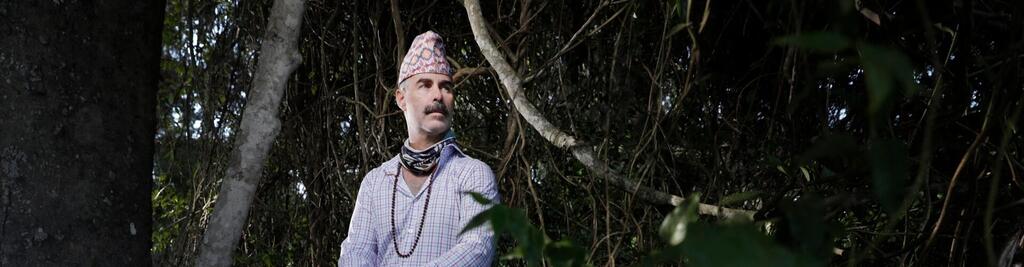
It was supposed to be a simple trip for an experienced traveler like Samuel Vengrinovich. He knew the popular route on Mount Moon Peak in India well and was preparing to cross it again when a friend invited him to join. Nothing made him think those moments would end in an impossible survival journey and a fight for his life.
"I said, come on, nothing complicated, two days — we go up the mountain and come down," he says.
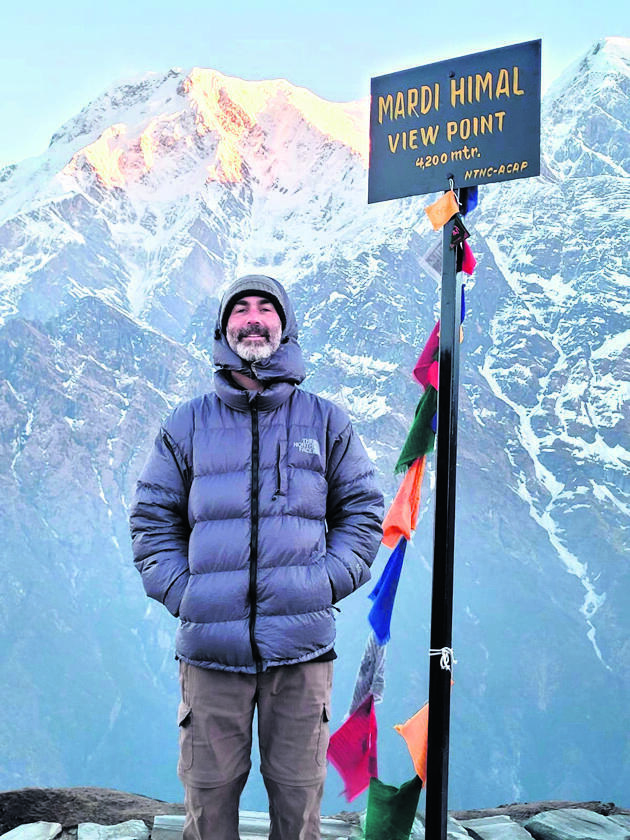
Halfway up the mountain, he knew, there was a camp that provided food and a tent for climbers, "so we also brought very few things — a coat, a headlamp, a sweater, shoes, maybe a few snacks."
On the morning of the second day of the trip, June 6, the sky gave no warning of a storm.
"The sky was blue and we decided to go a little higher and cross the snow line," he says. "We climbed a glacier, and halfway up my friend says to me, ‘Listen, Samuel, I’m going back down, I’ll wait for you at base camp.’ I said fine, no problem, and stayed with two Indian guys I met there."
Just before his life would change all at once, Vengrinovich and the two local hikers he had met that morning ran into the first problem.
"Suddenly, a huge fog cloud came in and caused a feeling of vertigo," he recalls. "You look down and it’s a very strange feeling, as if you’re above the world and all you see is a blanket of clouds. Incredibly confusing, as if the world is spinning and you don’t know what’s up and what’s down."
"We’re stopping here, you go on alone," the two Indian climbers who remained with him told him.
"I told them fine, we’ll meet at the top," he says. "I wanted to go up a little more to a better viewpoint, so I wouldn’t enter the wadi where there was snow that had crumbled off the glacier. I’m climbing, and everything is full of big rocks. I was in better shape than them, and when I reached the summit I called their names and heard nothing. Five minutes pass, and I decide: OK, damn it, I’ll go back down to the camp, meet my Dutch friend and get off the mountain."
Did you feel that was the time to stop?
"I wasn’t trying to set any record here, just a short trip, intuitive, to catch the vibe. I’d already done 200 kilometers in Nepal, I didn’t need to prove anything to myself. Some people go up this mountain for reasons of holiness, because there are temples and graves on it, so they sleep and pray there. I just wanted to taste it a little and return."
Completely alone, in heavy fog, Vengrinovich began making his way down the mountain.
"The fog felt like the sky," he recalls of the terrifying moments. "Clouds so thick that you lost your sense of direction. From my perspective, the way back was to go to the glacier and then to base camp, but everything was terribly confusing. Then I find myself on a cliff, I can’t go down, I go back, try another direction, and again a cliff, and I start to understand that I’m not managing to get down. I had to use my brain, how to solve the problem. In hindsight, I should have learned a lesson here: sometimes you have to slow down. You don’t have to understand everything immediately. You’re allowed to take a breath."
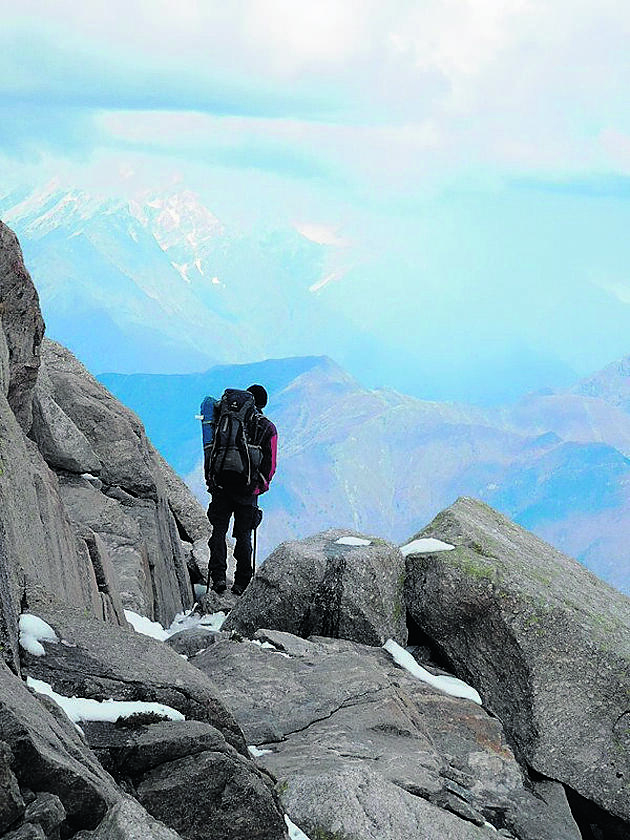
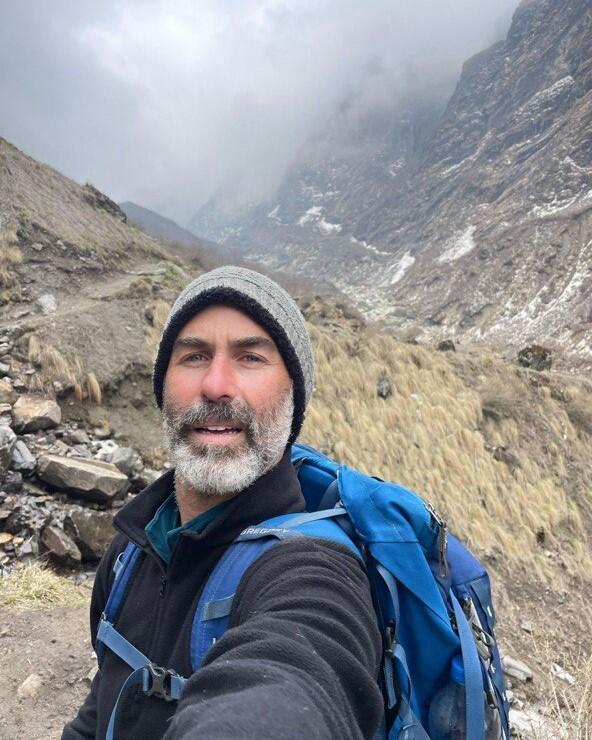
The views Samuel Vengrinovich encountered before crashing into the rocks
And still, in practical Western terms, what was the mistake you made that caused you to get lost?
"Afterward I researched everything that happened to me. It occupied me, and I discovered that all the experienced hikers say: ‘In the Himalayas the weather changes at crazy speed. Sun, rain, fog — everything can change within 15 minutes. So the rule is: if you’re in fog, sit and wait for visibility to improve.’"
And you didn’t wait.
"No, I was under pressure that I had to get down to meet my friend and get out of there. My Western brain said, how can it be that I can’t find the way? Instead of sitting in place, breathing, waiting, I was in a race. It’s a survival response, as I later discovered, but I had no experience in a situation like that. I’d done a lot of treks, but I hadn’t dealt with heavy fog in the middle of an open area, without trails. What happened from here on was a chain of mistakes that stemmed from lack of experience and pressure."
So now you’re between cliffs. What happens there?
"I start jumping between rocks, looking for a way down. Suddenly I see one reasonable rock, a little dangerous, but if I jump correctly — that’s what I tell myself — I’ll make it and reach the other side."
To his sorrow, that gamble failed, and then came Vengrinovich’s crash.
"I jumped, lost my grip and simply fell for three seconds from the height of a seven-story building. I landed in the gap between two rocks. On the way I went through a bush that tore my nostril, and suddenly there was silence, but I understood that I was alive and conscious."
‘It ended in a huge mess’
The next nine days would be unforgettable and would give him an astonishing story for the rest of his life. But to understand who the man is who survived them against all odds, one has to begin in 1994.
Samuel Vengrinovich, 44, a Jewish American, first came to Israel then at age 13. Since then he came and went, until he decided to settle there at age 28, when he moved to Florentin, but he always remained between places. He was born in Houston to parents who had emigrated from the Soviet Union, after which his family moved to California and, two years ago, to Florida.
‘It ended in a huge mess’
In the United States, he has meanwhile become a sought-after interviewee. The interview with 7 Days was conducted from his family home in Palm Coast, where he is undergoing a long rehabilitation three months after breaking the right side of his body — leg and arm — and managing to survive a nine-day journey from the mountain peak to the village where locals saved his life.
On the fifth day of the survival journey, Vengrinovich managed to stand above a cliff, see blue sky and hear the murmur of water. He had already begun imagining how he would drink it, after two days during which he had drunk only his own urine and eaten mostly insects, but then he discovered the painful reality: he had no way to reach the water source.
Another hiker, in all likelihood, would have ended his life on the mountain. Vengrinovich decided he was not giving up, and he credits his ability to survive impossible conditions in the Himalayas to the mentality he developed in childhood as an athlete.
"I trained as a child in floor gymnastics at an Olympic level, and you develop mental abilities, like overcoming fear," he says. "I think that’s one of the things that helped me most survive the descent from the mountain — the acrobatic skills, the ability to control the body, move correctly and know how to fall and how to grab the bushes. Fear accompanies you every moment and the body has to remember how to land. It’s a strong foundation in my personality, never to give up."
"On the fifth day I slid down the mountain through bushes and thorns. My face was cut and my body was bleeding, and then I heard the flow of a river. I imagined cold water, and discovered I was 100 meters above it, with no ability to get down and drink. I felt like I was part of a cruel joke by God."
Years after that, mental strength became fixed in Vengrinovich as a young athlete, he lived on Florentin’s Yedidia Frenkel Street, earned a living at an information security company and tried his luck in painting and music.
"I play several instruments and have been producing songs since age 11," he says. "In India, just before the injury, I managed to produce a song called ‘I’m Free.’ Nothing is probably coincidental."
On October 7, 2023, while he was vacationing in Sinai, came the turning point that led him to India.
"It was too much for me, I told myself I’m not going back to Israel now," he says. "I flew to Budapest and from there everything happened quickly — I found work, met a woman from Iran who had converted to Christianity and said she hated the regime there. I suspected she was a spy who wanted to trap me. I was afraid."
What made you suspect her?
"Once she joked about a cup of tea she made me and said she had poisoned it. I had an anxiety attack."
His money ran out in Budapest, he returned to Israel to pack up his apartment in Florentin, and then he fell in love — this time with an Israeli woman who did not make him suspicious of anything. But the urge to wander kept burning in him.
"I was without money and without work," he says. "I was torn between love and the feeling that I had to run away again. I decided to go to Dharamshala for treatment and healing, where the Dalai Lama is. I did a breathing workshop. I cried, screamed, everything that was stuck inside me came out."
From northern India, he continued to Nepal, where he proudly says he walked 200 kilometers in the mountains.
"Crazy treks," he says. "I discovered that I was strong, fast, connected to my body, to nature and to God. At 44, I rediscovered my body."
When you say crazy treks, give an example of a moment like that.
"In the jungle in southern Nepal, I was with two guides and we were looking to see a leopard. In the last two hours of the trek, suddenly, without binoculars, I see in front of us a huge Bengal tiger. Something like a quarter of a ton, two meters away from us! It was really special, I felt that God had sent me that tiger. The guides were in shock and told me, ‘You’re lucky, man.’"
They probably did not realize how lucky. At the end of May, Vengrinovich returned to Dharamshala, and after a few days there he thought he would return to Israel strengthened and rebuild himself.
"Returning there was, for me, the way to close this year, calm down, go back to Israel, look for work and be born again with everything I had learned."
"In the end," he smiles, "it ended in a huge mess."
‘Drinking urine for two days’
"I tried to get up and screamed in pain," he says, returning to the moments after the fall, in which his arm and leg were badly injured and his nose was torn by a bush on the way down.
Maybe it was the backpack that absorbed part of the impact and kept him alive, maybe it helped that his body was loose and did not resist the fall, and maybe it was simply the same kind of luck he had had with the Bengal tiger.
"Everything came together; it was a miracle. The ankle was broken, the knee was hurt, the arm was hanging, but in all of that, I remember saying to myself jokingly, ‘Well, this is also a way to get down from the mountain.’"
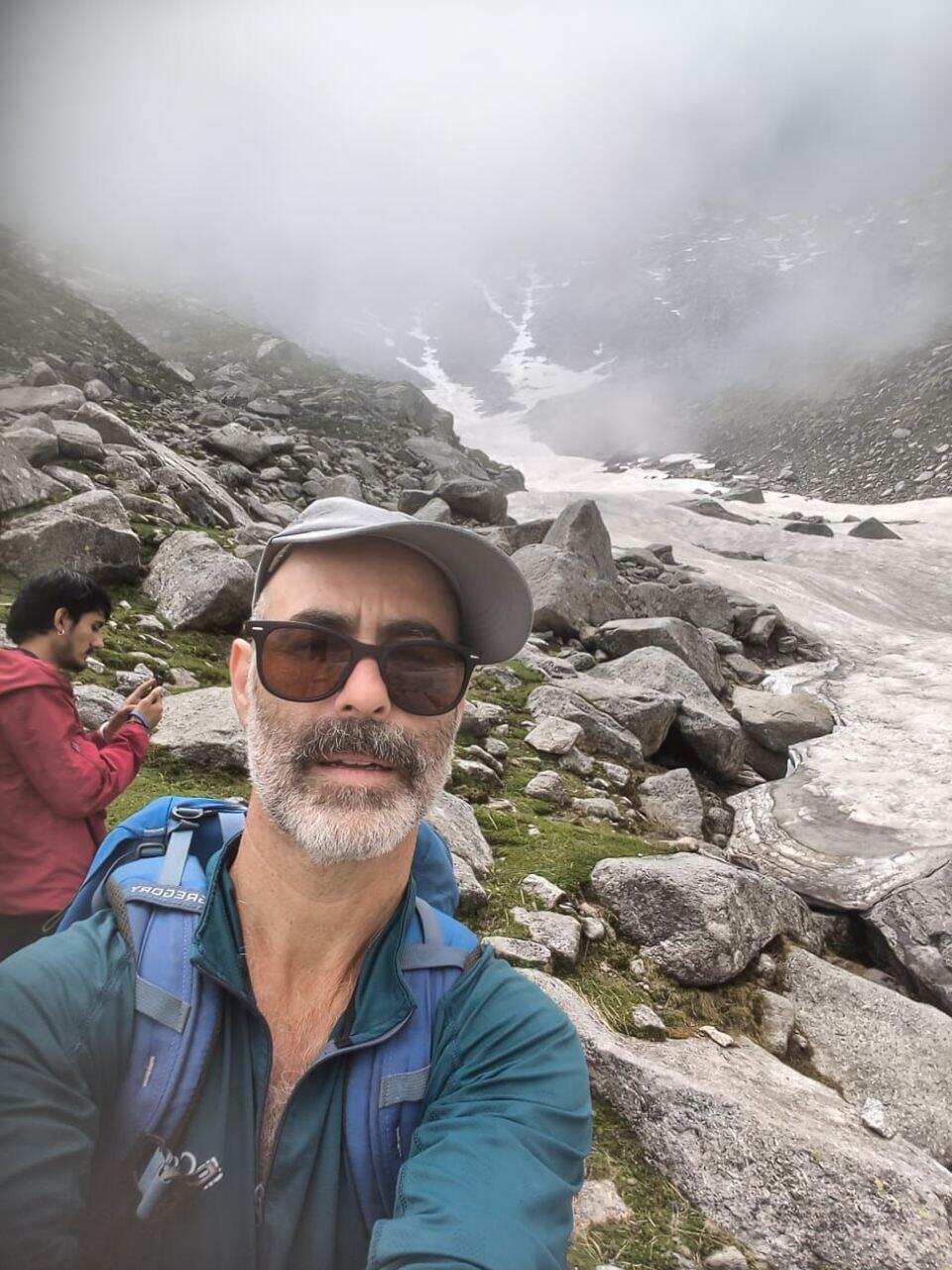
Injured and without a watch or cellphone, Vengrinovich made a decision to get down the mountain in order to save himself.
"I didn’t know what time it was, I think around four in the afternoon," he says. "I felt darkness approaching; the fog was still very heavy, as if night had come before its time. I shouted a little to see if anyone heard me, but there was no answer. Pretty quickly, I understood that here, at the place of the fall, I was going to spend the night. I put my headlamp next to me on blinking mode, maybe someone would see it after all, and lay down."
He did not manage to sleep on the first night. He also says he had no fear of wild animals at that moment.
"I was so focused on the pain, on the shock, that I had no room left to be afraid of nature," he explains. "I was in shock, how did I get to this situation? I had never broken a bone in my body, and suddenly, my arm, leg, nose — everything was injured. I looked at the moon all night, I’m still not sure I fell asleep."
"I jumped, lost my grip and simply fell for three seconds from the height of a seven-story building. I landed in the gap between two rocks. On the way I went through a bush that tore my nostril, and suddenly there was silence, but I understood that I was alive and conscious."
What do you do on the first morning?
"Without a phone or watch, I had no idea whether anyone was looking for me at all. My friend had probably already come down from the mountain; he didn’t even know I was lost. The Indians disappeared in the fog; who knows if they reported me. I knew nothing, but I understood that if they looked for me, it could take two or three days. I’m in India, and I’m not at all sure there’s an organized rescue here. I didn’t want to gamble on that. And then I decided: I’ll try to get out of this myself."
The plans changed when the decision in his mind did not match the condition of his battered body.
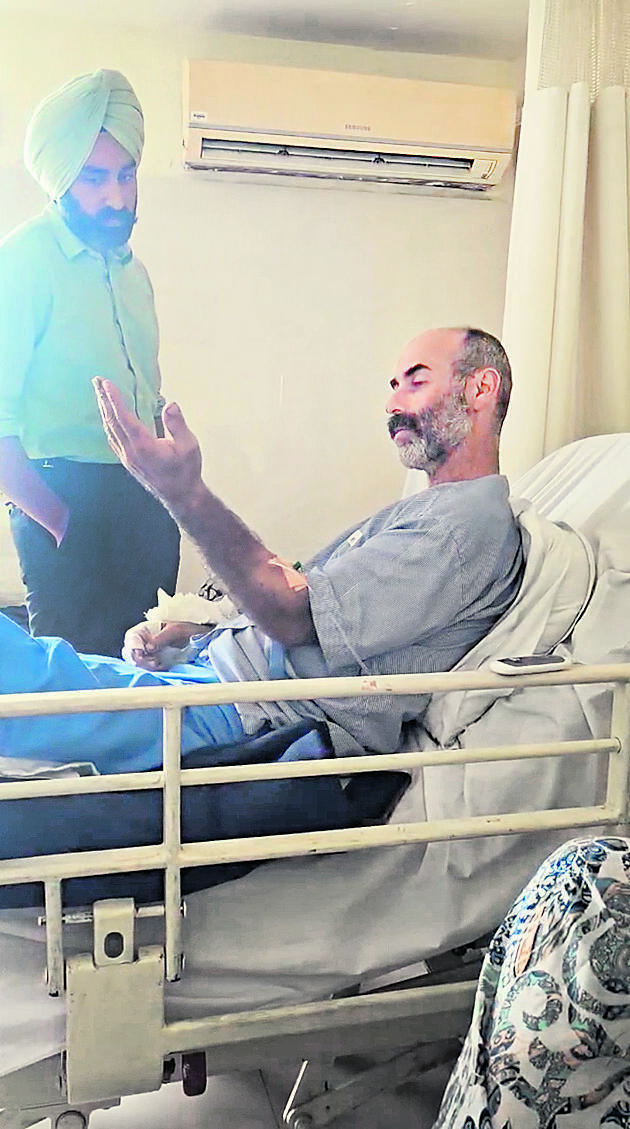
Samuel Vengrinovich at Tanda Government Hospital, the main medical center in Kangra district
"When I stood up, the pain was terrible," he says, "so I slid down on my backside to the edge of the steep cliff, which was dangerous and rocky, but I knew that if I had no water, I would not survive."
Did you have a drinking bottle?
"One liter, that’s it. I didn’t know how long it would take me to get down. One day? Three days? In practice, it took nine. I prepared for everything. I held on to the rocks carefully with only one hand, because the other was broken. There was no margin for error because I couldn’t fall again. In the end, somehow, I managed to get down the first cliff, and then I had to descend toward the wadi."
Sounds like quite a trek, even without half your body broken.
"I walked slowly, with a stick, at the pace of a grandfather, but I moved forward. Apparently quite quickly, relatively speaking, because the rescue teams my family hired didn’t find me. Everyone was looking for me on the mountain, and I was already below on the second day."
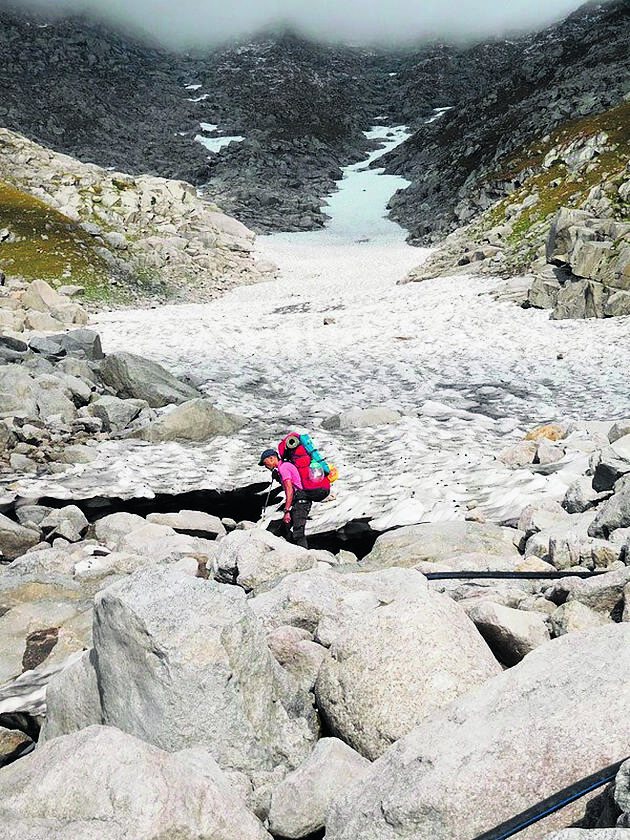
In the wadi, Vengrinovich encountered the first obstacle. It was a glacier, like a frozen river covered with snow.
"Something very dangerous," he says. "It can break and you fall into the freezing water. The glacier was very high. I climbed onto it, about two meters, and started walking, but the glacier was very steep — and suddenly I slipped off it."
Oh no.
"I was on my back going down sharply, almost 100 meters of sliding, mortal fear. And I couldn’t stop. By a miracle, in the end I managed to break myself with my hands and legs, even though they were injured. I was saved just before I crashed into a rock."
On the second night, he fell asleep at the junction of two ice tributaries that joined together, like a river, into a huge glacier. Despite the proximity to a water reservoir, he could not really drink when everything around him was frozen.
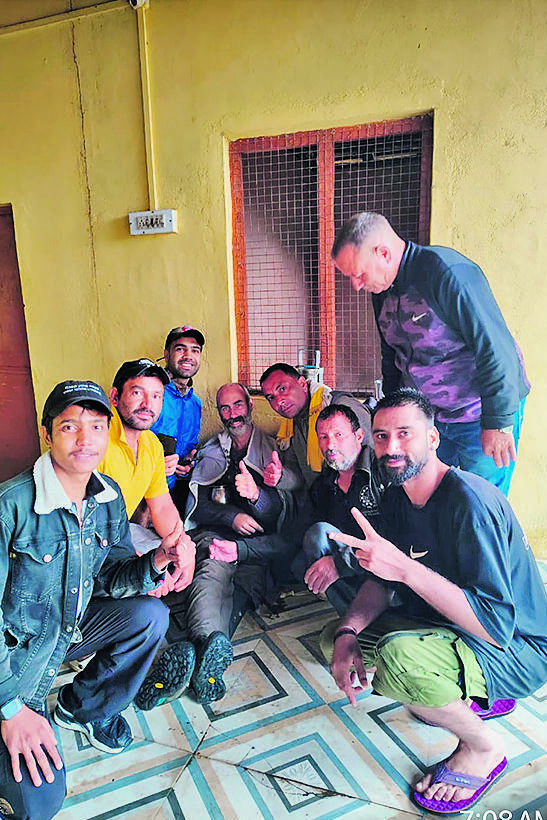
Samuel Vengrinovich, with members of the Magen team, who took him to Tanda Government Hospital, the main medical center in Kangra district
(Photo: Magen)
"It’s not like a stream in Israel that you can simply walk beside, the Himalayan river is like a canyon — steep walls, waterfalls three meters high," he says. "There were no banks to walk on. I tried, but it became dangerous."
At that stage, an insight arose in him that saved his life. He understood that he would not find people along the river and that he had no choice but to climb upward, where he might find shepherds, rest camps for hikers or more comfortable trails. And so, after he had slid downward, Vengrinovich began a Sisyphean climb. But not before he took water from the river, exactly one liter, as much as his bottle could hold.
"I started the climb and it was very hard," he says. "The right side was injured, so I climbed with my left hand and left leg, held on to plants, slipped, fell, and every step hurt. It took me two days to get up."
At that point, his water also ran out.
"I started drinking my urine," he recalls of those moments when there was no choice. "I filled the bottle and that’s what I drank for two days. I had never done it before, but I told myself, ‘Damn it, I need to survive.’"
‘Part of a cruel joke by God’
And that is how, on the fifth day of the survival journey forced on him in the Himalayas, after four days in which he was defined as missing and his location was unknown to anyone, and 48 hours in which he had been forced to drink only his own urine, he found himself at the top of the mountain. There, his sigh of relief quickly turned into disappointment.
"There was nothing there," he says. "No trails and no people, no camp and not even goats. Nothing. I started to despair; my body was thirsty for water and I started imagining it. And I’m standing at a crossroads, to the right the way I came from, after I had gone down and climbed back up; so I took the left path. I couldn’t stand, so I slid on my backside down the mountain and the whole way was full of bushes, thorns and hard earth."
Agony. How do you get out of that slide?
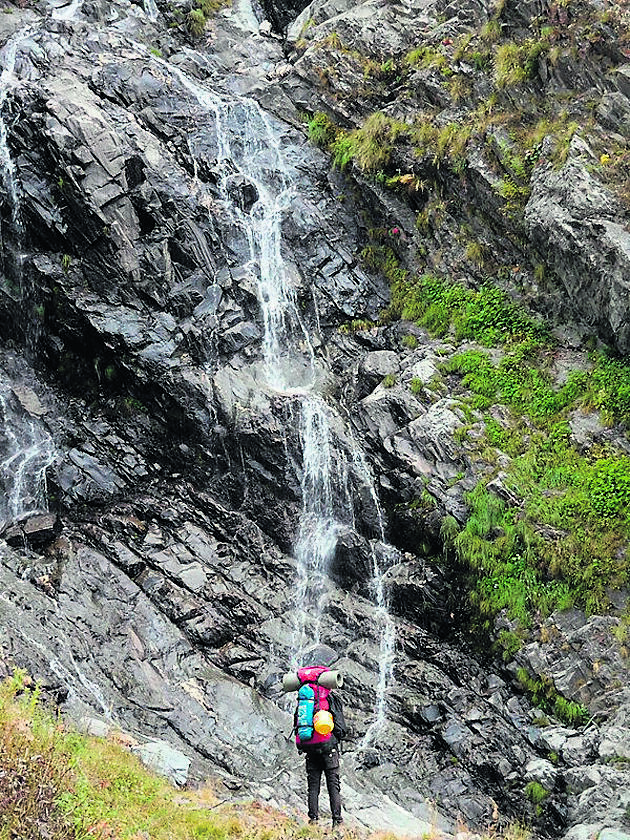
"My face was cut, and my body was bleeding, and then I heard the flow of the river. I was already imagining cold water. I reached the edge of the cliff and saw the most beautiful view I have ever seen in my life — a huge waterfall, clear blue water. But I am 100 meters above it, without any ability to get down and drink."
Optimism accompanied him through most of this journey, but on the fifth day, at those moments, he felt everything was lost.
"I sat down and felt that I was part of a cruel joke by God," he says.
But in the Himalayas, nature has its own laws. Nothing is fixed, and within 15 minutes everything can change.
"And then a crazy rainstorm starts and I take out my coat, stretch it and create a kind of hollow from the fabric, into which the water drains, and I drink the rainwater and also fill the bottle with it — a full liter. It was a moment of a miracle, a moment when I felt that God was with me. You can’t explain it, as if I received water from the sky. It’s a rebirth after despair."
You are not a religious person, but you talk a lot about God.
"Every morning I made myself a blessing. I didn’t ask for miracles, I asked for patience. I asked to be smart and not rush, to move forward just a little more, another meter, another ten meters. Not to slip and not to make a mistake. Even when I climbed I talked to myself, encouraged myself, after every meter I passed I told myself, ‘Well done.’ I talked to my hands and legs, I told them, ‘I know you’re in pain, but we’ll get out of this together.’"
And then he decided: the strategy had to change. There was no longer any point continuing down the mountain. And he went back to climbing it, toward the area he already knew. Again, rocks, bushes, pain with every step. And he did not stop.
On the eighth day, for a moment, it seemed the long-awaited moment had arrived.
"Suddenly I heard a helicopter," he says. "My heart was pounding. I thought, maybe they’re looking for me. I went out to open ground as much as possible, waved with my left hand, shouted, the helicopter flew above me — but too high, about a meter above the mountain peak, it circled around it and I was actually below, at the foot of the mountain. I thought it was a tourist helicopter; there’s no way it’s for me. It circled for a few minutes and disappeared. Only at the hospital did I discover that my family had hired it for the searches. But they were looking for me too high, at an altitude of 4,500 meters, while I was much lower, at an altitude of 2,000 meters and in a forested area. They had no chance of seeing me."
That is a moment of helplessness, no?
"It hurt to know that I had been so close, but also far. I had no bright marker on me, only a blue coat. I had lost the headlamp several days earlier. How would they find me?"
Without any kind of light with you, how did the nights pass?
"A nightmare. Twelve hours of absolute darkness every night. I would lie on the ground and wait for sunrise. In my thoughts, all that occupied me was: survive one more day. Move forward a few more meters, don’t slip and don’t break."
The next days, he says, became a real fight for his life.
"I left the river again, despite the fear of being left without water, because I knew that near water sources I probably would not find people. I climbed along the side of the mountain, looking for animal trails. On every route, if you look carefully, you’ll find animal trails — goats, rabbits, deer. They are delicate, but they exist. I tried to follow them; sometimes they helped and sometimes they led to dangerous places, because they are suitable for animals and not for an injured person. I looked for any sign of civilization. Sometimes I saw from afar a temple or lines that looked like roofs, and I knew: that’s where I need to get. Meanwhile, I became very hungry."
What did you eat during those days?
"Throughout the whole period, aside from leaves and berries, I ate insects. Beetles, ladybugs, ants, anything with protein that I knew my body needed, and even cannabis leaves, roots, and stems. Anything that looked reasonable. At certain moments, the body turned off the feeling of hunger, but I couldn’t ignore the thirst. At that stage, I wasn’t thinking about Israel, my parents or the war. I was a mountain man. The deep silence of the forest, the encounters with animals without fear — like the Himalayan monal and a huge deer — were truly mystical. I discovered that the valley I was walking in is considered sacred in Hindu tradition. I experienced a deep connection to nature, to the sublime and to the wholeness of the moment — and I came out of there not only alive, but a different person."
‘A lesson in patience’
On the ninth day of the journey, during which he walked and mostly dragged himself for kilometers with a broken body, Vengrinovich’s salvation came. Suddenly, a village appeared before him, with a temple and three local residents around it.
"But," he says, tempering the joy, "I was on a cliff opposite them and between us was a big river. And I start screaming: ‘Help! Help! I’ve been here ten days alone!’ I screamed like that nonstop, when I didn’t even know if they understood English."
He kept shouting toward them, begging them to call the army, the police, someone.
"After an hour, I see that they notice me and signal with their hands for me to stay where I am. They understood that I needed help."
And that help, did it come immediately?
"After another three hours, another three men from the village arrived, who circled the wadi and reached me. When I saw them, I started crying, because for the first time I understood that I am not alone. That they’ll save me. But it still wasn’t over. I was on a cliff, and they had to come down to me carefully. The moment one of them grabbed my hand, a downpour began, wind and mud, and they pulled me and each other, we were like a train, holding one another and going down a dangerous goat path."
How long did that last?
"About an hour. Until we reached the temple and they instructed me to pray to Shiva. And I surrender, get down on my knees, and thank him for saving my life. After that, they fed me gently, and here I understood it was over."
What was the first thing they gave you to eat?
"When they brought me to the village of Tatri, they gave me chapati to eat, more and more, they simply fed me nonstop. Whatever there was — I ate. Then they took me straight to a hospital, where the food was tasty, but vegetarian."
In total, Vengrinovich covered about 13 kilometers during his journey in a severe physical state. After the rescue on foot, he was taken by Magen, the rescue team hired by his family, to Tanda Government Hospital, the main medical center in Kangra district. After initial stabilization, he was transferred to the private Fortis Hospital. He still keeps in touch with the three rescuers from the village of Tatri.
"Throughout the whole period, aside from leaves and berries, I ate insects. Beetles, ladybugs, ants, anything with protein that I knew my body needed, and even cannabis leaves, roots, and stems. Anything that looked reasonable."
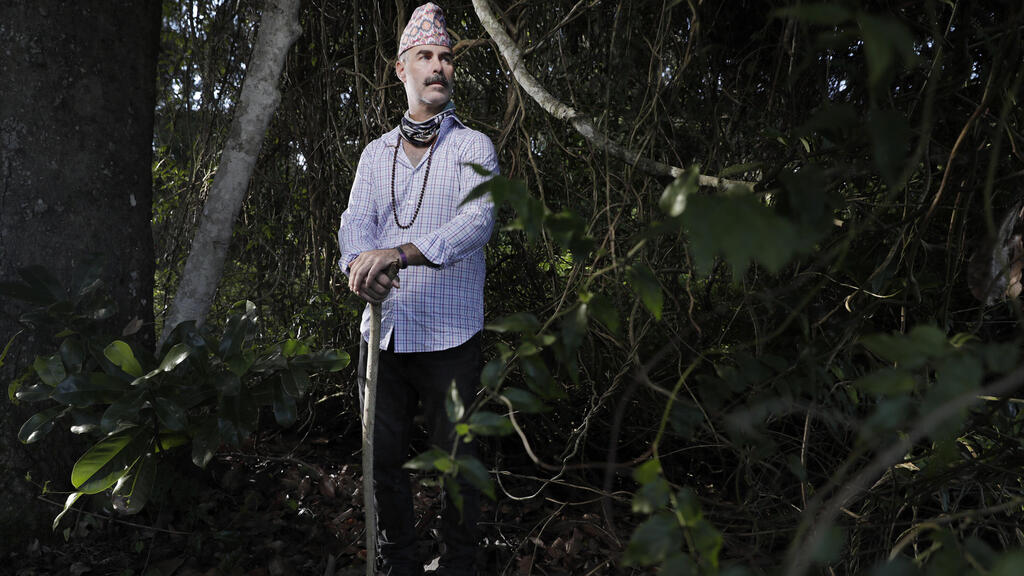
(Photo: Bob Self)
"The government hospital," he recalls, "was complete chaos. I felt like I was in a train station in India. At the private hospital, a young and kind Sikh doctor, fluent in English, treated me, operated on me and was like an angel. I was hospitalized there for 17 days, until my father managed to arrive from the United States. It took another month until I received permission to fly. I couldn’t get to Israel because that same week, the war with Iran began, the skies were closed, and my physical condition didn’t allow flights at all. I underwent surgeries on my hand, leg, and shoulder, and had screws, plates, and pain. I’m only starting to walk now with the crutches, the hand still isn’t functioning and the surgeries are difficult, but I’m learning a lesson in patience."
When he reconnected with his family, Vengrinovich discovered what they had done for him.
"Only at the hospital did I hear that my younger sister, Natasha, led the rescue efforts, raised more than $69,000 in a GoFundMe campaign, and coordinated with American members of Congress and military officials in India. The family operation was on the level of a military operation in every sense."
Strangely, when Vengrinovich is asked, the hardest part of the journey was not the survival, but rather what happened afterward — the hospital stay.
"At least in the mountains, I managed to move. It was hard, but I managed. So mentally it was easier. In the hospital, it was harder emotionally. Suddenly, rest, being with myself. I was in pain, I took painkillers, ate hospital food, and above all, I was lonely. On the mountain, I was alone, but I didn’t feel alone; I felt connected to God and to nature, and that filled me with energy. In the hospital, it was head down, no fresh air, only air conditioning all the time, and doctors and nurses who don’t speak English."
When you think about your rescue story, do you understand how lucky you were?
"Sometimes I think about the fall and it scares me a little, because it could have ended much worse. I could have fallen on rocks, broken my back, or been injured in the spine and remained paralyzed. The doctors in India told me: ‘You’re lucky, it could have been much worse.’ They also don’t understand how I managed to walk for nine days with those injuries. They said that most people who are injured like that don’t move at all, and I managed to move and do what I did. I don’t know, maybe because of the adrenaline that flowed through the body and reduced the pain — probably a combination of everything. Sometimes it frightens me to think about it. Wow, how I fell, like a rag."
There is no doubt that the extraordinary event changed Vengrinovich’s life. In an irony of fate, before he set out on his journey in India, he worked as a marketing manager at a security company, where he was, among other things, responsible for designing graphic material for a new website that included details about rescue, intelligence and special operations services. Today he already knows he does not intend to work there.
Instead, he intends to give lectures about survival following his extraordinary journey. As an artist and music producer, Vengrinovich plans to release an album called 9-Days.
"I’ll combine my story with the music. What I would really like to do is DJ and perform with my music live. To be an artist."
And a message to other travelers?
"First of all, on trips in the Himalayas — respect the mountain, respect the weather. If there’s fog — sit. If it’s raining, just find shelter. Don’t fight nature. The second thing I learned is about life. I survived thanks to faith. Thanks to the fact that I didn’t say, ‘Why me?’ but ‘How do I get out of this?’ I talked to myself like a parent to a child, strengthened myself and believed in myself. Today I think that if I managed to survive nine days alone in the Himalayas with broken bones, I can do anything. Anything you bring me — I’ll succeed."