

You're falling off a cliff. Down and down you go, unable to stop. You're certain you're about to hit the ground when suddenly you wake up in a panic, your heart racing. It takes a few seconds to realize you're actually lying safely in bed. A few nights later, just when you've almost forgotten about it, the same nightmare returns. Once again, you're falling, only to wake up drenched in sweat.
"Falling from a great height, drowning, tsunamis and enormous waves are among the most common nightmares," says Ronit Jenny Nesher, a dream expert and wellness psychologist with a doctorate in psychology. "Among Israelis, dreams about wars, bomb shelters, explosions and airplanes are also common. Since October 7, the number of nightmares has increased, and their content has changed. Now we're seeing more dreams involving tunnels and terrorists."
Gallery
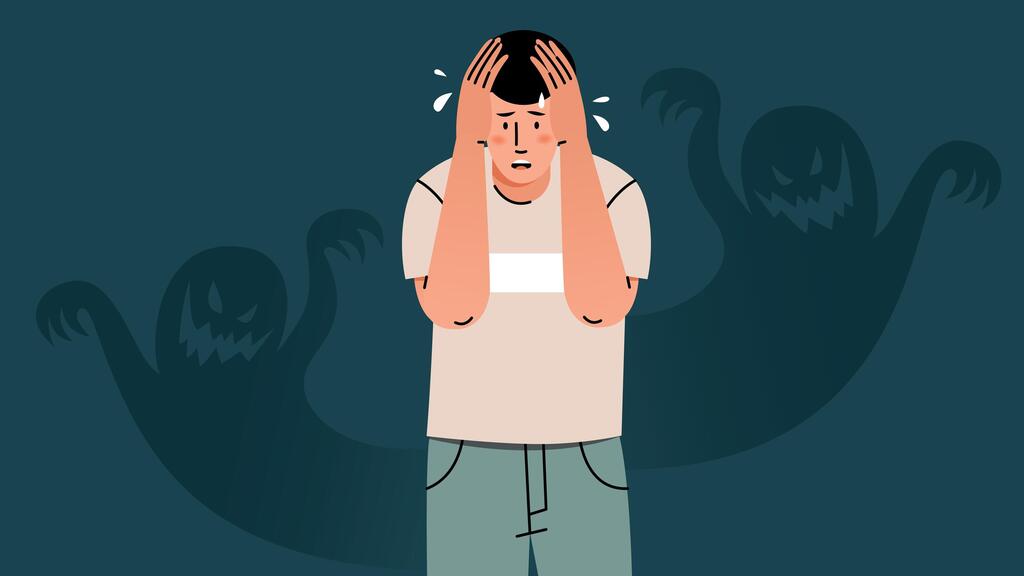
Why do we dream of falling, drowning or being chased? Experts explain
(Photo: Shutterstock/Tatiana Gavrish)
But why does the brain create these terrifying scenarios? And what does it mean when a nightmare doesn't just happen once, but keeps coming back?
"Nightmares are what we call unprocessed material in psychology," Nesher explains. "They can involve fears, frustrations, anger and suppressed emotions that we haven't given enough attention to or fully processed during the day. They remain unfinished business, and at night they come back to haunt us."
According to Nesher, dreams should not always be interpreted literally. "Dreams speak to us in codes. I might dream about someone else, but really I'm dreaming about myself. The important thing is that there's something weighing on me that I haven't processed."
She believes that even the most frightening nightmare is not necessarily a bad thing.
"There's no such thing as a bad dream. Every dream is like someone tugging at your sleeve and saying, 'Hey, there's something here you haven't noticed.' If I keep suppressing those feelings, the fears won't disappear. But if a nightmare keeps repeating itself, I have an opportunity to work through it."
Don't go to bed watching the news
So what causes nightmares to appear on a particular night? Nesher suggests starting with what we take to bed with us, both mentally and physically.
"If I go to sleep after watching frightening news, it's going to find its way into my dreams," she says. "I tell my patients, half joking and half serious, that if they go to bed with the news, they shouldn't be surprised when it follows them into their dreams. And you know how people say you shouldn't go to bed angry? Well, arguments can increase nightmares too."
She also recommends paying attention to the bedroom environment.
"If the room is too hot, it can trigger nightmares. Synthetic bedding, particularly fleece blankets, can also have an effect," she says.

From tsunamis to terror attacks: What our nightmares reveal about fear
(Photo: Shutterstock/FOTOKITA)
Nesher also believes that static electricity can influence what she describes as the body's energy field and contribute to disturbed sleep and nightmares, although this explanation is not an established scientific account of nightmares.
"That's why I recommend good sleep hygiene, less screen time before bed and cotton bedding," she says.
In her view, there is also an energetic dimension to sleep disturbances, even when nothing appears to be wrong with the sleeping environment.
"Imagine checking into a hotel room and feeling that something about it just isn't right. I'm sure plenty of people can relate to having a terrible night's sleep in a hotel. There was no noise, the room was clean, everything seemed fine, but you just kept tossing and turning."
Why does she think that happens?
"Sometimes sensitive people pick up on the energy of whoever stayed in the room before them. I travel a lot, and if I arrive at a hotel and the energy in the room feels unpleasant, I simply ask to change rooms."
She also suggests visualization exercises.
"You can imagine surrounding the room with a bubble or with sparkling lights, something I call the 'golden frequency.' Another option is to imagine yourself in bed surrounded by a bubble of red, orange, purple and blue. I sometimes use this in places where the energy doesn't feel right."
'A recurring nightmare is a friend'
When a nightmare keeps returning, Nesher believes the answer is not necessarily to try to get rid of it.
"A recurring nightmare is a friend. That's my slogan for children," she says. "The dream is telling us there's something valuable here, something we need to work on."
She gives the example of nightmares experienced before a wedding.
"Many brides dream that the groom runs away, that they arrive at the wedding naked, that they're driving around and can't find the venue, or that someone brings them a dress that doesn't fit. Those are all fears connected to getting married."
Rather than simply acknowledging that they had a nightmare, Nesher encourages people to examine what happened in the dream and how they might have responded differently.

'Nightmares are unprocessed emotions.' Ronit Jenny Nesher
(Photo: Or Kaplan)
"Explore the dream. Put yourself back into it and ask: How could I have acted differently? What does the feeling in the dream remind me of in real life? What am I afraid of? What can I do to feel more in control? Because a nightmare is about helplessness."
She recalls a student who repeatedly dreamed of falling.
"He was falling and falling, but at the bottom there was a trampoline, and he bounced straight back up. To me, that meant he had inner strength. He believed that even if he fell into a hole, he would have the resources to climb back out."
And what should you do when you wake up from a nightmare and the fear hasn't gone away?
"First, remind yourself that it was only a dream. Then get out of bed, wash your hands and face, have something to drink, tell someone about the dream or write it down. Get it out of your system and do something else."
Not every nightmare is a sign of a problem
Yakir Salem, a psychologist undergoing rehabilitation specialization training in the Dan-Petah Tikva district of Clalit Health Services, as well as a couples therapist and lecturer, offers another perspective.
For Salem, the important question is not necessarily what a nightmare means, but how much it affects someone's everyday life.
"In simple terms, a nightmare is a frightening dream that can also bring up feelings of guilt, disgust or shame," he explains. "Nightmares aren't a disorder in themselves. Having one doesn't mean I'm ill, that something is wrong with me, that something terrible has happened or that I've experienced trauma. They're part of our natural psychological activity."
There are many possible triggers, he says.
"Nightmares can be associated with anxiety, depression and post-traumatic stress, but also with ordinary stress. Sometimes changes we consider positive, such as getting married, having a baby or moving house, can be extremely stressful and lead to more dreams and nightmares."
Certain medications, drug use and withdrawal from some sedative medications can also be associated with nightmares.
"I've even seen research linking very large meals just before bedtime, particularly spicy meals, to nightmares," he adds.
Salem also recognizes that dreams can reflect emotions and experiences that are not immediately obvious to us.
"I still think Freud's old observation about dream interpretation being the royal road to the unconscious holds value. But I take a much more individual approach."
He gives the example of two people dreaming that they have lost their wedding rings.
"For one person, it might represent a fear of losing the ring. For another, it could reflect a suppressed wish for that loss to happen, which creates anxiety. For a third, it might symbolize something entirely different that has taken the form of marriage or a relationship in the dream."
His approach is to explore what a particular dream means to the person having it, rather than assuming that a specific image carries the same meaning for everyone.
When should nightmares become a cause for concern?
According to Salem, the most important warning sign is whether nightmares begin interfering with sleep or daily functioning.
"What interests us more than how frightening the dream feels is whether the nightmares are affecting my ability to function," he says.
"Am I sleeping poorly because I wake up during the night and struggle to fall asleep again? Am I having trouble falling asleep in the first place because I'm afraid of what I might dream? Am I tired or irritable the next day? Do memories of the nightmare interfere with my concentration?"
If sleep remains restful and daily functioning is unaffected, he says, even strange or disturbing nightmares are generally less concerning.
He also pays attention to whether recurring nightmares change over time.
"If the nightmares keep coming back but look a little different each time, that worries me less. The more a dream resembles an exact replay of something that actually happened, repeating again and again without changing, the more we begin to consider whether it could be a post-traumatic symptom."
In those cases, Salem recommends seeking professional help.
How to rewrite your nightmares
One way to address recurring nightmares is to deliberately change the dream's storyline.
Salem points to a treatment known as Imagery Rehearsal Therapy, or IRT, which involves rewriting a nightmare and then mentally rehearsing the revised version while awake.
"I take the nightmare and rewrite it in the first person and present tense, making some kind of change," he explains.
"For example, suppose I dream that I'm walking along a cliff and there's a murderer waiting for me at the end. Every time I reach him, I wake up. I take that dream and rewrite it so that something different happens."
The new ending does not necessarily have to be a happy one, he says.
"It doesn't have to mean I kill the murderer or manage to escape. I might even jump off the cliff and die. The important thing is that I change something in the dream."
After rewriting it, the person practices imagining the new version at regular times during the day.
"It's an exercise in developing the ability to edit the dream, to make changes and to experience a sense of control over my mental activity, my memories and my dreams."
But does it actually work?
"Studies show that, on average, we begin to see improvement after about two weeks, whether in the frequency of nightmares, changes that start appearing in the dreams themselves or symptoms experienced while awake," Salem says.
"After two months, the improvements can be very significant."
He cautions, however, that not everyone will be able to use the technique successfully on their own.
"If someone tells me, 'I can't imagine a new dream. I can't change this memory even when I'm awake,' that's a red flag for me. In that situation, I recommend seeking help rather than trying to solve the problem through exercises at home."
Can we make sure we only have pleasant dreams?
There is no guaranteed way to prevent unpleasant dreams, but Salem believes certain habits may encourage more restful sleep.
"Things that support sleep, such as breathing exercises before bed, guided imagery, meditation or practicing gratitude, may also encourage more pleasant dreams," he says.
Still, he believes the goal should not simply be to eliminate bad dreams.
"I prefer being curious about what's happening inside us rather than just trying to have good dreams. Even bad and frightening dreams are worth approaching with curiosity, because they can tell us a great deal about what's going on beneath the surface."
What if your child or partner wakes up from a nightmare?
When someone close to us wakes up frightened, the instinct is often to reassure them immediately that nothing is wrong. But both experts suggest that listening and helping the person feel safe can be more useful than dismissing their fear.
"When a child is frightened, I don't tell them, 'There's nothing to be afraid of, I'm here,' because the child really is afraid," Nesher says.
Instead, she tries to help children recognize the things that can make them feel safe.
"If a child is afraid that someone might break into the house, for example, I'll ask: Is the door locked? Do Mom and Dad lock the door at night? If someone came in, would they wake up? That helps the child see what exists in reality that can give them a sense of security and control."
Salem emphasizes the distinction between ordinary nightmares and night terrors.
"If we're talking about night terrors, when someone screams, sits up or moves around in their sleep without being fully awake and sometimes doesn't remember anything the next morning, we can try to comfort and support them without forcing them awake."
When someone wakes from an ordinary nightmare, he says, the most important thing is to be emotionally present.
"In emotion-focused therapy, or EFT, we ask, 'Are you there for me?' In other words, are you accessible, responsive and emotionally engaged?"
He believes this is particularly important between partners.
"Put simply, be there for your partner. Curiosity in a relationship is a superpower. Try to understand what the person in front of you is experiencing and what they need before trying to persuade them, help them or cheer them up. Don't dismiss or minimize their feelings."
So the next time you dream about falling, drowning or someone breaking into your home, it may be worth doing more than simply trying to forget the experience. Consider what keeps returning, what triggers the fear or sense of helplessness, and whether you might be able to give the dream a different ending.