

A familiar saying goes: “Never meet your heroes — you’ll only be disappointed.” But no saying warns you about meeting the object of your hatred, and the possibility that it might turn out to be a human, even warm, encounter. And so, without advance warning, my meeting with the infamous president of Iran, Mahmoud Ahmadinejad, took place.
Two decades ago I served as a Yedioth Ahronoth correspondent in New York, and as part of the job I covered the United Nations headquarters. Every September, the UN hosts world leaders for the General Assembly. Each year, I would arrive at the hall where Ahmadinejad’s press conference was held. Like an exemplary student, I would sit in the front row and raise my hand to ask him a question. But the Iranian media advisers knew exactly who the Israeli journalist of Iranian descent was, sitting right under the president’s nose and trying to trap him. Year after year I learned what a quiet boycott looks like: no shouting, no removal — just a gaze that passes over you as if you don’t exist.
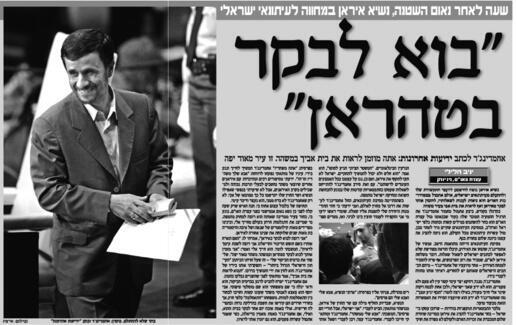
ynet's outlet Yedioth Ahronoth newspaper header, saying 'Come visit Tehran'
In September 2008, shortly before finishing my posting in New York, I decided that I had to speak with Ahmadinejad, no matter what. The desire was also deeply personal — a longing to allow my parents, who were born in Iran, to close a circle with their past. My late father, Yosef, was a descendant of the Mashhad Anusim — Jews who were forced to convert to Islam and lived for decades practicing Judaism in secret, under threat of execution. To this day, I carry a thoroughly Muslim last name and a deep historical family scar.
On the morning of the press conference, I called my mother in Tel Aviv and asked her to quickly teach me a few sentences that would allow me to address Ahmadinejad. I wrote the Persian words in Hebrew letters and memorized them. At midday, after the event ended and I was once again ignored, as the dignitary made his way out of the hall, I called out in Persian: “Mr. President Ahmadinejad.”
A hallway conversation with foreign minister as interpreter
To my surprise, he turned around and approached me. “Are you Iranian?” he asked in Persian. “No, I’m Israeli, but my parents are from Iran,” I replied in my broken Persian. I expected him to walk away upon hearing I was from the “Little Satan,” as Israel is known in the Iranian regime, but to my astonishment he began to converse with me. Ahmadinejad understands English but does not really speak it, so he took action — calling over the Iranian foreign minister who was standing nearby and ordering him to act as an interpreter.
Ahmadinejad asked about my roots, and when I told him my father was born in Mashhad — a city sacred to Shiites — his voice rose with reverence: “Mashhadi? Oh, oh!” We continued talking for several minutes. I asked him questions about his public anti-Israel rhetoric, but his answers were evasive. It was clear that he — and, truthfully, I as well — preferred to speak about our roots, like two enemies searching for a loose thread of shared memory that might connect them, if only for a moment.
At the end of the conversation, Ahmadinejad shook my hand warmly, smiled, and said: “I invite you to visit Tehran, and I urge you to travel to your father’s home in Mashhad.” In one sentence, he awakened the great dream of my life — to visit my second homeland, lost, forgotten, trampled.
The next day the story was prominently published in Yedioth Ahronoth, and foreign journalists also reported on the unusual meeting. My parents beamed with pride — their son stood upright before a president whose forefathers had carried out pogroms against their forefathers. I drafted a letter in Persian, sent it to Ahmadinejad’s office, and asked him to honor his promise: to invite me to Iran and ensure that my journey would not be a one-way ticket.
But a few months later, Iran’s presidential elections took place — and their results were rigged. Although Ahmadinejad lost, Khamenei declared him the winner and paved his way to a second term. Mass protests erupted across Iran and were brutally suppressed, in true ayatollah fashion. The authorities expelled all foreign journalists and launched a political purge. The Iranian people’s hopes for reform collapsed in a quiet drip of despair, and with them my dream of visiting the country and drinking saffron tea in the Isfahan bazaar was crushed.
The past two weeks have revived my longing to reach Iran free of the ayatollahs’ rule. I follow the popular struggle for freedom with excitement mixed with deep concern. Contact with the few acquaintances I have in Tehran has been cut off. I don’t know what has become of them. Every day I ask myself: Did they take to the streets? Are they holding on to hope, or drowning in despair? Are they even alive?
Every protest video, every documentary about Iran, every note of a Persian song awakens a piercing longing for my second homeland. But how do you miss a place you have never set foot in? And what does love for a homeland look like when you know it only through stories, food and accents? Is it permissible to yearn for a home that betrayed you, darkened its face, and slammed its eyes shut?
Finding solace with Liraz Charhi
Longing for Iran is taking a family trip to Azerbaijan, reaching the closest point to the Iranian border, gazing at the green mountains on the horizon, and wiping away a tear as you realize you are so close — yet infinitely far. Longing for Iran is also cheering for the Iranian national team in every World Cup, even when it plays against your favorite team, England. Longing for Iran is seeking out Iranian tourists on every trip abroad, rushing toward them to exchange a sentence, tell a joke, and part with the blessing “Khoda hafez” — “God protect you” in Persian — without deciding which God.
Ironically, during the 12-day war I received a warm — too warm — greeting from my second homeland. A powerful Iranian missile struck the building next to my apartment, wreaked massive destruction, and sent me into forced exile at a war-refugee hotel on the Tel Aviv beachfront. A few days later I returned to my battered home. I read that one way to overcome trauma is to perform a ritual that reminds you of home, and it was immediately clear what my ritual would be. I played my favorite music — Persian songs by Liraz Charhi, the bravest Israeli musician, who secretly recorded albums of exquisite Persian music with musicians from Iran. Only then did I feel at home again.
Between missiles and music, between a former president and citizens being slaughtered in the streets, between Tel Aviv and Tehran — today I understand that my bond with Iran is not nostalgia, but responsibility. Responsibility to remember that the real struggle is not between peoples, but between those who oppress and those who seek to live free. As long as the Iranian people fight for their freedom, and as long as my heart responds to the Persian sound, Iran lives within me. Not as a state — but as a home.