

What if the gods of the ancient world were not simply inventions, metaphors or supernatural beliefs? What if people really heard them?
Not symbolically. Literally heard them, as voices inside their heads issuing instructions, warnings and advice.
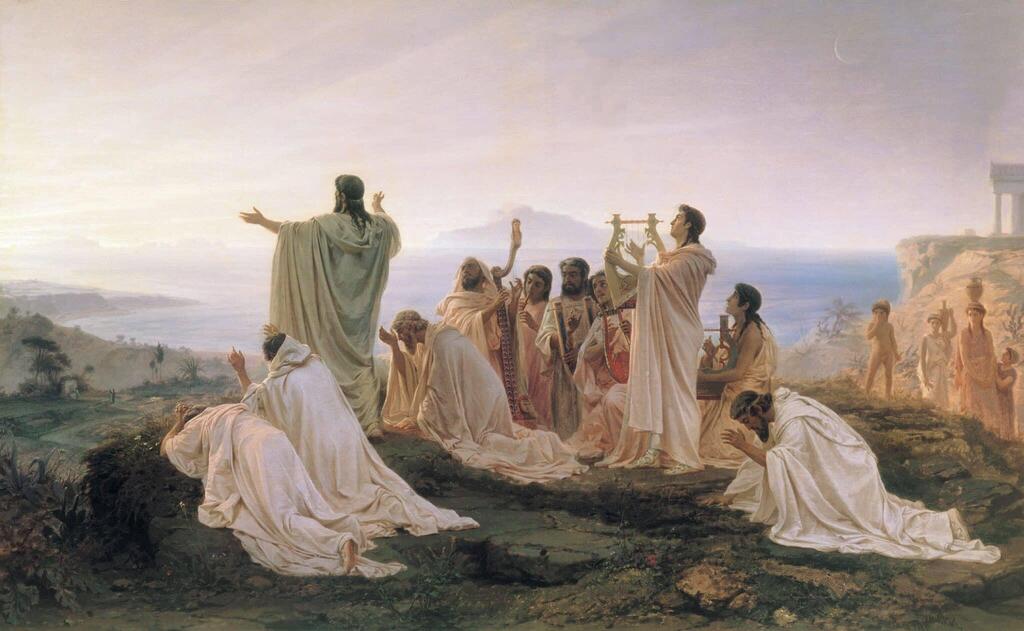
Pythagoreans' Hymn to the Rising Sun
(Painting: Fyodor Bronnikov)
That was the extraordinary argument made by psychologist Julian Jaynes in his controversial 1976 book The Origin of Consciousness in the Breakdown of the Bicameral Mind. Jaynes proposed that people living in the world’s earliest civilizations experienced their own minds radically differently from us. Internal verbal commands were not recognized as thoughts generated by the self, he argued, but as voices belonging to gods, kings and ancestors.
Then something changed. The voices weakened. The gods stopped answering. Humanity increasingly recognized the voice inside the head as its own.
And amid that transformation, according to one of the most provocative parts of Jaynes’ theory, Judaism offered a radically different model of the divine: God was not contained in an idol and could not simply be summoned whenever guidance was needed. He was invisible, transcendent and had to be believed in.
In that reading, the biblical battle against idolatry was not merely theological. It reflected a deeper change in how human beings understood the voices inside their own minds.
When the gods actually spoke
In Bronze Age Mesopotamia, gods were intensely physical. Temples contained idols that were fed, dressed, carried from place to place and treated as living divine presences. In some traditions, statues representing divine couples were even brought together for ceremonial conjugal visits.
To modern eyes, that looks like ritual symbolism. Jaynes insisted it may have been far more literal.
His theory was that worshippers speaking to an idol could actually experience an answer. The statue served as a focus for an internally generated voice, which the worshipper understood as the god itself.
A thought that a modern person experiences as “I should do this” might instead have arrived as “Marduk commands you to do this.” If a culture taught from childhood that such voices belonged to gods, there was no reason to interpret them as anything else.
Jaynes called this the “bicameral mind.” He argued that one part of the brain generated verbal instructions while another experienced them as coming from an external authority. The brain itself was anatomically the same as ours, but the experience of thought was different.
This is where the provocative comparison with schizophrenia enters the theory. People with schizophrenia can experience auditory hallucinations that seem to come from someone else, including gods or authority figures. Jaynes wondered whether something resembling that voice-hearing experience could once have been culturally normal.
That does not mean ancient populations can medically be diagnosed as schizophrenic. Schizophrenia is a complex psychiatric disorder involving far more than hearing voices. But Jaynes explicitly proposed that experiences resembling modern auditory hallucinations may once have been widespread and socially reinforced.
If everyone around you says the voice is Zeus, why would you call it a hallucination?
You would call it Zeus.
Then the gods went silent
Jaynes tied the breakdown of this system to the upheavals surrounding the Late Bronze Age collapse beginning around 1200 BCE. Across parts of the eastern Mediterranean and Near East, kingdoms disappeared, cities were destroyed or abandoned, trade networks fractured and literacy declined.
Historians point to combinations of warfare, migration, political instability, climate pressures and economic disruption. Jaynes noticed something else in texts from the period: people increasingly complained that the gods had abandoned them.
One Babylonian account describes a man desperately trying to restore contact with his personal gods. Diviners, dream interpreters and ritual specialists all fail him. His crisis is not disbelief. He is convinced the gods exist and cannot understand why beings that once communicated with him have suddenly stopped answering.
Jaynes interpreted such accounts literally. The gods had not physically left because, in his theory, they had never existed outside the mind. What disappeared was the mental experience through which people heard them.
Religion then began to change. If divine voices were no longer directly available, people sought substitutes: omens, dreams, divination, oracles and elaborate rituals designed to discover what the gods wanted.
The Oracle of Delphi becomes particularly interesting under this model. Greeks traveled vast distances to consult an oracle believed to transmit Apollo’s words. Jaynes suggested that oracles may have preserved an older form of voice-hearing after it became rare among the wider population.
He made a similar argument about poets invoking the Muses. When ancient poets said inspiration came through them from divine beings, Jaynes wondered whether they were describing an experience that felt genuinely external rather than using a literary metaphor.
Judaism’s radical answer: destroy the idols
This is where the theory becomes especially provocative in relation to the Bible.
Jaynes saw early Judaism as part of the post-bicameral world. Pagan religion was filled with accessible divine presences: idols, household gods, spirits, ancestors and oracles. Biblical religion increasingly moves in another direction.
Its God cannot be reduced to an image. Idolatry is repeatedly condemned. Necromancy and consultation with spirits are forbidden. The believer is expected to obey a God who remains real even when he cannot be physically represented or contacted through an object.
Under Jaynes’ interpretation, Judaism was teaching people how to live after the voices stopped.
His argument was essentially this: the gods have not abandoned humanity, but God is no longer standing inside a statue. Stop trying to restore the old divine voices through idols and spirits. Faith must replace constant auditory contact.
That turns the biblical prohibition on idols into something psychologically revolutionary. “Do not make an idol” becomes not only a command about worship, but a rejection of an older relationship between mind and divine authority.
The transcript also highlights biblical prohibitions against people associated with “familiar spirits,” divination and necromancy. Jaynes saw such passages as evidence of a transitional world in which some people still claimed access to voices or spirits that the emerging religious order sought to suppress.
Of course, the Hebrew Bible itself is filled with God speaking to people, from Moses and Samuel to the prophets. Jaynes’ theory does not require divine voices to vanish overnight. Instead, the ability to hear God becomes concentrated in exceptional individuals.
In that reading, prophecy itself could be understood as a surviving remnant of an older mental world.
From idols to an unseen God
The contrast is striking.
A Babylonian could feed an idol because the god was understood to be present there. Biblical monotheism increasingly insists that God cannot be captured in an object.
The old divine world was concrete. The new one demanded abstraction.
You could no longer simply point to the god and say, “There he is.”
You had to believe.
Jaynes even connected the biblical story of the Garden of Eden to this transformation. Humanity eats from the Tree of Knowledge and becomes self-aware. The fall is also an awakening: humans gain knowledge of themselves and become responsible for their own actions.
For Jaynes, myths of humanity gaining knowledge or becoming separated from gods could preserve cultural memories of a shift toward introspective consciousness.
It is a startling inversion of the religious story. Humanity did not lose direct contact with God because it fell. In Jaynes’ theory, humanity’s growing awareness of itself was the fall.
We discovered that the voice was ours.
Beyond the Bible
The transcript extends Jaynes’ ideas beyond Judaism, Greece and Mesopotamia. Traditional Chinese ancestor worship involved spirit tablets through which ancestors were believed to remain present and, in some accounts, communicate with the living. The narrator suggests that such practices resemble the household gods of ancient Mesopotamia.
It also points to Hindu traditions surrounding Jagannath, whose idol is carried ceremonially between temples, as another example of religion built around a physically present deity.
But these comparisons expose one of the theory’s biggest weaknesses. Jaynes focused overwhelmingly on the ancient Near East and Mediterranean. If human consciousness itself changed fundamentally, what happened in India, China, Africa or the Americas?
There is no obvious worldwide moment when everyone’s gods suddenly stopped speaking.
Jaynes even suggested that the Aztec and Inca civilizations retained bicameral characteristics until the arrival of Europeans, a claim difficult to reconcile with what historians know about their political, military and diplomatic sophistication.
Were our ancestors really ‘schizophrenic’?
Probably not, at least not in the clinical sense.
Modern psychiatry does not equate hearing voices with schizophrenia, and later neuroscience has not validated Jaynes’ specific theory that divine hallucinations resulted from one hemisphere of the brain speaking to the other.
His larger claim that ancient humans lacked consciousness like ours is even harder to sustain. Humans planned, traded, deceived, created art, raised families and navigated complicated societies long before the Bronze Age collapse.
Ancient literature is also an imperfect guide to ancient psychology. A dry royal letter does not prove its author had no inner life. It may simply prove that bureaucratic correspondence was as dull thousands of years ago as it is now.
But the weaker version of Jaynes’ idea is much harder to dismiss: perhaps ancient humans were fully conscious but interpreted their internal experiences differently.
Modern people still experience phenomena that blur the boundary between inner and outer worlds. Some people hear voices. Those under extreme stress sometimes report the “third man effect,” the sensation that an unseen presence is guiding or comforting them. Psychedelic drugs can generate encounters with apparently independent beings that feel overwhelmingly real.
Even ordinary inner speech is strangely conversational. We say, “I told myself not to do it,” as if two people were involved.
We know both are us.
But what if nobody had taught you that?
Imagine growing up in a world where everyone tells you that the commanding voice inside your mind is Marduk, Apollo, your dead ancestor or the God of your people. You might not merely believe that interpretation. You might genuinely experience the voice that way.
And that may be the most compelling part of Jaynes’ theory. It does not require believing that Bronze Age humanity was unconscious or clinically schizophrenic. It asks whether culture can shape something far more intimate: the way we understand our own thoughts.
Under that interpretation, paganism and biblical monotheism become not just competing religions, but different relationships between the mind and the divine.
The pagan god could inhabit an idol. The oracle heard Apollo. The poet heard the Muse. The ancestor spoke through a tablet.
Judaism increasingly insisted on something stranger: destroy the idol, reject the spirits and believe that God remains real even when you cannot see him and no voice answers.
Perhaps Jaynes was wrong about why that transformation occurred. Perhaps there was never a civilization of people mechanically obeying hallucinated gods.
But he leaves behind a haunting possibility.
Maybe ancient people were not simply more willing to believe that gods spoke.
Maybe some of them genuinely heard voices.
And perhaps, as humanity learned to recognize those voices as coming from within, the gods did not disappear.
They simply went silent.