

One year before Ziv Sherman founded the business that would grow into the Alalechem (in Hebrew: on the bread) brand, he learned for the first time how to roast potatoes and sweet potatoes in the oven. He was 26 at the time.
“I had a friend who had a recipe,” he recalls, “and I always said that one day I’d want to make it for my kids, and I didn’t know how. So he taught me. It was a weird recipe, with Coca-Cola. Back then I knew how to fry an omelet, make pasta with red sauce — tomato paste-based, of course — and make potatoes with Coke.”
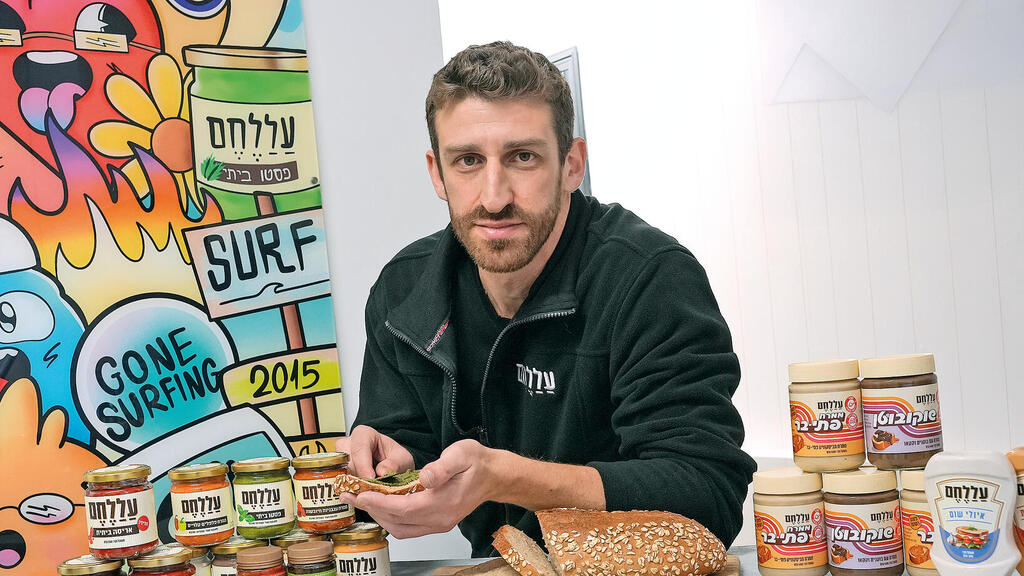
Today, 14 years later, Sherman sells more than 50% of the pesto spreads in Israel and likely buys most of the basil grown in the country for that purpose. It all stems from a recipe he developed himself, with the help of a friend’s wife — a pesto without pine nuts, to accommodate consumers with allergies, and without Parmesan cheese, for kosher reasons. It is one of the tastiest industrially produced pesto spreads on the market.
The profession: spread-maker
Sherman is the owner of the Alalechem factory in Maalot-Tarshiha, which produces eight tons of spreads a day — between 20,000 and 30,000 units daily at full capacity. That is an impressive achievement for a business that began with making 50 jars of jam at home. He no longer produces jams, but rather 21 types of refrigerated spreads and aioli, competing with Fresco, Biton, Zahavi, Olivia, Osem and others on a category shelf that continues to grow in Israel. Three major companies — Strauss, Coca-Cola and Leiman Schlussel — distribute his products, handle commercial relations and logistics, and serve as long-term partners.
He is 39, originally from Ganei Tikva. “I have one sister who’s a scientist doing a postdoc, another sister who’s a software engineer at Google who also started a forest kindergarten, and then there’s me, who makes harissa. A spread-maker,” he laughs. “Even though I’m Ashkenazi, I grew up on harissa because my aunt is married to a Tunisian. Pesto, on the other hand, I learned to make the day before I opened the factory.”
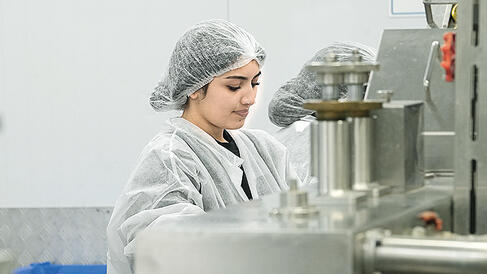
The factory in Maalot-Tarshiha
(Photo: Efi Sharir)
These days, Sherman is busy marketing the company’s Petit Beurre spread — his own idea, for which he registered a patent. The Biscotti chain will produce desserts using the spread, and Leiman Schlussel is distributing it to retail chains, alongside another new sweet spread called Choco-Butter.
“I noticed something happening on social media,” he says. “A lot of influencers we never even spoke to started sharing the spreads on their own. I only opened Instagram a year and a half ago — before that I didn’t know Nadir Eliyahu, Likush, Eden Habib or Daniel Amit. And they all shared stories about the Petit Beurre spread and it became a thing. That’s everything I dreamed of since I started working on the sweet spreads in 2021.”
You sound very emotionally connected to the product.
“That’s right. My soul is in these spreads — whole lives inside a jar. It’s everything I went through since I started producing: my parents’ health, two years when I couldn’t sleep at night because I didn’t know how I’d pay salaries in two days when there was no income coming in.”
How did your parents react to the idea of opening the business?
“I was supposed to be an insurance agent, but my parents were never disappointed in the kid who decided to sell jam. On the contrary. On the first day I opened my first stall at the Givatayim Mall, selling jam I made at home, my father sent me a message at 7 a.m.: ‘Good morning. An ancient Chinese proverb says that even a journey of a thousand miles begins with a single step. Good luck.’ I keep that message to this day. Later he came to the mall to watch me selling jam from the side. That kind of support carries you through hard times.”
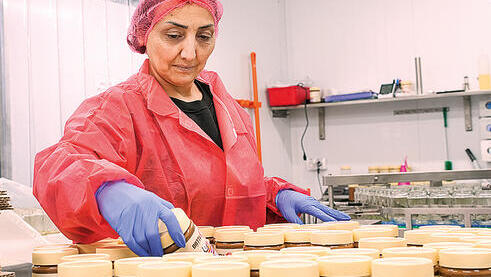
Support also came from the factory’s 25 employees, who continued working throughout the war. “My employees are the gold of the north,” he declares. “The best people in the country are there, really. I worked in high-tech, but the quality of people in the north is sky-high, without the posturing and abrasiveness of the center. When we launched the sweet spreads in September, after working so hard, I gave them a book about them and the factory, which I created using AI on my iPhone. I connected to the north through the vein, and I hope to move back there. But that also depends on my partner.”
(Photo: Efi Sharir)
Fruit headed for the trash — turned into jam
It all began after Sherman returned from a four-year post-army trip to Australia. One ordinary visit to a greengrocer set his business journey in motion. “A woman came in and asked if it was okay for her to buy fruit — she didn’t mind taking the more bruised, shriveled ones, as long as he sold them cheaply. I thought she didn’t have money, and afterward I told her quietly, ‘Listen, it’s fine, I’ll pay — buy good fruit.’ To my surprise, she laughed and said, ‘No, no, it’s fine. I make jam at home.’
“After she left, I asked the greengrocer what he would do with that fruit if she hadn’t bought it. He said it spoils every weekend and on Sunday he throws out six or seven kilos. I said, ‘Listen, I have an idea. I’ll take the fruit you’re about to throw away and make jam.’ I don’t know where the confidence came from — I had no business experience. I said, ‘I’ll make jam and we’ll sell it here, fifty-fifty.’ He said, ‘That’s fine, but do you know how to make jam?’ I said, ‘No, but there’s Google.’ This was before ChatGPT. I saw it was 50% fruit, 50% sugar, and that was it. I started making jam and called it Ribal'e.”
A designer friend made him a label, 1950s style. Each month he brought the greengrocer 50 jars to sell. Sherman had started studying business administration and thought that if he did this with two more produce shops, it would cover rent and expenses. He began going to all the greengrocers in the neighborhood and buying their leftover fruit. Everyone was happy to sell cheaply rather than throw it away. He started making jam and selling it at a farmers market stall at the Givatayim Mall, and it quickly caught on.
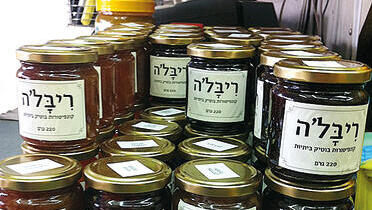
Ribal'e jams
Within months, he quit his job and opened another stall in Herzliya. Soon there was a third.
Within a few months: a ton of jam a month
“One day a guy came up to me at the mall and said he loved the jam and asked if I sold to delicatessens, because he owned one. I said, of course — completely invented it. Of course, that’s my forte. He started buying for the Pat Lechem deli in Givatayim, and it sold well. Then I went to the grocery store where I shopped every week and he gave me a chance, then the one next to it, and so on. I reached a point where I had 10 customers and three stalls a week, and I was already making a ton of jam a month.”
What kinds of jam did you make?
“Strawberry, of course. Fig, pear and apple with cinnamon. My neighbors didn’t understand why my gas tank was replaced so often — my stovetop was running nonstop, every day, all day. One neighbor even set me up with an older man who taught me how to make apricot jam. Older women at the mall helped too: ‘You know what goes well with figs? Clove.’ Eventually I upgraded — for holidays I’d make things like pumpkin jam.”
At the Interdisciplinary Center where he studied, people didn’t know what to make of it. “One time a woman heard I made jam and probably wanted to needle me,” he recalls. “We were sitting at a table and suddenly she says, ‘You know what I think is the most pathetic thing for a man? Making jam.’ I told her, ‘More embarrassing is taking money from your parents.’ Not that it’s bad — but that’s what came out. It was very belittling, but my parents raised me to be proud of what I do.”
Did you manage to study?
“I stayed enrolled the whole time, but I didn’t attend much. The lecturers were very understanding. Two lecturers bought from my stall. Friends from school would ask me to buy for their mothers. So the one day a week I came to class, I’d show up with bags of jam — for this one’s mom, for that one’s friend. It was nice.”
Choosing a name and growing
During that period, Sherman was essentially running a small factory out of his apartment. Jars of jam were stacked under the TV in the living room. The piano doubled as a label-gluing station. “I didn’t really have a home,” he says. “After a year like that, I said, OK, this can’t go on. Either you shut it down and tell your kids one day as a nice story, or you take a risk and open a small factory.”
And there’s the Health Ministry issue.
“Absolutely. At that stage, everyone who bought from me knew it was homemade. I didn’t want to take unnecessary risks, so I said, okay, I’ll open a business.” He took out a loan and opened a small factory in Petah Tikva’s Kiryat Aryeh industrial zone — next to a carpentry shop, with a welder above him, in an area unrelated to food production.
“In the mornings I’d drive around to greengrocers, delis, health food stores, walk in with samples and say, ‘Hi, I’m Ziv, I opened a business, these are our spreads and jams, want to start buying?’ I tried to recruit at least five to seven customers a day. After two or three months, I already had 50 to 100 customers.”
At that stage, he decided to make spreads as well. “I said, if you already have a manufacturer’s license and jars and suppliers, make more products. I thought a long time about a name for the spreads. I had many opportunities to choose names that were 70% or 80% good. I didn’t compromise, thank God, because I’m in love with the name Alalechem.”
Yes, it’s a great name.
“I think it helped us succeed. It makes people smile.” He learned how to make pesto the day before opening the factory. He called a friend’s wife who had studied cooking with Estella and told her, “I need spreads. She said: ‘OK, pesto: basil, garlic, salt, oil — grind it in a food processor. Tasty? Write it down. Tomato spread: sun-dried tomatoes, oil, garlic, salt. Tasty? Write it down.’ Within three hours I had all the recipes. Some of them are still basically our recipes today, and people like them.”
What about the jams?
“I gave them up. Jam needs uniqueness, which I was still searching for. As soon as I opened the factory, I brought in two people I found through job ads. One had kitchen experience, the other had no experience at all, so he worked closely alongside him. A third employee spent the day sticking on between 150 and 200 labels, which was our daily output, and I washed dishes at the end of the day.
“In the mornings I’d get in the car and start going around to greengrocers, delicatessens and health food stores, walking in with a few samples. ‘Hi, my name is Ziv, I opened a business, these are our spreads, these are our jams — do you want to start buying?’ I tried to sign up at least five to seven customers every day. After two or three months, we already had 50 to 100 customers.”
The collapse — and survival
After a year and a bit, Sherman decided to grow and become more efficient. “I went on an adventure — and that’s where the trouble began.”
He took out maximum loans from four banks simultaneously and moved to a 1,500-square-meter facility in Maalot-Tarshiha, requiring renovations of about 4 million shekels. Sales didn’t justify it. “I was at 250% credit relative to turnover. That’s basically suicide,” he says. He bought machines suited for much larger businesses and hired too many employees. At the same time, personal tragedy struck: on the day the factory opened, his father was diagnosed with cancer. His father later died, and his mother suffered a stroke and was left with aggressive Alzheimer’s disease.
“There was no one to teach me how to work at those volumes. A lot of mistakes were made. At my father’s shiva, a bank representative showed up — I thought he came to comfort me. After two minutes he said the branch manager wanted me to write a check from another account or they’d bounce one. That’s when it really felt like pulling a plane up a meter before crashing.”
Did you consider declaring bankruptcy?
“I couldn’t. My father believed I could get out of any situation. And my mother always said, ‘Don’t owe anyone a single coin.’”
For two years he negotiated with suppliers, cut costs and scraped by. At one point, his electricity was cut off in his rented apartment. The disconnection notice is still framed in his office today.
The Strauss partnership
A turning point came when he met a Strauss product development technologist at a food exhibition. “I told them, ‘I believe in the Alalechem brand.’ We checked sales data — and I was selling more in my niche than they were. That’s how the partnership began.”
Strauss began distributing Alalechem products without taking equity. “Financial institutions calmed down. I focused on what I’m good at — creating quality spreads. Overnight, I went from 300 to 400 sales points to thousands.” Today, Coca-Cola also distributes his products. “I messaged the CEO on Facebook,” he says. “He agreed to meet.”
Have you raised prices?
“Not even once, even though it could help us grow as a manufacturer. I was worried about criticism from consumers and retailers. So I prefer to become more efficient — through automation, by keeping the existing team and by smarter purchasing.”
A life project in a jar
After everything you have been through, why do you call the Petit Beurre spread your “life project”?
“Because I’ve been working on it for four years. This series is dedicated to my parents, who loved children so much. The Petit Beurre spread is in memory of my mother. Another product will be in memory of my father. I also hope to donate a fixed percentage of sales each year to sick children.”
And the dream?
“My long-term dream is that one day, after I have financial security, I’ll retire and become a teacher or a social worker.”
First published: 18:48, 01.23.26