

In the summer of 1946, as Europe struggled to emerge from the wreckage of World War II and empires began to fracture, two men fighting for national independence found themselves living under the same roof in a Paris luxury hotel — and briefly contemplated an idea that today sounds almost inconceivable: the possibility of a Jewish government-in-exile on Vietnamese soil.
The unlikely encounter took place at the Hotel Le Royal Monceau, a gathering place for diplomats, resistance figures and political exiles in the immediate postwar years. One guest was David Ben-Gurion, then head of the Jewish Agency and the most prominent leader of the Zionist movement. The other was Ho Chi Minh, prime minister of the newly proclaimed Democratic Republic of Vietnam and the face of his country’s struggle to break free from French colonial rule.
Ben-Gurion had arrived in Paris only days after what became known as “Black Saturday,” June 29, 1946, when British authorities arrested thousands of Jews across Palestine and detained much of the Zionist leadership. Wanted by British forces and unable to return home, Ben-Gurion took refuge in France, where Paris had become the main hub of Zionist political activity in Europe.
Ho Chi Minh, meanwhile, was in the French capital seeking international recognition for Vietnamese independence. Though the Japanese had occupied Indochina during the war, France was attempting to reassert control over its former colony. Ho hoped negotiations in Paris might spare Vietnam another conflict.
According to Ben-Gurion’s later recollections, recorded years afterward by Israeli journalist Shmuel Segev, the two men discovered each other at the hotel and began meeting daily. For nearly two weeks, one would climb a flight of stairs to the other’s room, and the conversations stretched for hours.
Ben-Gurion described Ho as soft-spoken, weary and intensely focused on his people’s future. He said the Vietnamese leader avoided communist rhetoric and preferred to present himself as a nationalist fighting for independence rather than as a revolutionary ideologue.
During one of their discussions, Ben-Gurion spoke candidly about the Zionist predicament — a stateless people, restricted immigration, British opposition and rising violence in Palestine. Ho responded with a striking proposal: he suggested that Ben-Gurion establish a Jewish government-in-exile in North Vietnam.
“He proposed that I immediately establish a Jewish government-in-exile on Vietnamese territory,” Ben-Gurion later recalled. “I thanked him and said that when the time came, I would consider his offer.”
Ben-Gurion said the idea, though offered sincerely, was never realistic. Zionist leadership was committed to establishing a state in Palestine, not elsewhere. Still, the conversation left a lasting impression.
“I am certain that we shall be able to establish a Jewish government in Palestine,” Ben-Gurion reportedly told Ho. He added that if he ever wrote to him, the Vietnamese leader might invite him to visit North Vietnam.
Ben-Gurion also said he learned to track the progress of Ho’s negotiations with the French by watching the red carpet outside the Vietnamese leader’s door. At first, it stretched from the street through the lobby and up the staircase. Gradually, sections were removed.
“When the carpet outside his door was removed, I knew the talks had failed,” Ben-Gurion recalled. “A few hours later, he came to my room to say goodbye. He was tired, worn out and disappointed, and he told me nothing remained but to fight.”
Within months, the First Indochina War erupted between Vietnamese forces and France.
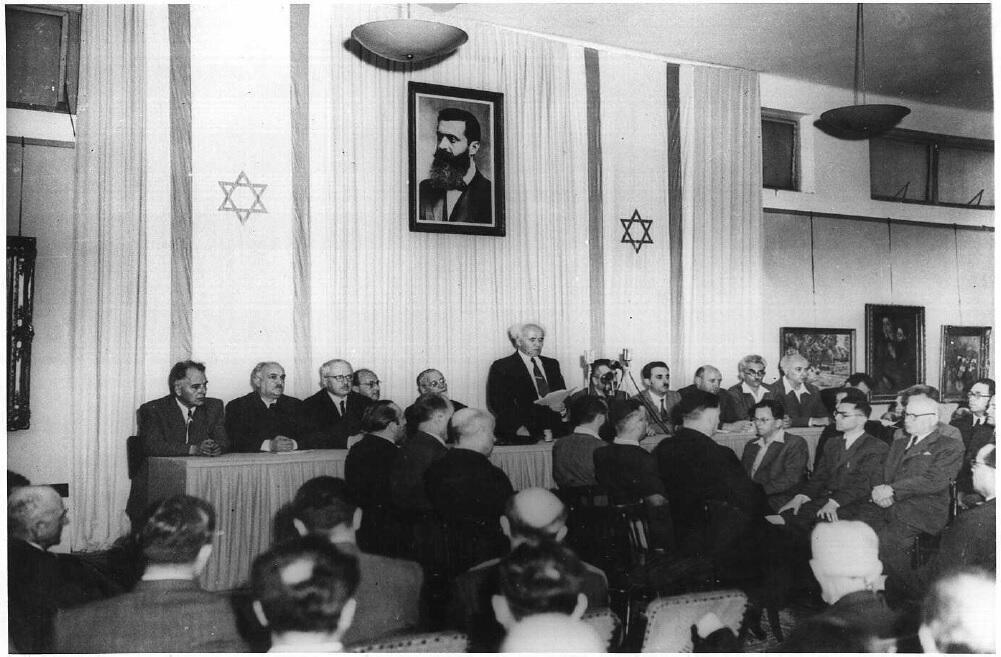
Two years later, on May 14, 1948, Ben-Gurion stood in Tel Aviv and declared the establishment of the State of Israel. The following day, armies from Egypt, Syria, Jordan and Iraq invaded. Israel survived the war and secured its independence, though conflict would continue for decades.
Vietnam’s path proved longer and bloodier. After years of fighting, the country was partitioned in 1954 under the Geneva Agreements — which Israel supported — dividing North and South Vietnam. Full independence and reunification would not come until 1975, after decades of war that included extensive American involvement and the deaths of millions of Vietnamese and nearly 60,000 U.S. troops.
Diplomatic relations between Israel and Vietnam did not materialize during Ho Chi Minh’s lifetime. North Vietnam aligned itself closely with the Soviet Union, China and Arab states, while Israel, on the opposite side of the Cold War divide, provided limited technical assistance to South Vietnam without formal ties.
In June 1967, during the Six-Day War, Ho Chi Minh sent a message to Egyptian President Gamal Abdel Nasser condemning Israel, describing it as an outpost of Western imperialism. By then, Vietnam itself was deeply entrenched in war.
Ho Chi Minh died in September 1969, six years before the fall of Saigon and the reunification of Vietnam. Ben-Gurion died in December 1973, having spent his final years in retirement at Kibbutz Sde Boker.
Israel and Vietnam would intersect again in an unexpected way in 1977, when an Israeli merchant ship rescued dozens of Vietnamese refugees at sea. Then-prime minister Menachem Begin likened their plight to that of Jewish refugees turned away during the Holocaust and opened Israel’s doors to several hundred Vietnamese “boat people” between 1977 and 1979.
Formal diplomatic relations between Israel and Vietnam were finally established on July 12, 1993, with Israel opening an embassy in Hanoi later that year.
The fleeting Paris encounter between Ben-Gurion and Ho Chi Minh remains a historical curiosity — a moment when two revolutionary leaders, both stateless or newly displaced, briefly imagined alternative futures for their peoples. In a postwar world still fluid and uncertain, even the most improbable ideas could surface in a hotel corridor.