

On the northbound Ayalon Highway at 2 a.m., inside a car pulled over on the side of the road, loud sobs could be heard. Inside sat Iska Hajeje, then in her early 20s, in the midst of yet another heartbreak. Shortly before, she had broken up with a Dutch man she had been dating. In that moment of profound loneliness, Hajeje did what a girl raised in the home of a community rabbi knows best: she opened her heart to God.
“I told Him: I’m making a deal with You — find me the right man, and I promise I’ll erase my past,” she says, quoting a rabbinic teaching: “Open for Me an opening like the eye of a needle, and I will open for you an opening like the entrance to a hall.” In other words, God asks for a small effort and in return gives you the world.
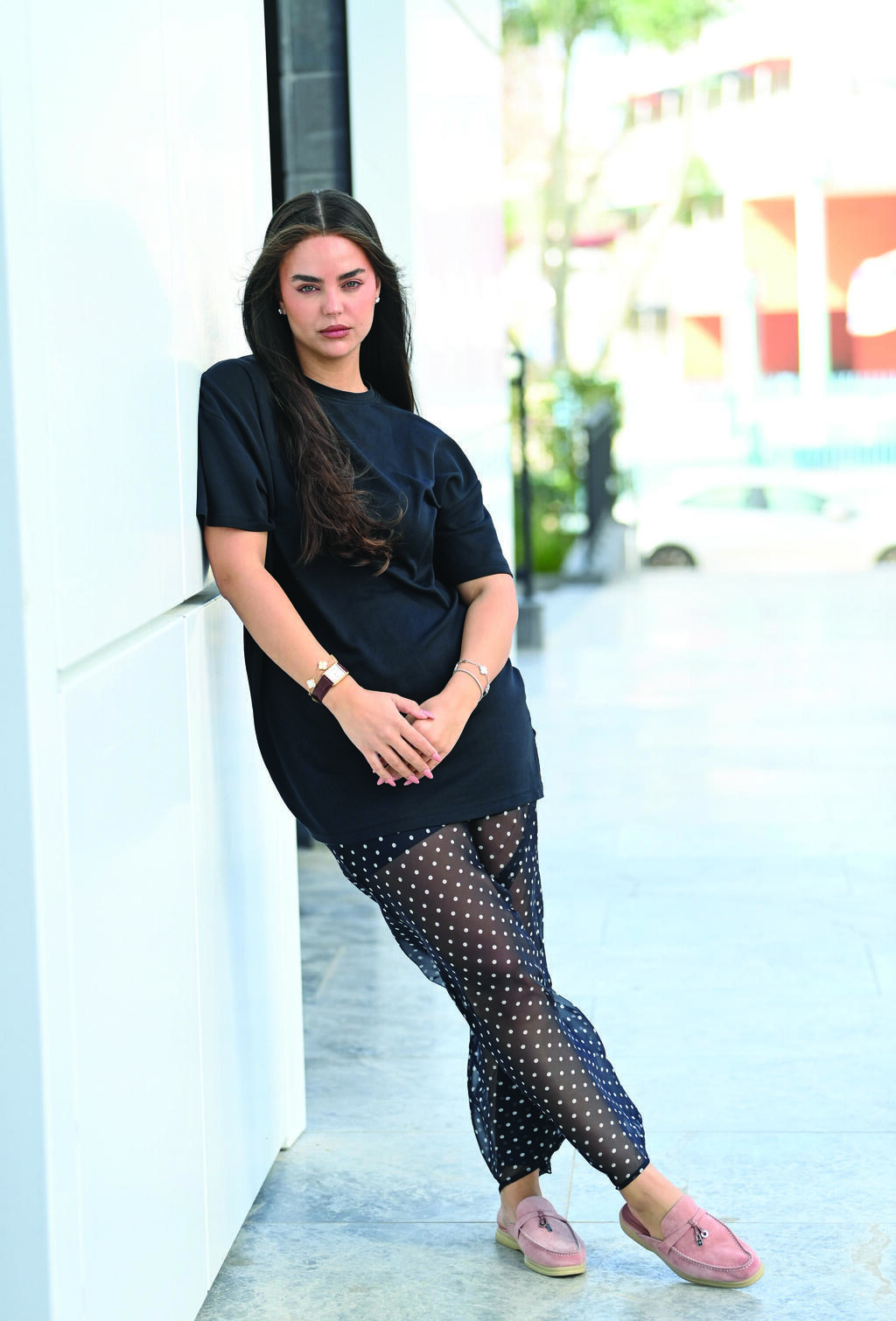
Four months later, she was standing under the chuppah, the traditional Jewish wedding canopy, with Jeremy, a student of her father’s. Today they are parents to Luria, a 16-month-old boy named after the Arizal, the revered 16th-century kabbalist Rabbi Isaac Luria. But the road to that wedding did not follow the customary path of arranged matches in the ultra-Orthodox sector. It ran instead through nightclubs in Tel Aviv and hotels in Dubai.
Secret meetings with boys
Hajeje, 28, was born in Netanya, the second of five children in an ultra-Orthodox home. Her father is a rabbi, and her mother comes from a Bnei Akiva background, a religious Zionist youth movement. While her clothing included white tights and button-down shirts, it was not a completely sealed bubble — at her grandparents’ home she watched cartoons on television.
Iska was always the loud one. “I was the one who took all the attention in the family,” she says. “At the Sabbath table I was always the one making the most noise.”
The difficulties began at school. Only recently, during emotional therapy she is undergoing, have the memories she repressed begun to surface. “I erased memories of the bullying I went through at school,” she says. “Memories of girls who didn’t want to sit next to me, who threw my bag out the window, games where I was never chosen. On the bus I always sat alone in the back, and to get attention I made a lot of noise.”
Toward the end of elementary school, she befriended what she calls “the wrong girl.” “One Sabbath she said her brother was picking her up from an apartment and asked me to come along. We got there, and her brother, a yeshiva student, was there with his friends. They were excited to see girls, we were excited to see boys. It was the first time a boy paid attention to me, and I loved how it felt. Nothing happened, not even touching, but is there a better feeling than finally being noticed?”

Iska as a teen
(Photo: Courtesy)
Week after week she returned to that apartment. Her parents, of course, did not know. “I thought if they found out, the sky would collapse on them.” Before entering the Beit Yaakov high school, the ultra-Orthodox girls’ school system, she took a step back. “I knew they had their eye on me, and that if anyone found out, I wouldn’t be accepted. So I stopped going. I got into high school with blood, sweat and tears, and probably also with a donation from my grandfather.”
A year later, at a family event, she saw a boy from that group. She went back, this time with other girls from school. “These meetings made me popular,” she says. “The girls heard I was going and wanted to come too.”
One day, during a religious law class, her name was called over the school intercom and she was summoned to the principal’s office. “The principal sat there, looked at me and said, ‘We know everything — that you go to an apartment on such-and-such a street, with people named this and that.’ I denied it, and she called one of the girls, put her on speaker, and I heard her say, ‘Iska Hajeje took us there, and she’s not a virgin.’”
“I was so shocked by what I heard. I thought about the disappointment my parents were about to feel. I knew that no matter how much I explained that no man had ever touched me, it wouldn’t help.”
Hajeje was expelled. “My parents took it hard. I had never seen such pain as they had at that time.”
Her parents refused to give up on her education. “My father went to Rabbi Chaim Kanievsky, a leading ultra-Orthodox authority, who wrote a letter to the principal asking her to take me back. I sat outside her office for a week reading Psalms, until the guard was instructed not to let me in. I sat outside the gate in the sun and kept reading Psalms, and not one girl even looked at me, so they wouldn’t become a target for the principal.”
As is often the case in the ultra-Orthodox community, rumors spread. No school would accept her. Her parents enrolled her in a state religious coeducational school, where she began 10th grade. Four months later, she dropped out. “My academic level was close to zero,” she says. “They didn’t know what to do with me. I stopped studying and never went back to school.”
A short marriage and life in Dubai
At 18, while working as a waitress at an event hall in her city, she met a Jewish man of Italian descent at her father’s synagogue. “Drop-dead gorgeous, I’m not embarrassed to say,” she says. He was five years older, spoke little Hebrew and some English. “We got married for all the wrong reasons,” she admits. “There was no communication between us. Our lives didn’t match.”
In distress, she turned to her father. “I took him out for coffee and said, ‘I’m lonely, I’m not happy.’ He asked, ‘Did you get your period this month?’ I said no. He said, ‘Then let’s wait. If you’re not pregnant and you still want to divorce, your mother and I are behind you.’”
Eight months later, she divorced. “My parents deserve a medal. My father is a community rabbi, and his daughter, with all the rumors, caused him grief and embarrassment — it’s not obvious to accept that. My mother always said, ‘I prefer my daughter do what she wants in front of my eyes, so I can supervise.’ That’s the mindset of a lioness of a mother. Now that I’m a mother, I appreciate her even more. Today I don’t take a step without consulting her.”
The divorce marked the start of turbulent years. Hajeje, who grew increasingly distant from religion, began going out to nightclubs in Tel Aviv. “I had a need for excitement. Suddenly I was exposed to the world. I told myself — I’ll switch from skirts to pants, I’ll travel, I’ll have fun.”
She moved through a series of relationships, some with non-Jewish men, until she landed in Dubai at the end of 2020. “I had just gone through a painful breakup when a friend called and said they were flying to celebrate New Year’s in Dubai. A short trip, 48 hours. He said they’d pay, just that I come. I told him I don’t sleep with men, I have boundaries, and he said he knew a woman staying at the hotel and I could sleep in her room.
“I didn’t like Dubai at first. Everything felt too big, too excessive, too rich, too beautiful. At the end of the vacation I got to the airport and realized my flight had been moved up and I didn’t know. I sat there and cried, I wanted to go home. I didn’t know what to do, I had no money. I went back to the hotel to that woman, and she said, ‘Stay with me, I’ll pay.’ That evening we went out to a restaurant and I met a charming French Jewish man. I stayed there until my visa ran out.”
She returned to Israel, and after some time began another relationship — with a Dutch man who had come to Israel for work. A whirlwind romance, talk of conversion to Judaism, thoughts of marriage — and heartbreak. “It turned out he wasn’t faithful,” she says. “I couldn’t believe it. I was completely broken. Shattered.”
An Egyptian boyfriend and a match
When she returned to Israel, she received an offer from the Chabad center in Dubai to manage its kosher restaurant. “They were looking for someone who speaks English, French and Hebrew and remembered me,” she says.
In Dubai, Iska became “Jessica.” She worked as a restaurant manager and entered a relationship with Tony, an Arab Christian man from Egypt. “I met him at an upscale club, he looked me in the eyes and I knew there was no turning back. But then restrictions started: when my cousin came to Dubai, Tony said, ‘You’re not going out with men.’ When we went to the gym he said, ‘Don’t wear shorts.’ Then I wanted to fly to my sister’s wedding and he threatened that if I flew, it was over. I chose to leave, and I no longer wanted to return to Dubai, even though I had everything there: work, housing and friends.”
Did your parents know about him?
“Yes. My mother prayed for me every day. I believe she’s the one who brought Jeremy to me.”
Her husband Jeremy, a student of her father’s, met her in Dubai when she was still with Tony. He did not judge her. “He suggested I spend a Sabbath with him at Chabad. I told him, ‘I don’t keep the Sabbath and I have a boyfriend — if he catches you, God help you.’ He said, ‘Your mother told me to take care of you.’ That convinced me to join him. He booked me a room at a nearby hotel so I wouldn’t violate the Sabbath, and like in romantic comedies there was only one room left. I told him, ‘If I find out you did this on purpose, I’ll kill you.’ In the end I slept in the bed and he on the couch, and Tony didn’t know.”
At the time she did not even give him a second look. “He was heartbroken after a breakup with his ex. All weekend he told his story to anyone who would listen — and even those who wouldn’t. When the Sabbath ended, I thought I never wanted to see him again.”
Then came that turbulent drive on the Ayalon Highway and her prayer to God. A few days later, Jeremy showed up at her parents’ home and suggested they meet through a match, the traditional dating process in religious communities. “I told him, ‘Are you sure? I’ve dated non-Jews, I don’t have the nicest past.’ He said, ‘So what? That doesn’t say anything about you.’ It was the most beautiful thing he could have said to me.”
Looking for attention and drama
Today, Hajeje is a content creator. She has 53,000 followers on Instagram and hides nothing from them — not the crises in her marriage and not her complex religious identity.
In a conservative country like ours, how do people respond to your story — a girl from an ultra-Orthodox home who dated non-Jewish men?
“My audience has been with me since my first marriage. They know everything I’ve been through, they know every partner I’ve had. Every project I do, every mood I go through, they’re there to hug, love, support and not judge. The ones who judge are men — they write to me, ‘How did your husband take you?’ ‘Who marries someone who assimilated with non-Jews?’”
Is there a part of you that creates drama for Instagram?
“In my story there are the same patterns from childhood — I was always the one looking for attention and drama. It’s not that I invented a life story, I chose to share it. In contrast to the falsehood on Instagram, I choose truth, to show myself as authentically as possible, with the difficulties and the outbursts. Still, I don’t post everything in real time. The crying in the car, for example, I posted only months later.”
How do you define yourself religiously today?
“I’m the strangest kind when it comes to religion. There are days I wear full head covering or a wig, and days I go to the beach in a bikini. I’m too ultra-Orthodox for the secular world and too secular for the ultra-Orthodox, and I’m finding my own path with religion in a way that suits me.”