

European capitals are considering recognition of a Palestinian state, with Spain and France signaling support, Canada expressing alignment, and the United Kingdom weighing a conditional approach. The debate comes as the war in Gaza continues with no clear end in sight, fueling growing international calls for a political response. But legal and political experts caution that recognition alone may remain largely symbolic, and the path to actual statehood is filled with legal and practical obstacles.
Professor Robbie Sabel, a scholar of international law at the Hebrew University of Jerusalem, said that statehood under international law depends on specific criteria that remain unmet in the Palestinian case. “A state has to fulfill certain conditions to be regarded as a state,” he said. “It must have an effective government and a clearly defined territory. Many of the Palestinians’ powers are controlled by the Israeli authorities. They cannot enter or leave without Israeli oversight, and Israel controls the air and communications,” he added.
Gallery
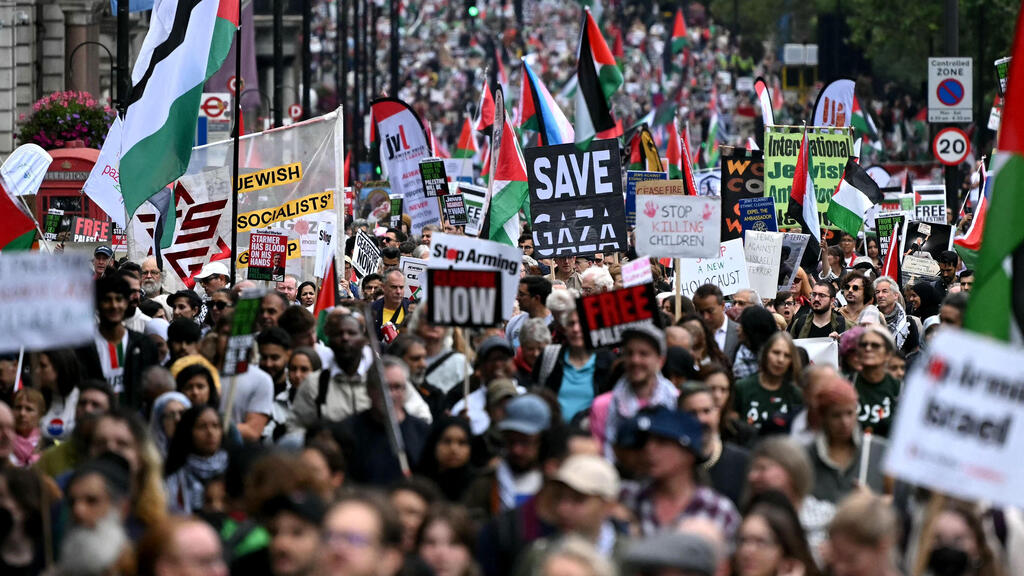
Pro-Palestinian activists march in London against the war in GAza on a national day of action for Palestine
(Photo: Justin Tallis/AFP)
Sabel emphasized that recognition, while politically significant, does not automatically create a state. “These are statements of aspiration,” he said. “Western states would like to see a Palestinian state, but stating that doesn’t make it a state. For that to happen, there would need to be agreed borders and effective governance and, at the moment, neither exists.” He also noted that such recognition “would in no way serve Hamas’ interests or agenda,” as Western governments are unlikely to legitimize the group through political gestures.
Amjad Salfiti, a London-based human rights and international law attorney, described the recent wave of recognition talk in similar terms. “The media makes it sound as if these countries are declaring a real Palestinian state with sovereignty and borders,” he said. “No, it’s purely symbolic—an act of solidarity, tapping someone on the shoulder and saying: we are with you. But on the ground, it remains academic until the occupation ends or the international community enforces change,” he added.
Both experts pointed to the complex realities that obstruct state formation. The Palestinian territories are fragmented: Gaza is controlled by Hamas, the West Bank is under limited Palestinian Authority administration, and East Jerusalem has been annexed by Israel. Sabel noted that fragmentation alone does not disqualify a claim to statehood—“a state can have separate parts, like Alaska and the United States”—but he added that effective control is lacking. “Clearly, the Palestinian Authority does not have that in Gaza,” he said.
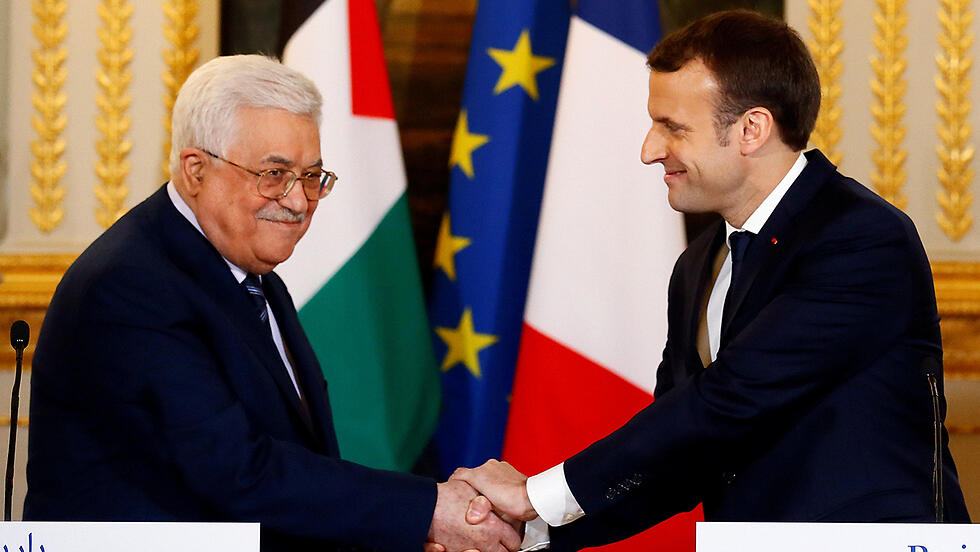
French President Emanuel Macron with PA President Mahmoud Abbas
(Photo: Reuters)
Salfiti stressed that territorial and demographic shifts have further complicated the issue. “The map looks like a leopard pattern,” he said. “Israeli settlements and the forced displacement of Palestinians are reshaping the territory in a way that destroys the idea of a permanent population and a connected state. Under the Geneva Convention, you cannot expel people or implant your own population. Israel is doing both, creating a situation where the legal foundations of statehood are deliberately weakened,” he added.
The future status of Jewish settlers in the West Bank and Arabs in East Jerusalem introduces another layer of complexity. Sabel argued that the presence of minorities does not preclude statehood. “States can and do have minorities,” he said. “If there were a Palestinian state, it would be for the Palestinian Authority to decide whether Jews in the West Bank could become residents or citizens. Their presence does not make statehood impossible,” he added.
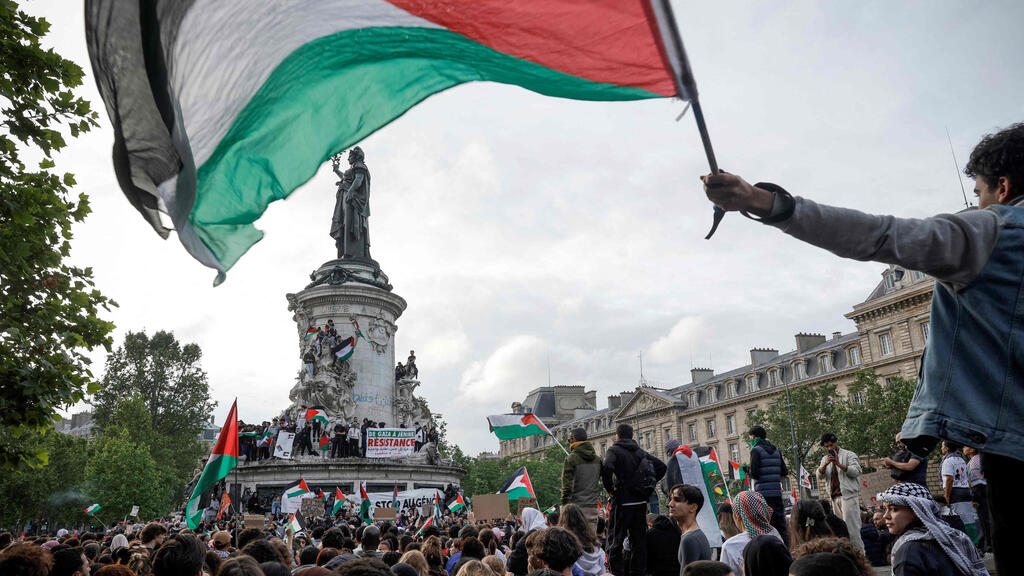
Pro-Palestinian march in Paris
(Photo: Geoffroy Van Der Hasselt / AFP)
Salfiti countered that the settlement enterprise blurs sovereignty in more fundamental ways. “Israel behaves as if its settlements are extensions of its state, with full security and freedom of movement,” he said. “That’s like an octopus stretching arms into someone else’s territory. It’s very hard to call that land the foundation of a sovereign Palestinian state,” he added.
Both experts agreed that European recognition could carry pressure implications. Sabel said that if recognition coincides with European perceptions of Israeli violations, diplomatic or economic responses may follow. “There’s a lot of Western anger about Israeli activities in Gaza,” he said. “On that front, they may take action, possibly through sanctions or legal measures, especially if they frame Israeli operations as inconsistent with international law.”
Get the Ynetnews app on your smartphone: Google Play: https://bit.ly/4eJ37pE | Apple App Store: https://bit.ly/3ZL7iNv
Salfiti observed that recognition also touches on the principle of self-determination and may become politically contentious if conditioned on excluding Hamas. “If recognition is tied to removing a major political faction from the Palestinian landscape, it raises doubts about whether this is truly about the Palestinian people’s national rights, or primarily about meeting Israel’s security concerns,” he said. He added that any such moves would likely be inconsistent across the continent. “Europe is not uniform,” he said. “Spain or Ireland may push for measures against Israel, while Germany or Britain remain more cautious. Recognition could be the prelude to pressure, but whether it translates into real punishment depends on political will.”
Sabel reiterated that diplomatic statements do not create legal obligations. “Recognition by European countries would not create new legal obligations for Israel,” he said. “It still requires two to tango. Israel and the Palestinian Authority would have to negotiate powers and borders, and that has not happened yet.”
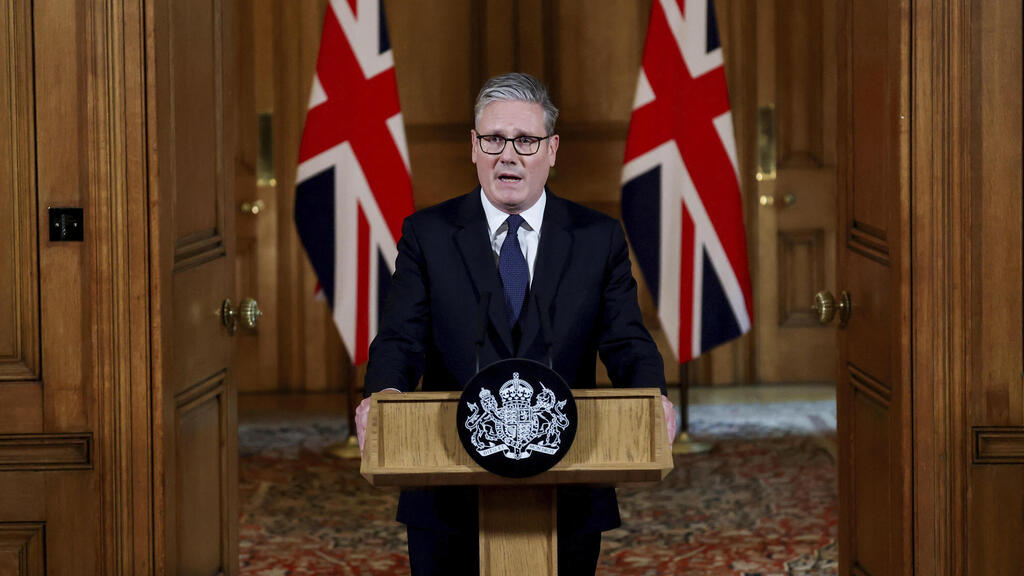
British Prime Minister Keir Starmer: If Israel does not act to end the "appalling situation" in Gaza - we will recognize a Palestinian state
(Photo: Toby Melville, Pool Photo via AP)
Both experts expressed concern that symbolic gestures without follow-up could undermine diplomacy. Salfiti warned: “If the world recognizes Palestine and does nothing, that will be the end of the diplomatic route. It would crucify international law. Imagine a world where occupation and expulsion are normalized—we would return to the instability of the pre–World War II era.”
Sabel agreed that negotiations remain the only viable path. “International pressure on Israel may increase, but the only way this can happen is to sit and negotiate,” he said. “Without agreed borders and effective governance, recognition remains symbolic.”
Salfiti, while acknowledging those limits, said symbolic moves still have value. “Symbolic recognition is still positive,” he said. “When you have nothing, anything can be something. But without concrete steps, we remain in a stalemate that erodes hope, law and global stability.”
This article is written by Giorgia Valente and published with permission of The Media Line