


For years, we assumed our children would be smarter than we are simply because the world keeps advancing. The logic seemed straightforward: more education, more accessible knowledge, more technology, more tools for children should mean greater cognitive ability. As the world progressed, so would the mind. It became something close to a modern article of faith. If there was one promise to rely on, it was that the next generation would be sharper, faster and better equipped. But in recent years, something has begun to shift.
Across several Western countries, international assessments no longer show steady improvement. In some cases, scores have plateaued. In others, they have declined. The question is no longer theoretical: For the first time in decades, could the younger generation be showing lower cognitive performance than those who came before?
Gallery

For the first time in history, declining cognitive performance in the next generation
(Photo: Shutterstock)
The issue has moved beyond parental conversations and opinion columns. It was recently discussed in a formal hearing in the U.S. Congress on the impact of screen time and educational technologies on children and adolescents. Two facts framed that discussion. Over the past few decades, education in Western countries has become more expensive, more technological and more accessible. Yet measures of reading literacy, numeracy and executive function no longer show the consistent gains many expected. In some areas, experts now speak of stagnation and even regression.
Dr. Jared Cooney Horvath, a neuroscientist specializing in brain and learning research, offered a blunt assessment in his congressional testimony. Over the past 20 years, he argued, it is possible to identify not only a slowdown in progress among young people, but deterioration in some indicators. Horvath does not claim children are generally “less intelligent.” He points instead to troubling movement in measures that education systems and societies consider foundational skills: reading, mathematics, science, sustained attention and task persistence.
Among the data he cites are results from PISA, the OECD’s international assessment program that evaluates the reading, math and science skills of 15-year-olds every three years across dozens of countries. In recent cycles, many countries have recorded stagnation or declines in certain domains. National assessments in the United States and other Western countries paint a similar picture, with the COVID-19 pandemic and remote learning acting as force multipliers. Screens were no longer supplementary tools. They became the infrastructure of schooling.
Horvath highlights what he sees as a central variable: the rapid and widespread penetration of screens and educational technologies into children’s learning environments. His argument goes beyond the claim that “more screen time is bad.” He urges serious consideration of whether prolonged screen exposure alters how children process information: less continuity, more skipping; less accumulated cognitive effort, more rapid responses to brief stimuli. Deep learning, he argues, requires sustained attention, repetition and effort. These processes may be compromised in a digital environment that rewards constant task switching and normalizes distraction.
The debate carries additional weight because of history. For most of the 20th century, researchers documented steady increases in IQ scores and intergenerational cognitive measures, a phenomenon known as the Flynn effect. In simple terms, each generation tended to outperform the previous one. If certain measures are now declining, this may represent more than a minor fluctuation. It could signal a turning point. And if it is a turning point, it raises fundamental questions: Is technology enhancing thinking, or subtly reshaping how we learn, focus and remember without our noticing in real time?
Screens enter the classroom
Dr. Amir Gefen, a researcher and lecturer in artificial intelligence at Bar-Ilan University and an academic adviser to Israel’s Education Ministry, says that before ideological arguments begin, the data must be acknowledged. “We are indeed seeing a decline in achievement,” he says. Gefen notes that around 2010, student performance began to dip in several international analyses. Those years coincide with the mass adoption of smartphones and social media. The screen was no longer a shared computer in the living room. It became a constant presence in the palm of one’s hand.
 Dr. Amir Gefen, Bar-Ilan University Photo: Einat Mayo
The United States, he says, has an advantage in its long-running standardized assessments, which make trends easier to track. Causes may be debated and confounding variables proposed, but the overall trajectory is difficult to ignore. “The same data exist here in Israel,” Gefen says. “Results in international standardized tests are also declining. In some cases, sharply, as in the TIMSS assessment.”
Prof. Horowitz-Kraus said: 'In studies we conducted in the United States, we examined the link between longer screen exposure among children ages 3 to 5 and brain structure, not just function. We found an association between the organization of white matter, the axons, the parts of nerve cells that transmit electrical information from one region of the brain to another, and the amount of time children were exposed to screens'
Horvath’s concern, however, extends beyond averages. He questions whether the fundamental learning environment has shifted without sufficient reflection. Classrooms were once primarily human spaces. They are increasingly digital. Perhaps it is not children’s abilities that have changed, but the conditions under which they develop. “According to Horvath, humans learn better through interaction with another human than through a screen or keyboard,” Gefen says. “This claim is grounded in neuroscience research. The curriculum has not changed dramatically. So what has? The entry of technology.” He acknowledges that causality in the social sciences is complex and that other variables may be involved. Still, the timing is striking.

Data in Israel show a similar picture: a classroom in Israel
Horvath estimates that today’s children spend roughly half their waking hours in front of screens. Out of 24 hours, subtract about eight hours of sleep, leaving 16 waking hours. Of those, roughly eight are spent facing a digital display. “That is a fact,” he says. “And it is relevant in Israel as well. Children’s eyes are not on a human face, but on a digital screen.”
Inside the brain
Not all researchers rush to embrace sweeping conclusions. Prof. Tzipi Horowitz-Kraus, head of the Child Brain Imaging Lab at the Technion’s Faculty of Education in Science and Technology and Faculty of Biomedical Engineering, urges caution. “It is important to approach this carefully,” she says. “Scientific research requires clear definitions, rigorous methodology and peer review.”
Scientific journalism, she notes, relies on studies that undergo scrutiny by other researchers who examine methodology, data quality and statistical analyses to ensure robust samples and appropriate tools. “That said, I do think there is reasonable ground to assume the findings align with what we see in our own lab,” she adds.
 Prof. Tzipi Horowitz-Kraus, The TechnionPhoto: Nitzan Zohar
Her laboratory examines how environmental factors influence children’s learning abilities, particularly executive function, attention, reading and language. Unlike standard paper-and-pencil tests, her team measures brain activity directly using MRI and EEG during task performance. “These tools allow us to examine mechanisms,” she explains. “We can see which attention networks are engaged when reading from a book versus a computer, and which networks activate when a child listens to a story from a tablet versus a printed book.”
The findings are tangible.
In children ages 2 to 4, simply the presence of a mobile device during parent-child interaction reduces shared attention, even if the device is not actively used. EEG measurements taken simultaneously from parent and child show diminished synchrony during story reading when a device is present. In slightly older children whose parents read to them from a tablet rather than a printed book, researchers observed lower attention directed toward the parent. The device itself becomes the focal point. Children repeatedly attempt to touch or pull it closer, while the narrative recedes.
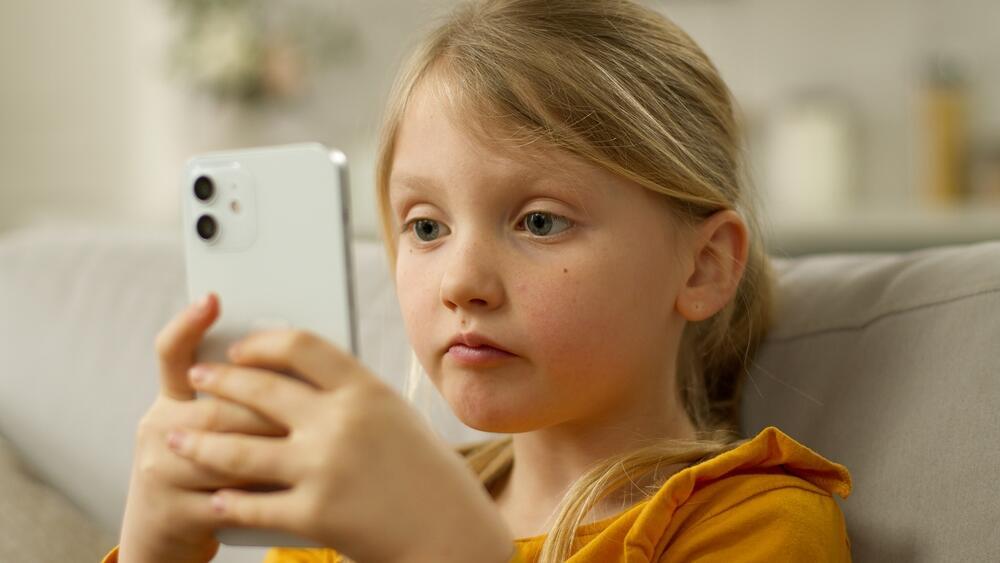
Studies find brain structure changes in children after screen exposure
(Photo: Shutterstock)
In experiments with 6- and 7-year-olds performing simple computer tasks, the mere presence of a phone in the room increased cognitive load and distractibility, even when the phone was not used. Among 7- and 8-year-olds reading from a screen versus printed pages, researchers detected brain activity patterns associated with greater distraction. In other words, the device does not need to be active to occupy attentional resources.
Long-term exposure patterns deepen the concern. Among older children, extended screen reading time correlates with weaker connectivity between brain regions responsible for reading and those involved in language and executive functions. By contrast, reading from printed pages is associated with stronger positive connectivity in networks considered critical for deep reading.
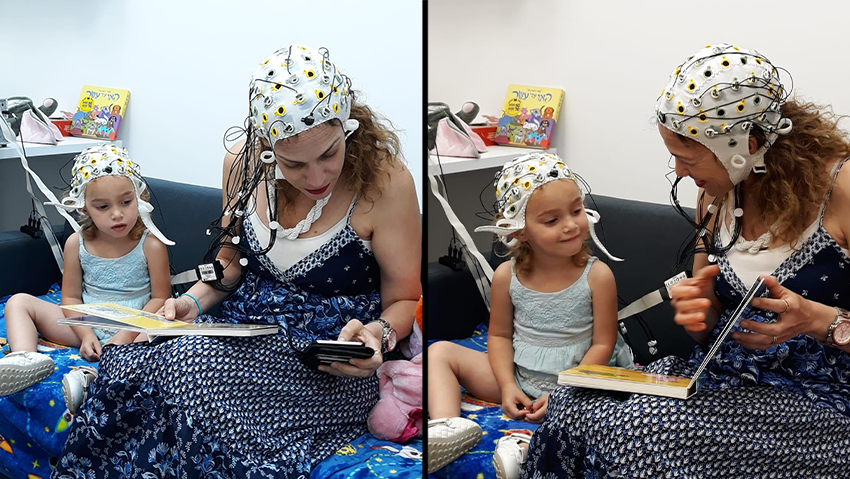
With a phone or without, it makes a difference: Prof. Horowitz-Kraus and her young daughter during the study
Studies conducted in the United States in 2020 also found links between higher screen exposure among children ages 3 to 5 and measures related to white matter organization, the neural pathways that enable communication between brain regions. Passive screen time, without adult mediation or interaction, was associated with less optimal white matter organization.
In research involving 6-year-olds exposed to large language models such as ChatGPT, Horowitz-Kraus observed lower recruitment of certain cognitive networks in children, in contrast to adults. “Complex abilities like reading and writing require coordinated development of visual, auditory, cognitive and attention systems,” she says. “There is a certain pace to their maturation. If we try to accelerate processes using fast, visually intense screens that do not match the brain’s developmental stage, we may effectively skip steps.”
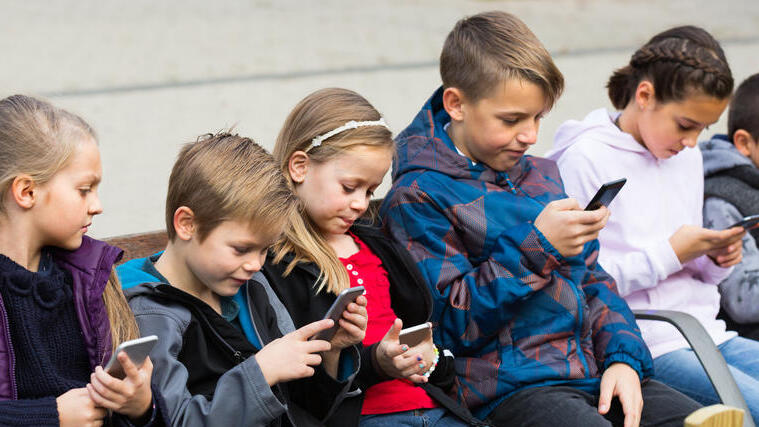
Early exposure is addictive
(Photo: Shutterstock)
If attention networks do not mature properly, children may struggle to sustain focus as expected in school settings. Researchers report increased distractibility and altered sensory processing. To illustrate, Horowitz-Kraus points to periods of intense stress, such as during recent regional tensions, when cognitive load was high and sustained reading felt difficult. Deep reading requires cognitive availability. Children today, she argues, are bombarded from all directions with devices and notifications. Even when reading on a screen, the experience may be shallower and less immersive.
Her conclusion is cautious but clear. She is not surprised if adults, whose cognitive foundations developed in less saturated environments, differ from children growing up in early, fast-paced digital contexts. Yet she does not advocate abandoning technology.
“We are not going to get rid of technology, and I do not want to,” she says. “It offers extraordinary benefits and unprecedented access to information. But basic abilities like sustained attention are essential for deep learning. We do not want a physician trained only through AI summaries. We want someone who has engaged deeply with the material. To achieve depth, we need stable neural foundations and we cannot skip developmental stages.”
Rethinking the teacher’s role
Gefen similarly reframes the debate. Rather than “for or against screens,” he argues for systemic adaptation. If the learning environment has changed due to technology and AI, the teacher’s role must evolve. Teachers may become facilitators of learning processes rather than sole authorities of knowledge. When information is available at the press of a button, value shifts to skills: empathy, critical thinking, teamwork, public speaking and emotional resilience. Knowledge acquisition may partly occur through digital tools, freeing time to strengthen other competencies. Technology will change education, he says, but it will not replace teachers.
The price of technology
(Photo: Shutterstock)
Another concern hovering over the debate is cognitive offloading, a term used in academic research to describe reliance on external tools to reduce mental effort. “We already identify this in studies,” Gefen says. “If students simply copy and paste from a chatbot without reading it, that is not learning.”
However, when assignments are redesigned to work productively with AI, outcomes can improve. Without deliberate changes in teaching and assessment methods, students will naturally turn to chatbots and expend less effort, reinforcing cognitive offloading.
“If I give my students an assignment that requires two prompts in a chatbot and they get a 95, the problem is not the students,” Gefen says. “It is the task I designed.” He says these insights are being conveyed to the Education Ministry as part of Israel’s national AI program and an institute focused on AI applications in education.
Are our measures outdated?
Some argue that traditional intelligence metrics may not fully capture skills relevant to the modern era. “We are using the same yardsticks that have existed for many years,” Gefen says. “That allows us to track trends over time. But we must also update them.”
Future PISA assessments will continue to measure established domains while adding new ones, including the ability to distinguish fact from opinion and identify misinformation online. According to recent announcements, such competencies are expected to be included in international assessments in 2029.

The responsibility lies with teachers
(Photo: Shutterstock)
“We have a few years to work hard in this direction,” he says. Horowitz-Kraus notes that many IQ subtests emphasize speed. Generation Z, accustomed to rapid information flow, may excel in speed-based tasks. But many subtests prioritize accuracy over speed. “If you look only at speed, I think Generation Z will be faster,” she says. “But are they equally accurate? I am not sure.”
Should screen use be reduced?
“It is part of the solution,” Gefen says, adding that age matters. Israel’s Education Ministry recently clarified regulations. In elementary schools, smartphones are generally prohibited except for specific educational activities. High school policies are more complex and under review.
The broader question remains unsettled. Technology has transformed childhood and education in little more than a decade. Whether it is quietly reshaping intelligence itself is a debate that is only beginning.
First published: 06:07, 02.21.26