

Since the start of the campaign with Iran, the combat intelligence soldiers of the “Ayit” Battalion say it feels as though the ground beneath their feet is burning. “Hezbollah woke up all at once,” Staff Sgt. Y. tells me. “We’re operating at a much higher intensity, working at full force. We’re stationed 24/7 along the Lebanon border, and just yesterday one of our companies carried out a ground incursion.”
Just before the escalation with Iran and Lebanon, I joined the Ayit Battalion deep inside Syrian territory. Even then, the soldiers operating drones on enemy soil struck me as determined, almost superhero-like figures navigating a complex reality. But it turns out that what I saw then was on a much smaller scale than what they are experiencing now.
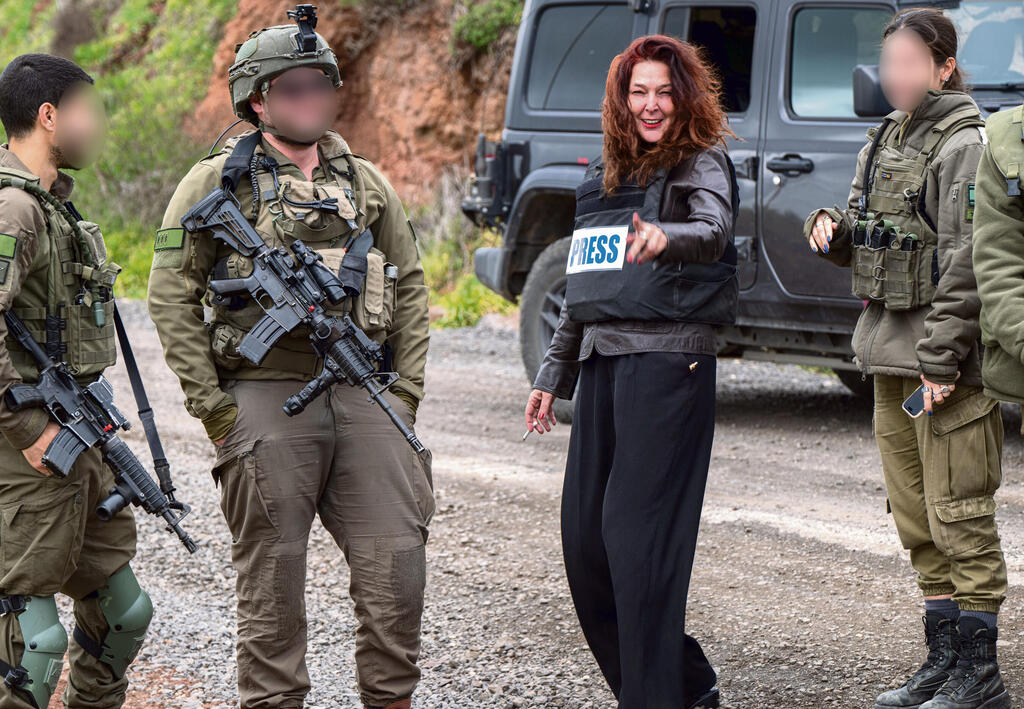
“You saw our routine activity in Khodna — it’s completely different now,” Staff Sgt. Y. continues. “There are far more ‘deployments’ today” — targeted strikes carried out by drone — “We’re eliminating actors who aren’t supposed to be operating among us. For example, last week we identified dangerous activity by an operative in Lebanon. At that moment, we got the order: launch the drone and drop a ‘boomerang’ — a mortar. Within 30 seconds, the drone was airborne. Since the war began, we’ve had at least five identifications a day, sometimes as many as 12. There’s a very intense sense of the enemy here — right among us.”
Have the conditions also become more difficult?
“Of course. I’m heading home now for a three-day break after three weeks inside. And the conditions you saw in Khodna? That’s luxury compared to what we have now. We sleep in defensive trenches at night, with sirens going off 10 times a day or more. But personally, I’m so glad I’ve had the chance to take part and serve in such a historic moment. To think that Khamenei has been eliminated — it’s crazy — and to see Iranian youth taking to the streets now is unbelievable to me. It’s a story I’ll tell my grandchildren. It gives meaning to all our work here and to the difficult conditions.”
× × ×
Last month, I found myself sitting in a military vehicle, on a road I never imagined I would travel in my lifetime. “So, are we already in Syria?” I ask G., the battalion commander. “Not yet,” he replies patiently. “I told you — when we get to Syria, you’ll know.”
So I fall silent and stare out the window as the vehicle jolts like a restless goat over rocks and rough terrain. For half an hour, I behave like a five-year-old on the way to Eilat, peppering with questions: “Are we there yet?” and “Are we at Yotvata yet?” I simply cannot wait to see what Syria looks like.
We are not alone on the winding road across the Golan Heights, between green hills and black basalt rocks. A convoy leads us, and another follows, carrying the combat intelligence soldiers of the Ayit Battalion — a striking, energetic group of very young women, most of them 19 or 20. At an age when many are dreaming of beaches in Thailand, these soldiers have already visited not one but two enemy countries — Syria and Lebanon — in addition to operations in Jordan. And not just once: they have been so many times it almost feels routine. “At first I was really excited to be in a place my father told me about from the Yom Kippur War,” one soldier says. “Now it’s like, ‘OK, we’re having coffee in Syria.’”
Armored vehicles escort us as we enter enemy territory, ensuring no Alawite, Sunni, jihadist, Hezbollah operative or Islamic State member decides to take a shot at us. Syria offers no shortage of adversaries — a kind of grim tasting menu of terrorists, each from a different faction or group.
Despite a landscape that resembles a calm, romantic English countryside, the security convoy reminds us the quiet is deceptive. At any moment, everything here can ignite. “It’s a misleading calm,” the commander says. “All this pastoral scenery — you don’t know what’s behind it. Things can go from zero to 100 instantly. It could be a ‘simple’ attack — an explosive device or sniper fire — or something much larger.”
This is one of the challenges facing the Ayit Battalion, tasked with gathering the most immediate intelligence hidden among these hills and rugged fields: never to be lulled by the quiet of this remote rural landscape. To remember that even a seemingly idle shepherd you film picking his nose or tending his flock could, in an instant, meet with others and plan a deadly attack.
We stop abruptly, and I immediately understand what the commander meant when he said, “When we reach Syria, you’ll know.” It takes 45 minutes to travel from the battalion’s base at Camp Yarden in the central Golan Heights to the Syrian outposts beyond the border where they operate drones. Forty-five minutes of uneventful, monotonous scenery — and then, suddenly, everything changes.
We are ordered out of the vehicle to put on helmets and heavy protective vests. Then we wait half an hour until a voice over the radio grants permission to proceed into what the soldiers jokingly call “Golaniland.”
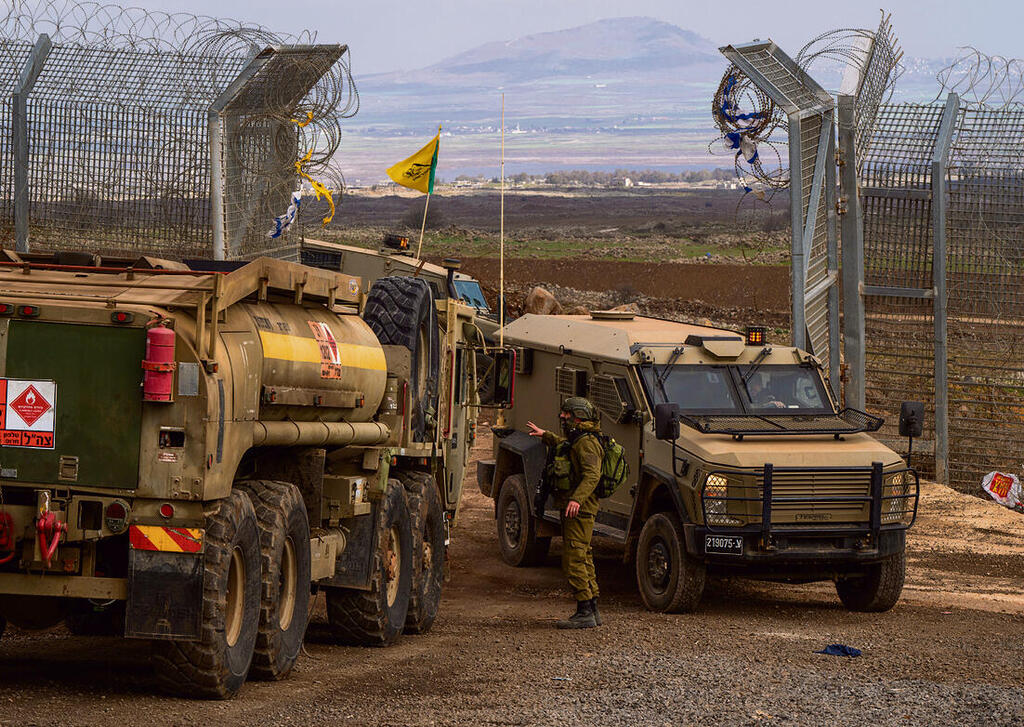
The border fence
(Photo: Yuval Chen)
× × ×
It is hard to describe the moment when the gate finally opens and we take our first steps into Syria. Only the photographer Yuval and I are excited — the soldiers are used to it. We point at everything in the landscape. On the surface, the Israeli and Syrian sides look similar — the same misty, mesmerizing terrain that evokes Rivendell from “The Lord of the Rings.” And yet something feels different, as if we have crossed not just a border but into another world.
“I don’t understand why this feels so different from Israel — maybe it’s because I know it’s Syria?” I say to one of the soldiers. “It’s because it’s exactly like the Golan Heights,” she replies, “but the Golan Heights from 100 years ago.”
She is right. Southern Syria looks frozen in time, like a region stuck in the Middle Ages. There are no cities, not even small towns with basic shops — just vast, uncultivated emptiness with almost no visible agriculture. Occasionally, small clusters of houses appear — the villages. But there are no children playing outside, no schools. The only sign of life is thick smoke rising from the chimneys of bare, impoverished homes.
We finally stop near one such house. Earlier, when I tried to research southern Syria using an AI tool, it described “ancient basalt buildings with arched structures and dramatic black tones.” The gap between that description and the reality in front of me is stark.
This house is not picturesque basalt — it is built from scattered fieldstones or even mud. Despite the surrounding wilderness, not a single tree or flower has been planted. The only color comes from two water tanks on the roof. “These villages don’t have running water,” the commander explains, “or electricity. Residents buy water tanks every few months. That’s what they use for everything — cooking, bathing. They can’t really cultivate their fields or olive groves.”
The lack of infrastructure is not just underdevelopment — it is also the result of deliberate policy under former Syrian President Bashar Assad, who restricted access to water, electricity and roads to maintain control over the population.

Former Syrian President Bashar Assad
(Photo: Eraldo Peres, ASSOCIATED PRESS)
“Look, people are coming out,” the commander says. A man and a woman step outside and stand by their doorway. Their poverty is evident — he in loose, worn trousers, she with a headscarf and a frayed sweater. “And there’s a baby,” a soldier notes, as a toddler crawls out and is quickly picked up.
The family says nothing, just stares at us with unreadable expressions. I expected hostility toward Israeli soldiers operating in their area, but hatred requires energy — and they seem too defeated for anything beyond quiet despair.
I want to stop and speak with them, but the commander presses on. The military’s policy here, he explains, is to minimize direct contact with civilians. With that, he accelerates, leaving behind a cloud of dust — and my lingering fantasy of one day eating hummus in Damascus.
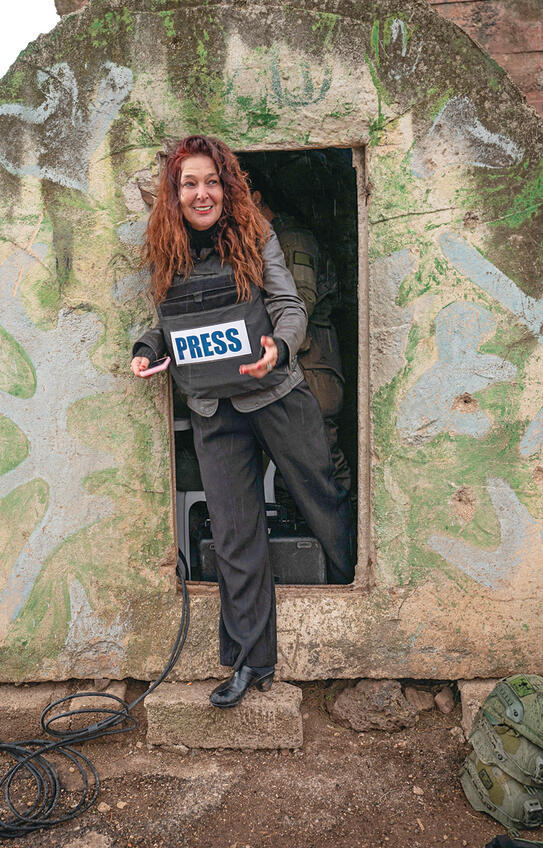
Dana Spektor in Syria
(Photo: Yuval Chen)
× × ×
I was born in 1971, right on that fault line between the euphoric victory of the Six-Day War and the traumatic failure of the Yom Kippur War. One of my only memories as a toddler is being rocked in my mother’s arms as she ran quickly down the stairs of our home in Haifa, into a dark, unfamiliar room that made me burst into tears. Sometimes I think I invented that memory, but that would not explain the smell I can still swear lingers in my nose — the smell of an old bomb shelter. There is no way to remember that scent so vividly unless I experienced it at age 2.
For that reason, Syria has always held a near-demonic place in my psyche — fitting for a country that taught me what mortal fear feels like at such a young age. There were also two phrases everyone used that captured the myth. The first was “the Syrians are on the fences,” meaning a moment of extreme danger — a reference to Syrian forces breaching Israeli lines during the Yom Kippur War. The second was “to eat hummus in Damascus,” an expression of a once-common dream: a true and lasting peace in the Middle East. It sounded almost messianic, distant and unrealistic.
Until the past year, when Assad fell and Israel, amid the chaos, moved quickly to seize a narrow buffer zone along Mount Hermon and the Syrian Golan Heights.
Soon after, a bearded man known as al-Julani rose to power — a figure who looks like a luxury watch model with the persona of a mass killer. I came to that conclusion after watching countless videos of his men abusing Druze civilians, mutilating bodies and abducting Kurdish women for sexual violence.
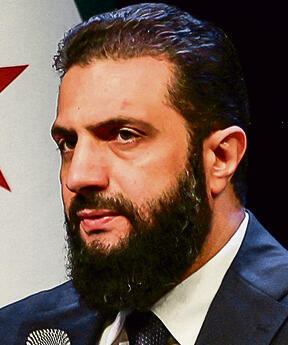
Al-Julani
(Photo: Khalil Ashawi, REUTERS)
As a result, Damascus — his seat of power — is far from welcoming. And yet, I allowed myself to imagine that during our visit to southern Syria, we might stop in a village and find a small stand where an old man would offer us fresh hummus.
“What hummus?” one of the soldiers tells me. “We don’t eat or drink anything from them.”
The vehicle speeds past another village that looks more like a cluster of huts in Africa. I think to myself: what hummus — these people cannot even afford flour for bread.
So no hummus — but there is something called a “Syrian pita.” That is the IDF’s nickname for the type of outpost we are heading to. It refers to a Syrian military construction method from the Assad era: a fortified position built atop a high, rounded hill overlooking the surrounding area. The Golan Heights is dotted with such volcanic mounds — dormant volcanoes, essentially — flat and circular like a pita, with soldiers’ quarters, ammunition depots and bunkers built at the summit.
Tel Khudna, where we are headed, is one of nine such outposts the IDF has taken over in this sector, forming a security belt. To reach it, we zigzag up from the base of the hill to its narrow peak, like climbing a volcano. At the entrance, we stop beside an old Russian tank.
“That’s a T-55,” the commander says — one of the most common tanks in the world and long a staple of the Syrian army. It is also a fixture of these “pita” outposts, embedded in the ground and raised onto a firing ramp when needed.
Khudna is now fully under Israeli control, but it still looks like the Syrian position from which soldiers once fired at Israel decades ago. The bunkers and trenches remain, resembling World War I-era fortifications. Even the observation post where the Ayit soldiers now analyze drone footage is a small, dark stone alcove that looks more like a tomb than a modern command center.
Inside, the soldiers sit with their officer, reviewing sophisticated digital intelligence streaming in from their drones — all within a cramped, bare room no more than three meters wide.
If I did not admire them before, seeing the conditions they operate in makes it impossible not to. They sleep in temporary structures the army has erected, exposed to freezing temperatures and snow.
“When I first got here,” one soldier says, “it was just hours after the paratroopers arrived. There were no basic conditions. We slept under the open sky, with a tarp for rain. It was so cold we hugged each other all night.”
I speak with C., a 22-year-old company commander with a youthful face and a fiercely protective demeanor.
“The 595th ‘Ayit’ Battalion operates under Division 210, which is responsible for the Golan Heights and Mount Dov — essentially the borders with Syria, Lebanon and Jordan,” he explains. “It’s a mixed unit of male and female soldiers tasked with intelligence collection across all three fronts. During the war, we were involved in everything — from fighting Hezbollah to responding to the Majdal Shams incident,” referring to a deadly missile attack. “From there, we moved into Operation Northern Arrows. Throughout the defensive fighting, our teams were deployed across outposts, trying to understand the enemy — how they behave, where they might attack, how they are organized.”
When Assad fell, did you see forces withdrawing from your positions?
“Absolutely. We saw them leave with our own eyes. It was December 2024, during the final phase of the civil war. Within a week, the regime collapsed. We watched convoys of soldiers abandoning their posts. The moment Assad’s army fled, we understood this was an opportunity to establish a security buffer. One night, during a call with officers, the commander said, ‘Get ready — we’re going in.’ I remember thinking: what is happening?”
Describe your first entry into Syria.
“We are the advance force — we go in first to gather intelligence before larger units enter. We went in with paratroopers, before the division itself. It was at night, on foot, through forests and rough terrain. I will never forget how tense I was — that realization that you are deep inside enemy territory. You look back at the border and know that if anything unexpected happens, you and your soldiers are in danger.
“We reached our position and set up observation equipment. I kept thinking: any moment now, everything begins — the operation, the fighting.
“When we returned, it hit me. I gathered my soldiers and said: ‘Do you understand you just made history? You took part in an operation on Syrian soil, defending northern Israel.’”
× × ×
The commander takes me to see the Syrian soldiers’ living quarters. Calling them “quarters” is generous — they are little more than crude stone huts, with branches tied together as makeshift roofing. Inside are bare, filthy walls. On one wall, someone had drawn a tally — perhaps counting days since eating anything beyond moldy tomatoes.
“When we entered, their clothes were still here, food still on the floor, coffee still in their cups,” the commander says, showing me photos from those first hours. “It was surreal. We had watched them flee, and now we were inside their posts, still full of traces of life. The conditions were substandard — filthy toilets, food on the floor, minimal rations, moldy mattresses. Hard to believe this was a functioning army.”
Among the items left behind was a notebook in which Syrian soldiers had been learning Hebrew. I read a line: “A new student, Ezra, arrives. He does not speak Hebrew…” Innocent words from a first-grade exercise — except here, there is no classroom, no shared future.
Did you witness the civil war from your positions?
“Yes. It looked like a war movie — brutal. We would see groups approaching Syrian posts, gunfire, people falling. There was even a spot people called the ‘tourist ramp,’ where civilians came to watch. The hardest part was the hospital Israel set up for wounded Syrians — especially the injured children. That was very difficult for me, as a father.”
From a lookout point, the valley stretches out below us. Nearby hills — once Syrian outposts — have all been taken over.
“There’s one key difference,” the commander says. “Our firing positions face the enemy. Theirs were two-sided — they were built to fire not only at Israel, but also inward, at their own people.”
× × ×
We continue observing the area. The nearest city is New Quneitra. The original city was left deliberately in ruins by the Syrians after it was returned, as a symbol of destruction. The largest nearby village is Hader, a Druze community.
“They actually welcomed us,” one soldier says. “They smiled, made heart signs.”
Farther away lies Daraa, where the Syrian civil war began.
The soldiers finish their mission, and we head to the small base on the other side of the hill. Finding a place to sit is not easy. There is a makeshift gym under a tarp, a worn couch outside. Eventually, a Golani soldier offers us his office.
The soldiers sit easily. It takes me several minutes to balance myself on the chair under the weight of my protective vest, as the three of them watch and laugh while I struggle to sit upright.
How do you manage to move around here so easily with such heavy gear?
Staff Sgt. Y.: “Sometimes it really is challenging. When we crossed the border on an operation, we carried packs that weighed as much as we do. I thought, ‘There’s no way I can walk like this.’ The entire route is full of boulders — huge rocks you have to climb with all that weight on your back.”
Staff Sgt. N.: “Injuries are part of the service here. Whenever I’m asked if it’s worth becoming a combat intelligence soldier, I say: ‘Yes — but expect to get injured constantly.’”
Staff Sgt. Y.: “Stress fractures, knee inflammation — my parents are already used to it. I have two other sisters who are also combat soldiers.”
Aren’t you afraid this could affect you for life? For example, there are claims that heavy loads can impact fertility.
Staff Sgt. Y.: “Of course, it could have long-term effects, but we take that into account. When a woman enlists in a combat role, she considers everything — her body, even her future fertility.”
To risk that for the country?
Staff Sgt. N.: “I’ve never heard of a female soldier who couldn’t have children because of this, and even if that were the case, it wouldn’t stop me. Personally, I feel that if I weren’t a combat soldier, I wouldn’t be fulfilling myself. I’m giving everything I have here.”
And when it comes to ability, it is hard not to notice the quality of this group — intelligent, driven, confident. Combat intelligence is a highly sought-after role, with candidates carefully selected. Each of them has the presence of a natural leader — the kind who leads at home and will likely go on to succeed in civilian life. Yet when I try to compliment them on their values or motivations, they brush it off and point to something else.
What qualities suit this role?
Cpl. M.: “Attention deficit. Zero ability to sit still. You always have to be doing something — you can’t rest.”
Staff Sgt. N.: “I’m not the strongest or the most athletic. I didn’t believe I could be a combat soldier. Even now, I’m not some top athlete. But when I saw this role, I realized I’d go crazy doing anything else. There are a lot of girls who arrive by accident and discover a completely new version of themselves. It’s wild.”
So what exactly is their job? Their mission is to gather as much intelligence as possible on activity in their sector and provide early warnings when they identify individuals who may be involved in terrorism. To do that, the Ayit unit uses a range of tools — primarily drones that track suspicious individuals or targets identified by Israeli intelligence.
These are not long-range unmanned aerial vehicles; their operational range is limited to about 3 to 4 kilometers. That means the soldiers must be physically present inside the territory they monitor — close to the people they are tracking.
As we speak, one of the soldiers suddenly focuses on her screen. A suspect she has been monitoring has just mounted a motorcycle, and the drone is tracking him as he speeds down the road. She must stay alert — he could be heading to meet others to plan an attack.
This is where the combat aspect of their role comes in. The unit also operates what the soldiers refer to as “suicide drones.” Once a target is designated for elimination, they deploy drones equipped with explosives that pursue and strike the individual.
“So you actually have to press the button that kills someone?” I ask one of them earlier.
“Yes,” she replies. “It’s stressful, I won’t lie. But it doesn’t happen often. In the end, you remind yourself you’ve stopped an attack they were planning.”
“When we reach the point of eliminating someone,” their officer, Lt. G., explains, “it means the target has been thoroughly vetted. We’ve tracked them for months. The strike is confirmation that we’ve done our job.”
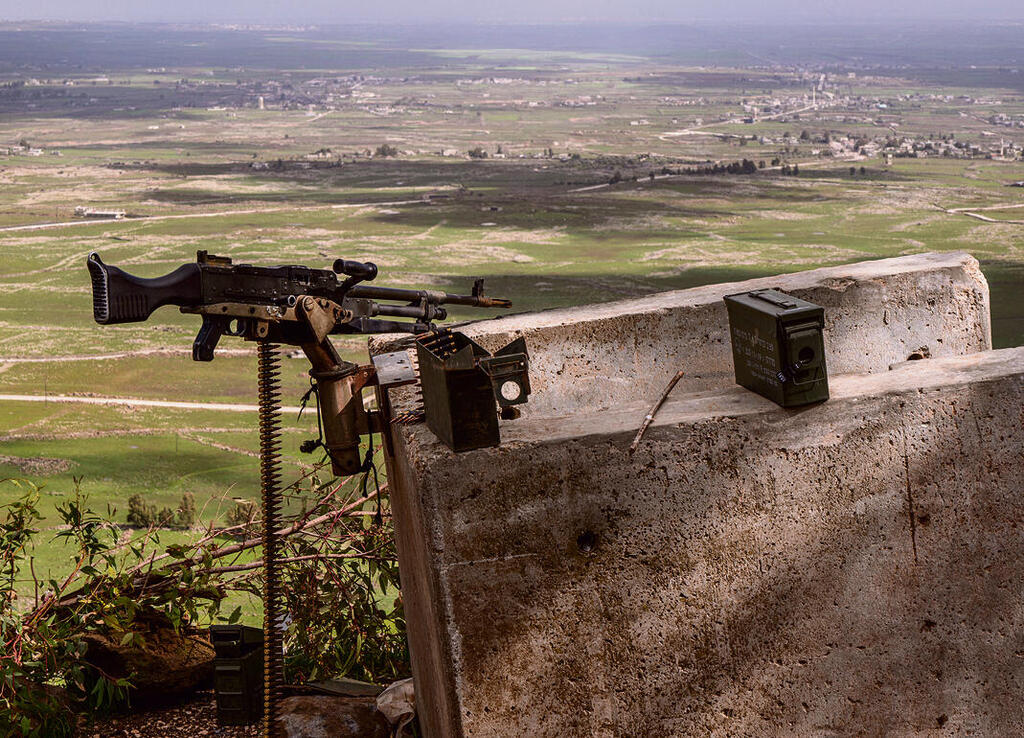
A firing position in Syrian territory
(Photo: Yuval Chen)
× × ×
The soldiers here carry out a rare role — part intelligence operative, part frontline fighter. To prepare them, they undergo an especially demanding eight-month training program. In return, they serve an extended term of two years and eight months.
They still speak about that training with a mix of pride and exhaustion. It included weapons training, intense physical conditioning and countless marches that took a toll on their bodies. Most nights were spent in the field.
“We cried a lot during training,” says Cpl. M. “And we were on base most of the time — 28 days in, two days at home.”
“Eight months in a pressure cooker,” adds Staff Sgt. Y. “You wake up at seven straight into drills, crawling, exercises.”
It is hard not to think of the broader debate in Israel about women in combat roles.
Some critics argue that female soldiers undermine military readiness, or that their presence discourages ultra-Orthodox men from enlisting due to concerns about mixed service environments.
Staff Sgt. N.: “Come on. I’m from the religious Zionist community, and I can tell you it’s about willpower. The army respects the ultra-Orthodox, and we do too. When we’re at shared bases, we maintain clear boundaries. We understand that if a Haredi unit is present, we adapt our behavior accordingly. We also have many religious women here, and they manage just fine in mixed service. I think ultra-Orthodox men could do the same.”
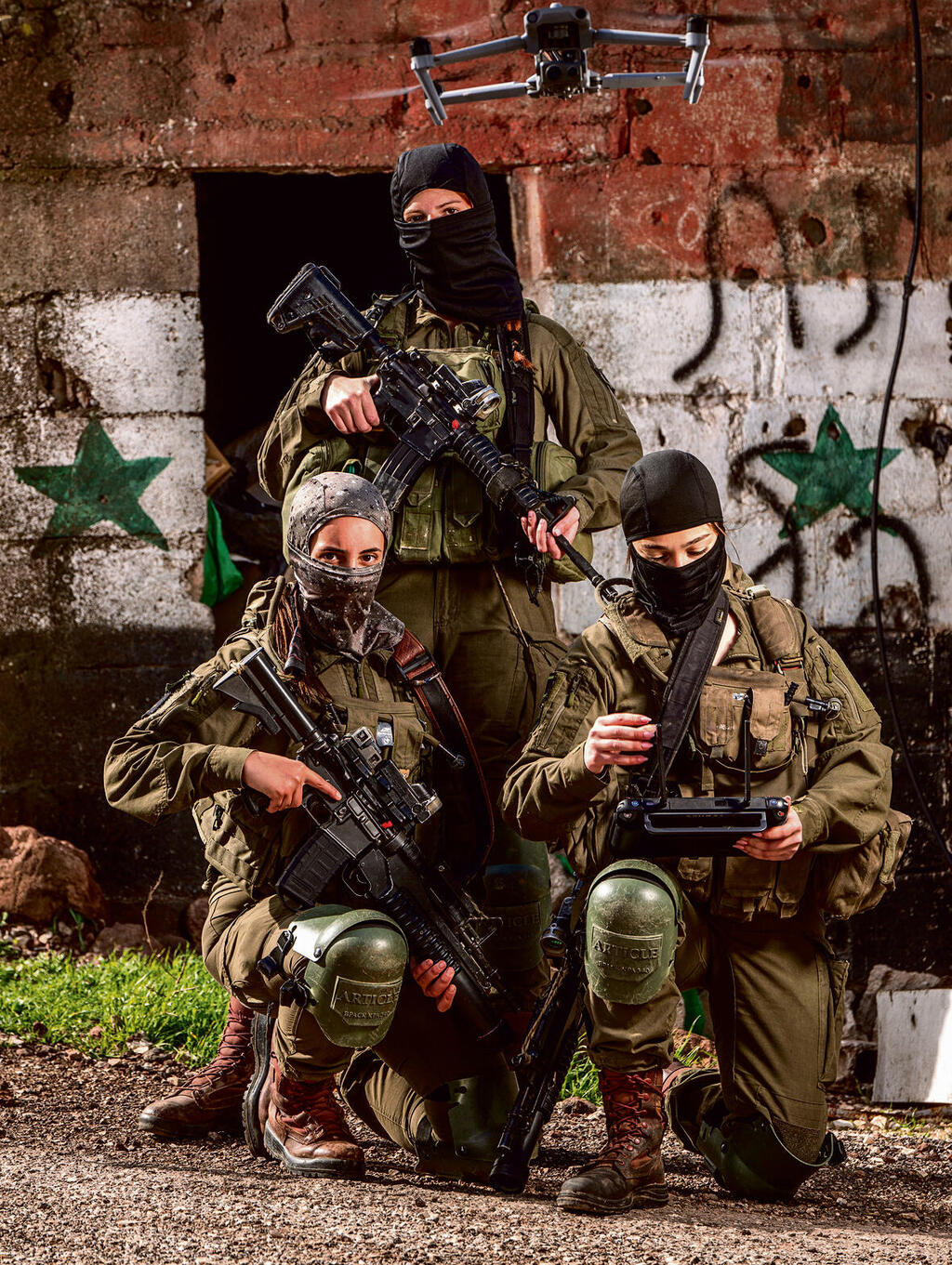
Ayit Battalion soldiers
(Photo: Yuval Chen)
“Being a combat soldier isn’t about gender — it’s about character,” says the battalion commander. “If these women weren’t here, they would still stand out in any role. After their service, you’ll see them leading in civilian life as well. But they also have an advantage — I call them ‘combat plus one.’ Beyond their capabilities, they come with extra motivation to prove themselves. Because they’re women, people still doubt them. For me, as a commander, that’s an asset. In one of my most complex operations, 14 kilometers from the border, I deployed an all-female team. I knew that whatever I asked, they would execute it flawlessly.”