

Two months before Oct. 7, Tomer Peretz stood facing Mount Everest. He had reached base camp and felt, quite literally, that he was at a high point in his life: a successful international artist living in Los Angeles, traveling the world, seeking out extraordinary people, living among them and creating art inspired by their stories.
In a moment of exhilaration, he began talking to the mountain. “I told it, ‘Listen, what’s the next story? What’s next? I’ve already done everything. What are you planning for me?’” he recalled. The mountain did not answer. But a gray cloud appeared and covered the summit. Peretz now jokes that the message was clear: “Your call is important to us. Please hold.”
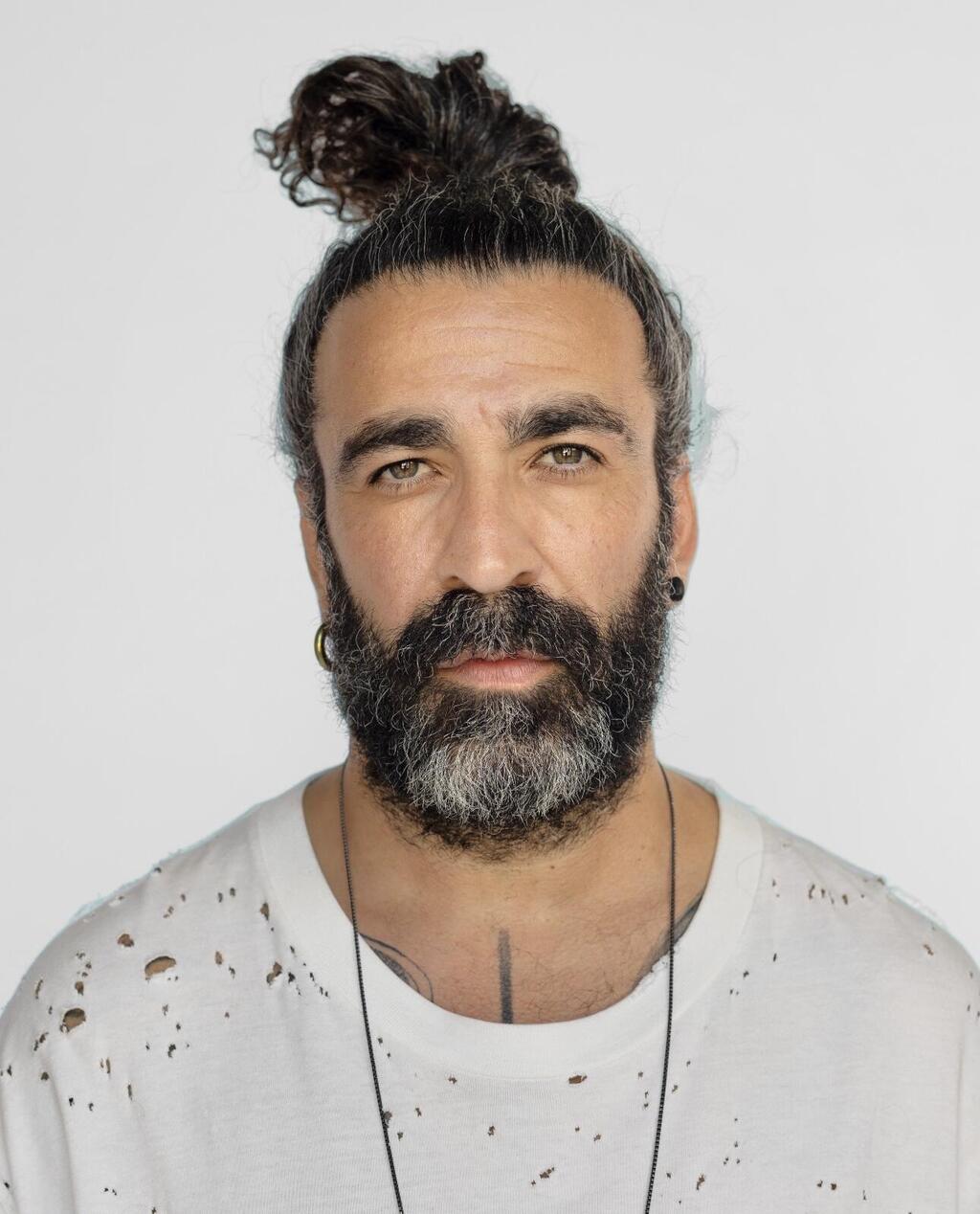
Two months later, in October 2023, Peretz landed in Israel with two of his children, Roi and Ziv, for a two-week vacation and a relative’s wedding. The previous evening, he had attended a reunion with old army friends on a Tel Aviv beach.
On the morning of Oct. 7, like so many Israelis, he woke to the sound of an air-raid siren. He and his children ran to the safe room, where he tried to explain to two children he describes as having grown up extremely sheltered what a terrorist was.
Twenty years had passed since his discharge from the military, where he had served as a combat officer and later been diagnosed with PTSD. But now all he could think about was getting into the battle zone.
His calls to friends from the army went unanswered. They had all already been called up. Only that evening did he manage to reach Natan Sabag, a childhood friend from Jerusalem who volunteered with ZAKA, Israel’s emergency response and recovery organization.
Peretz rushed to Jerusalem, left his children with his wife Lital’s family and told her he was going to help distribute food. The next morning, he climbed into a ZAKA vehicle. Less than two hours later, he found himself inside the scenes of the massacres at the Nova music festival and Kibbutz Be’eri.
The instinct of someone with trauma is usually to stay away from a battlefield, not rush toward one.
“I come from a family with deep ties to the security world,” Peretz said. “I come from a culture where, when something happens, you run toward the fire. It doesn’t matter what you’re carrying, physically or mentally, you go. Nobody stops to say, ‘Sorry, I can’t, I have PTSD.’ That wasn’t even a thought.”
What did you think you were going there to do?
“I thought I’d hand out sandwiches to soldiers, drive a vehicle, do anything that might help. When they picked me up, I still assumed they wouldn’t actually let me do what they were doing. They were trained volunteers with experience. Who was I? I hadn’t been here in years. I never imagined that less than two hours after getting into the car, I’d be picking up body parts.”
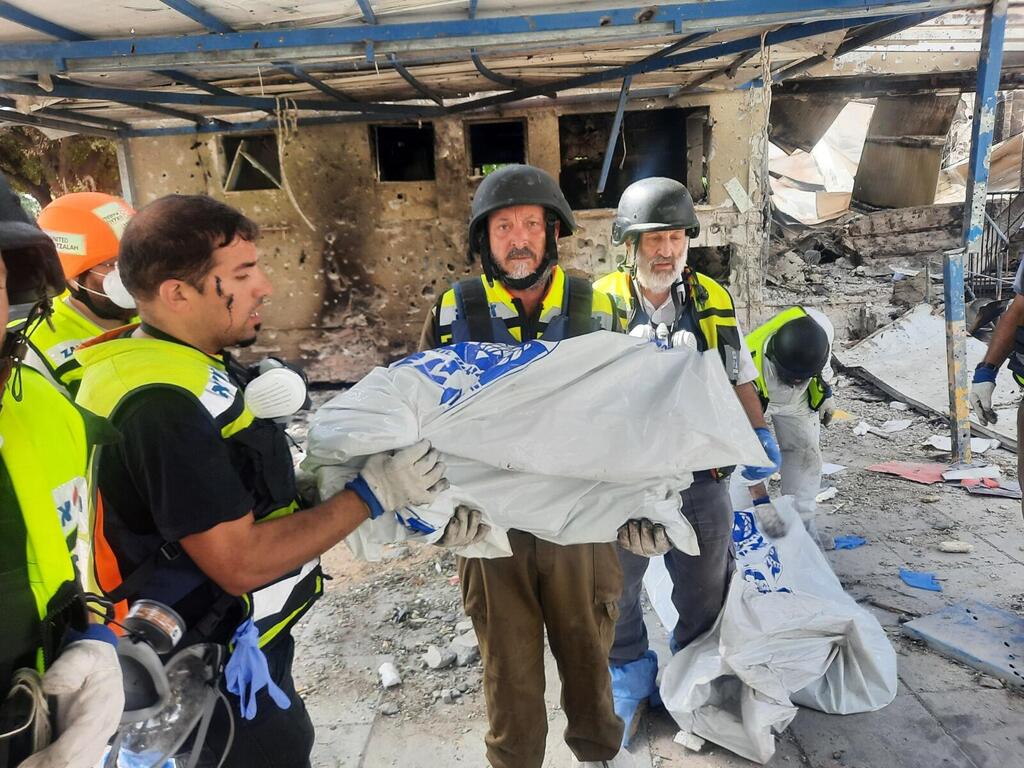
‘I never imageined that I’d be picking up body parts.’ ZAKA volunteers at the site of the Be’eri massacre
(Photo: Zaka)
Weren't you afraid of dying?
“I didn’t really have time to think about dying. My trauma from the army was never about fear of death. I didn’t have nightmares about gunfire or shelling. For me, the trauma was always rooted in guilt.”
Once inside Be’eri, Peretz began filming. “I filmed 40 bodies and immediately uploaded the video to Instagram and YouTube,” he recalled. “By then I was completely focused. I couldn’t understand how we could be doing this work while no one was documenting it. We were about to clear everything away, and I kept thinking: Is no one going to see what happened here?”
“So I said, screw it, I’m filming,” Peretz recalled. “People shouted at me, and ZAKA’s leaders nearly threw me out. I already stood out; they had sidelocks and their religious sense of mission, and I was covered in tattoos. I was an outsider, and that only made me work harder to prove myself. I went from body to body without stopping, filming on my phone as I worked. I wasn’t getting sick, I wasn’t fainting, and I wasn’t taking breaks.”
Within 10 minutes, Peretz said, the videos had accumulated millions of views. Then the messages began pouring in. “My phone completely crashed from messages sent by families of missing people,” he said. “I suddenly went into some kind of trance that lasted several days.”
While working, he said, he would climb into trucks carrying bodies. “Each truck had between 30 and 50 bodies. I would open the zipper around the face, photograph it and check. People sent me passports and ID cards of their missing relatives. Of course, I did it privately. Most of the ZAKA guys didn’t really know, except for one person who helped me.”
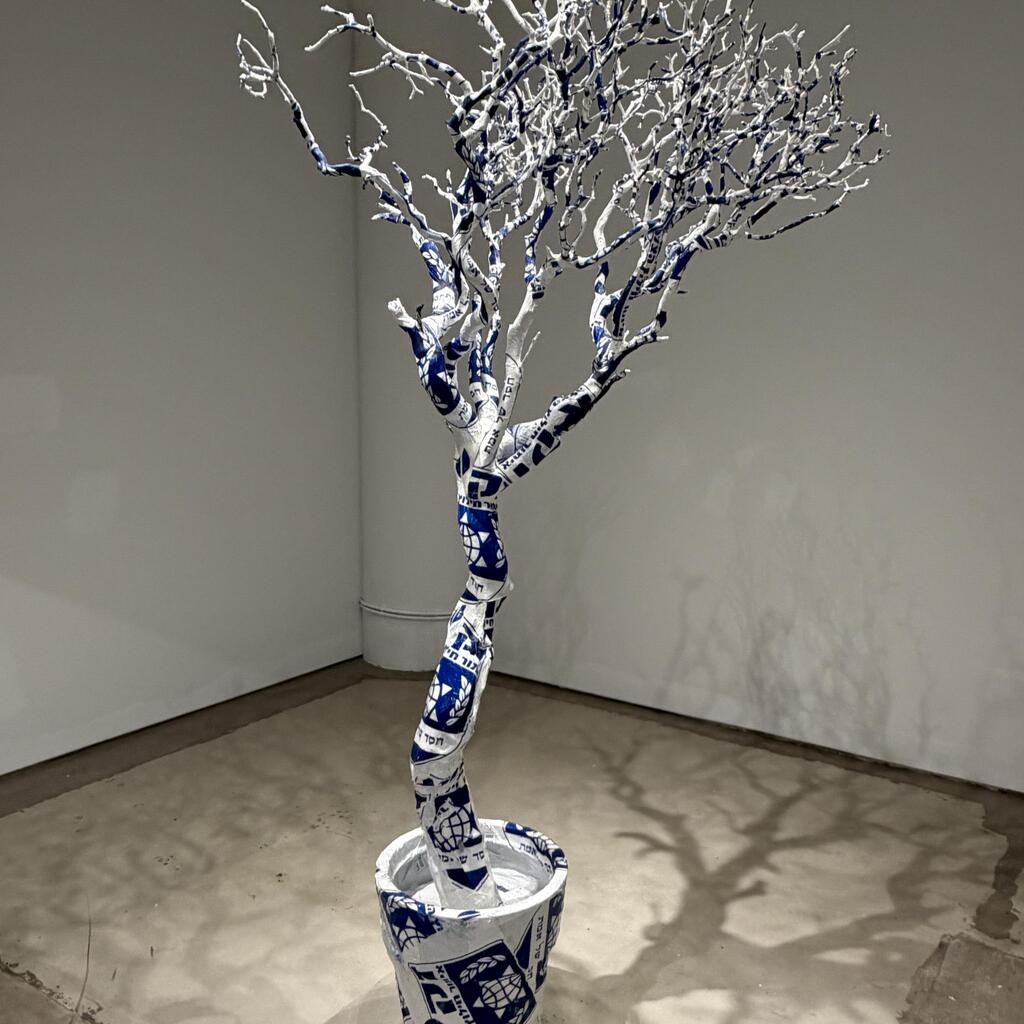
Tomer Peretz’s Tree of Life (2025)
(Photo: Courtesy of Tomer Peretz)
How was it seeing your sons afterward?
“Every night I came home, and most of the time the kids were already asleep. Roi found out what I was doing from friends in the community. At some point, packages and chocolates started arriving at our home in Los Angeles from different people, and suddenly Lital discovered that I had been collecting bodies. She was really angry with me.”
“She had already lived through some of my worst triggers and flashbacks from the army, and in the years before Oct. 7 she dealt with things most people could barely imagine. For her, this felt like going backward. She was basically saying, ‘You dumped the kids at my parents’ house, decided you were Rambo and, thanks a lot, wrecked our lives.’
“That was how she saw it, and at the time I fought with her over it. But she wasn’t the only one. A lot of people close to me, people who knew what I had been through with PTSD, were furious with me.”
To them, it looked like a relapse.
“Yes. Because by then I had really come a long way. Between COVID and 2023, I had several years without nightmares, anxiety or triggers. I had done a huge amount of work on myself.
“I was in a very good place financially, professionally, socially and with my family. I had seen every kind of therapist imaginable. I even traveled to China to meet an old Chinese healer. I tried every ritual, every medication, every approach, from holistic treatments to conventional medicine, ayahuasca and rehabilitation. For nearly 20 years, I dug as deep as I could, and it had worked.”
Then guilt appeared and sent you back into a battle zone within minutes.
“Exactly.”
‘Just go as far away as possible’
The day after leaving the IDF, Peretz boarded a plane to South America. A Jerusalem native raised in a religious-Zionist family, he grew up supporting Beitar Jerusalem and at times mixed with the club’s more hard-line fans, while moving back and forth between religious and secular life. “My father still studies in a yeshiva,” he said.
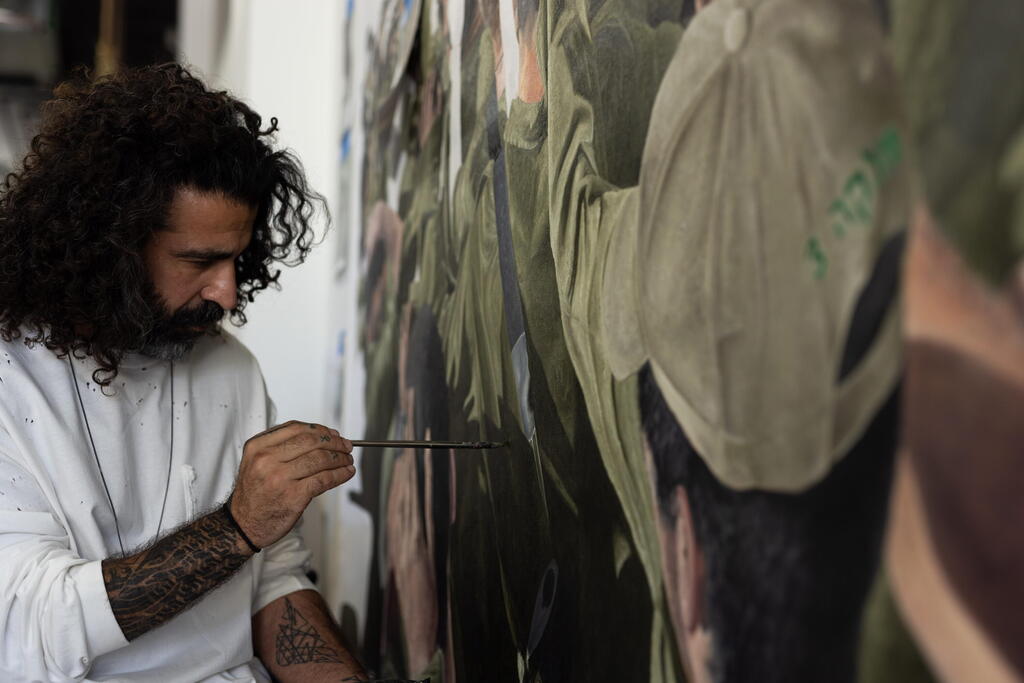
Tomer Peretz
(Photo: Kalia Gisele Littman)
After four years in the military during the height of the Second Intifada, including one year as a career officer, Peretz left Israel on a one-way ticket. An incident during fighting in Jenin in which one of his soldiers, David Solomonov, was killed, along with intensive operations in Gaza and the West Bank, left him with severe PTSD.
“I didn’t know where I was going,” he said. “Just go as far away as possible. Run and don’t come back.” In hostels across South America, he developed a system: accommodation in exchange for painting murals. For 10 months, he returned to an interest from his school days, when he had channeled his restless attention into doodles in notebooks and later graffiti on the streets of Jerusalem.
When he arrived in Los Angeles, one of the first things Peretz did was buy canvases and start figuring out how to build a life that would let him keep painting without interruption.
Years later, after meeting Lital, also from Jerusalem, starting a family with her and establishing himself as an artist, including a series of solo exhibitions in Los Angeles such as “Unbreakable,” dedicated to IDF soldiers, Oct. 7 forced another dramatic turn.
In retrospect, Peretz says, as strange as it may sound, the catastrophe became a positive turning point in his life, transforming him from someone who ran from his trauma into someone willing to live alongside it. But that did not happen immediately. To climb again, he first had to hit bottom.
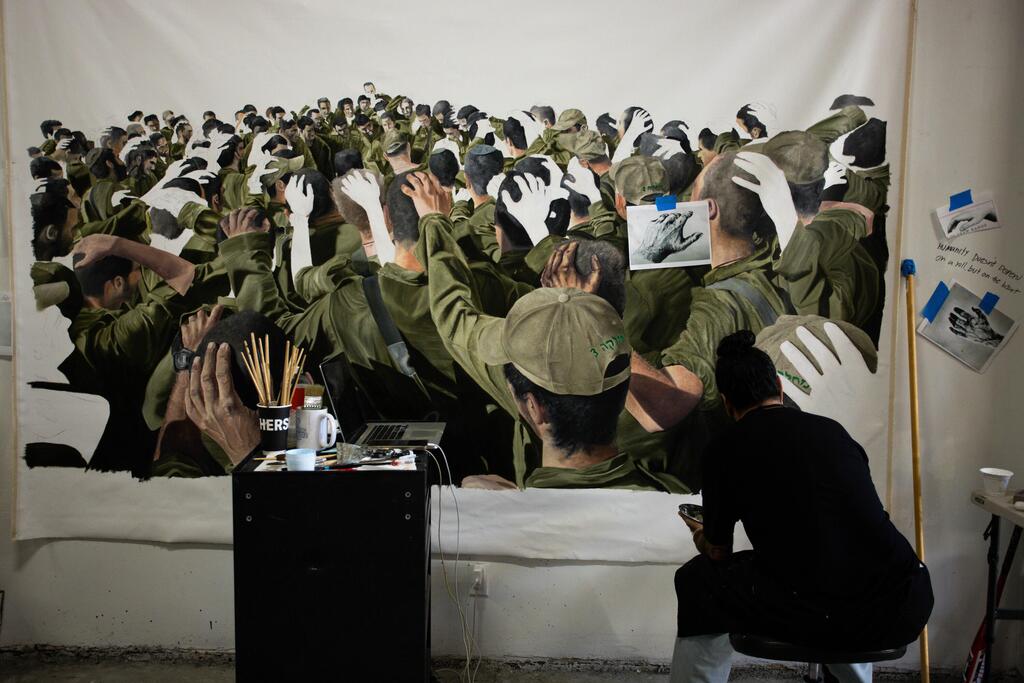
‘I’d do it 30 more times, including Be’eri.’ Tomer Peretz
(Photo: Kalia Gisele Littman)
“What I did on Oct. 7 and in the days afterward included some of the best things I’ve ever done and some of the best decisions I’ve ever made in my life,” he said. “I would do it another 30 times, including Be’eri. “I can say that now, in hindsight. If you had asked me during the first six months, I would have told you, ‘Shoot me.’ I was a walking dead man.
“In those six months, I lost everything. I lost my business partner, my manager, my gallery representation, my entire career, all my money and all my savings. I grew distant from my wife and my children. I lost friends. Everything I had was falling apart.
“When PTSD is at its worst, you can end up losing the people who love you most, and the people you love most. That’s the blast wave of trauma. It hits the people closest to you.”
Was that a direct response to what you experienced on Oct. 7, or did it also bring back things from your military service that had never fully been resolved?
“Mostly things from the army that came rushing back. I started having flashbacks I hadn’t experienced since the first year or two after I was discharged. Oct. 7 also dealt a serious financial blow to my career. A lot of people distanced themselves from me, and I could no longer maintain the business relationships I had built because I had entered this completely different world. At that point, I didn’t have the motivation to keep them going anyway.”
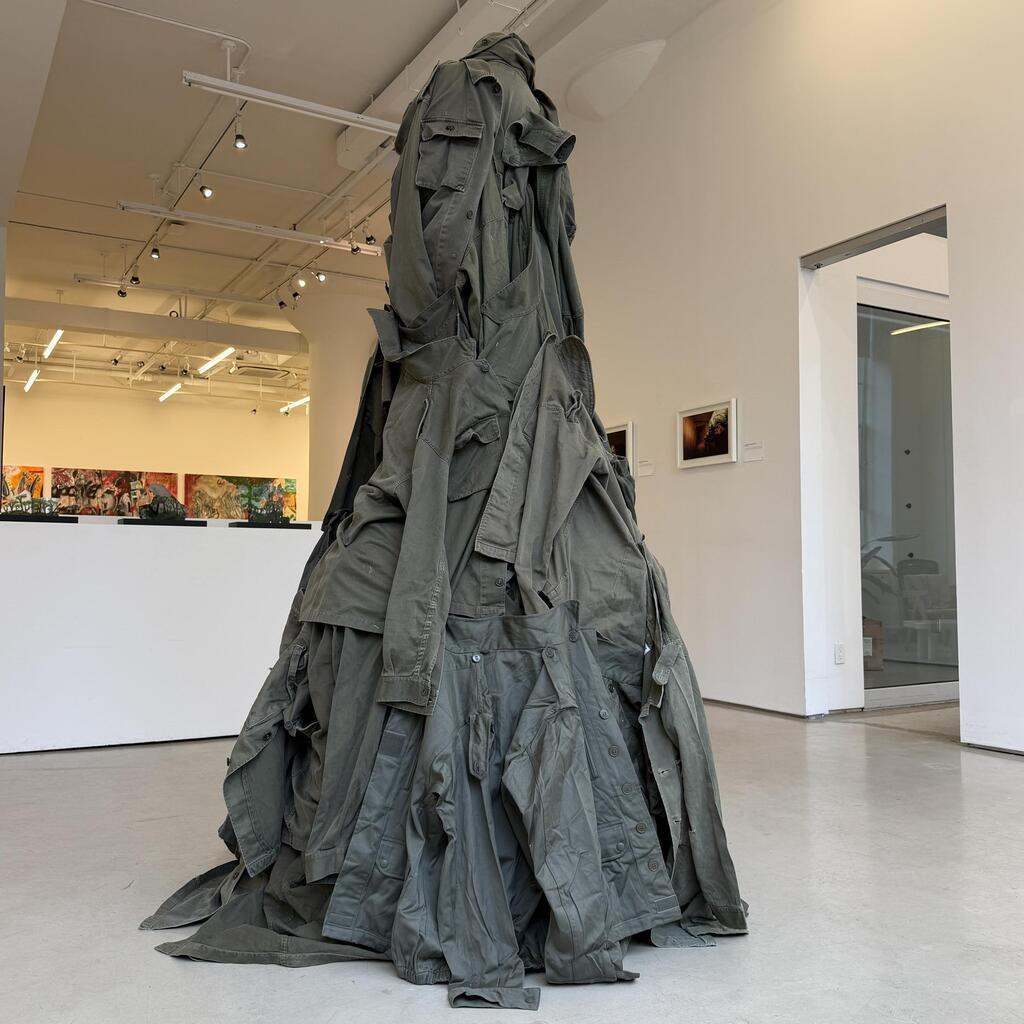
Tomer Peretz’s The Bride, from The 8 Project Gallery
(Photo: Courtesy of Tomer Peretz)
Did your manager simply leave because you were Israeli?
“To this day, I honestly don’t know. I never spoke to him, and I’m not interested in doing so. I’m not particularly curious. He simply stopped answering me. Projects were canceled. Galleries where I used to show took my works off the walls. Nobody informed me. I found out afterward that the works weren’t even hanging anymore and there were no sales.
“Nothing was happening. No money was coming in. “But the point is that at the time, I didn’t care either. Everything had lost its meaning. I’m still suffering from that loss today, but I’m at peace with where I am. I don’t want it back. I’m building a new life now, one that includes both Oct. 7 and everything I carry from my military service.”
‘On the eighth day, we began to live’
The turning point came through a Nova survivor living in Los Angeles who had lost her father. She contacted Peretz while her father was still considered missing and Peretz was moving through the kibbutzim. Their connection continued after he returned to the United States. Her father’s body was found some time later, and she and other survivors began coming to Peretz’s studio.
“We talked, and the next time she came back with more people, and then more. By then I was completely broken. I was spending all my time in the studio and barely leaving. Soon, people displaced by Oct. 7 started coming through the door: evacuees, Nova survivors and survivors from the kibbutzim.”
“We would create together. We all felt the same thing: We didn’t want to sit around a table and talk about something other than what we had been through. There was a lot of crying, a lot of pain.”
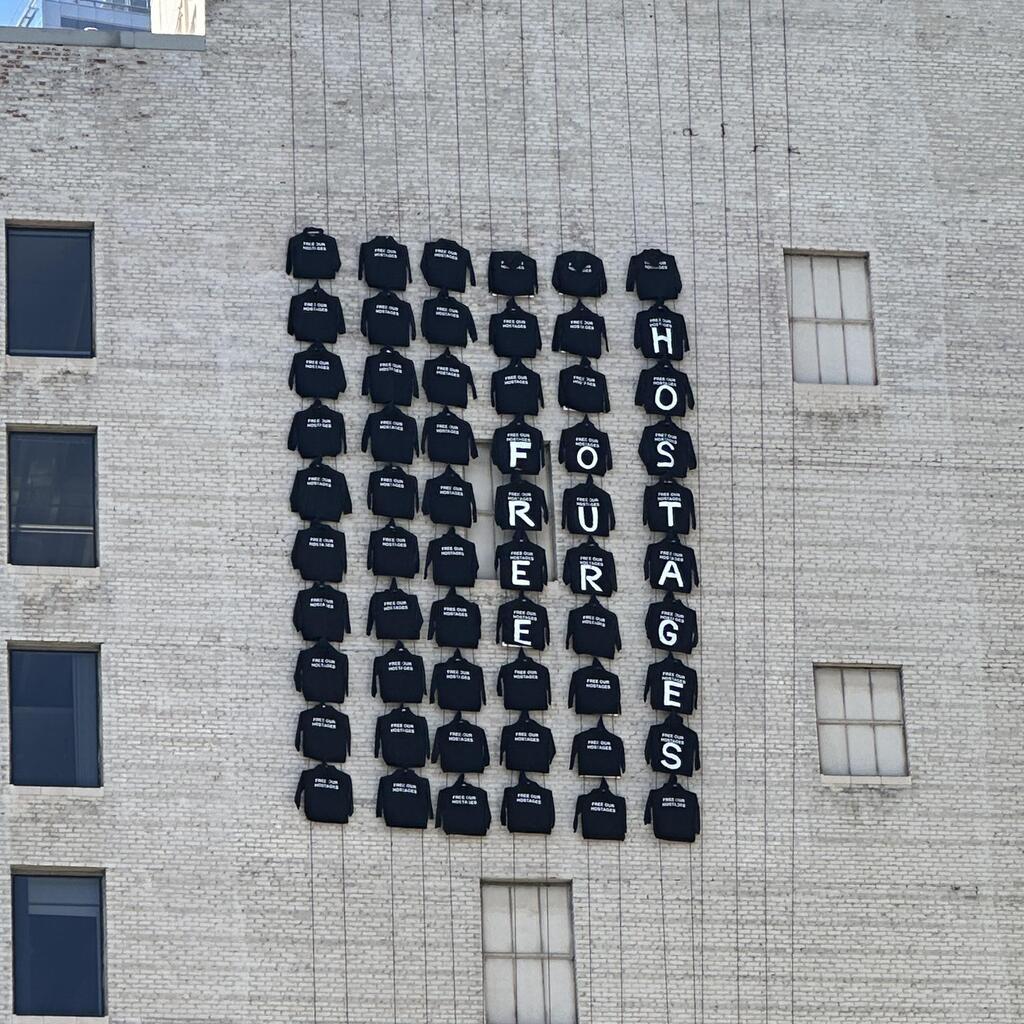
Free Our Hostages, by Tomer Peretz
(Photo: Courtesy of Tomer Peretz)
When people Peretz did not know began reaching out, he started organizing the studio sessions more formally. He brought in groups of survivors at scheduled times, prepared specific activities and developed concepts for them. He would spread a canvas across a wall or floor and groups of 10 to 20 people would paint together. As they worked, conversations began.
“These were people who weren’t involved in art, so their work was very naive,” he said. “Technically, I loved the fact that they would paint something that looked like a four-year-old’s scribble, then I would add some realistic element. Then you would see this collection of elements in a painting that told a story. The problem was, I ran out of money. I couldn’t keep financing it.”
Peretz decided to establish a nonprofit that would raise funds to fully subsidize flights and accommodation for survivors. He called it Project 8. “Creation lasted seven days, and on the eighth day, we began to live.”
Hostages, reservists, active-duty soldiers, children and bereaved families all came through his studio. “But eventually I started asking myself, what happens to them afterward?” Peretz said. “They come here, let everything out, and that helps. But then they go home and have to face the nights, when everything comes back.”
That question led Peretz to rethink his approach. Instead of working with groups, he began spending three months at a time with a single participant, creating what became the residency program.
He drew on an earlier chapter of his life in Los Angeles. “Two or three years after I arrived, I started a marketing company with 60 people doing telephone sales,” he said. “I recruited many of them through a government program called Plan C, which helped people leaving prison gradually reintegrate into society. They would work from nine to five and then return to supervised housing.
“That meant I worked with people convicted of murder, rape and drug dealing, and I learned a lot from recovery programs like Alcoholics Anonymous. If I was short on salespeople, I’d sometimes bring in people who were using crack on the street. We’d get them cleaned up, wait for the high to wear off and put them on the phones. I swear. I would drive around looking for people who were completely down and out, because sometimes they turned out to be the best salespeople.”
How come?
“Because they would do anything for $10. I spent years working that way, and I learned a lot about how to see the person underneath everything, but also not to embrace them too much. You also have to know when to be firm.
“If someone genuinely wants to rehabilitate themselves and all you do is comfort them, you can lose them. You need to create a certain kind of structure, and they need to feel that they don’t want to let you down. It’s a very particular relationship, and that’s what I brought into the residency program.
“I brought therapists in to make sure I wasn’t doing something reckless, and they were always stunned by the results.”
Do you focus on a particular group?
“Reservists with families, with wives and children.”
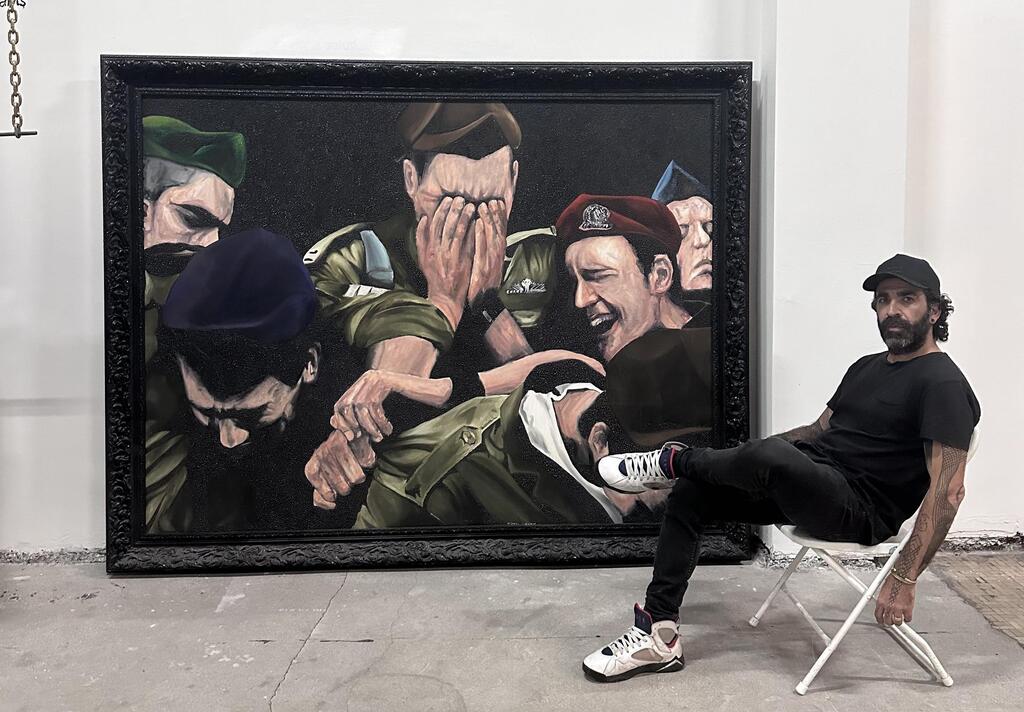
Tomer Peretz alongside his work Funeral (2011)
(Photo: Courtesy of Tomer Peretz)
Is that who you identify with most?
“That’s where I’m able to see the woman I failed to see in my own life,” Peretz said. “A lot of this is about lessons I’ve learned. I think the wife is the most important caregiver, and in many cases the first person who should receive support, even before the person suffering from the trauma. She’s with him all day. If she gets the tools to understand how to deal with what he’s going through, we can save a lot of marriages and families, and that ultimately reaches the children too.
“I think most of the resources should go to the women, because they’re the ones who will hold all of us together.”
But that can be complicated. You risk turning the wife into his caregiver.
“But she already is his caregiver. Who holds him when he’s vomiting or having flashbacks? The psychologist who sees him once or twice a week on Zoom? Who makes him food? Who answers the phone? Who sees him crying when he comes home after being ‘Rambo’? Who sees him shattered on the floor and tries to help him get back up? She’s the person living through all of it with him. If she isn’t given the tools to cope, she’ll collapse too.”
What is this period like for you personally?
“On one hand, I’m doing the most incredible thing in the world. I’m painting, I’m making art. We put together an exhibition from everything we created in the studio over the course of a year, and their works were shown in a museum. My professional world has developed enormously, just in a completely different direction. On the other hand, everyone who used to buy my work before Oct. 7 disappeared. Everyone buying my art today is someone who came to it after Oct. 7.”
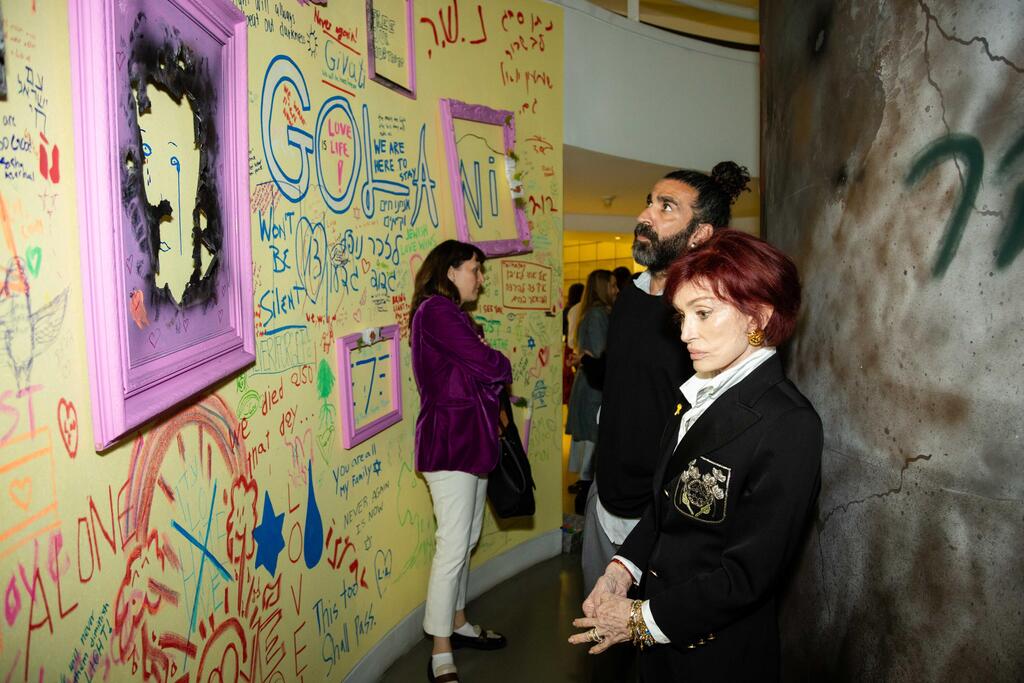
Tomer Peretz with Sharon Osbourne at his exhibition "Art Will S8t You Free"
(Photo: Linda Kasian Photography)
How do you manage the trauma?
“I think I arrived at Oct. 7 as patient No. 1,” he joked. “It’s financially very difficult to replace a clientele, a collector base and a network of galleries that you built over 20 years. Personally, I’m still picking up the pieces. Socially, I’m disconnected too, because I’m so focused on one thing. I gave up a lot.
“But for the past year and a half, I’ve been in the best mental place of my life. I fall asleep instantly. I sleep well. I don’t dream about anything. I don’t use any substances to function. I feel very good about myself.
“I think I’m doing the most incredible thing in the world, but it comes with enormous sacrifice. I’m currently separating from my wife, who couldn’t join me on this journey. I don’t blame her at all. I don’t know anyone who could have.
“I applaud her for making it this far. I honestly don’t know how she did it. I was always traveling as far away as possible, while she stayed home waiting for this crazy person to return with some ridiculous story after she’d been alone for two or three weeks. Then I’d disappear into the studio for another three months to create work about whoever I’d met.”
Do you think things might have been different between you and Lital if she had been given the right tools?
“I don’t know how to answer that. I don’t blame her. What I do know is that I see it in other couples. I can see the relationship now. I can see the women. That’s the most important thing in this whole story. When something good happens between the couple, something good happens with the children too. They need to see their parents standing strong together.”
‘I’m not focused on advocacy, but on healing ourselves’
Last week, Peretz completed his first work in Israel, a mural commemorating hostages Ori Danino and Hersh Goldberg-Polin, who were held together and later murdered in Hamas tunnels.
The two are depicted wearing the jerseys of their favorite soccer teams, Danino in Beitar Jerusalem colors and Goldberg-Polin in Hapoel Jerusalem colors. They are shown embracing in front of the stands at Jerusalem’s Teddy Stadium, conveying a simple message: If supporters of bitter rival clubs can come together, perhaps the rest of the country can too.
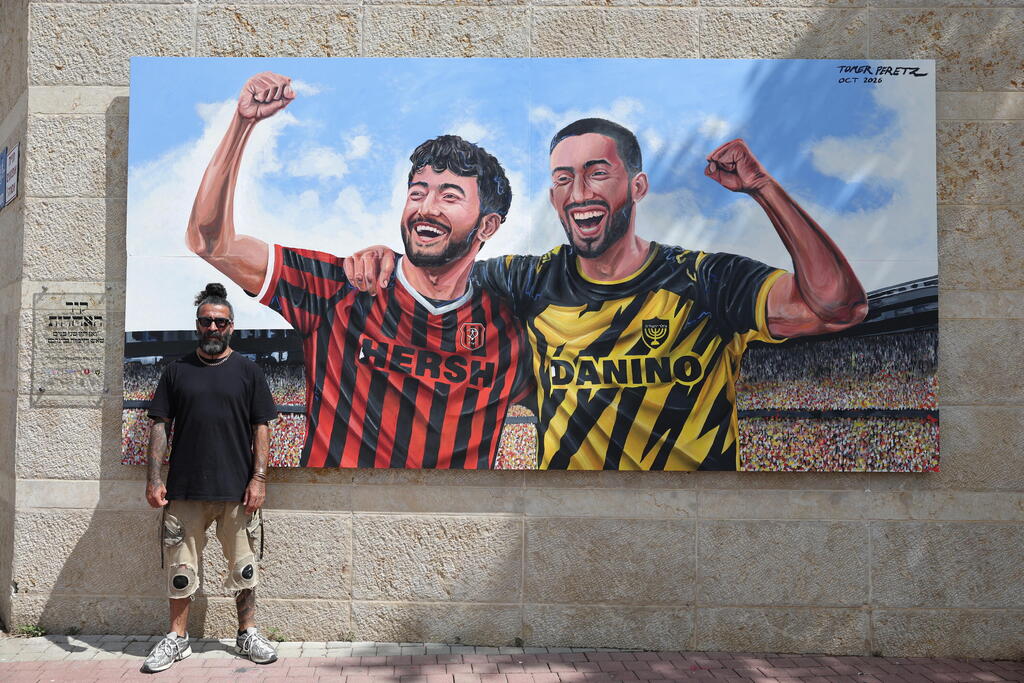
Tomer Peretz beside the Jerusalem mural he painted in memory of Hersh Goldberg-Polin and Ori Danino
(Photo: Jerusalem Municipality)
“There will probably be people who don’t like seeing it, but that’s fine. The focus today needs to be on strengthening the connection among ourselves and worrying less about how people outside see us. I’ll stand with my brothers and sisters no matter what, with my eyes closed. But I’m focused on healing ourselves.
“All this antisemitism doesn’t interest me. I’m not focused on advocacy. If someone calls me a ‘baby killer’ in the street, I’m basically like, ‘Fine.’”
People threw stones and smashed windows at your studio in Los Angeles.
“My studio was broken into six times. They wrote ‘Free Palestine’ on the windows and came to threaten me. One day, two people came up and asked if I was Tomer Peretz. I was carrying a gun, so I felt protected and said yes. One of them said something about babies in Gaza and told me we’d meet again. I said, ‘Why meet again? Let’s meet now.’
“During the first year and a half, I got into a lot of trouble because I was very outspoken. Twice I ended up in physical fights with protesters outside the studio, but that rarely happens anymore. I carry a gun openly. When I filed my sixth complaint after another break-in, I told the sheriff very simply, ‘Be prepared. The next time this happens, I’m shooting anyone who comes near me.’ “That was the end of it. The sheriff is Jewish and a decent guy. He understood.”
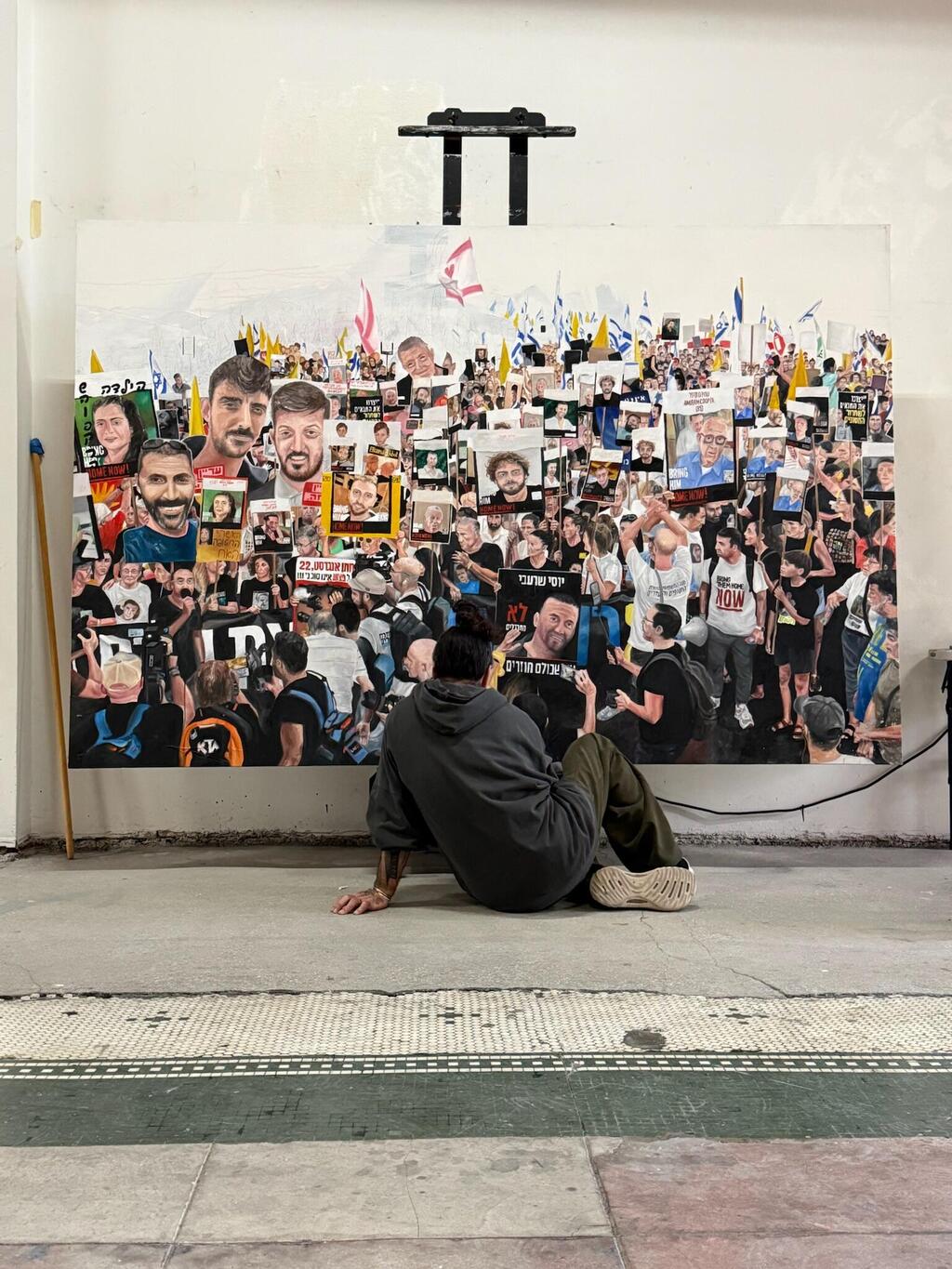
‘The focus today should be on strengthening the connection among ourselves.’ Tomer Peretz
(Photo: Courtesy of Tomer Peretz)
So have you become a different person?
“I don’t think so. Even before Oct. 7, I would travel to Mexico and India looking for unusual people with extraordinary stories, sometimes people involved in illegal things. I would live with them for a week, two weeks, three weeks, and tell my story through them. I would create work about them. So before, it was Mexico, India, Nepal or Bhutan. Now it’s Israel.
“My attraction to unusual stories is still there, and some of them are also about trauma. The only real difference between who I was before Oct. 7 and who I am now is that today I use all my resources to help people.
“The only problem is that it’s harder now to find a story that truly moves me, because it’s become harder for me to be moved. There just aren’t that many things left that can surprise me.”