

Chief Warrant Officer T., the first Bedouin tracker to detect Hamas tunnels, was severely wounded earlier this year by shrapnel in a booby-trapped tunnel in Gaza that left him with serious burns and impaired vision.
“I spotted two cables and began tracing their start and end points. My gut told me the tunnel was booby‑trapped,” he told Ynet in an interview.
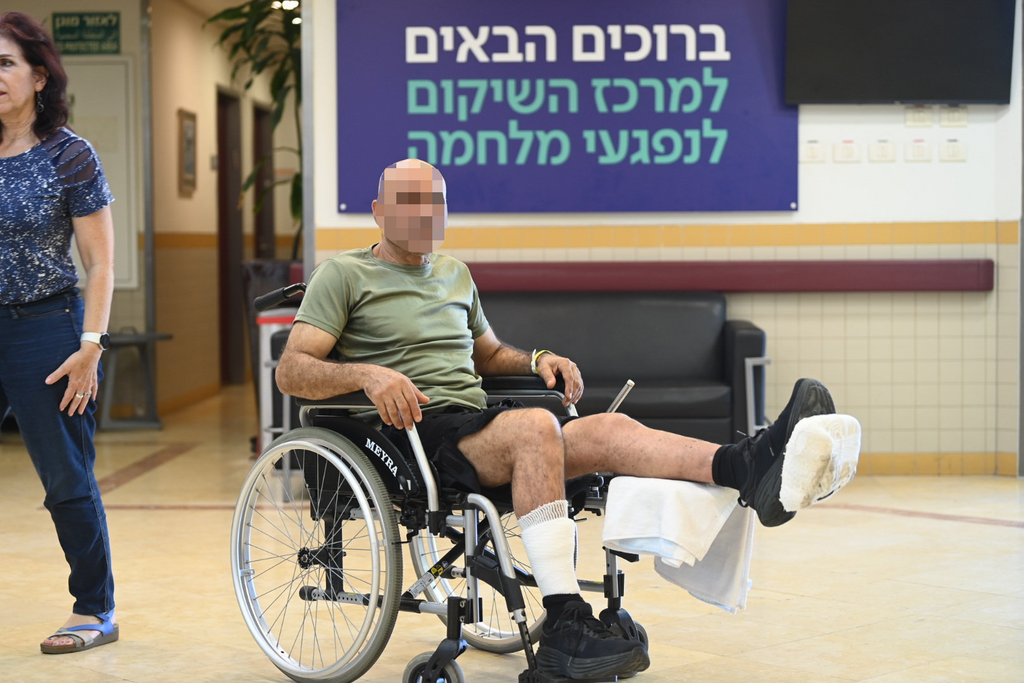
He was airlifted to Soroka Medical Center in Be'er Sheva, where doctors fought to save his life. He is now undergoing rehabilitation at Sheba Medical Center near Tel Aviv, taking the first steps toward recovery. This is a story of devotion and cross‑sector solidarity.
When a bird of prey circled above him, back and forth, T., a highly experienced combat veteran with 35 years of service defending the country he loves most, froze. He reads nature’s signals well.
“We Muslims believe that a raptor is an omen of misfortune,” he told his commanders, asking them to spit to avert disaster. They looked at him in confusion. A few minutes later, he lay blind and battered on the ground, having discovered an explosive-laden terror tunnel that nearly cost him his life.
T., 54, a Muslim, married with three children and comes from the Bedouin village of Muqeibila in northern Israel, was raised in a pro-Israel home, and chose to devote his life to defending the country he loves most. Some residents of Muqeibila serve in the IDF and Border Police. His son is also to be enlisted soon.
“I was born into a Zionist, pro‑Israel home,” he says. “My father was a policeman; my brother serves in the army. The way I identify myself, my Israeli identity comes before my Muslim one. I’m a Zionist who loves the country, and I have more Jewish friends from the military than Arab ones.”
"It was one morning in early July 2025 that I woke with a sense of unease, made myself some coffee and, as the battalion’s tracker, I led my team to Kerem Shalom. We were summoned to the operations center following intelligence about a tunnel," describes T., whose full name and likeness are withheld for security reasons due to the nature of his operational work.
Seconds before being hit the blast, he said: “I rely solely on my senses. I spotted two cables, one black, one gray, and traced their path, which ended at a section concealed by sand‑colored fabric. Beneath the folded fabric I spotted a handle leading into the tunnel. I was on high alert as my gut told me the tunnel was booby‑trapped."
" We joined the battalion, and together with the unit, we reached the area where tunnels were being exposed. We held a situational assessment. At the site there were also engineering forces equipped with D9 armored bulldozers and tanks.
From where I was standing, I noticed a surveillance camera and realized I detected a tunnel. As a curious tracker, I approached for a better view and saw a reinforced underground structure.
"Moments later, I noticed a raptor circling overhead, flying back and forth. I froze,” he recalled. “We Muslims believe this bird signals bad news. I immediately told the battalion commander and the intelligence officer to spit. They looked at me strangely, asking, ‘Why should we spit? What’s wrong?’ I explained that our tradition says spitting can avert disaster."
“I rely solely on my senses. I spotted two cables, one black, one gray", he describes the dramatic moments, preceding the explosion that nearly cost him his life. "I traced their path, which ended at a section concealed by sand‑colored fabric. Beneath the folded fabric I spotted a handle leading into the tunnel. I was on high alert as my gut told me the tunnel was booby‑trapped."
'I will not remain blind'
The sudden explosion thundered from the tunnel, blowing T. through the air. The intelligence officer and battalion commander were lightly injured; T.’s wounds were extensive. “I suffered a fracture in my left leg, severe burns on the other, shrapnel in my scalp and another one above my eyebrow, and burns on my back. But worst were the burns to my eyes. I couldn’t see a thing, fearing I had gone blind."
He was airlifted to Soroka Medical Center by helicopter, fully conscious, and taken to the trauma unit and from there to surgery to remove the embedded shrapnel. "I woke in recovery, blind. I just heard my wife speaking above me,” he remembers, “and, half out of it, my instincts kicked in. I asked, ‘Who’s with you? I feel you’re not alone.’ And indeed, a comrade from his unit was there. I told my wife to go home, asking him to stay with me.”

Evacuation of wounded from the Gaza Strip. Chief Warrant T. was airlifted to Soroka and rushed into surgery
(Photo: IDF Spokesperson's unit)
As the anesthesia wore off and clarity returned, he made an almost impossible request to his friend: “I told him that the surgeons cleaned and treated me and took the shrapnel out, but it was the least important. I urged him to go and call for an ophthalmologist. 'I won’t remain blind'," I said.”
He is not sure how his request was communicated, but not long after, an eye specialist arrived. The next day, surgeons performed an eye operation that saved his left eye. His right eye, however, remains impaired. “Please mention,” he adds, “how grateful I am to the doctors at Soroka, especially the ophthalmologists, who saved me."
'It’s in my blood'
About two weeks later, T. was released from Soroka Medical Center and transferred to the "Getting Back to Life" rehabilitation center at Sheba Medical Center.
Though still using a wheelchair, he can now stand on his own. Most of his injuries are superficial, and his rehabilitation has focused mainly on physical therapy. “I can no longer wait to get back to my unit and run 80 kilometers with the brigade commander,” he said. Thanks to his determination, that may happen sooner than expected.
T.’s life story and battlefield heroism could easily serve as the basis for a gripping film.
He enlisted in the IDF’s elite Trackers Unit in 1990, beginning his service in Netzarim, in the northern part of Gush Katif (in the Gaza Strip). “In 2008, I moved to the southern brigade, and I’ve been there ever since,” he said.
He chose the role of a tracker because it combines combat and defense. “It’s in my blood, in my nature. I’m alert 24/7, attentive to every detail. I don’t just spot suspicious ground markings, but everything around. I’m suspicious by nature and curious, and that’s what makes me a senior tracker on the brigade commander’s command team."
Over his long military career, including during the 2005 disengagement, T. took part in numerous complex operations, foiled infiltrations, and located terror tunnels.
The turning point came just months before Operation Protective Edge in 2014. “The event that earned me the title of the first tracker to detect tunnels happened in April 2014, a few months before Operation Protective Edge.
"I reached the Kerem Shalom area and went out for a patrol. Near Khan Younis there was radar and other detection systems. I was wondering how they were able to throw explosives from the other side. It didn’t make sense to me and really bothered me."
“I stayed at the base over the weekend. That Friday afternoon we received an alert about a possible infiltration. We drove to the border fence but didn’t see anything. Back at base, we got a red-line call, reporting that there was an alert about a terrorist infiltration. We went back out. I fired around to draw return fire, but nothing happened. We returned to base thinking the incident was over.”
At a checkpoint in Ofakim, a police officer stopped me and asked, “Where are you heading?" “To Re’im,” I replied. “If you want to die, go to Re’im,” the officer warned. But T. reassured him. “Bro, I know every leaf and speck of dust there. I read the terrain. Trust me; I’ll make it there safely.”
T., however, couldn’t return to normalcy. Something didn’t sit right. He skipped the festive Friday night dinner, closed himself in his room, and couldn’t shake a deep feeling of unease.
“I asked the brigade commander to assign me a team, and we went back out. Walking toward the east, I spotted a tunnel shaft. I inserted a thin pipe the width of an antenna, and it dropped 17 meters. I kept going and found more shafts. A day before Protective Edge began, we destroyed that tunnel."
Know every speck of dust
The morning of October 7 found T. at home. Around 6:30 a.m., his phone started ringing nonstop. “I sensed something was going on, but I didn’t know what. When the IDF attaché in Romania called to ask if I was okay, I realized it was serious. I put on my uniform, grabbed my pistol and the go-bag I always keep ready, and sped south to my division at Re’im base."
At a checkpoint in Ofakim, a police officer stopped me and asked, “Where are you heading?"
“To Re’im,” I replied.
“If you want to die, go to Re’im,” the officer warned.
But T. reassured him. “Bro, I know every leaf and speck of dust there. I read the terrain. Trust me; I’ll make it there safely.”
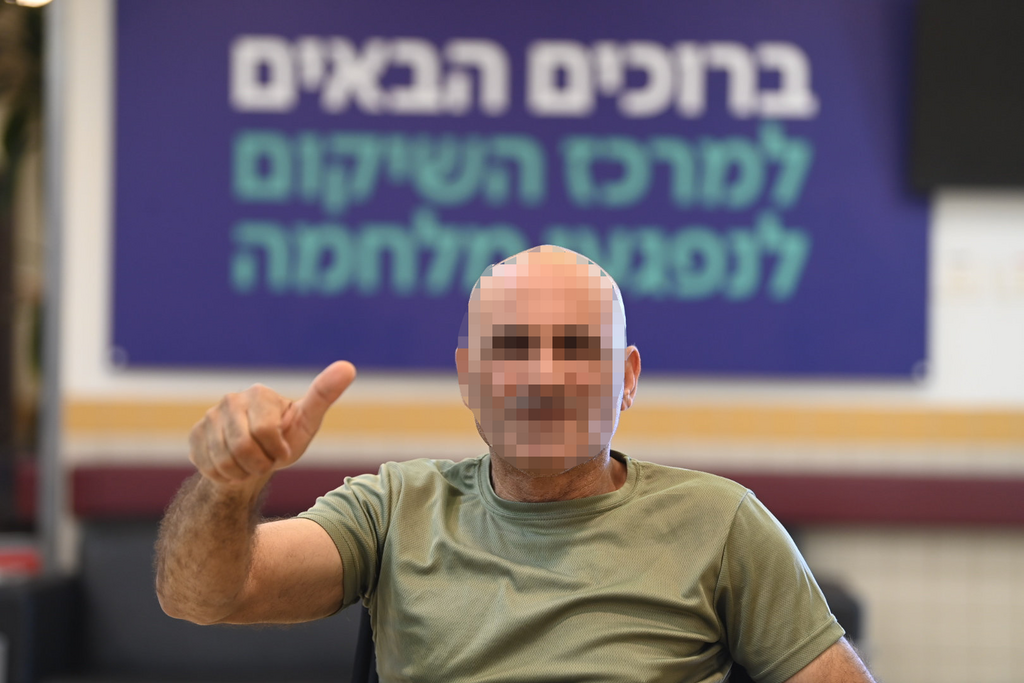
At the rehabilitation center
(Photo: Yair Sagi)
T. did reach the Re'im base, only to learn that his admired commander, Col. Asaf Hamami, head of the Southern Brigade, was killed fighting Hamas terrorists near Kibbutz Nirim, and his body was later taken into Gaza.
“We first met when he was a company commander in the support battalion. I was honored that he saw me as a commander and friend. He admired my professionalism and trusted me enough to make me the senior tracker in the command team; from that day, we were inseparable. Our connection even extended to our families. When I was wounded, his family never left my side."
T.’s devotion to the IDF is total. He speaks without a trace of self-pity about his early days, when he would head home on weekends with a backpack slung over his shoulder and, with no transportation available, would walk the entire dark road to his village of Muqeibila. He says he would do it again in a heartbeat.