

As we unite with the memory of our loved ones, the piercing silence of the siren binds us together. In the military cemeteries, for one singular moment, we are all one—religious and secular, right and left, standing shoulder to shoulder before the same graves. How is it that the day after, we struggle to live together? Is there a chance that throughout the rest of the year, we can create something different here?
If you ask the hundreds of thousands of reservists returning from the front lines, they will tell you: this is the mission of our generation. According to them, a quiet revolution has emerged in Israel during this war: "The Reservist Model."
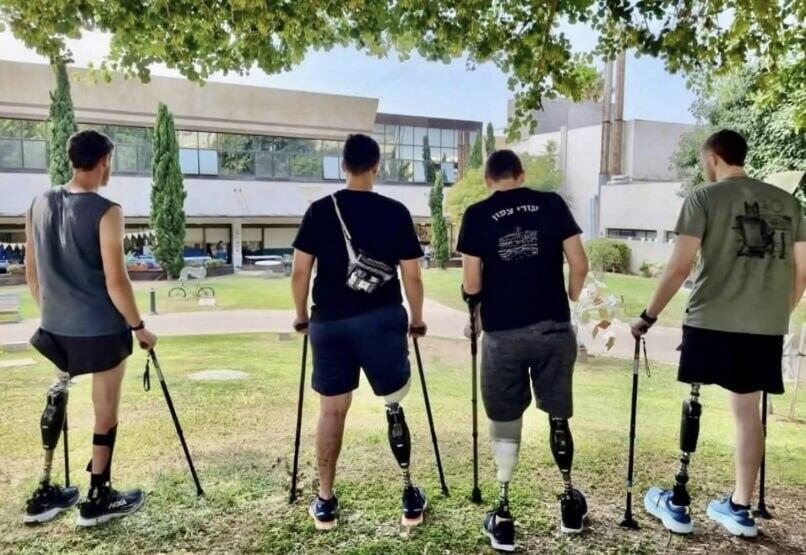
There, on the battlefield, a new reality was forged. People who are different: in their opinions, backgrounds, and identities - learned to fight together, to trust one another, and to lean on each other during the darkest moments. Not because they agreed on everything, but because they realized they could act as one even when they don’t think alike.
Yoav Tzivoni and the Zvika Lavi (z"l), fighters in the Maglan unit, were such a pair. A secular Tel Avivian alongside a religious settler. Two completely different worlds that, in the field, became a single team.
During a complex encounter in Gaza, Yoav was critically wounded and lost his leg; he is currently undergoing his 33rd surgery in the U.S. Zvika, tragically, was also critically wounded and passed away after several weeks.
“The more we talked about our disagreements,” Tzivoni says, “the more we discovered we agreed on more than we thought, and that we truly love one another.”
Their story is not an exception. It repeats itself over and over across hundreds of teams and in every unit. From this profound experience, the “Iron Dous” (Tzemed Barzel) initiative was born by the “Nifgashim” movement. Its goal is to take the model that worked under fire and bring it into civilian life and our daily routines, thus leading a grassroots change.
The model is simple: two reservists, vastly different from one another, stand together before an audience. They openly present the gaps between them and engage in an authentic dialogue. They do this not by blurring the differences, but by searching for common ground.
For example, this is how one pair introduced themselves at a secular high school in central Israel: “This is Omri: secular, leftist, a protester at Kaplan, lives in Jerusalem. This is Amit: a settler, messianic, a father of four (and still counting). And we are an Iron Duo.”
In another encounter at a religious high school, the youth sat in awe as they heard about another Dou: “Meet Eran. A military rabbi, religious settler from Lod. This is Erez: a kibbutznik from the north, atheist, leftist. Together, we are an Iron Duo. We are here to show you how, despite all the disputes and opposites, we can create a powerful connection.”
In honest conversations with dozens of pairs, they share that their starting point wasn't always comfortable. Some admit that in their first meeting, they “flinched a little.” Others confess they thought they would have to “re-educate” the other person just to be able to stand beside them. But something happens along the way.
“If before I was in a place where everyone had to think like me,” says Ilan, a paratrooper, “during the war, I realized we don’t need everyone to think the same. I learned to listen. When someone comes with a different stance, they have a real need. We don’t always agree, but we’ve stopped fighting each other. We realized who the enemy is and who the brother is—despite all the gaps.”
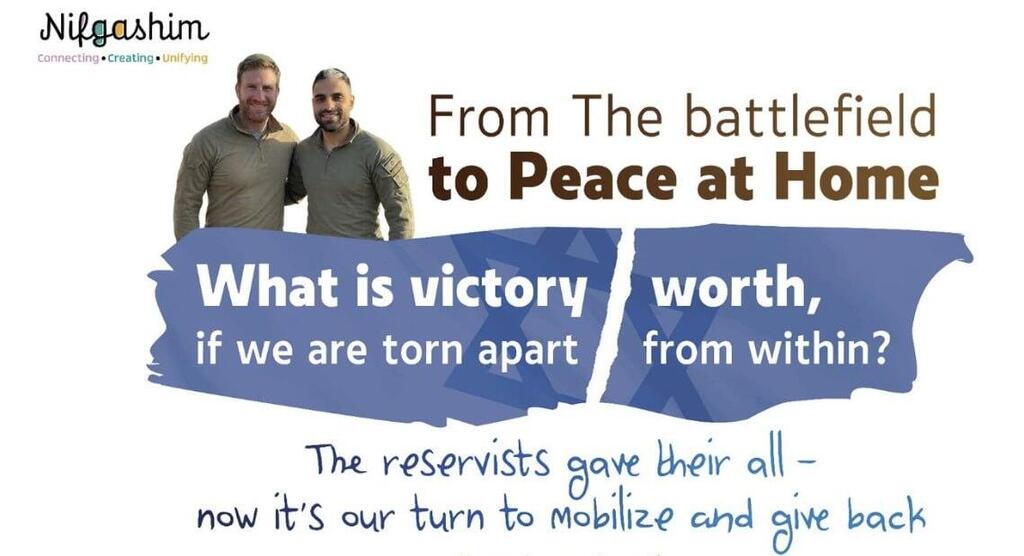
(Photo: Nifgashim)
One sentence repeated by the fighters echoes deeply: “If we don’t learn to live together, we will find ourselves being hit by the fire of internal strife again and again. After the heavy price we paid, we are not willing to go back to October 6th. We must lead a change, and it is possible not only in the reserves.”
To date, over 350 “Iron Pair” encounters have taken place across the country, reaching over 100,000 Israelis. But facing today’s Israeli reality, it is not enough.
Hundreds of fighters who returned from the front after hundreds of days of reserve duty, some wounded, some mourning lost friends, refuse to accept the status quo. They are now enlisting for the next mission. Not with weapons, but with a story. With responsibility. With a genuine attempt to hold together a society fraying from within.
To allow them to dedicate their lives to this new mission, we must empower them to do so.
The “Nifgashim” movement has launched an urgent crowdfunding campaign. The goal is not only to expand the “Iron Pairs” activity to hundreds of additional meetings and reach hundreds of thousands of Israelis but also to allow the reservists themselves to dedicate their time and receive support for the leadership they provide.
After hundreds of days of giving everything “out there,” the reservists are asking to continue leading from within.
“We know how to fight together, we know how to die together—we must learn how to live together. These fighters have received the ‘vaccine’ of unity deep within them. The reservists proved it’s possible, and after giving everything in the field, they are moving on to the mission of our generation: bringing peace to our home. This is the time for all of us to choose to be partners and make an impact,” says David Solomon, founder and CEO of the Nifgashim movement.
The plea of the reservists and the legacy of so many fallen heroes is clear: Do not leave unity only for the moment of the siren. Carry it forward into life itself.
Between the siren and the elections: it is a daily choice for all of us.
To partner with and support the “Iron Pairs” project and the activities of the Nifgashim movement: