

What do you do about an overdraft, how much do you pay for your home and what dream did you fulfill in the shadow of war? People from across Israel speak candidly about everyday life, before and during the war. This time: the Arwas-Youell family of Even Yehuda.
Pictured: Thomas, 45, Mai, 36, Blue, 5, and Creed, 2.
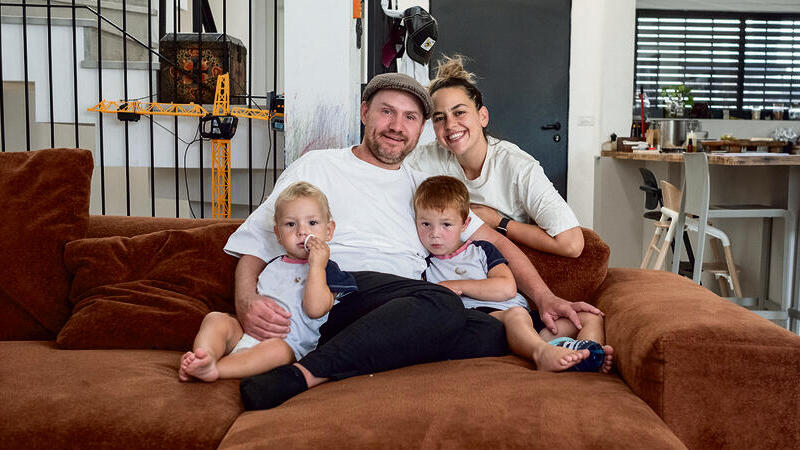
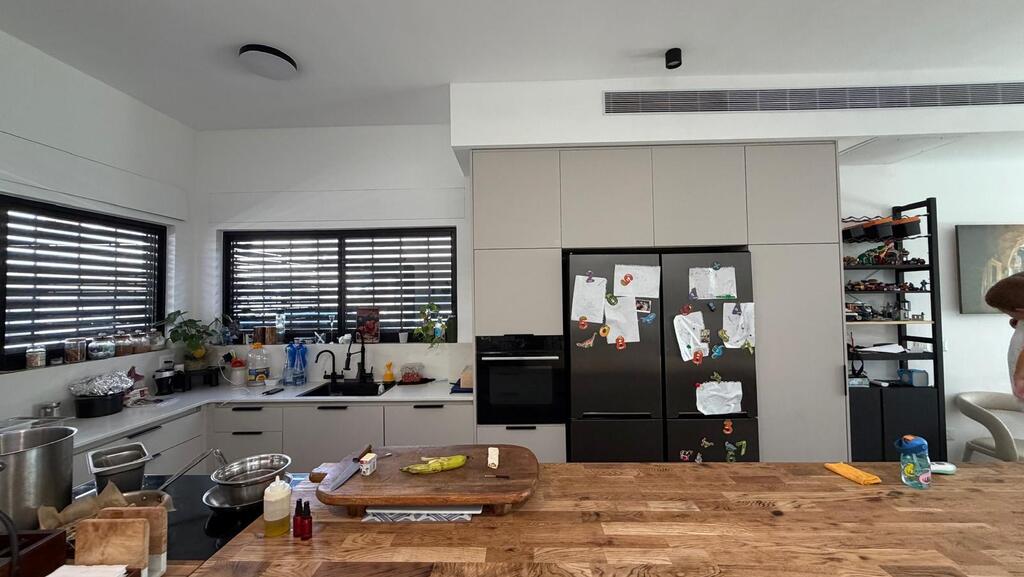
The home: A rented house. They pay about NIS 14,000 a month.
How did you meet?
Thomas: “I lived about a 45-minute drive northwest of London. One of my rules is that I have to live no more than 30 steps from the local pub, and Mai worked at that pub.”
Mai: “I worked there as a bartender. I moved to England with my parents when I was 14, and at 18 I started working at a pub near where we lived. One Sunday afternoon Thomas walked in and started giving me a hard time. He said, ‘I want a Vedett.’ I opened a Vedett, and then he said, ‘Actually, I want a Guinness.’ I poured him a Guinness, and then he decided he wanted another beer. So I put all the beers in front of him and said, ‘Drink all of them, because you’re paying for all of them, and you’re buying me one too. Now shut up and let me close the pub.’ We’ve been best friends ever since.”
Thomas: “Guinness has to be poured in a very specific way, and she passed the test.”
(Photo: Assi Haim)
Best friends?
Mai: “Every night after my shift, I would go over to his place with two pints from the pub, we’d smoke a joint and watch a show on MTV called ‘Yo Momma,’ where rappers battled by insulting each other’s mothers. We would sit there for hours laughing, and then I’d go home. That went on for nine or 10 months.
“Then one night, when I was at his place, I wanted to keep the night going, so we got in the car. Thirty minutes later, I was in a very serious accident. They had to cut open the car to get us out.”
Thomas: “I suffered a head injury. I was in the hospital with a broken neck and broken joints.”
Mai: “After the accident, I helped him through his entire recovery. After about three weeks, we started realizing that something between us was becoming more than friendship. Our first official date wasn’t until about a month after the accident.”
What do you do?
Thomas: “I’m a chef. I grew up with my grandfather, who was a chef in the Royal Air Force, and from the age of 7 I started working with him in kitchens and at events all over England. I caught the bug. By 14 I was already attending culinary college in London, and I completed a three-year program in two years. From the age of 16, I started traveling the world.”

(Photo: Assi Haim)
Traveling the world?
Thomas: “My grandfather had saved about £20,000 for me, and he said, ‘Either you get an apartment and work in London, or you travel the world.’ I decided to travel.
“At 16, I moved to Sydney on my own and worked in different kitchens. I would work for three months and travel for three months. I had a rule: If the chef annoyed me or I didn’t like something, I left and moved on to the next kitchen.
“When I returned to London, a Japanese friend from Sydney called and said they were looking for a Western chef to train in sushi in Tokyo for a year and a half, so of course I flew to Tokyo. A sushi master took me under his wing and taught me Japanese techniques.
“At one point, I opened and ran Michelin-level restaurants in five hotels across Southeast Asia. I did that for three years and then returned to London. Six months later, I met Mai at the pub.”
Mai?
“Commitment has never exactly been my strong suit. After we had been together for a while, I moved to Los Angeles. I wanted to be an actress. I told him, ‘I’m leaving. If either of us meets someone else, we’ll call each other and end it properly.’
“We were long-distance for two years, writing letters through the mail, emailing and talking on Skype. There was no WhatsApp back then. My parents actually banned him from coming to visit me because of the accident. They didn’t like him being around. He would come secretly and hide at a friend’s apartment in the building next to mine. Once, my brother showed up unexpectedly and I hid Thomas under the bed.
“It took six years for my family to accept him. When we were already living together in Los Angeles, I heard that a restaurant called BAZAR was looking for a chef who understood Middle Eastern food. I knocked on the door and said, ‘I have someone for you.’ He worked with them for 10 years and opened restaurants for them in Chicago and Istanbul. From there we moved to New York for three years, and that’s where Blue was born.”
Blue?
Mai: “He was hospitalized for a year. He can’t be vaccinated, so he can’t attend regular preschools because anything could put him at risk. That’s where the idea of homeschooling came from. We teach the children ourselves and have a preschool teacher come to the house twice a week.
“It’s not that we didn’t want them in regular frameworks, but because of his health we had no choice. Then Thomas was transferred to work at the group’s restaurant in Jaffa, so we went with it and made aliyah. We’ve been here for three and a half years.”
(Photo: Assi Haim)
Israel?
Thomas: “We arrived at exactly the right time, shortly before the war. My grandfather fought in two world wars. If he knew there was a war where I live and I ran away, he would be ashamed of me. So I’m not leaving.
“I love Israel. It’s the only place where people tell you exactly what they think to your face and nobody gets offended.”
Mai: “Adjusting to life in Israel was difficult for me. Coming back after 20 years, dealing with all the bureaucracy in Hebrew and everything being shouted — I was in shock. I felt very lonely. Thomas was working long hours, and I was alone with a small child and postpartum depression. Slowly, we learned how to manage. We didn’t really have a choice.”
What do you do today?
Thomas: “I realized that opening a conventional restaurant right now would be financial suicide. Half the staff could be on reserve duty, the fixed costs are insane and places are constantly shutting down.
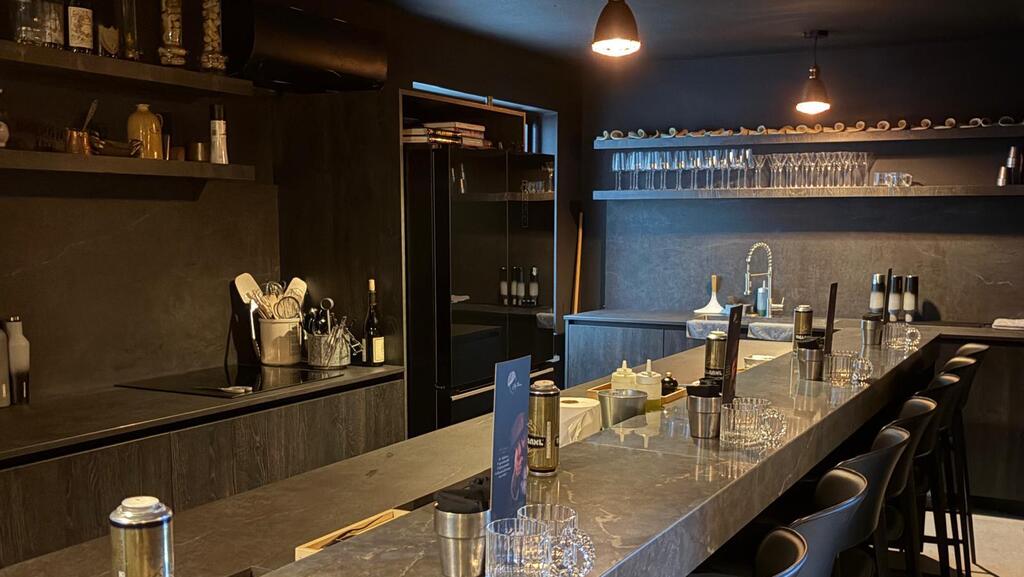
“So we developed a different concept: private culinary hosting here in our home, three times a week. We host up to 22 people for a 10- to 12-course chef’s meal. Every month has a different concept. This month, for my birthday, it’s a British menu with an Israeli twist and Japanese techniques.
“We use only Israeli ingredients. For me, it’s critical to support Israeli producers.”
Mai: “People come into our home for the experience, ask questions and take an interest in our story. It’s all very intimate, and it’s simply a lot of fun.”
Financial situation?
Mai: “We’re balanced. We calculate everything carefully and are looking ahead at how to develop the business profitably.”
What do you do for fun?
Mai: “The evenings when we host people here are our entertainment. Beyond that, when we finally have some peace and quiet, it’s a good joint at the end of the day, some music or a TV series, and a chance to breathe.”