

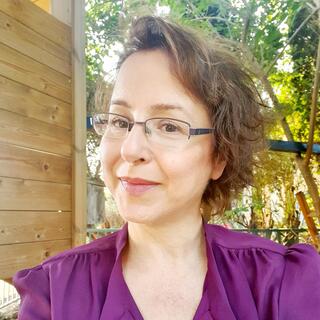
At just 27, Dr. Orly Grobeisen-Duque has already lived a few lifetimes’ worth of experiences: she’s a doctor, an on-call physician in two hospitals, a soon-to-be gynecology resident, and engaged to be married. She now lives in Ra’anana, where she is learning to balance long shifts, Hebrew medical jargon, and the energy of Israeli life.
“I was born and raised in a traditional Jewish family in Mexico City,” she recalls. “We celebrated all the Jewish holidays. When I was nine, my family became more religious, and I started studying in a national religious school that included Hebrew lessons.”

Dr. Orly Grobeisen-Duque. "Since I arrived here, I’ve met only open hands reaching out to help new immigrants.”
(Photo: Yariv Katz)
At 15, she visited Israel for the first time. “I fell in love,” she says. After high school, she joined a gap-year program through the Bnei Akiva youth movement. “We studied, traveled, and volunteered on a kibbutz and in the army. When the year ended, I knew it wasn’t my last time in Israel.”
Discovering a passion for women’s health
“Back home, I began medical school already thinking I would do my residency in Israel,” she explains. “One of my reasons was that Israel’s medical research is much more advanced than Mexico’s. I wanted to be part of that and combine clinical work with research.”
After six years of study and during her internship, she realized her calling: “I wanted to specialize in obstetrics and gynecology. It’s such a privilege to be part of women’s fertility journeys and witness their strength.”
Then came October 7. “After that day, I understood Israel desperately needed doctors. I couldn’t wait any longer. I wanted to help. That’s when I began preparing for aliyah and for the Israeli licensing exam for foreign-trained doctors.”
Love across continents
“Yosef, my fiancé, has been with me since I was 19,” she smiles. “While I was studying medicine, he was studying physics at another university. He came to Israel nine months before me on a student visa. Today, he’s working toward a master’s degree at Bar-Ilan University.”
Arriving in Israel
“In August 2024, in the middle of the heat and humidity, I landed in Israel and settled in an absorption center in Ra’anana,” she says. “I already knew the Israeli mentality from my gap year, so I wasn’t shocked, but I was stunned by supermarket prices. Food here costs twice as much as in Mexico.”
She studied Hebrew for five months in ulpan. “Absorption was easier thanks to my sister and her husband, who made aliyah two and a half years before me and helped me settle in.”
Lost on the bus
She laughs as she recalls one of her early adventures. “During my first month, I had to go to the licensing office in Petah Tikva. I got on a bus but was too shy to ask the driver if I was going in the right direction. Later, I saw on the app that I was totally off-route. I finally asked, ‘Aren’t you going to Petah Tikva?’ He said, ‘No, I’m going to Netanya!’ and started shouting at me for not asking earlier. I almost cried, and then the passengers started shouting too: ‘Why didn’t you ask?’ He dropped me off in the middle of a traffic island with no sidewalk, and I had to cross a highway.”
Becoming an Israeli doctor
“One month after I arrived, I took the licensing exam for immigrant doctors. Two months later, I had my Israeli medical license,” she says proudly. “I’m still adjusting to the language and medical culture. Sometimes I say a word wrong and people don’t understand, so I switch to English.”
She’ll soon begin her gynecology residency. “The Gvahim organization helped me so much. They connected me with a Spanish-speaking gynecologist who became my mentor and guided me through all the bureaucracy.”
Finding open hearts in wartime
“Even though I arrived during the war, I’m happy I made aliyah,” she says. “There’s such a sense of unity here. Even when we disagree, we’re still together and support one another. Since I got here, I’ve met only open hands — people who genuinely want to help new immigrants.”
Quick questions with Dr. Orly Grobeisen-Duque:
What’s one Mexican habit Israelis should adopt?
“To say good morning, even to strangers.”
What do you miss most from Mexico?
“A dish called chilaquiles - tortilla chips with spicy salsa, egg, or cheese.”
What will you never get used to in Israel?
“That people shout. Sometimes I ask, ‘Why are you shouting?’ and they shout back, ‘What? I’m not shouting!’”
What’s your favorite place in Israel?
“The northern forests, I discovered them while hiking parts of the Israel Trail.”