

In her first stand-up show, held in late September at the Camel Comedy Club, she drew on her personal life: “When my husband told his family he wanted to marry me, they tried to convince him not to marry a Russian prostitute. When our kids grew up, I showed them Gaza terrorists and told them that’s what people who don’t study look like. Around age six I took them to my workplace — I’m a pathologist — don’t worry, these are organs that can’t move. And when they told my husband’s family about their experiences, by that point they no longer thought I was a prostitute, and from there everything flowed.”
A barrage of exaggerated punchlines, blunt language laced with sharp, intelligent and biting humor — these are the tools used by Dr. Daria Kozlova, an outstanding pathologist at Beilinson Hospital, in her performances — but not only there. Offstage, she lives on a kind of virtual stage as well, without uttering a single exaggerated word. It is hard to ignore her presence — and she does not want you to.
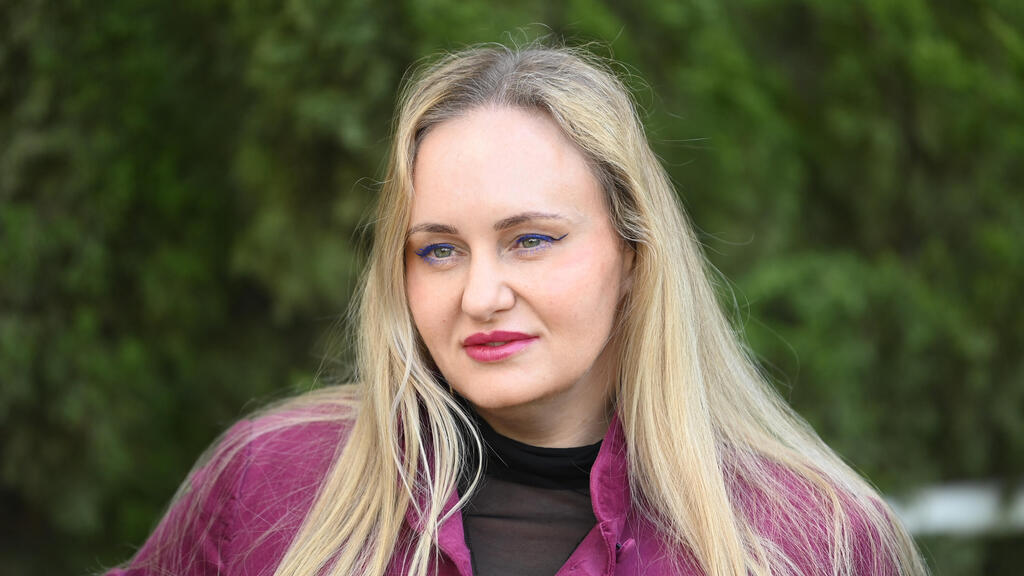
Are you aware of what you project, Doctor? A tall, blonde and attractive woman, in a miniskirt and a low-cut top, on stiletto heels, with provocative speech and sexual innuendo — all this offstage.
“Absolutely. I need that attention, the result of years of being put down in my childhood home. As I grew older, I knew I would dress how I want and say whatever I want. I love wearing both minis and low-cut tops. If you’re asking how my husband deals with who I am — my husband is a man of love and accepts me unconditionally. He has no problem with my provocative clothing or blunt speech. He’s all love. In his family, women sit at home and cook, but he’s different. He gives me complete freedom, and if not for him — I would never have gotten married.”
In an attempt to decipher her complex and polarized character — no simple task — we began to unravel its many elements, which should not fit together, and try to piece them back into a whole.
“I’m 44, married and a mother of three boys. I was born in Moscow, an only child to intellectual parents who raised me with strict, comprehensive Soviet education. In the minutes I wasn’t studying — everything, at an advanced level — I swam, rode the horse my mother bought me, and learned fluent English from my grandfather. But mostly I invested in trying to please my cold parents, who didn’t believe in me and put me down. In their youth, like their parents before them, they were baptized into Christianity, and over the years they became more extreme, and the home became strictly Orthodox.”
After finishing high school, she enrolled in a nursing school intended for religious girls.
“You imagine me in a modest skirt and head covering? Of course I rebelled. More than once they threatened to expel me, and still I graduated with honors.”
A career turning point
Dr. Kozlova absorbed two career-shaping insights during her nursing studies:
“The first was that I needed to be a doctor, and the second — no less critical — was that I cannot work with sick people. I can’t stand patients.”
True to her decision, she enrolled in medical school in Moscow. During a break between her fourth and fifth years, she joined a friend on a Christian pilgrimage to Israel.
“We visited Christian holy sites, and it happened that on my birthday we went to a church at the foot of the Mount of Olives.”
A local choir walking toward them changed her life in an instant.
“I nudged my friend when I noticed one of them. There was something magnetic about him.”
They spoke briefly before parting, and at the end of the trip she returned to her student routine in Moscow. As the weeks passed, his image increasingly occupied her thoughts — before she knew anything about him — until she made an unusual and bold move for a conservative Orthodox woman.
“I went to the church of the Jerusalem patriarch and told a priest about that man. I didn’t even know his name. Luckily, the priest immediately recognized him, because my husband is an artist who paints in churches.”
The priest arranged an exchange of phone numbers, and the Russian pilgrim and “the dark dwarf,” as she jokingly called him, began speaking regularly.
“It turned out my husband is Armenian, and his entire family lives in the Armenian Quarter of Jerusalem. He also told me openly that around age 18 he had a falling-out with the Armenian Church, and after that became an Orthodox Christian.”
You first saw him at the end of August, contacted the priest in October, and by January — before you had even gone on a date — you were already engaged. Even in retrospect, does that rapid move seem reasonable?
“At 18, my parents tried to marry me off to a priest. What didn’t I do to escape that disaster? I told him I was on drugs, that I slept with men — when in reality I was still a virgin. But the moment I saw my husband, something happened in my heart and I knew we would connect in marriage. And yes — I would absolutely do it all again, even with the wisdom I have today. Because what is the secret of a relationship? Talk less, have more sex and drink more alcohol. And I still oppose sex before marriage — because what does sex actually contribute to a good relationship? There is no correlation between sex and a relationship, since in most cases sex stops being fire and becomes routine, while the relationship itself needs time and develops gradually.”
'They didn’t believe anyone would take me'
Five months after meeting briefly — without seeing each other again — she arrived in Jerusalem for a second time, accompanied by her mother, for their engagement ceremony.
“We went out for a week, I returned to my studies in Moscow, we stayed in touch by phone, and by summer we were already married.”
She described the traumatic wedding in her stand-up show:
“At our wedding there were 400 guests on my husband’s side and three on mine — my mother, my father and a friend — who didn’t believe anyone would take me.”
The 23-year-old bride experienced the ceremony as particularly difficult and overwhelming.
“I come from a strict, cold Soviet home that operated on achievement, not touch. And suddenly at the wedding — it was the first time in my life I saw 403 people together. It was a shock. And if that wasn’t enough — all 400 hugged and kissed me. Too much contact.”
Her new husband joined her in Moscow to complete her final year of medical school, after which they returned to Israel.
“My mother-in-law, a Christian Arab woman whom I speak Arabic with, accepted me like a daughter and gave me all the warmth I never received from my parents. Without her help with the children, I couldn’t have continued in medicine with the same total dedication.”
During their first six months back, the couple lived in the Christian Quarter of Jerusalem’s Old City, then moved to the Arnona neighborhood, where they still live today.
“I went to Hebrew classes, and fairly quickly gave birth to our three sons, now 18, 15 and 13. I stayed home with them for six years, breastfeeding and weaning three times, and only then — when I was distant and disconnected from the medical world — I took the Health Ministry licensing exams and passed them.”
In love with the field
Then came the decision of which specialty to pursue.
“I didn’t hesitate for a moment in choosing pathology, and the specialization was immediate — and I’m still in love with the field. As I said, I can’t stand sick people who are still alive.”
Or, as she put it in her stand-up show: “My patients are neatly arranged in boxes. It radiates calm and happiness.”
In addition, she said, “pathology is the most intellectual field in medicine, because it ultimately determines the type of treatment. At the same time, I’m aware of the dismissive attitude from colleagues toward our profession. It’s not considered prestigious, there’s no heroism. It’s also known that pathologists are misanthropes who prefer a microscope over human interaction — and at least some of us, myself included, drink alcohol. I can finish a bottle of wine in an hour and move on to a second.”
After completing her residency at Shaare Zedek Medical Center and additional work at Meir Medical Center, she pursued further training in Boston, Memphis and Rome. After passing her final certification exams and being recognized as a specialist, she received job offers from several hospitals, including Beilinson.
“They snapped me up, but conditioned my hiring on working in fetal pathology and pediatric oncology. Since then I’ve effectively been responsible for Schneider Children’s Medical Center — except for skin and brain tumors — alongside work on testicular cancer.”
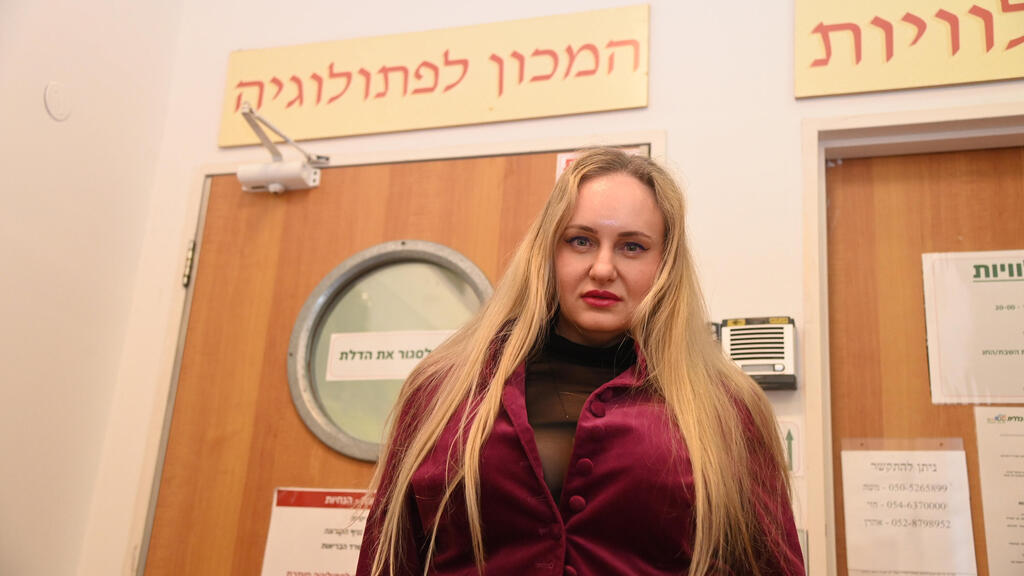
(Photo: Yair Sagi)
Her specialization has earned her a reputation, and she is considered one of the country’s leading experts.
“Eighty percent of my workload focuses on childhood cancer, and about 20 percent on determining causes of fetal death. I’m proud of the productive collaboration between me and Prof. Yinon Gilboa — head of the ultrasound unit at the Beilinson Women’s Hospital — and the brainstorming with experts at Schneider.”
Fetal autopsies are the part of her work least infused with the cynical humor she shares with colleagues.
“One day they brought in a sample of a tumor removed from the neck of an 80-year-old woman — a tumor that typically appears in children. It felt completely natural to tell the oncologists that their patient had anticipated her own postmortem.”
At the end of the workday, her protective layers fall away instantly. The clothing, the blunt language — they stop at the threshold of her home. The moment she steps inside, a strict, uncompromising mother emerges, raising her sons to excellence.
“I had serious disagreements with my husband about how to raise the children — he’s on the lenient side and I’m strict — because I don’t know any other way. That’s how I was raised, and that’s how I raise my sons. In their early school years they studied at an Armenian school, and then I transferred them to Israeli schools. All three, with the help of private tutors, speak five languages: Hebrew, Armenian, Arabic, Russian and English. From seventh grade they study in Mofet” — a program for excellence that emphasizes the exact sciences, including mathematics, physics and computer science — “and if they have any energy left, they invest it in Muay Thai boxing.”
How does it feel to be a Christian in Israel?
“There’s no problem at all, so it never even crossed my mind that I should convert to Judaism. I was baptized into Christianity, and I’m a proud Christian and religious in the most conservative sense. I don’t believe in sex before marriage and I’m firmly opposed to abortion. Every Saturday the whole family goes to church together, and we also observe fasts before holidays. I love Israel מאוד, and it never occurred to me to leave. My sons also have an Israeli identity, and our eldest is about to enlist in the army.”
You’re also a stand-up comedian. How did that happen, and how does it align with your religious and conservative identity?
“All my life people told me I’m funny. I was looking for a hobby and somehow I rolled into it. I admit that this occupation is still conflicting — in my first show and even now I think it’s a compromise, an innocent hobby compared to what I could do if I focused on stand-up.”
When she is not inhabiting one of her many identities, Dr. Kozlova lectures on pediatric pathology to second-year medical students at the Hebrew University’s medical faculty and works on writing scientific articles.
“Pathology is the final link in the chain of treating a patient, but it is the first and only one that determines which treatment will cure — and in effect decides the patient’s fate.”
Or, in the less polished language she used in her stand-up show:
“Someone ignores it, gets hospitalized, intensive care, lots of medications, ends up in brain surgery, they send a sample to pathology. Then I tell the doctors who treated him for months, ‘You’re idiots, it’s made of fungi and all he needed was antibiotics.’ The satisfaction from saying that — nothing compares to it.”