


Until 2022, August was synonymous with the arrival of IKEA’s annual catalog — a global celebration for design lovers. Since then, the catalog has gone fully digital, reflecting today’s more conservative style. But it’s worth remembering that, in earlier decades, its pages sometimes featured images that would raise eyebrows today.

In the 1977 printed catalog, the Swedish furniture giant included a photo of a couple in bed, their naked bodies covered by green-and-white floral sheets. And if you wondered about the woman’s leg resting at an angle on the floor, there was, in the 1960s and ’70s, an unwritten rule in film and advertising that a human leg touching the floor was a subtle cue that the subjects were not in the middle of having sex. Such an image, mailed to nearly every Western household today, might not pass without controversy.

An image from the 1975 IKEA catalogue
(Photo: IKEA)
By 1985, a similar image of a couple appeared — this time sleeping closely together under covers pulled up to their necks. Other snapshots from past IKEA catalogs show people knitting, reading, eating dinner with their (blonde, of course) children, and smoking freely in the living room. Television screens, in their bulky glory, were often built into large wall units, but were almost always switched off.
Get the Ynetnews app on your smartphone: Google Play: https://bit.ly/4eJ37pE | Apple App Store: https://bit.ly/3ZL7iNv
Looking back, IKEA’s catalogs in the 1970s portrayed a broader, less restrained range of life scenes. While most photos focused on the (brightly colored) furniture, the human interactions were often bold, conveying a freer, more relaxed lifestyle. Women frequently appeared in miniskirts, bare-legged, lounging in intimate, comfortable poses. These catalogs didn’t just show sofas — they showed what it felt like to live with them.

The 1977 catalog
(Photo: IKEA)
Until IKEA announced in 2022 that it was ending the printed edition in favor of a digital format, millions of people eagerly awaited their copy each August, delivered by mail and available in stores. For decades, it was one of the most powerful marketing tools in the design world — in fact, the most widely distributed home design book in history.

The 1975 catalog
(Photo: IKEA)
The first IKEA catalog was published in Sweden in 1951 and continued for nearly 70 years. The final printed edition was in 2020. At its peak, it reached a global circulation of around 200 million copies a year — more than any single newspaper and, in some years, even surpassing the annual number of Bibles printed. The catalog appeared in over 50 editions and was translated into 32 languages, including Hebrew, with cultural and religious adjustments for different markets.
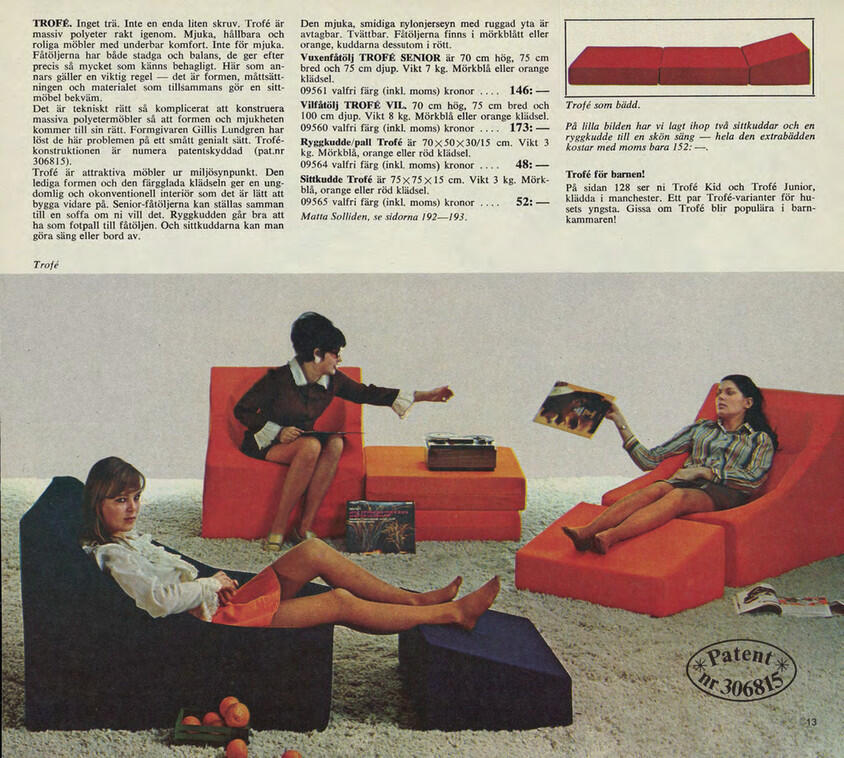
The 1970 catalog features miniskirts
(Photo: IKEA)
Over time, the vibrant blues, reds, yellows and greens faded from the pages. First, they were replaced by floral or subtly colored upholstery. In recent years, the palette shifted toward universally appealing neutral tones — gray, brown, black, white, cream and similar shades.