


The Zoom call with Chaninat Hashem Gordon finds her in Thailand. But anyone imagining a tropical vacation filled with cocktails, swimming pools and idle afternoons would quickly realize they were mistaken.
At 60, she spends her days in a training gym, accompanying her three boxer sons, Ahavat Hashem, Ruach Hashem and Kibedia Mishalti. Between sessions, she films them, manages their nutrition, massages them and, most importantly, gives them what she says no coach can provide: “emotional support.”
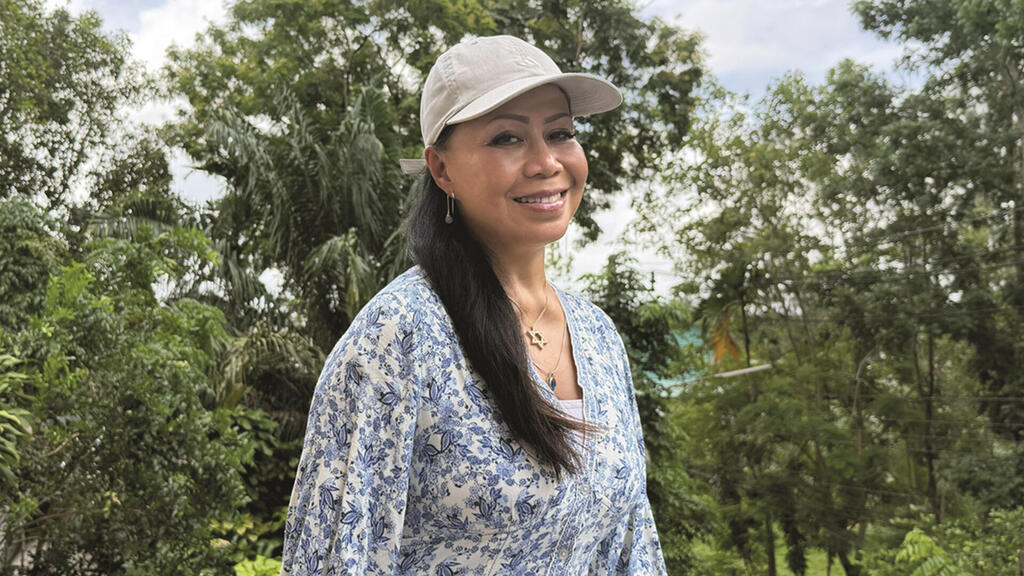
From the first day she became a mother, Chaninat Hashem says, she always put her children first. In recent years, since her husband died and several of their seven children became prominent competitive athletes, she has become an inseparable part of the team accompanying them to competitions around the world.
As far as she is concerned, even though they are now adults, her role has not changed: to be there for them. “We get up early every morning for training,” she says. “We rest a little and then go back to training. In the little free time I have, I also train myself. I am constantly learning new things. Right now, I am becoming certified as a mobility coach, and I hope to teach it in the future.”

The Gordon family
Her connection to fitness did not begin with her children. Before she married, and long before the Gordon family became a familiar name in the martial arts world, she worked full time as a fitness instructor in Hong Kong, where she was born under the name Gracie.
That is also where the first chapter in the remarkable story of the Gordon family begins, a story that Mama G, as her children call her, says has already attracted the attention of several film producers.
A stranger in Hong Kong
She was born in Hong Kong to a Thai father and a mother of Spanish descent, and says she always felt she did not belong in the place where she grew up. “Hong Kong was a British colony at the time,” she says. “Everyone thought it was the perfect place to live, but I never connected with the culture or the people. Because my parents were not Chinese, I also looked different from most of the people around me.
“When I was a teenager, I always told my father I wanted to leave. He would ask me, ‘Where?’ and I didn’t know what to answer. I only knew I didn’t want to stay there.”
This was before the internet, when people were curious about life in the West and pen-pal correspondence had become popular. One magazine, distributed only in the United States, published photographs of Asian men and women alongside short biographies. American subscribers could send letters to people who interested them.
“It wasn’t necessarily romantic,” she says. “It was also about friendship and broadening your horizons. My cousin had sent her details to the magazine and was corresponding with several people from the West. She suggested that I try too.
“I sent a fairly old photograph of myself and wrote a few lines saying that I was vegetarian, liked a healthy lifestyle, did not smoke or drink alcohol and worked as a fitness instructor. A few months later, letters began arriving. I especially liked one of them.”

'Because I grew up in Hong Kong but didn’t look Chinese, I had a difficult childhood. It was important to me that my children not go through the same experience'
The letter was signed by Azriel Gordon, a Jewish chiropractor living in Pennsylvania. She immediately felt that they had a great deal in common. “He was also a certified fitness instructor and had previously competed as a bodybuilder,” she says. “Like me, he did not smoke, did not drink and lived a healthy lifestyle.
“But what really caught my attention was that he wrote that his purpose in life was to help people and make the world a better place. That spoke to me deeply. I grew up in a very materialistic society, and suddenly I met someone who did not talk about money or success, but about giving and meaning. For me, it was like a breath of fresh air.”
Did you immediately write back?
“Yes. I wrote him a five-page letter in which I told him all about myself and included several recent photographs. Soon afterward, I received another letter in which he asked for my phone number.
“In those days, an international phone call was very expensive, but he called me. At the end of the conversation, he proposed marriage. I immediately said yes. To this day, people find that hard to believe, but I felt we were the same person. The same mind, the same values.”
Did the fact that he was Jewish bother you?
“I had studied the Bible at school, so I knew who the Jews were and what Israel was, but for me it was mainly history. What truly mattered was that he believed in God.
“I also believed in God, and in that sense I felt we believed in the same God, the one who created the heavens, the earth and human beings. To me, that was much more significant than the religious definition.”
Love has no age
There was another detail: Azriel was 22 years older than her, divorced and the father of two children. Chaninat Hashem, by contrast, was only 20. That did not deter her either. “In the photographs, he did not look like he was in his 40s at all,” she says. “He was in amazing shape, looked young and lived exactly as I did. To me, age was only a number.”

Ahavat Hashem Gordon
After two months of correspondence, Azriel traveled to Hong Kong to meet her, met her family and became formally engaged to her. He then returned to the United States to close his clinic and, after completing his arrangements, moved to Hong Kong to live with her.
Azriel, who was born Daniel but changed his name after his bar mitzvah, encouraged Gracie to choose a Hebrew name. “He said that Grace meant chen, or grace, and looked for a Hebrew name with a similar meaning,” she says. “That is how I received the name Chaninat Hashem.”
Two years later, after the birth of their eldest son, the family left Hong Kong and moved to Pennsylvania. For Chaninat Hashem, the move to the United States also marked the beginning of a deeper spiritual journey.
Living alongside her Jewish husband aroused a growing curiosity. “I had so many questions,” she says. “Azriel was not religious at the time. He told me a little about the Judaism he had grown up with, but it was not enough for me. I began buying books, reading and studying on my own.”
The more she learned, the more she felt a sense of belonging for the first time in her life. “Suddenly, I felt that I had found my place.”
She began observing Shabbat on her own initiative, long before her husband joined her. “I stopped answering the phone, and every Friday when Azriel came home from work, he found the house dark. It was my decision.” From there, conversion felt natural. “The more I learned, the more I felt that this was where I belonged.”
In 1997, when they were already parents of three, Haninat Hashem had a dream that led to one of the most significant decisions the family ever made. “I dreamed that God was telling me we had to move to Israel,” she says. “But Azriel did not connect with the idea at all. There were also many terror attacks in Israel at the time.
“When I told him that God had said we needed to move, he replied, ‘God didn’t tell me anything.’ It was difficult to persuade him, but he wanted to make me happy, so he agreed that we would try.
“At the time, several of our neighbors had been trying to sell their homes for years and had failed. We said we would put our home up for sale too, and if it sold, that would be a sign that we were meant to move to Israel. The real estate agent did not believe it would happen. She told us, ‘You have no chance.’ But two weeks later she called and said there were buyers. She was shocked, and we knew it was a miracle, a sign.”
And then you immigrated to Israel.
“Yes. I remember clearly the moment the plane landed in Israel. I cried, and my body would not stop shaking. Later, I met a rabbi who told me that my soul had stood at Mount Sinai and that I felt as though I was returning to my people. Suddenly, everything made sense. I understood why Israel was the place where I felt most at home.”
Every name has a reason
Beyond their achievements in the ring, the Gordon family has become almost equally famous for the unusual names given to the couple’s seven children: Otzmat Hashem, 40; Teshurat Hashem, 31; Emunat Hashem, 28; Kibedia Mishalti, 26; Simchat Hashem Belibenu, 24; Ruach Hashem Bechayenu, 22; and Ahavat Hashem, 20.
The eldest was born in Hong Kong, the next two in the United States and the four youngest in Israel. Behind every name is a story. “From the beginning, my husband and I knew we did not want to give our children standard names,” she says of the seven children, all of whom she delivered at home.
“We always loved the Native American approach, in which children receive a name expressing the spiritual place their parents were in when they were born. We named our eldest Otzmat Hashem, Strength of God, because we felt we needed strength in our lives. After that, it took me a long time to give birth again. I had complications and miscarriages.
“When we had a daughter nine years later, we chose to call her Teshurat Hashem, Gift of God, because to us she was a gift from God. I chose the name Emunat Hashem, Faith in God, spontaneously after the birth. I had written a list in advance of everything I wanted to happen during the delivery, and every one of those things came true.”
Did you call the children by their full names?
“When they were young, always. Their siblings also called one another by their full names. Only when they got older and began spending more time with friends did nicknames develop.
“I remember that people would often call our home and ask to speak to one of the children using a shortened name, and Azriel did not like it. For example, someone would ask for ‘Simcha,’ and he would always correct them: ‘Simchat Hashem Belibenu.’ I still usually call them by their full names, but they now mainly use nicknames: Amun, Ruach, Kibedi. Ahavat Hashem is often called Ahava or even Avsha.”
After immigrating to Israel, the family moved among several communities. They first lived in a community overlooking the Sea of Galilee, then moved to Efrat in the West Bank and eventually settled in Shiloh. They lived there for 16 years, raised their children and made the community their home. Today, their seven children are divided between Israel and the United States, but sport continues to connect almost all of them.
Otzmat Hashem recently returned from Boston to recruit investors for the family’s Gordon brand. Teshurat Hashem cleans windows by rappelling from buildings and is studying medical massage. Emunat Hashem is a Muay Thai coach.
Simchat Hashem Belibenu is an acrobat currently performing with a circus in Florida, while Kibedia Mishalti, Ruach Hashem and Ahavat Hashem Gordon are decorated boxing and kickboxing champions with international titles. All three came to Menora Mivtachim Arena for GFN, Gordon Fight Night, billed as the largest Muay Thai and kickboxing event ever held in Israel.
The brothers entered the ring together for the first time, competing in headline bouts against international fighters. Some of Israel’s leading fighters also took part, facing opponents from around the world. For Haninat Hashem, it was undoubtedly one of the most emotional high points in the family’s life. But alongside the excitement was sadness: The man who had encouraged their children from the beginning to pursue their dreams was not there to see them continue fulfilling them.
“At first, when the children entered boxing, I did not like it,” she admits. “The thought that they would be hit was difficult for me. When Kibedia Mishalti said he wanted to move to the United States to train in MMA, it was too much for me because it felt too violent. I asked Azriel to try to convince him to stay in Israel. I remember my husband saying to me, ‘He has to follow his dream, not ours.’ Looking back, I understood how right he was.”
A family tragedy
The father of the family died six years ago at the age of 76. According to Haninat Hashem, his death was caused by chronic exhaustion. “Azriel worked constantly, and at a certain age there is a price for that,” she says. “I always compare it to a battery. If you do not allow it to recharge, eventually it simply runs out.
“His death was very fast. He suddenly felt unwell, became extremely weak and tired, and then simply did not wake up. It was very difficult for me to get used to life without him. More than anything, I miss our conversations. We could talk for hours about everything: life, politics, the children. We had so much in common, and we agreed on almost everything.”

After Azriel’s death, Chaninat Hashem moved with some of her children to Zichron Yaakov. “We always rented homes in Israel,” she says. “The house in Shiloh was too large and too expensive, so we moved to a smaller home.
“I now live on my husband’s pension, and the children also help me with expenses. At the moment, Ahavat Hashem lives with me, but he is getting married on August 23 to an IDF surveillance soldier and will naturally move into a home of his own.”
When did you realize your children were especially talented athletes?
“My husband and I always trained, so from a young age they imitated us. Gradually, I began to notice they had strength and abilities that you do not usually see in other children. For example, we never taught them to swim, ride bicycles or roller-skate. They simply did everything on their own. At first, I thought that was how it was with everyone. Only when I heard other parents say they had to teach their children those things did I think, ‘Wow, wait, apparently this is not something to take for granted.’ That was how I realized they had special talent.”
Was there jealousy among the children over the years?
“Never. I think it is connected to the fact that they were homeschooled. They spent a great deal of time together, did things together and shared similar interests and goals, so an exceptionally strong bond developed among them. They always supported one another. What makes me proudest is not necessarily their achievements, but the fact that they truly love one another and are happy for each other’s success.”
She says the decision she and her husband made to homeschool began when they had only one child and were still living in the United States. “I remember Otzmat Hashem coming home from school and beginning to use ugly words, expressions that were very common among American children. We were shocked.
“We were also very strict about healthy food in our home, and the other children teased him because of the food I packed for him. He was so embarrassed that he threw it in the garbage. I said to myself, ‘My God, if a child attends a school where the environment is so opposed to our values, he will not be able to maintain those values for long.’ We began thinking about an alternative and eventually found a private teacher who came to him every day.”
When the family moved to Israel, they initially tried integrating their children into the public education system, but saw the same problems repeat themselves. Israelis were also not accustomed to seeing children with Asian features, and the Gordon children were bullied because of their appearance.
“I went through the same thing as a child,” she says. “Because I lived in Hong Kong but did not look Chinese, I had a difficult childhood. It affected me throughout my life. I had very low self-esteem because of the way people treated me. It was very important to me that my children not go through a similar experience. I believed the most important thing was to protect them.
“We joined several other homeschooling families and created a community in which different teachers came to teach. Everything took place in a very loving and supportive environment.”
Even then, the children were not completely protected from prejudice. Haninat Hashem remembers one incident that was especially painful. “When Teshurat Hashem was six, she was standing outside the library, and a group of children gathered around her and shouted, ‘Chinese girl, Chinese girl, look what you look like. Who would ever want to marry you?’ I was not there when it happened, and when she came home she did not tell me anything. A neighbor who had been present told me.”
How is it today?
“Everyone wants to be friends with my children, but when they were young, it was not always easy.” In retrospect, she believes those experiences pushed some of her children toward martial arts. “Before the boys began training, there were children who tried to bully, push and harass them. They always fought back.
“I remember that whenever it happened, I felt very embarrassed because I did not want them to fight. But even when they were young, I could see that they were very mentally strong and knew how to defend themselves.
“Once they began training, no one bullied them anymore. At first, as I said, I did not like it. But over the years, I came to understand how important it was. Today, I tell every parent: Send your children to learn martial arts. Boys become more disciplined and get into fewer fights, and girls learn how to defend themselves. When you know how to fight, you usually no longer need to fight. It gives you confidence, changes your body language and makes people understand they should not mess with you.”
How do you raise champion children? What is the formula?
“I was always very involved in my children’s lives, and every one of them knew they mattered to me. Beyond that, we raised them with values.
“They knew they had responsibilities and that everything required hard work. Nothing came easily to them. When they wanted something, they had to work for it. I always tell young parents: Give your children what they need, not what they want. The things they want, they should earn for themselves. Otherwise, they will never learn to appreciate those things and will believe they are entitled to everything.
“When my children wanted to get driver’s licenses, for example, they went to work and saved money to pay for their lessons. One of my sons told me that a friend once asked him, ‘What, your parents don’t pay for the lessons?’ That was the first time he had ever heard of parents doing that.
“The children also knew that everyone had to take part in the housework. They all knew how to clean and help. If they liked something I made, even cookies, and asked me to make more, I would tell them, ‘If you like it, learn how to make it.’ Fortunately, they always understood the approach and never complained.”