

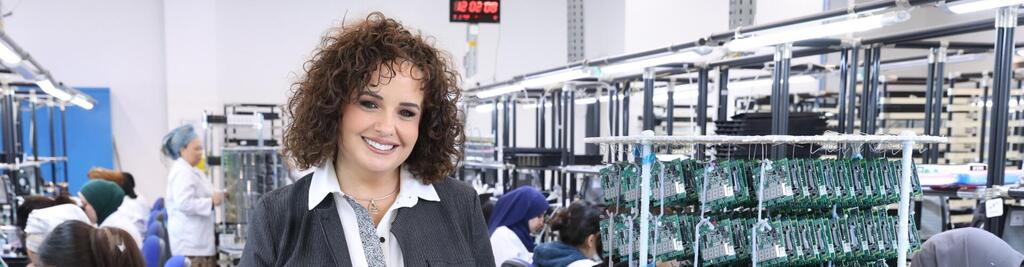
From a small workshop in a northern village to a prestigious international award for women industrialists that she received last month in Bahrain, Tal Kaufman’s story is one of resilience, ambition and unconventional success.
Kaufman, founder of Simtal Nano-Coatings Ltd, a pioneer in electronic circuit coating in Israel, employs a workforce that is 99% women from across Israeli society. In an interview, she describes how she entered an unlikely field, the debts she accumulated in her early years, raising her children alongside factory machines and the emotional moment she stood on stage in the heart of a Gulf state.
Last month, Kaufman stood on stage in Bahrain wearing an evening dress she had specially commissioned in blue and white. The choice was deliberate. Standing beside her was a Lebanese entrepreneur who, upon learning where Kaufman was from, visibly distanced herself.
Kaufman, founder and owner of Simtal, which operates in the Tziporit industrial zone, went on stage with her mother to receive recognition from the International Women’s Entrepreneurial Challenge (IWEC), which promotes female entrepreneurship in industry and technology. She was the first Israeli woman to receive the award.
“The ceremony was all about women, yet all the hosts and speakers were men,” Kaufman said. “That upset us. The Bahrainis ran the event, and unfortunately, the winners were not allowed to speak when receiving the award. That was very important to me. I wanted to dedicate it to my late father.”
As an Israeli, did you feel treated differently?
“Aside from that incident, I didn’t feel any anti-Israeli sentiment from the other participants.”
A workforce of women
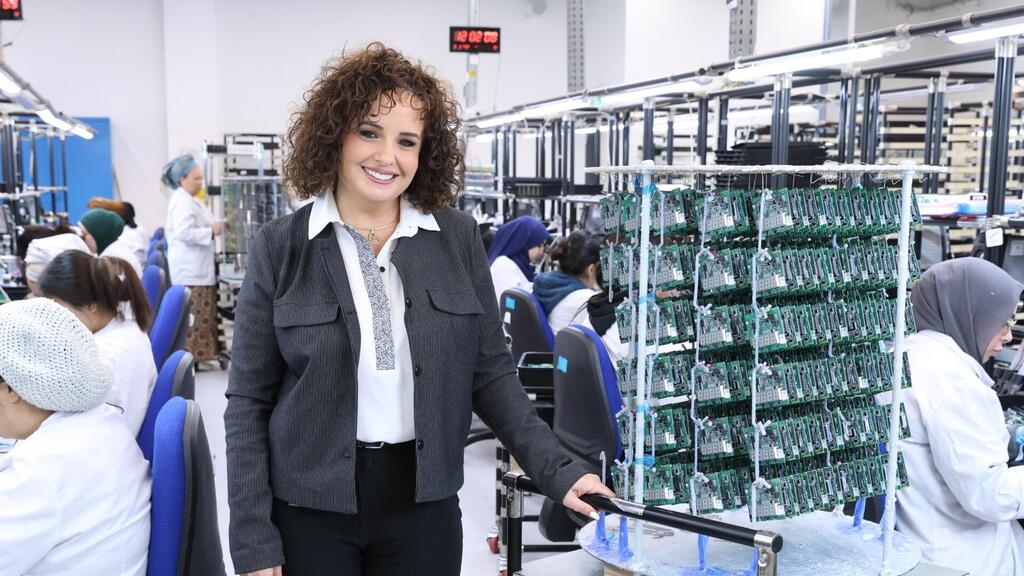
A purple-pink color scheme runs through Simtal’s factory in the Tziporit industrial zone. Even the appliances in the break room match, hinting at the company’s core ethos: women’s empowerment.
Ninety-nine percent of the factory’s employees are women from diverse backgrounds.

Tal Kaufman with the prestige award
Kaufman, 51, lives in the Jezreel Valley community of Shimshit. She is married with five children. Her husband, Eran Bar Rabbi, a former municipal CEO, now serves as Simtal’s CEO and is one of only four men at the company. Kaufman serves as chairwoman.
She is used to surprised reactions when people hear what she does: she owns a factory specializing in coating electronic circuits with parylene, a material known for its high sealing capabilities. Developed in Israel in the 1970s, Parylene was adopted early on by NASA.
Simtal is the only factory in Israel specializing in this technology, coating circuits found in everything from toys to supercomputers and weapons systems. The coating protects against dust, corrosion and environmental damage, using ultra-thin nano layers.
Why are most employees women?
“In our field, women perform better than men,” she said. “I compare coating to nail work. Ask a man to sit under a microscope for nine hours doing delicate work, it won’t last. Men tend to apply force when facing a problem. Women know how to solve things more delicately.”
From medicine to manufacturing
Kaufman’s career in coatings began in an unlikely place, a small private workshop in the Bedouin village of Zarzir, where she first worked as a manager after completing electrical engineering studies.
“I grew up in Kiryat Ata. I wanted to study medicine, but my grades weren’t high enough. I was a competitive swimmer and one of the first girls in Israel to compete in triathlons. I even went to Canada to study medicine, but came back. Eventually, I studied electrical engineering.”
After a brief stint in high-tech, she realized programming was not for her.
“I ended up managing a small workshop in Zarzir, a modest place near a falafel stand, with old machines. I didn’t know it was in financial trouble. Eventually, it went into receivership, and in 2006, I bought it. I believed in the field and added another machine.”
The early years were difficult.
“I had almost no clients. Until 2011, the business was losing money. I basically did a PhD in convincing banks to give me loans. I was a young mother with twins. I still have a photo in my office showing the machines, a baby crib and one of the workers watching my children.”
She brought bathtubs, toys and tapes to the factory so she could raise her children while working.
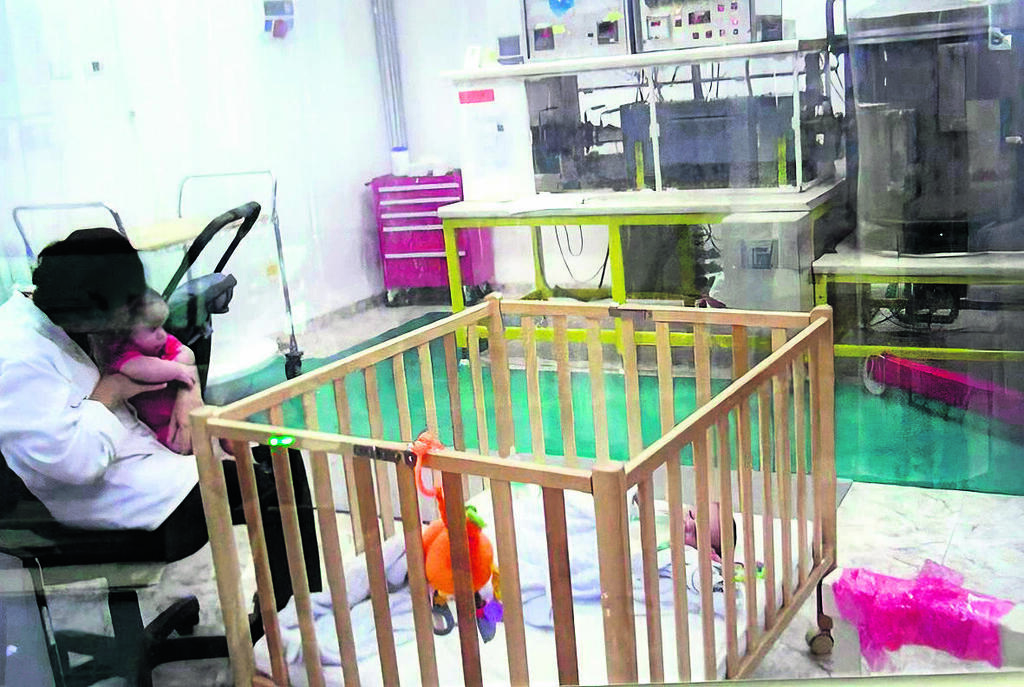
In the early days with her twins at the small factory in Zarzir
The breakthrough
The turning point came in 2012.
“Representatives from Flex came to visit. The place was on the ground floor of a building in a Bedouin village. No anti-static floors, nothing. The machines were on makeshift tables. They were shocked.”
Yet the international parent company wanted to assign them a project linked to HP printers, requiring parylene coating.
“They told me, ‘We’ll bring furniture, tables, everything. When you have money, you’ll pay us back.’ And that’s what happened.”
Soon after, Simtal secured a major contract.
“I was covered in grease helping my ex-husband with industrial equipment repairs when I got a call that a Panasonic representative was arriving in two hours to close a deal. I rushed to the office and picked up my twins from daycare on the way. She said, ‘We want to close a two-year deal.’ I just said yes. After the meeting, I called my father and told him, ‘We’ve entered a new era.’”
War and growth
The company expanded, acquiring machines from a closing factory in Arad and hiring more workers, including women from nearby Bedouin communities.
Eventually, Kaufman purchased land in Tziporit and built a new facility.
The factory’s inauguration was planned for October 2023, but war disrupted those plans.
“It was a very difficult time. Four of our children were serving in combat. I couldn’t sleep. I sat by the door waiting.”
At the same time, demand increased.
“We kept working during the war because we supply the defense industry. Parylene prevents nano-growth that can cause electrical failures. In weapons systems that may sit unused for years, reliability is critical.”
On Nvidia’s radar
Inside the factory stands a massive machine designed to produce graphene, a highly conductive material that efficiently dissipates heat, a key challenge in the AI era.
The project began as part of a consortium led by Nvidia and Israeli research institutions.
“We realized Simtal had a ceiling as a local factory. Graphene opens global opportunities,” Kaufman said.
Simtal has since launched a new company, DeepGraphene, in partnership with Bar-Ilan University, and is seeking investment to scale production internationally.
“If this works,” she said, “Simtal could become a global graphene supplier, even to Nvidia. It could be the next Tower Semiconductor.”