

“Here we see the body of a person who was burned,” he says, pausing over one of the photographs. “We know he was burned alive: When we open his airway, we can see soot inside. That means he inhaled smoke while he was being burned.”
Prof. Chen Kugel, director of the National Center of Forensic Medicine in Tel Aviv, shows us a presentation containing hundreds of photographs from the autopsy rooms. Three years after the Oct. 7 massacre, he shows us some of them, including images that have never before been published. They document the horrific brutality of the Hamas terrorists, to the point of obliterating all trace of those they murdered. These sights exacted a heavy price from him: Months after the main work of identifying the victims was completed, he sought psychological treatment and was diagnosed with post-traumatic stress disorder.
Gallery
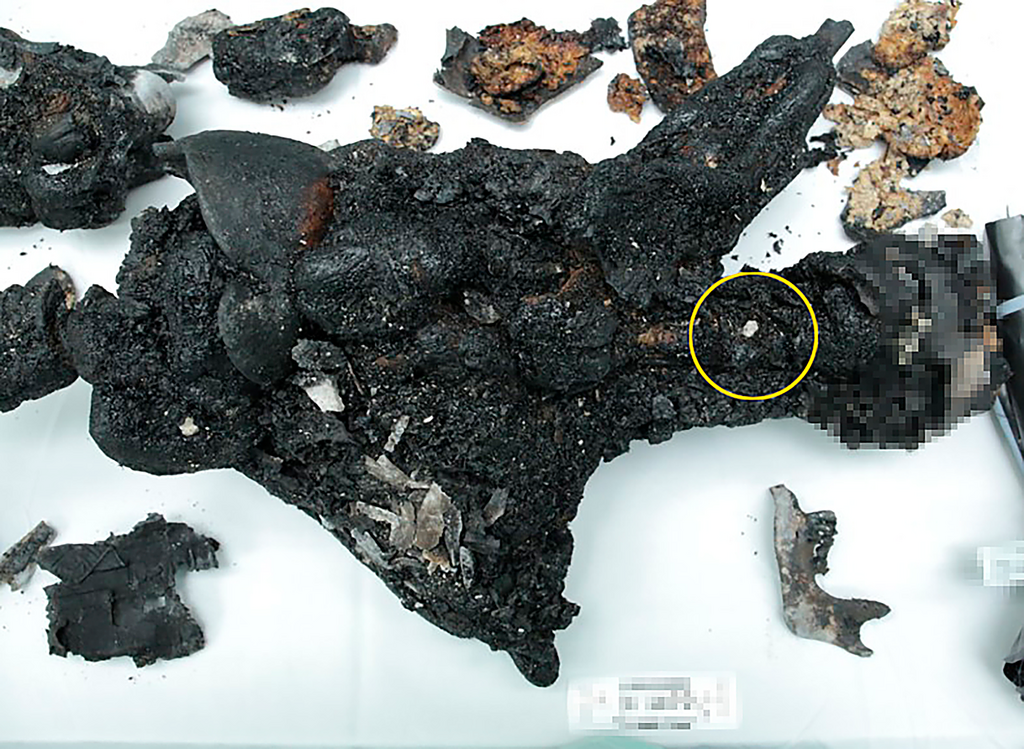
Horrifying brutality: Soot in the trachea proves that a person was burned alive
(Photo: National Center of Forensic Medicine)
“While I’m working, I’m on autopilot, focused. I examine, investigate the cause of death in order to reach an identification. I don’t involve emotions. But there were cases that affected me personally, like the case of a young woman.”
She had attended the Nova music festival and was shot in the legs as she ran to take shelter in an ambulance parked nearby. There, she was murdered along with 18 other people who had crowded inside, when terrorists fired an RPG at it. The crescent-shaped necklace she was wearing was found at the funeral home and mistakenly attributed to another body, until her DNA was extracted from it.
Her body was transferred to the Shura military base. Because no CT scan had been performed there, Kugel and his team assumed that her body had fused with another body in the fire that broke out in the ambulance and that the two had been buried together. To identify her, the bodies were exhumed. The young woman was identified through DNA extracted from the necklace and brought to burial.
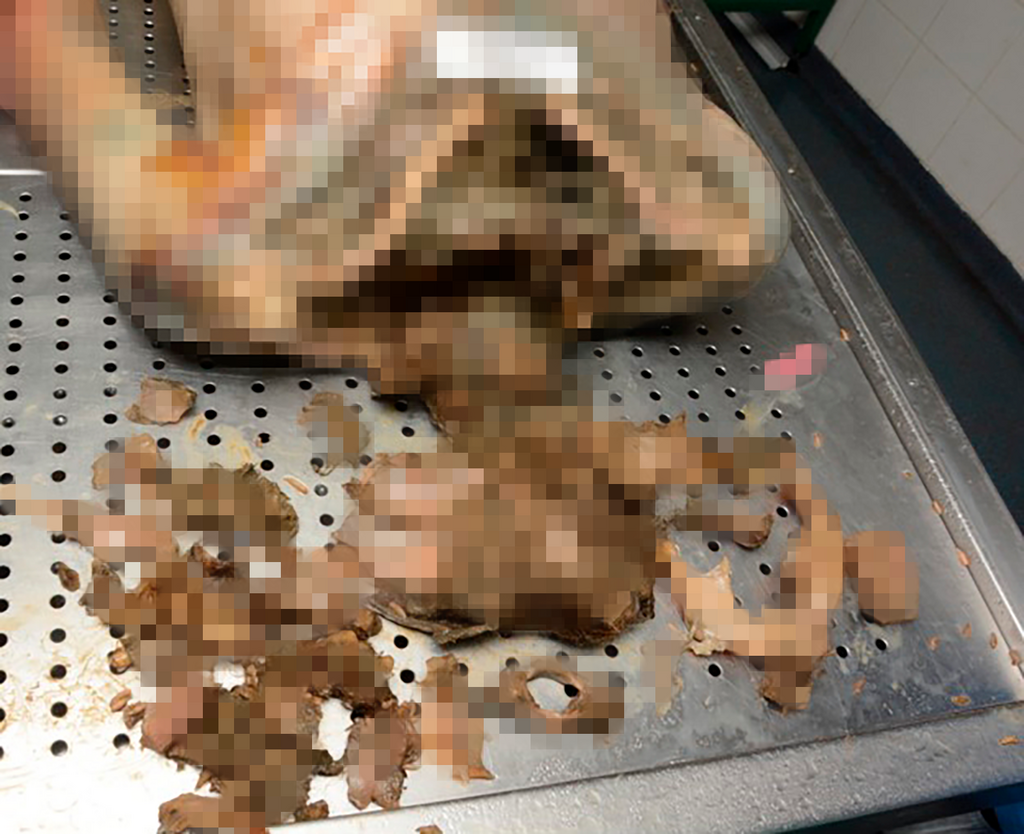
Terrorists ran over a person’s head
(Photo: National Center of Forensic Medicine)
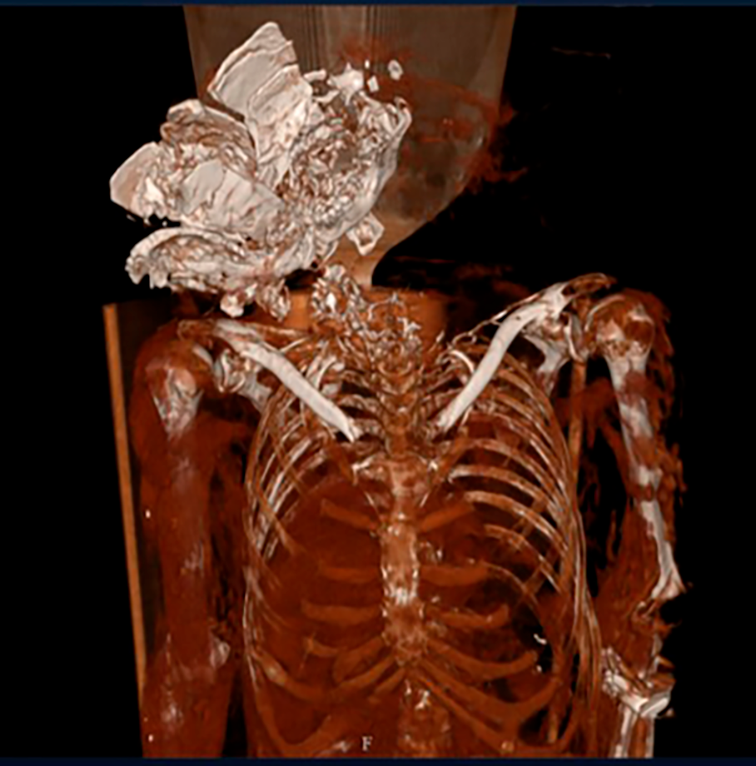
Terrorists ran over a person’s head — as seen on a CT scan
(Photo: National Center of Forensic Medicine)
“It was very difficult for me,” he says of the moment she was identified.
A week after the deadliest attack in Israel’s history began, large numbers of bodies started arriving at the center, reaching a peak when trucks stood in line and refrigerated containers had to be urgently brought in because there was simply no room left. According to Kugel, the smell of the horror spread throughout the surrounding neighborhood in south Tel Aviv.
“We received about 3,000 bags, most of which contained body parts and burned bones. The more bags we opened, the more we found parts of the same person scattered among different bags. Ultimately, we handled more than 900 bodies at the institute from the events of Oct. 7 and the Swords of Iron war.
“That does not include hundreds of bodies of terrorists and Gaza residents that were removed from hospitals and cemeteries to check whether any of them were the bodies of hostages. Examining those bodies cost us precious time and an enormous amount of work for nothing.”
The moment he broke down in tears
The identification work continued from morning until night, including on weekends. The goal was to remove the uncertainty for the families and allow them to bring their loved ones to burial in Israel.
Kugel’s breaking point came on one Friday, another busy and frantic day at the center. It was approaching evening, and the teams and volunteers had their hands full. Laboratory directors arrived to help collect DNA from the victims’ bodies, some bringing their laboratory technicians with them. Alongside them worked anthropologists who helped interpret findings from bone fragments, as well as other professionals.
Prof. Chen Kugel: “There were also people whose faces had been deliberately mutilated, or whose remains had been obliterated and virtually erased, or whose bodies had been gnawed by animals. We also saw bodies of people who had been abused before they were murdered, and sometimes afterward as well. In one place, people were tied up and shot, including in their genitals. We saw decapitated bodies, including the heads of children.”
In all, about 100 people crowded into the center’s small spaces. Shortly before Shabbat began, civilians arrived at the institute carrying trays filled with food for Friday-night dinner.
“I gathered everyone together and stood up to say a blessing, and I couldn’t. I broke down crying in the face of all that goodness. After seeing the cruelty, what moved me most was the kindness, the way the civilians mobilized and the reality that showed me there are good people and not everything is shit.”
We first came to the National Center of Forensic Medicine about two weeks after the massacre, when its doors were opened to the foreign and Israeli press. Before our eyes, ZAKA trucks unloaded, one after another, black bags containing the bodies of victims. The bodies were brought from the national body collection center at the Shura military base.
“On Saturday, Oct. 7, I received a report from the police about an incident with dozens of fatalities. The number rose to 100, and we have room for 140 bodies. So all the bodies of the dead, civilians, soldiers and police officers, were transferred to Shura, which was equipped with storage containers.
“Our doctors and technicians traveled there to collect identification data, fingerprints and DNA, with the aim of opening victim files as quickly as possible. Those were analyzed in our laboratories and created an enormous workload. A week later, the center of gravity shifted to us,” Kugel recalls.
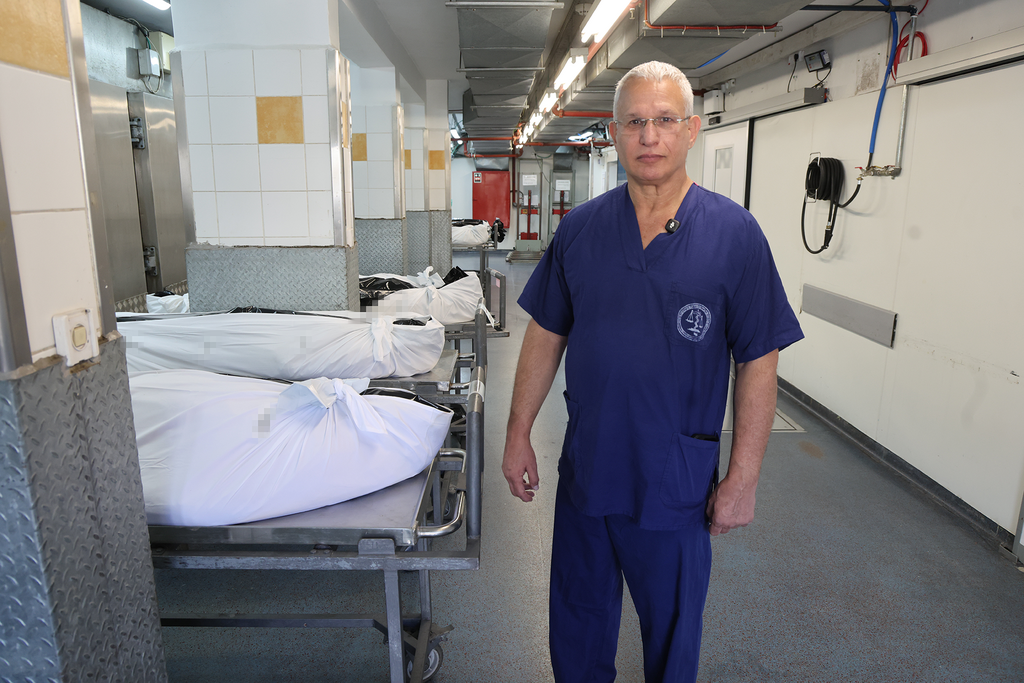
‘We saw things that were unprecedented. Evil incarnate.’ Prof. Chen Kugel, director of the National Center of Forensic Medicine
(Photo: Yariv Katz)
Then, after more than 30 years of experience, he came face-to-face with cruelty in its purest form.
“Gradually, complex bodies were sent to us from Shura for identification. There were burned bodies, and bodies already in a state of decomposition that could no longer be identified using fingerprints. We were dealing with thousands of bodies, body parts and objects.
“There were also people whose faces had been deliberately mutilated, or whose remains had been obliterated and virtually erased, or whose bodies had been gnawed by animals. We also saw bodies of people who had been abused before they were murdered, and sometimes afterward as well.”
“In one place, people were tied up and shot, including in their genitals. We saw decapitated bodies, including the heads of children.”
About a month after the massacre, Kugel told us: “We saw things that were unprecedented. Evil incarnate. You can’t call it cruelty, because that word does not adequately describe the situation.”
Nearly three years later, the difficult findings have settled and accumulated into important conclusions.
“We noticed that the murderousness of the Nukhba terrorists was deliberate and planned, according to an organized operational plan,” he said, referring to Hamas’ elite commando force. “For example, we identified a group of foreign workers who were locked inside a room in one of the Gaza-border kibbutzim, shot in the legs and left to bleed to death.
“In one place, we saw people tied up and shot execution-style. Somewhere else, we saw a safe room set on fire with additional accelerants so that it would become a crematorium. In other places, there were other methods, meaning there was a plan.
“The brutal killing was something planned, not a spontaneous outburst. People tried to attribute things to drugs they had taken - Captagon - and that isn’t true. Otherwise, they wouldn’t have followed the plan.”
According to Kugel, the systematic way in which the Nukhba terrorist squads operated, using different methods of killing in different areas, points to an organized plan of extermination.
“You see that in one place they used one method and in another place they used another.”
In the first weeks, there was a great deal of confusion. No one knew who was missing, who had been murdered but not found, and who had been abducted to Gaza. Did you also receive terrorists’ bodies by mistake?
“Yes. Hundreds of Gazans, civilians and terrorists. One of them, as can be seen in the CT scan, was wearing a Hamas bandanna, and grenades and a serrated knife were identified on his body. Meanwhile, eight Israeli bodies were evacuated to Sde Teiman.”
Slide after slide changes on Kugel’s computer, and the horror only intensifies.
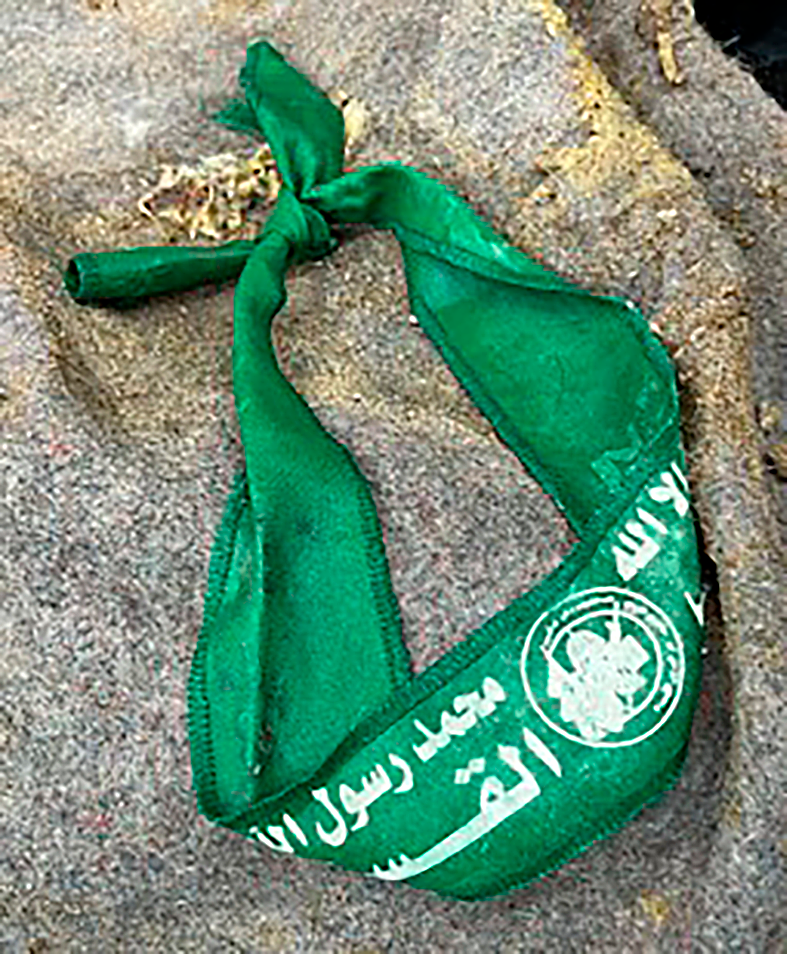
Hamas terrorist’s headband found on his body after it was brought to the National Center of Forensic Medicine
(Photo: National Center of Forensic Medicine)
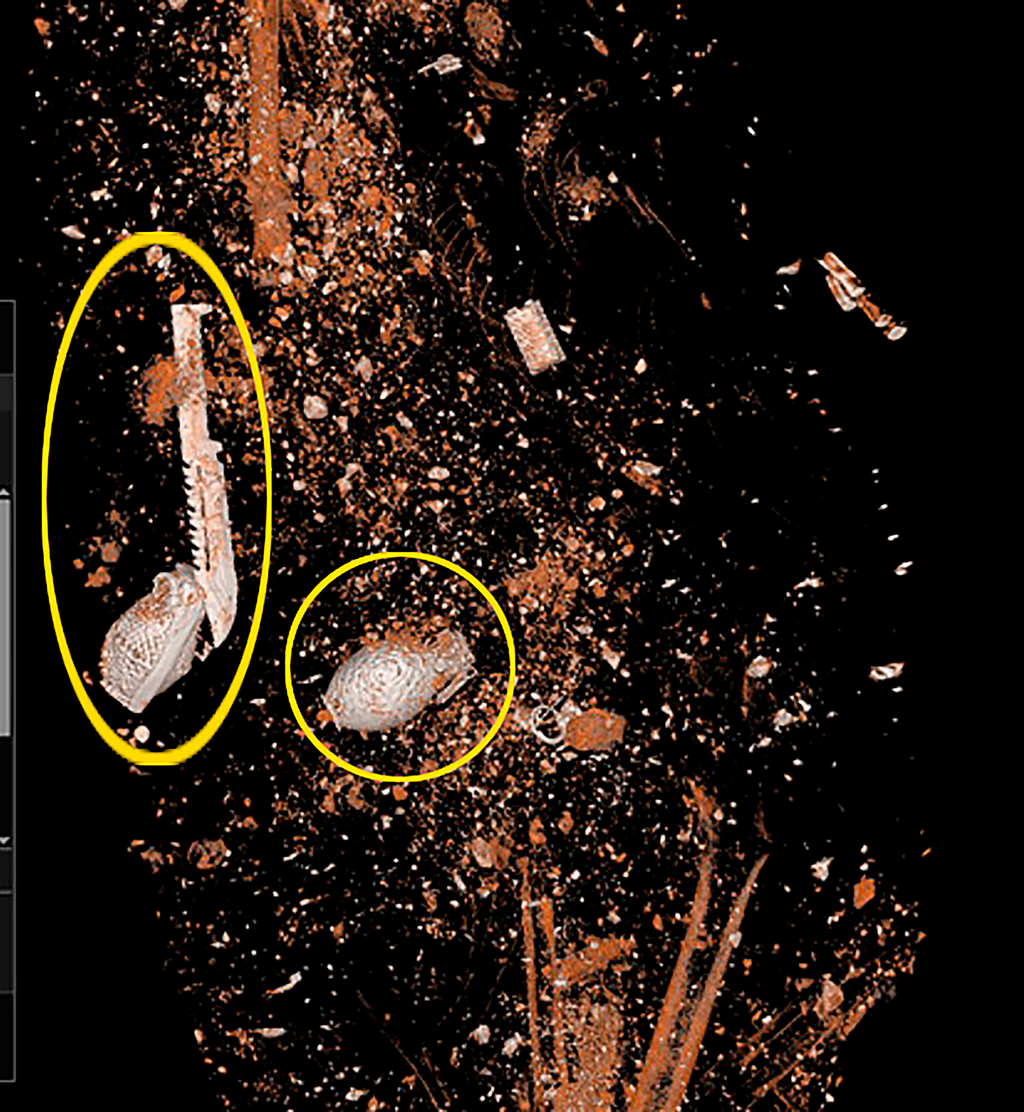
Grenades and a knife on the body of a terrorist placed in a CT scanner
(Photo: National Center of Forensic Medicine)
One body was intact except for the head, which had been smashed, run over and ground into tiny fragments of bone. From those fragments, DNA was extracted and the victim was identified.
The long and exhausting days of analysis also brought professional satisfaction and stirred a sense of patriotism: Sometimes, a tiny piece of bone was enough to determine that a person was no longer alive.
“We received someone’s helmet, and there was muddy-looking material on it. Under a microscope, you could see that it was brain tissue, meaning he had been shot in the head. From the DNA, we know who it belonged to. And alongside it was a tiny fragment of skull bone, and that was how we understood that he was dead and his body had been abducted to Gaza.”
Were children’s bodies also brought to you?
“Absolutely. Children who were shot and decapitated as well, like a girl of about 12 who was shot in the head and then decapitated.”
During our previous visit to the center, we were shown the body of a girl about five years old who had been shot throughout her body, from her skull to the soles of her feet.
Amid the chaos of the first weeks after the attack, and given the incomprehensible number of people murdered, it took time for the bodies to be identified. Exhausted and grief-stricken families gathered at the center’s gates.
“Their screams of anguish reached all the way here and broke my heart. When I perform an autopsy, as I said, I’m emotionally detached and don’t know any biographical details about the person. But when I read about them in the newspaper the next day and see that they have a family, that they had a life, it destroys me.”
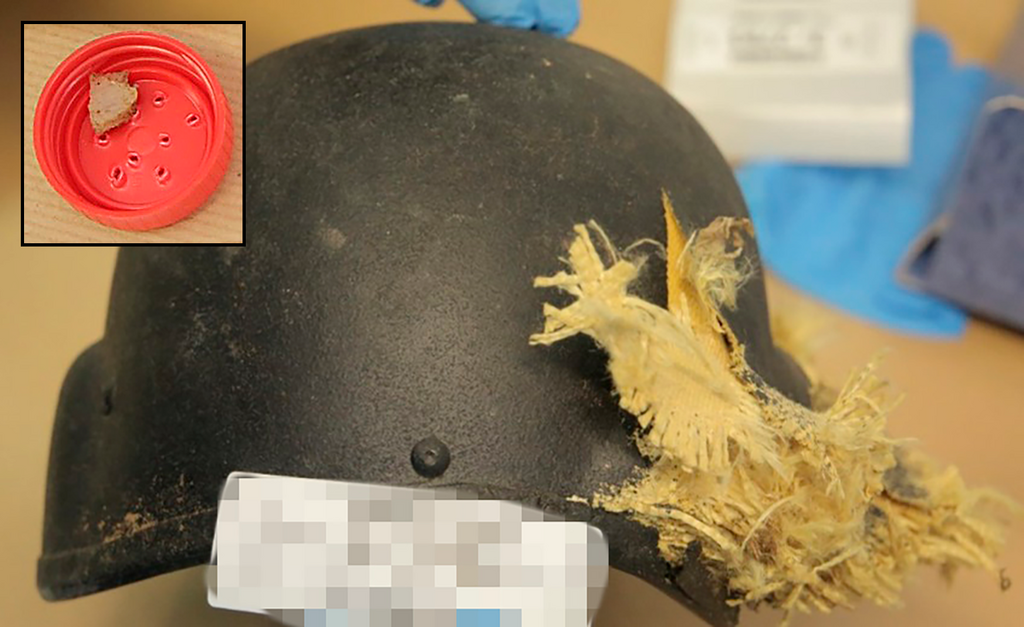
A tiny skull fragment found beside a helmet containing brain tissue was sufficient to determine that the person had died. The body was abducted to the Gaza Strip
(Photo: National Center of Forensic Medicine)
The footage Kugel was exposed to added another layer to the horror.
“There is a video of a foreign worker resisting abduction. The terrorists shot him and stabbed him with a knife that went in one side and came out the other. You can see that he isn’t Israeli, isn’t Jewish and has nothing to do with us, and he tells them that too. What is wrong with them?
“And this is in addition to the account of another foreign worker, which you published in a previous article, who was stabbed, shot, burned and murdered.”
Unprecedented in forensic medicine
Alongside the difficulties came a professional achievement. According to Kugel, the institute definitively identified 100% of the bodies of those murdered.
“That is unprecedented in forensic medicine, including compared with the identification of victims of the Twin Towers disaster.”
In New York, remains of only about 60% of the 2,753 people murdered in the Twin Towers have been identified to date.
For this, among other reasons, Kugel received the 2024 Israel Prize for Civilian Heroism in the field of mutual responsibility. The committee’s decision noted that the center had developed new identification methods and played a central role in presenting the atrocities to the world.
Looking back, do you think Israel’s public diplomacy efforts were sufficient? Was enough use made of this evidence of the atrocities?
“The Health Ministry and the Public Diplomacy Ministry opened the center’s doors to foreign media, and later to Israeli media as well. The difficult images were shown to the world, but there were also those who questioned their authenticity.
“That happened with a photograph published by ynet showing two figures bound together with rope and burned alive. Al Jazeera wrote that it was a photograph of dogs.
“In my opinion, photographs contribute to public diplomacy. There were families who opposed releasing details, particularly among the families of the hostages — details that could have shed light on the vicious cruelty. It would have contributed to public diplomacy, but it would not have prevented the antisemitism that erupted around the world.”
In October 2024, the body of Hamas leader and architect of the massacre, Yahya Sinwar, who was killed in the Gaza Strip, was brought to Israel.
What did you feel when you examined Sinwar’s body?
“In this room, where we are sitting now, I examined his body. A doctor standing outside the room said to me, ‘Do you know who you’re examining? The man who changed the history of the Middle East for the worse.’
“The findings showed that he had been shot several times, not in succession, and died from a fatal injury to the head, which no longer contained a brain.
“I told myself that he was one of the most evil people in the world, and I was glad he was on one side of the table and I was on the other.”
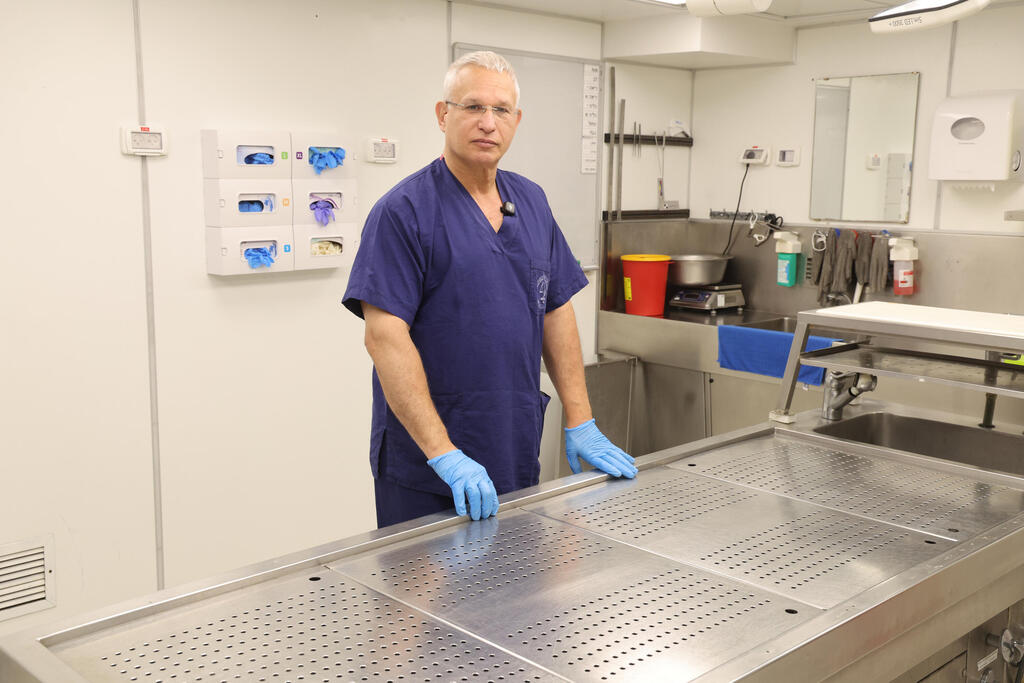
'When I perform an autopsy, I’m emotionally detached. But when I read about them in the newspaper the next day, it destroys me'
(Photo: Yariv Katz)
Another heavy burden was placed on his shoulders when he was selected to serve on a committee for determining death remotely. The committee also included Dr. Hagar Mizrahi, head of the Medical Division at the Health Ministry, and Prof. Ofer Merin, director-general of Shaare Zedek Medical Center.
The committee members unanimously determined with certainty, without forensic evidence and without a body, that 44 hostages in Gaza were dead. It was an unprecedented and extraordinary determination that did not receive enough attention around the world.
“I felt the weight of the responsibility on my shoulders. Removing uncertainty, that is the most important thing in my eyes.”
Was examining the bodies of hostages who were returned also a challenge in itself?
“We were no longer as surprised as we were on Oct. 7, but you never get used to these sights,” Kugel says, referring to the closure for families who now have a grave to mourn at.
It cannot be easy to lead such a difficult identification effort, which ultimately resulted in the identification of all those murdered, including the hostages.
“Not at all. My employees were shattered, and some left the center because of their exposure to the atrocities. In addition, I had to deal with the parents of hostages who had been murdered. Their screams of anguish broke me.”
“We wrote an article and submitted it to the prestigious Lancet. After only two days, without even reading it, they rejected us. That antisemitic pattern repeated itself when Prof. Ofer Merin wrote an article about the experience we accumulated on the world’s first committee for determining death remotely without a body, and the article was rejected. My conclusion is that they don’t want to hear us or hear about us.”
As someone who saw up close the evil, the malice and the intent to annihilate Israel’s residents, how do you explain the rise in antisemitism?
“The whole world knows what happened, and yet they compare what happened here with what happened in Gaza, as though it were the same suffering. No Israeli burned bodies.
“But I encountered the softer, less overt form of antisemitism only a few months after Oct. 7. Together with Prof. Yehuda Shoenfeld, editor of the medical journal Harefuah and the author of important medical books, we wrote an article and submitted it to the prestigious Lancet. After only two days, without even reading it, they rejected us.
“That antisemitic pattern repeated itself when Prof. Ofer Merin wrote an article about the experience we accumulated on the world’s first committee for determining death remotely without a body, and the article was rejected.
“My conclusion is that they don’t want to hear us or hear about us. Until I arrive at a conference, show the slides - and their jaws drop.”
Standing with us inside the autopsy room, Kugel recalls the weeks and months after the massacre, his expression turning serious. “This room saw evil incarnate, the burned bodies, the bodies that were tied up and shot, the severed heads, the murdered children. We all saw it here, and sometimes when we enter this room, we also remember the deceased hostages whose bodies were brought back. It isn’t easy.”
As a forensic pathologist, Kugel has seen thousands of bodies over the course of his long career. But the Oct. 7 massacre was an unprecedented event that became seared into his mind and left him with a diagnosis of post-traumatic stress disorder. “We saw masses of bodies and witnessed horrific cruelty. It is difficult to see the bereavement and the loss. There are people who were left alone, and you are the one who gives them the final confirmation.
“The screams, the cries of anguish I heard from my office or downstairs with them. And my employees, seeing them shattered. It wasn’t easy being the director during those historic days. There was so much pain that had an impact. It is a heavy burden.
“While it is happening, you work on autopilot. You are very task-oriented. Only afterward do you see the person as a whole, and their family.”