

Moe Berg sat in a Zurich lecture hall in December 1944 with a pistol hidden under his clothes and one of the most consequential questions of World War II in his hands.
At the front of the room stood Werner Heisenberg, the Nobel Prize-winning German physicist whose name had become inseparable from Allied fears that Nazi Germany was racing toward an atomic bomb. Berg, a former Major League Baseball catcher turned intelligence officer, had been sent by the Office of Strategic Services to listen, judge and, if necessary, act.
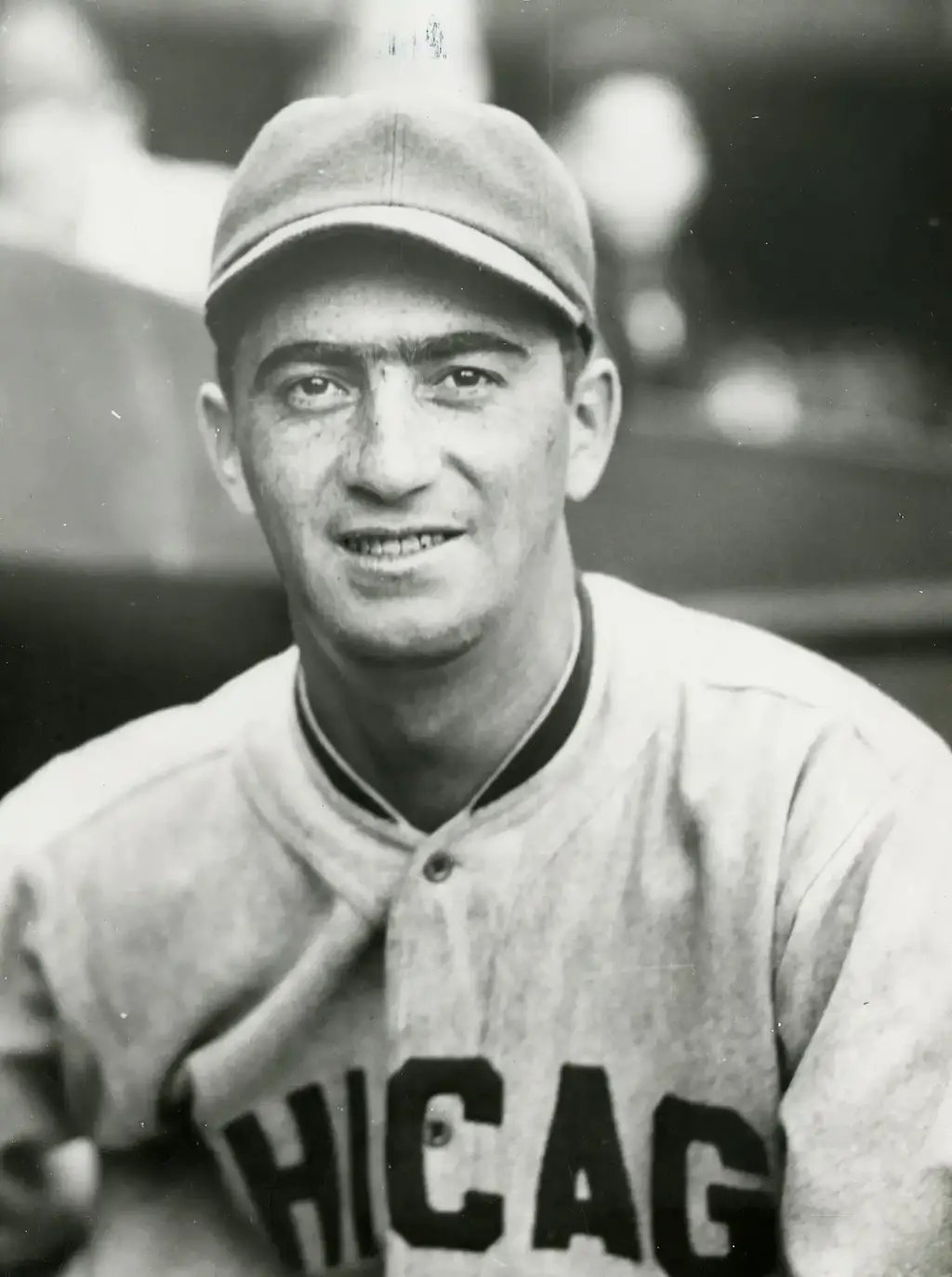
The instruction was stark. If Heisenberg revealed that Germany was close to building the bomb, Berg was to shoot him.
So he listened. He followed the lecture, weighed the clues, studied what Heisenberg said and, perhaps just as important, what he did not say. The pistol stayed where it was. Berg concluded that the Nazis were not close enough to justify the shot.
The episode would become the center of his legend: a backup catcher from Newark sitting in a European lecture hall, carrying the power to kill one of the world’s most important scientists.
But before Berg learned to read physicists, he had learned to read hitters.
Seventeen years earlier, in 1927, the Chicago White Sox were running out of catchers. Injuries had thinned the roster, and Berg, still new to the position, was asked to catch Ted Lyons against the New York Yankees. It was a brutal assignment for any catcher, let alone one still learning the job. Lyons threw a knuckleball, one of baseball’s most unpredictable pitches, and the Yankees’ lineup was Murderers’ Row: Babe Ruth, Lou Gehrig, Earle Combs and the most feared offense in the sport.
Berg did more than survive. Lyons beat the Yankees 6-3, Ruth was held hitless and Berg made one of the game’s defining defensive plays. When a poor throw came in from the outfield, he caught it, spun and tagged Joe Dugan out at the plate.
It was the kind of play that explained why Berg lasted in baseball far longer than his bat alone should have allowed. He was never a star. He was never a dangerous hitter. But he could stay composed while a game sped up around him. He could process details under pressure. He could wait for the important thing to reveal itself.
Those qualities served him behind home plate. Later, they served him in the shadows of war.
Berg was born Moses Berg in New York in 1902, the youngest child of Bernard and Rose Berg, Jewish immigrants from Eastern Europe. The family later moved to Newark, New Jersey, where his father, a pharmacist, sought good schools, respectability and a stable middle-class life. Moe, as he became known, was brilliant early and restless almost from the start. As a child, he played baseball under the name “Runt Wolfe,” as if even then he understood the usefulness of an alias.
At Princeton, where Jewish students still stood outside much of the old social order, Berg became captain of the baseball team and graduated magna cum laude in modern languages. He studied Latin, Greek, French, Spanish, Italian, German and Sanskrit. He was the kind of college athlete who could turn a double play and then discuss philology. He and Princeton second baseman Crossan Cooper reportedly communicated plays in Latin when an opposing runner reached second base.
Baseball found him quickly. In 1923, after his senior season, Berg signed with the Brooklyn Robins, the team later known as the Dodgers. New York teams understood the appeal of Jewish players to the city’s large Jewish fan base, but Berg was not merely a curiosity. He could field, he could think, and in his major league debut in Philadelphia he entered at shortstop and collected a hit.
It was the start of one of the strangest careers in baseball history.
Over 15 seasons, Berg played for Brooklyn, the Chicago White Sox, Cleveland Indians, Washington Senators and Boston Red Sox. He began as an infielder but became a catcher almost by accident, after injuries forced the White Sox to improvise. The move should have been difficult. Catcher is baseball’s most demanding defensive position, a job of bruises, memory, strategy and constant calculation. For Berg, it made sense. The position fit his mind.
What did not fit was his hitting. His lifetime batting average was .243, and teammates never let him forget it. The old joke followed him everywhere: Berg could speak several languages, but could not hit in any of them.
The joke endured because it was funny. It also obscured the more interesting truth. Berg remained in the major leagues for a decade and a half, far longer than most players. He played for the 1933 American League champion Washington Senators. He later coached with the Boston Red Sox. He knew the game deeply, absorbed its rhythms and shared clubhouses with some of its greatest figures.
Still, baseball was only one room in the strange house of Moe Berg’s life.
After his first major league season, he sailed to Paris, rented a room overlooking the Sorbonne and enrolled in classes. He later studied at Columbia Law School, passed the New York bar and worked for a Wall Street firm while still playing professional baseball. He read newspapers obsessively, sometimes as many as 10 a day, and enforced a private ritual around them: until he finished a paper, it was still “alive” and no one else could touch it. Once he was done, it became “dead.”
He seemed to collect places the way other players collected bats. Europe, Asia, Latin America, universities, embassies, ballparks, hotel lobbies. He was at ease among athletes and diplomats, professors and newspapermen, though never entirely knowable to any of them.
His first great intelligence-adjacent adventure came through baseball.
In 1932, Berg joined a small baseball mission to Japan, officially to teach the game at Japanese universities. When the other players returned home, Berg kept traveling through Asia and Europe. Two years later, he returned to Japan with an American all-star delegation that included Babe Ruth, Lou Gehrig, Jimmie Foxx, Lefty Gomez and other giants of the game.
On paper, Berg was the odd man in that group, a backup catcher among legends. In practice, he was the one who understood more than baseball. He spoke Japanese. He delivered remarks in the language. He noticed things others missed.
During that trip, Berg went to St. Luke’s Hospital in Tokyo, supposedly to visit the daughter of the American ambassador. Instead, he made his way to the roof, one of the tallest vantage points in the city, and filmed Tokyo and its harbor with a movie camera. Years later, he gave that footage to U.S. intelligence officers.
The exact military value of the film has been debated. The image has not lost any of its power: a Jewish backup catcher, standing on a hospital roof in Japan, quietly recording a city America would soon be fighting.
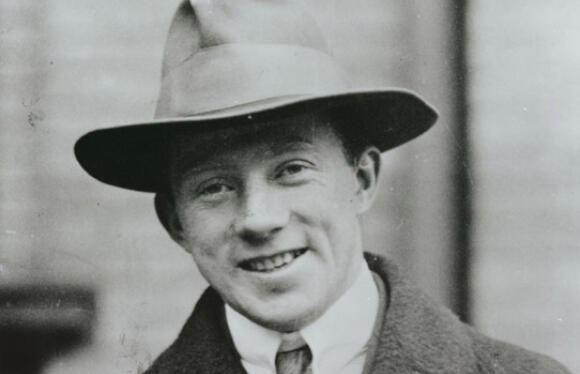
Werner Heisenberg
After Pearl Harbor, the odd pieces of Berg’s life suddenly formed something useful. He had languages, travel experience, social ease, patience, curiosity and the discipline of a man who had spent years studying both pitchers and people. In 1942, he joined Nelson Rockefeller’s Office of the Coordinator of Inter-American Affairs and traveled through Latin America as a sports ambassador while the United States worked to counter Axis influence in the region. He met officials, journalists and businessmen. He listened more than he talked.
In 1943, he moved into the Office of Strategic Services, the wartime intelligence agency that later became part of the foundation for the CIA. His code name was “Remus.” The catcher was now officially a spy.
His work took him into one of the most urgent intelligence questions of the war: whether Nazi Germany was close to developing an atomic bomb. Berg was sent through Europe to interview physicists, gather fragments of information and assess what German scientists knew. He was not a physicist of Heisenberg’s caliber, but he knew enough science, enough German and enough human behavior to be useful.
That work led him to Zurich, to Heisenberg, to the pistol in his pocket and to the decision not to fire.
It is tempting to see that moment as a clean dramatic climax, the scene that explains the man. But Berg resists that kind of simplicity. He was not just a ballplayer who became a spy, and not just a spy who had once played baseball. He was a man who lived in the spaces between categories: athlete and scholar, patriot and drifter, charming guest and unknowable loner, public performer and private keeper of secrets.
After the war, the United States awarded him the Medal of Freedom for his intelligence service. Berg refused it without public explanation. After his death, his sister Ethel accepted it on his behalf and later donated it to the Baseball Hall of Fame. His baseball card is displayed at CIA headquarters, an almost perfect symbol for a life split between two American mythologies: the ballpark and the secret file.
The postwar years were quieter and sadder. Berg did occasional work for the CIA, but he never found a lasting role equal to his wartime purpose. In 1951, he tried to persuade the agency to send him to the newly founded State of Israel. “A Jew must do this,” he wrote in his notebook. The CIA declined.
He drifted through the rest of his life with the air of a man who knew things he would not say. He lived with relatives, appeared at ballgames and scientific lectures, and maintained friendships with journalists and academics. When people asked what he did for a living, he sometimes put a finger to his lips, allowing them to believe he might still be engaged in secret work.
Maybe he was. Maybe he simply preferred the mystery.
Israel remained part of his afterlife. After Berg died in 1972, Ethel scattered his ashes on Mount Scopus in Jerusalem. In the mid-1970s, she donated some of his papers and photographs to the National Library of Israel, then housed at the Hebrew University of Jerusalem.
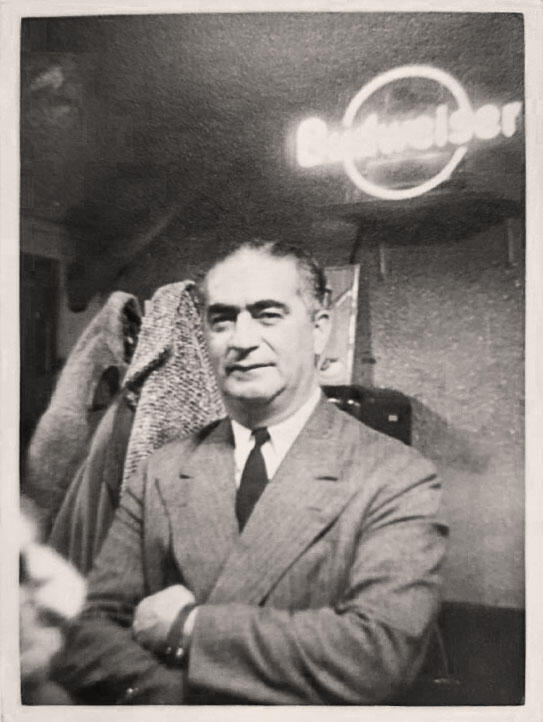
Moe Berg
The archive does not solve Moe Berg. It does something better: it preserves flashes of him.
There is a 1932 letter from Tokyo, written on Imperial Hotel stationery, in which Berg describes bowing, kimonos, traffic, baseball clinics and Japanese food. Raw fish dipped in soy sauce, he wrote, was “very tasty.” He nicknamed Tokyo’s Ginza boulevard “the Ginzberg.” After Franklin Roosevelt won the presidential election, Berg mentioned the news almost casually: “heard Roosevelt won — lucky.”
There are letters from Nelson Rockefeller. There are notes about sports and culture. There are photographs that feel less like documentation than riddles. In one, Berg stands in a suit and hat beside two uniformed soldiers, another figure and a goat. Where it was taken, who the others were and why the goat was there remain unknown.
Somehow, that feels exactly right. Moe Berg left behind evidence, not explanations.
He died in New Jersey after injuries from a fall at home. According to one account, his final words were not about Heisenberg, the OSS, Japan, Israel or the atomic bomb. They were about baseball.
“How did the Mets do today?”
They won.
Berg never entered Cooperstown as a player, and his numbers never made a serious case for it. But numbers are the least interesting way to measure him. He was a mediocre hitter who became a wartime intelligence asset, a Jewish ballplayer who carried a gun to a physicist’s lecture, a man whose ashes were scattered in Jerusalem and whose secrets still seem to be traveling.
Maybe he could not hit like Babe Ruth. But he spoke more languages than Ruth did. For Moe Berg, that was not just a punchline. It was the beginning of another life.