

Three years have passed since that Saturday, but for Hamid Abu Arar, the day never ended.
“Every day I live October 7, 2023,” he says. “You can’t ignore it or forget it. You have nine children at home who lost their mother, and they remind you of October 7 every day, every hour, every minute. They ask for their mother, ask why she isn’t coming back. I thought that as they grew older, they would understand, that maybe slowly it would leave their minds. But exactly the opposite happened.”
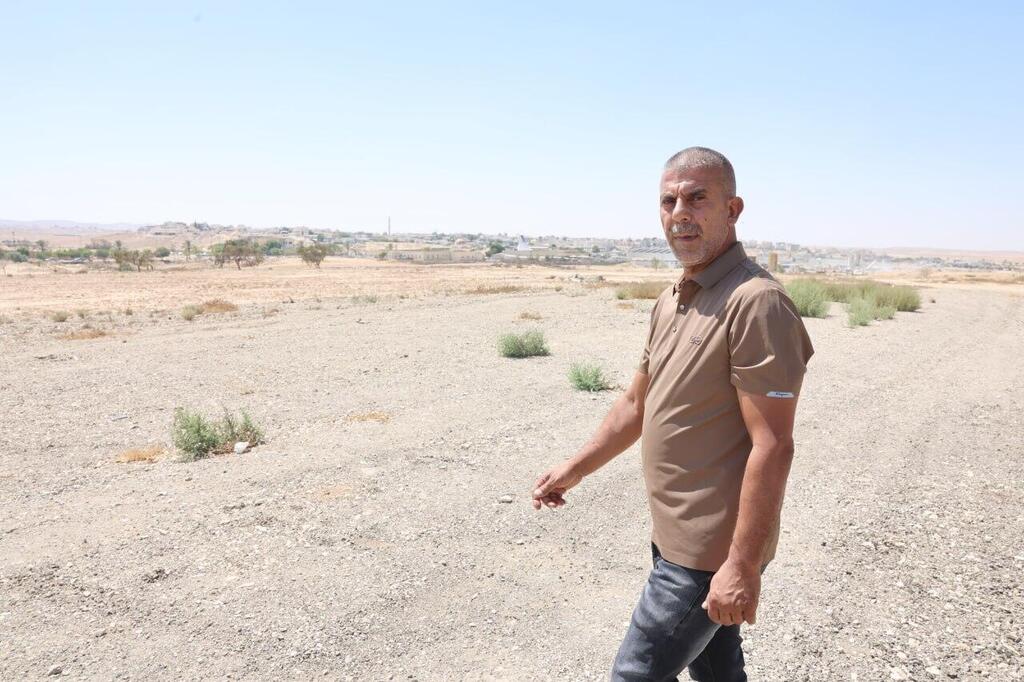
That morning, Abu Arar was driving to his agricultural job with his pregnant wife, Fatma, and their son Elias when Hamas terrorists who had invaded Israel opened fire on them. Fatma, who was four months pregnant, was murdered before his eyes. Hamid and Elias, then about six months old, were wounded.
Hamid hid with the baby for hours, listening as the terrorists spoke Arabic among themselves and discussed plans to attack civilians and Israeli security forces.
“I was in a state I had never experienced in my life,” he recalls. “I’m wounded in my shoulder and leg, my baby is wounded, my wife was murdered in front of me, and I don’t know where I am. The terrorists didn’t leave the area for a moment. They went to different places and came back to the junction, and I could hear them clearly. I heard their plans.”
At one point, he says, the terrorists prepared an ambush for an approaching IDF force. Hamid’s phone had already died after he spent hours passing information to Israeli security forces.
“I heard Hebrew from the other direction. I looked and saw the army,” he says. “The first thing that went through my head was: That’s it, our chance of surviving is over. They’ll start shooting at each other and we’re in the middle.”
“Then I told myself, ‘Hamid, you’re a strong man. You need to make a quick decision. You have to save the situation.’”
He removed his shirt, fearing that the soldiers might mistake him for a terrorist or believe he had kidnapped the baby, and walked toward them.
One soldier opened fire. “The bullets passed by my head, and some of the shrapnel went into my back. I was hit by 11 fragments. The officer shouted, ‘Cease fire, Israeli, Israeli.’”
Hamid continued toward the soldiers and warned them about the ambush. “The terrorists were waiting for them,” he says. “One wanted to open fire at the soldiers, and the other told him to wait, to let them come another seven or eight meters closer. They wanted to hit them at point-blank range. The soldiers were advancing without knowing. It was certain death.”
‘Mom blood, Mom blood’
After the soldiers fought the terrorists, Hamid and Elias were evacuated to Soroka Medical Center. But for Hamid, that was when the real battle began. Hamid and Fatma’s nine children, seven girls and two boys, were all young when they lost their mother. Their oldest is now only 11.
Elias is now 3, and his father says he is receiving treatment from an early-childhood psychiatrist for trauma. When Elias was around 2, Hamid began noticing changes.
“The child became angry, aggressive. At night you could see his hand shaking,” he says. “I took him for treatment and they told me he was experiencing trauma. I said to the doctor, ‘But he was six months old. What does he understand? What does he remember?’”
Then came a moment that changed Hamid’s own understanding. “Two or three months ago, Elias came to me while I was sitting in the living room and said, ‘Dad, I have a big gun.’ I asked him who he wanted to shoot. He couldn’t explain and said, ‘Mom blood, Mom blood.’ Like he meant the person who killed his mother.”
Hamid immediately got up, hugged him and told him his mother was in heaven. He then bathed him, changed his clothes, took him out to buy something and drove with him to the cemetery.
“He and I washed his mother’s grave,” Hamid says. “He calmed down. We went home and he slept.” It is only one moment, he says, in the daily reality of their home. “There is hardly a day without some crisis. If it isn’t this child, it’s that daughter. Every day, another one remembers Mom. Listen, I’m living a life that only Allah knows how I survive and how I cope with the children. There are nine of them. All I can say is that there is Allah in heaven.”
When Hamid speaks about Fatma, he is not talking only about the woman he lost, but about the life they almost had together. His voice breaks and he struggles to hold back tears. “We were a special couple. We met, we loved each other and built our life hand in hand. She was my right hand.”
‘Hamas destroyed everything’
Fatma was a beautician, and the couple had planned to open businesses of their own. They had already found a location in Rahat for her salon, which she planned to open with a partner.
“On the evening of October 7, I was supposed to sign the contract for her shop,” Hamid says. “We had already found the place, and then the Hamas terrorists came and destroyed everything. They left us no dream, nothing.”
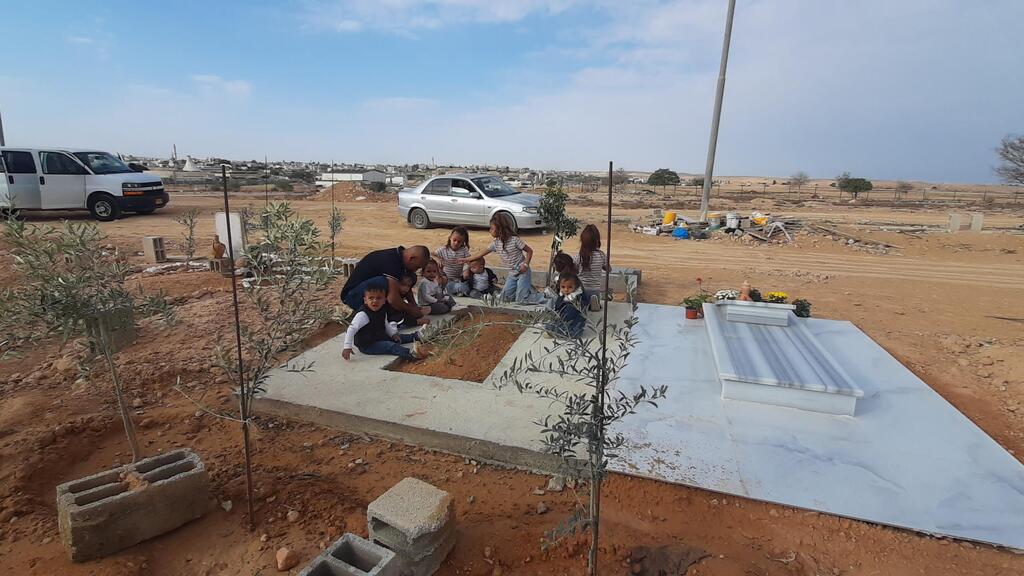
Hamid Abu Arar and the children at Fatma’s grave, November 2023
The one dream that remains, he says, is the one they shared for their children: education. “Today I take care of the children. I even pay for private teachers for them and strengthen them,” he says. “I have very smart children. I promised them, and I am continuing Fatma’s dream.”
Hamid has not returned to work since October 7. His life revolves entirely around his nine children: driving them, picking them up, arranging schools, treatment and studies.
But he also needs treatment himself. “I live on five kinds of pills,” he says. “What can I do? Otherwise I can’t cope.”
Even with treatment, he cannot stay away from the place where his previous life ended. “There isn’t a week or 10 days that goes by without me going to the Gaza border area. I have to. I feel like I live there. My wife is there. My soul is there.”
He drives to the junction, sits there and sometimes stays for hours. “I just sit, smoke, talk to Fatma. I’m always telling her about the children.”
Elias, he says, looks exactly like Fatma. Perhaps that is also one reason the bond between father and son has become nearly inseparable. “If I go to Be’er Sheva to run errands, I do everything like a missile, fast, fast, so I can get back to Elias,” he says. “I can’t be without him. He is the air I breathe.”
Abu Arar’s story is also shaped by the identities that collided that morning. He was born in Gaza, grew up in Rafah and is a Muslim from a religious family. His Muslim wife was murdered by Hamas terrorists.
“What happened on October 7 has nothing to do with religion, unequivocally,” he says. “I know the Quran very well. To come to innocent people while they are sleeping, to babies, children and women and murder them in cold blood, where is that written? Our Islam is completely different.”
He says the terrorist who shot Fatma knew she was Arab. “He saw a religious Muslim woman wearing a head covering, there was a Quran in the car, he recognized that she was Arab and Muslim, and despite all that, he shot her.”
Abu Arar left Gaza in 1995. When he returned for a visit years later, after Hamas had seized control of the territory, he says he struggled to recognize the place where he grew up. “I was supposed to stay for three days and I didn’t stay six hours,” he says. “I said: This is not the Gaza I know. I felt like I was inside Iran, inside Tehran.”
Despite his fierce criticism of Hamas, Abu Arar insists on making another distinction. “You can’t say all of Gaza is Hamas,” he says, adding that there are also Gazans who oppose the terrorist organization and that he still receives updates from relatives living there.
A new life he cannot imagine
After October 7, Abu Arar received permanent residency and an Israeli identity card in recognition of his actions. He speaks with deep gratitude about Interior Minister Moshe Arbel, who helped arrange the status. “He stood by me like a man, an incredible man,” Abu Arar says. “I will never forget him, and I will never forget what he did.”
By contrast, he criticizes the policy of home demolitions promoted by National Security Minister Itamar Ben-Gvir. “It’s not good,” he says. “It creates division, it creates hatred. You can’t constantly talk about coexistence while at the same time playing with people’s emotions.”
Nearly three years after the massacre, relatives and in-laws tell Hamid that it is time to try to build a new life. He even tried. “But it isn’t it,” he says. “I can’t. It is very difficult to accept.”
“They tell me, ‘Hamid, you can’t live like this. Fatma is dead. You have to build a new life, get married.’ I tell them: It’s easy to talk. You can talk until tomorrow.”
Sometimes, he says, he sits alone and searches his memories of Fatma for “one small flaw,” something that might break the perfection with which she remains in his mind. “There isn’t one,” he says. “I’m telling you the truth, there isn’t. A woman like that is what I wish for anyone who wants to live with security, peace and hope.”
He knows Fatma herself would have wanted him to be happy. “But where is that happiness supposed to come from?” he asks. “Only from my children. For them to grow up and study, that is the only happiness I take.”
And that is the promise he intends to keep for her. “Their mother and I promised them they would be educated, and I will continue with that until the last minute of my life,” he says. “I am with them. I don’t leave them for a moment. I have nothing else. This is my family.”