


When Amit Yaron, 40, a social worker at the Joint Distribution Committee and mother of three from Hod Hasharon, was 16, she saw a television report about surrogacy. She had not known the option existed, but found herself glued to the screen. From that moment on, the thought of becoming a surrogate someday stayed with her.
Then life happened. She met Aran, her partner, and after several years together they began building their own family. “The children were born relatively close together, and I didn’t have the space to even think about the idea,” she said. “But whenever it came up or crossed my mind, I remember telling myself that now wasn’t the time, and burying the thought again somewhere in the back of my mind.”
Gallery
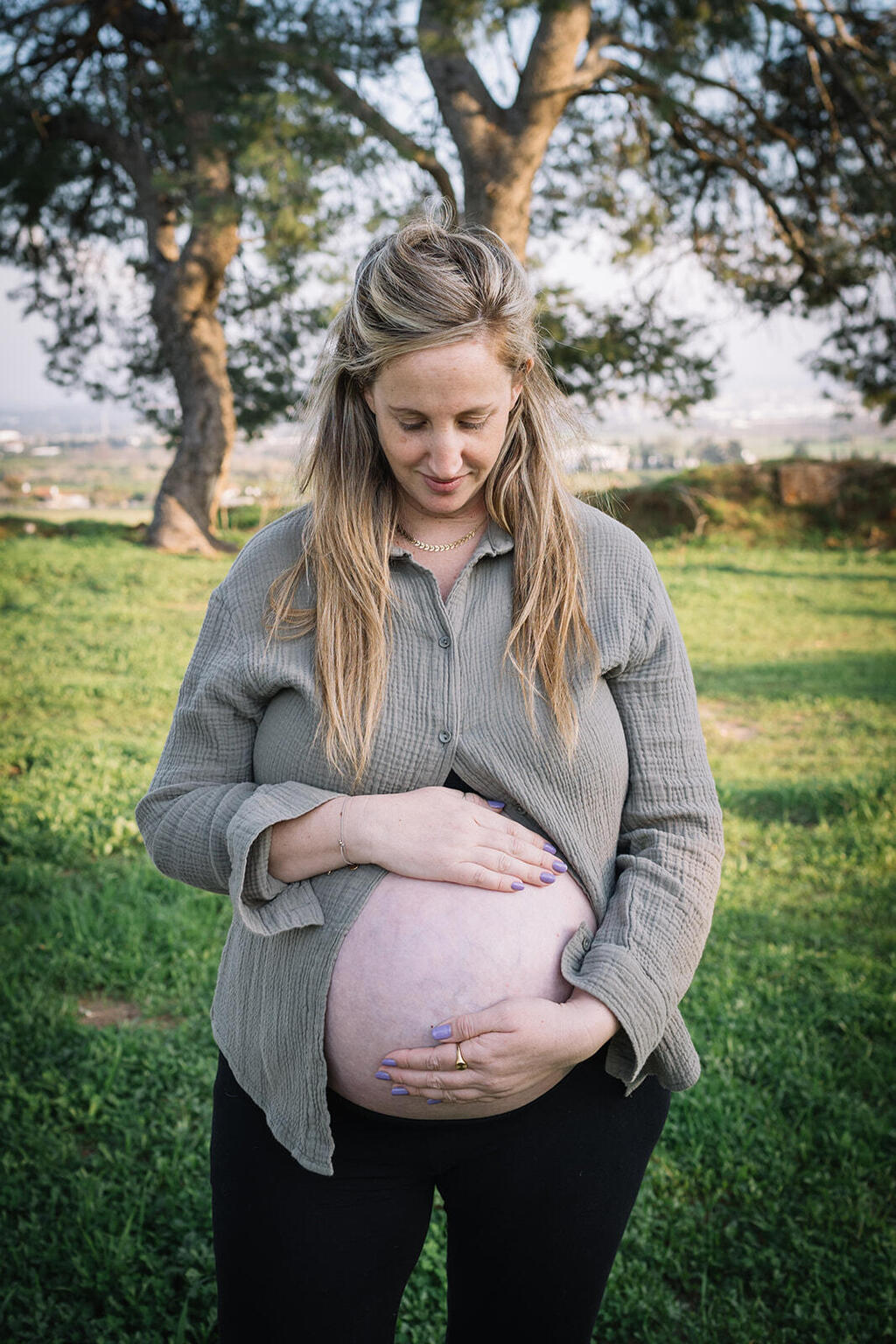
Amit Yaron while carrying the baby as a surrogate. She would do it again if she could
(Photo: Yasmin Berda Peer)
Three years ago, one of her closest friends sent her a WhatsApp message and asked her to share it as widely as possible. “There was a photo attached to the message, and I recognized them immediately,” Yaron said. “It was her brother and his partner, who had posted a beautiful, moving call to find a surrogate.
"I immediately forwarded the message and promised everywhere that they were an amazing couple, guaranteed, and that whoever went on this journey with them would definitely be lucky. But in reality, that message simply reignited that old thought inside me.”
For several weeks, she wrestled with the idea. Maybe it was a sign. Maybe this time, it was the universe calling her. “I let those thoughts sit with me for quite a while, in my head and in my heart,” she said. “Usually I’m a very open person. I share things, I consult. My sisters, my mother, my friends are usually part of almost every thought and dilemma as soon as they emerge. But this time was different. I didn’t even tell Arani at first. I let the feelings rise and wanted to sit with them on my own.”
What kind of thoughts?
“All sorts of internal questions: Do you really want to do this? Do you have the strength for another pregnancy? How will it feel to carry an embryo for another couple? Do we, as a family, have enough resilience to go through a journey like this? And if you miss the chance, what will that sense of regret feel like?”
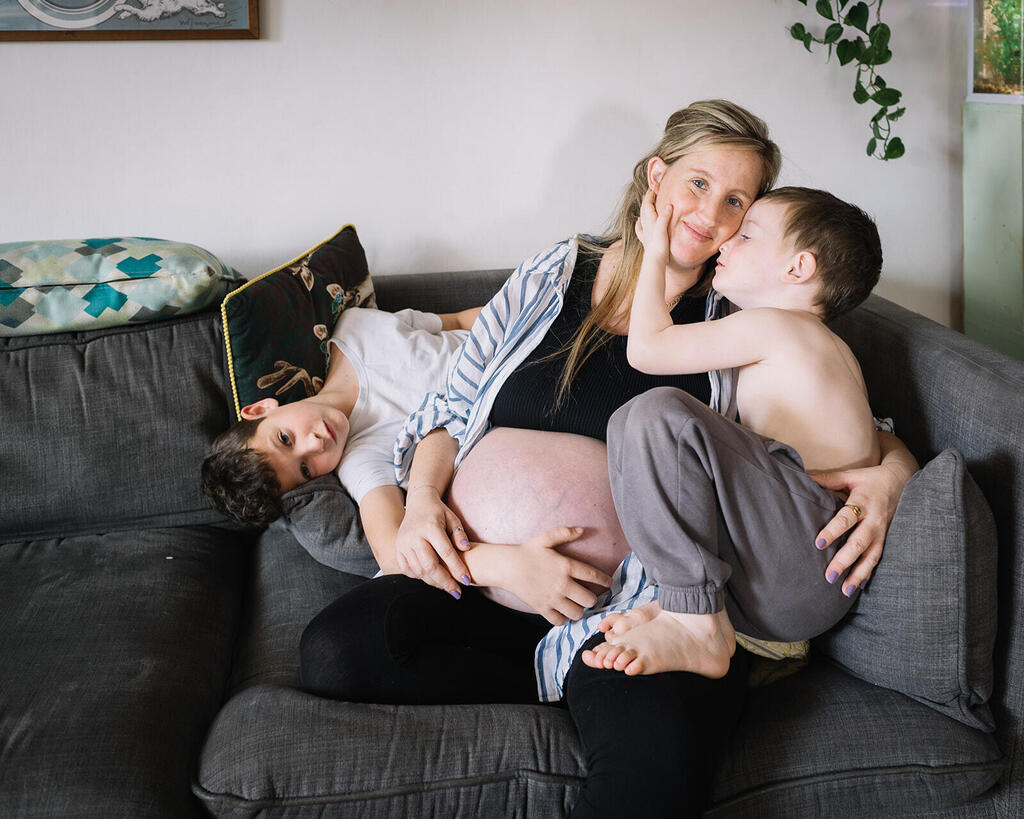
Amit Yaron with two of her children. "I asked myself: Do you have the strength for another pregnancy?"
(Photo: Yasmin Berda Peer)
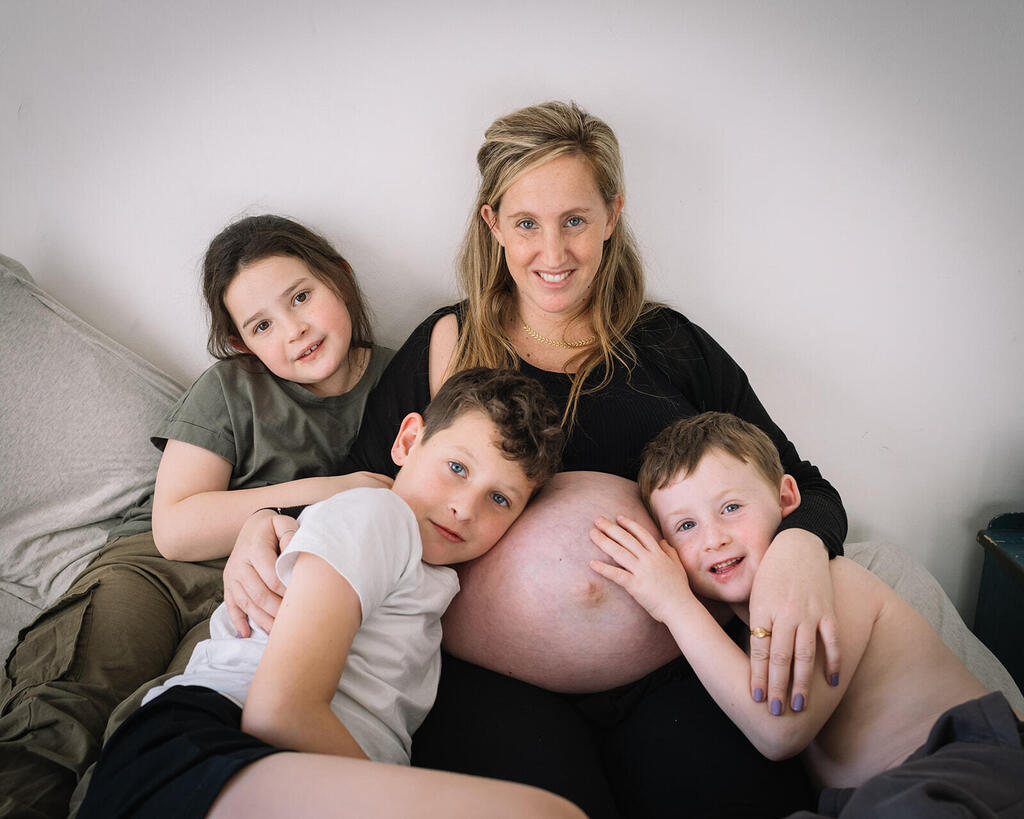
Amit Yaron with her three children. She told them from the start that it was not her baby
(Photo: Yasmin Berda Peer)
Alongside all those questions, she said, another realization matured inside her. “I understood that I wanted it much more than I feared it,” she said. “I was more eager and curious to enter this process than blocked or frozen by it. I realized that if I was going to set out on this path and jump into these wonderful waters, then obviously it would be with Ron and Yonatan. Suddenly, everything felt so logical. As if all roads had led here. Of course with them. Of course for them.
“You have to understand, Yonatan is the brother of Shiri, my best friend. I knew him through her stories, from previous encounters, from life. And Ron too, of course. Once I realized I wanted to be a surrogate, everything fell into place. I decided to suggest that we take this journey together.
“The fact that I did know them, that this wasn’t starting from scratch, and that I knew we would remain in each other’s lives afterward, reassured me and made me happy more than it frightened me.”
Then they met, and the couple was overjoyed. “In the first conversation we had, in our living room, together with Nitzan, who accompanied the process, we understood that we were completely on the same page,” she said. “It was clear to us that this would also force us to communicate more openly, to coordinate expectations and intentions more closely and, in general, to be in a very open dialogue.
“Today, a year and a half after the birth, we are in excellent contact. Our families have become one big family. My children are in love with them and with sweet Noam. We meet, and it feels very natural and pleasant.”
How did your partner and children react?
“When I first sat down with Aran and shared my thoughts out loud, it was the first time I had said them anywhere outside my own head,” she said. “It was a meaningful moment for me, because some things become real the moment you say them out loud.
“His reaction was amazing. First, he told me he would never stand between me and my dreams. From the way I talked about it, he immediately understood that I was thinking it through, but also that, in some way, I already knew this was what I wanted.”
“When I asked him whether he was worried, he said, ‘Of course.’ In every pregnancy I carried, he had concerns, mostly hoping I would get through it as easily as possible. In that sense, this time was no different.
“Emotionally, he knew we would go through it together. And once we connected with Ron and Yonatan, it was so clear that there was open dialogue and a lot of love between us, and that all of us were in this mission together, protecting one another and especially me.
“For me, it really was a foursome going through pregnancy together. I was just the only one who gained weight,” she said, laughing.
When it came to the children, Yaron has a story she still finds amusing. “Aran and I decided we would tell them after week 11 or 12, when we knew everything was OK, and I was also afraid they would start noticing things at home,” she said. “It was important to us that when we told them, we could tell them the names of the baby’s parents, so they would have faces and names to connect to the story.
“So we arranged to meet Ron and Yonatan one Friday afternoon at the park. We brought food and a Frisbee. It was amazing. From the children’s point of view, they had met their parents’ friends, and we sat and played and walked around.”
Then, as everyone was about to leave, they stood near Ron and Yonatan’s car to say goodbye. “At that point, my son Dori asked them whether they were brothers, and they answered, ‘We’re friends, partners, like Mom and Dad.’ Dori told them they weren’t like Mom and Dad because they didn’t have children. At that point, I was already well into my second month of pregnancy.”
“So they explained to him, beautifully and gently, that they didn’t have children but wanted them very much, and that two men cannot be pregnant and give birth. Their dream, they told him, was to have a little baby.”
“And then Eli, my middle daughter, who was seven at the time, blurted out without missing a beat: ‘What’s the problem? Ask Mom to help you,’ and went right back to what she was doing. “We looked at each other, burst out laughing and were deeply moved. We told her it was a wonderful idea.”
Two days later, after consulting with Yaron’s father, a psychologist, they decided to strike while the iron was hot, although she had originally planned to wait a little longer.
“We planted a camera between the books in the living room library so we would have a record of that sweet moment, and called the children in for a conversation,” she said. “We reminded them that a few days earlier we had met Ron and Yonatan, and that near the car they had told us how much they wanted children. Then we reminded them that Eli had suggested that I help them, and that we had thought about it and decided it was a generous, friendly and beautiful idea. They understood immediately and jumped with excitement.
“Each of them was at a different age, and their level of understanding was a little different, so we continued mediating it a bit differently for each child. From that point on, they were part of the pregnancy and the process in every way. They put their hands on my belly, sang songs to the baby, worried about me when I was exhausted, connected deeply with Ron and Yonatan and were wildly excited ahead of the birth.
“Every time I heard them explaining to other children, and also to adults, who the baby in my belly was, I understood how much they knew and how well they understood.”
How did your parents respond to the idea of you becoming a surrogate? Was there any hesitation?
“First of all, I’ll say that unlike maybe all the other decisions, dilemmas and consultations I have in life, where my family sometimes knows about them even before I say them out loud, this time it was different,” she said. “I felt this was something big, significant and very personal to me. In fact, it was the first time in my life that I came to them not to consult, but to tell them, to inform them. That was when I had begun the series of tests and approvals so we could approach the Health Ministry committee together, meaning I was already inside the process.”
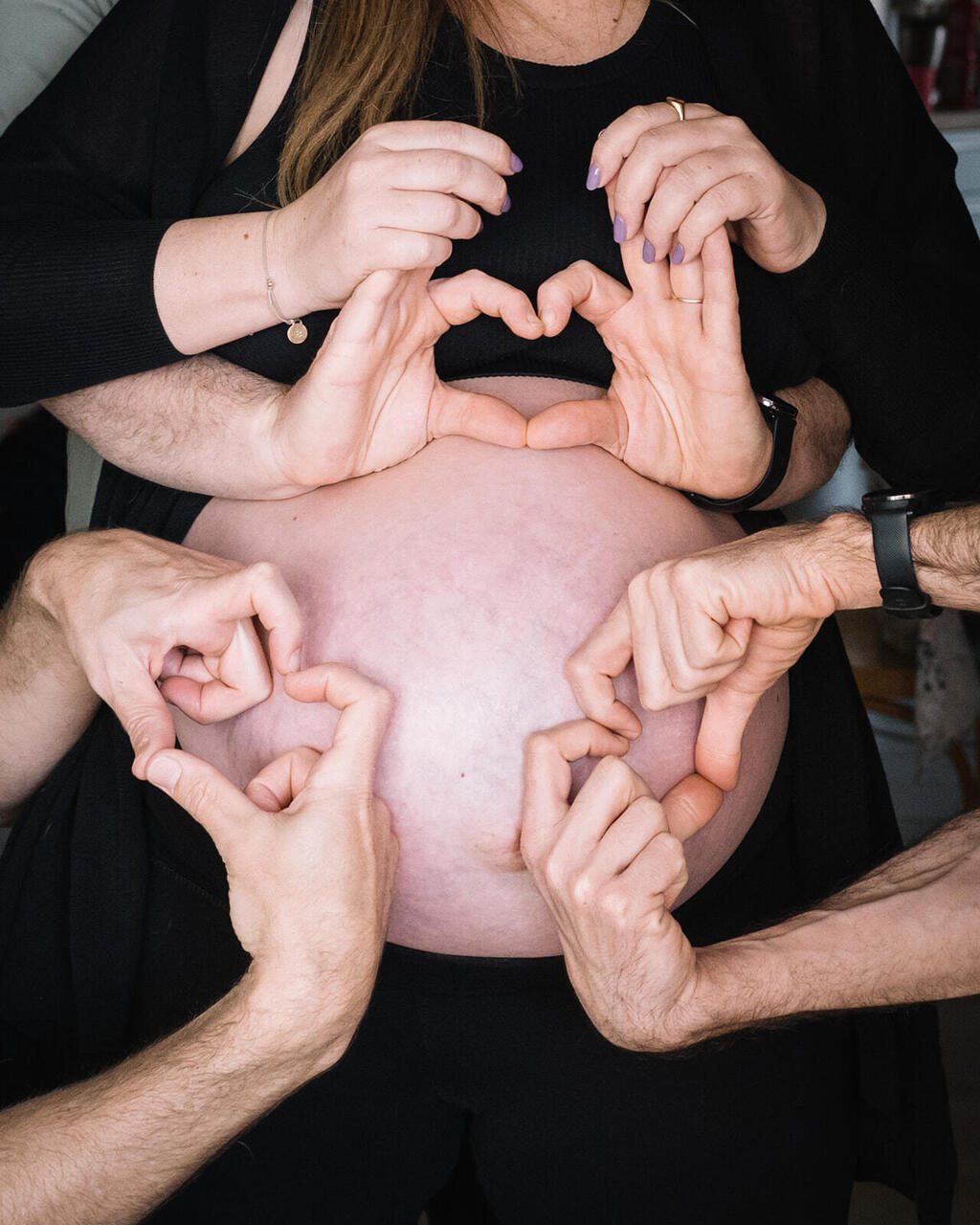
Amit Yaron. “Carrying a pregnancy is not something you can ignore, especially in the final months”
(Photo: Yasmin Berda Peer)
What did they say?
“My mother was shocked, but immediately a huge smile spread across her face. She expressed concern because, in the end, it was a fourth pregnancy, and the ends of my pregnancies are difficult because I suffer from symphysiolysis,” she said, referring to pelvic or groin pain caused by the widening of the pelvis during pregnancy.
“Surprisingly, the concern wasn’t focused on the emotional side of ‘How will it be for you to part from a baby you carried inside you,’ but came from worry about my physical health.
“My father too, when we sat at his house and I told him, started, like a good psychologist, breaking down the reasons with me, trying to understand what inner place I was coming from, and thinking through the pros and cons together. I remember stopping him and saying, ‘Dad, I didn’t come to deliberate with you. I came to tell you I’m inside this process.’ So he stood up and said, ‘Come give me a hug.’”
Their reaction, she said, signaled that she was making the right move. “When you set out on a journey like this, you need a lot of support,” Yaron said. “They, together with the rest of my family and friends, were the perfect envelope that helped me carry the process in the best possible way.”
What did the process involve once you made the decision?
“Once I decided to move forward, Ron and Yonatan connected me with the wonderful Nitzan, who accompanies surrogacy processes here in Israel. She took me by the hand and explained everything to me, from A to Z. The first stage is very technical and requires a lot of tests, approvals, old documents like the birth certificates of my own children, and very comprehensive physical examinations.
“After that, there is a psychological evaluation that Aran and I had to undergo. At the end of that process, we went before the Health Ministry’s Embryo Carrying Agreements Approval Committee. After that, there is a joint committee with us and Ron and Yonatan, the intended parents. Once we received the committee’s final approval, we could begin the medical process, which is IVF in every sense. We did it at Wolfson Medical Center, and had an amazing, extremely respectful and professional experience.”
What does it mean to be a surrogate in Israel? Are you considered an altruistic surrogate?
“In Israel, every surrogate receives, by law, predetermined financial compensation for the pregnancy period and the expenses that come with it. The process is legal, closely supervised and requires approval from the Health Ministry’s Embryo Carrying Agreements Approval Committee. That means there are no loopholes in the law, and the entire process is closely accompanied and protected, both to protect the intended parents and to safeguard the surrogate.”
“I experienced it in a very positive way, but in the end, this needs to be said: the compensation is very good, but it is based on financial compensation for the pregnancy period and everything it entails. That includes reimbursements for alternative treatments, emotional therapy for the surrogate and her family members if she chooses it, babysitting when she goes with her husband to pregnancy-related appointments, maternity clothes and more.
“The overwhelming majority of surrogates I was privileged to meet along the way choose to become surrogates for entirely altruistic reasons, certainly not out of a desire to get rich. At the same time, the compensation every surrogate receives is entirely fair and appropriate.”
I have a very intimate question, but it’s unavoidable: How did you not become attached to the baby?
“I think there is something about this kind of pregnancy, with everything it involves, that prepares you throughout for the birth and for what comes afterward. From the very first moments of the process, through the embryo transfer itself and all along the way, the clear knowledge that you are carrying a baby for another couple is always present and becomes a very significant part of the experience.”
“Ron and Yonatan joined me for every test. They would gently and sensitively place their hands on my big, stretched belly and feel, with enormous excitement, their son kicking and moving inside me.
“When we sat together, talked and prepared for the birth, we were talking about the birth of their son. When my children at home helped me, watched me grow bigger, lay beside me in bed and saw my belly move, we talked about the wonder of a baby growing inside me. We reminded ourselves all the time that he was Ron and Yonatan’s sweet baby, and how excited we were for the moment they would meet him. “I have to say, it wasn’t a matter of fake it till you make it. That was truly how it felt.”
Carrying a pregnancy, she said, is not something you can ignore, especially in the final months. “You feel the pregnancy every minute and every second of the day,” she said. “But the excitement and anticipation were for them. We were not expecting a new baby, and I knew I was not coming home with a brother for my children or another son for us.
“That understanding was mental, but it was also emotional and physical. For me, it was never about attachment to the baby, but about the connection to his parents and the family they create. And from that, I have no reason to part.”
How did you feel after the birth?
“After the birth, I felt like I was on cloud nine, really floating. When Noam was born, they placed him on me. I put my hands on him, and in my heart I said goodbye to the shared part of our journey in bringing him into the world.
“Afterward, in the hospital, I nursed him and felt that this was another small part I had in his arrival. In other words, the birth was absolutely the peak of the process, but my return to my own separate life was gradual. I nursed him, and later pumped milk for him for a short time, until my milk dried up.
“Emotionally, that allowed me to step back into my life from a more complete place, not through a sharp, technical cut.”
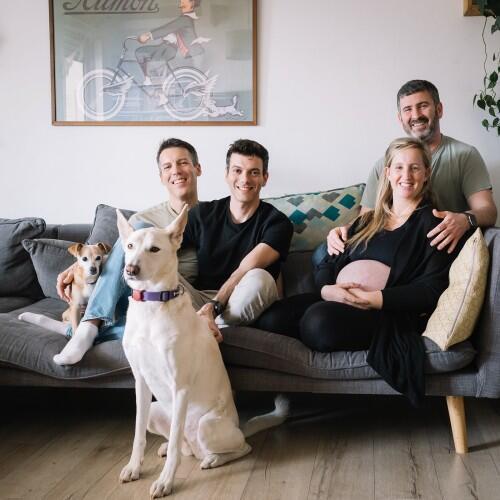
Amit Yaron, her partner, Ron and Yonatan with the dogs
(Photo: Yasmin Berda Peer)
“The feeling I have toward amazing Noam is that I have a part in his arrival in the world, and that the two of us will always, forever, carry a shared experience,” she said. “He may not know how to remember it in words or feeling, but it belongs only to the two of us. There is something very cool about that, in my eyes.”
Would you do it again?
“I joke all the time that my greatest luck is that a year after the birth, which is the required waiting period for any woman who wants to be a surrogate, the committee would no longer approve me because of my age.
“I won’t lie, there is something very tempting about it. I had a truly perfect experience, mainly thanks to Ron and Yonatan. They were sensitive, caring, supportive and incredibly attentive to me and to us as a family throughout the entire journey.”
“Today they are looking for another surrogate. They want to expand their family and bring a brother or sister into the world for sweet Noam. I see their search and longing from the side, and I hope that they soon find someone who will go on another journey with them.
“I picture her in my mind and want to give her a huge hug, because she has no idea how lucky she is to have this privilege. There is truly no one like them. “So it’s not entirely fair for me to answer the question, because technically I can no longer be a surrogate. But in principle, if I could, would I do it again? Yes, yes and yes.”