


It happened in late October, about two weeks after the ceasefire everyone had been waiting for. The two combat medics, Cpl. G and Sgt. L, were already thinking about their upcoming exit from Gaza after an intense operational period. The morning began quietly, with a sense that the end was near. Within seconds, everything changed.
A guerrilla-style raid by terrorists on an IDF defensive position turned what was supposed to be a secure area into a point-blank battlefield. Just a few minutes were enough to alter the course of both medics’ lives. “This was my first week in Gaza,” Cpl. G recalls today, about two months after the incident. “Overall it was a calm day, really the day before we were supposed to leave Gaza. Earlier we even made pancakes. There was a real end-of-training atmosphere.” “We were supposed to leave toward noon, and in the meantime we were working on tanks inside the defensive position,” Sgt. L continues. “What happened was that four terrorists managed to infiltrate the area.”
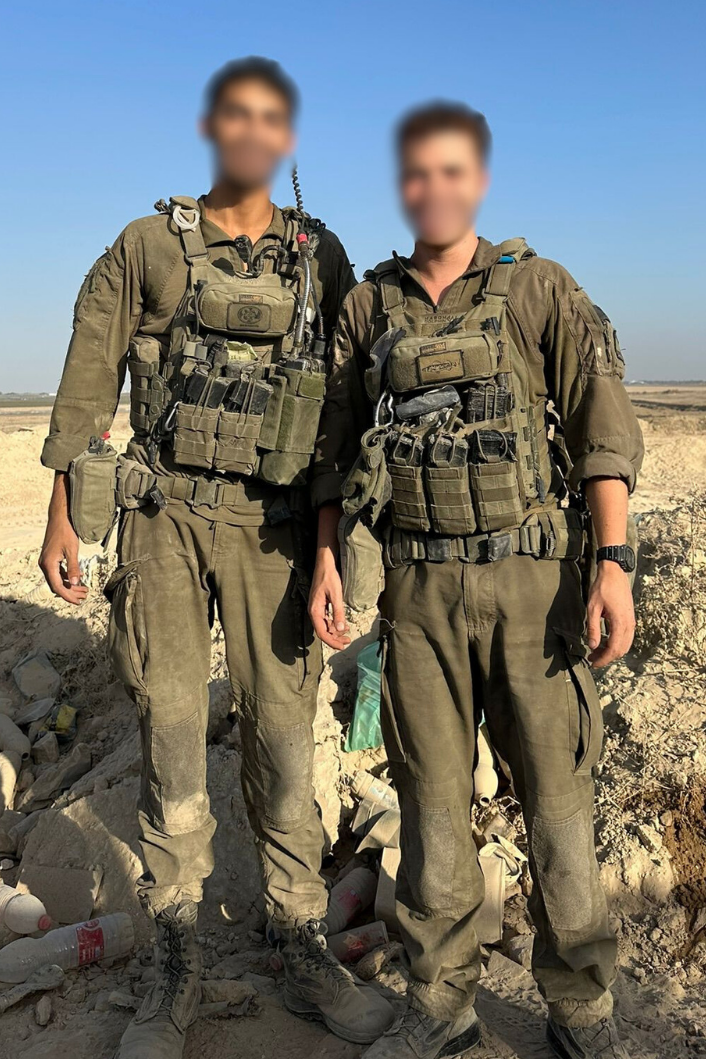
Sgt. L remembers those moments vividly. Seconds before the attack began, he had opened the rear ramp of the Namer armored personnel carrier. A moment later, chaos erupted. “I wanted to take my protein powder out of a compartment outside, and G was also outside. I was standing at the entrance and he was by the door,” he recounts. “Suddenly there were a lot of explosions. G started shouting, and the doctor who was with us started shouting too, telling us to get into the Namer immediately. I went in, pulled G in with me and he fell on top of me. A terrorist who was at the entrance of the Namer fired at us at point-blank range while G was on top of me. He took five bullets in the waist, chest and abdomen and literally shielded me with his body.”
He continues: “I tried to close the Namer door. I went to the commander’s position to close it and was hit by three bullets in the legs and couldn’t close it. I gave up. At that moment G jumped on his weapon and tried to fire toward the terrorist. Eventually he managed to close the ramp. During that time I tried to report on the radio. I started to speak and got hit by another bullet in the hand. Bullets were passing right over my head.”
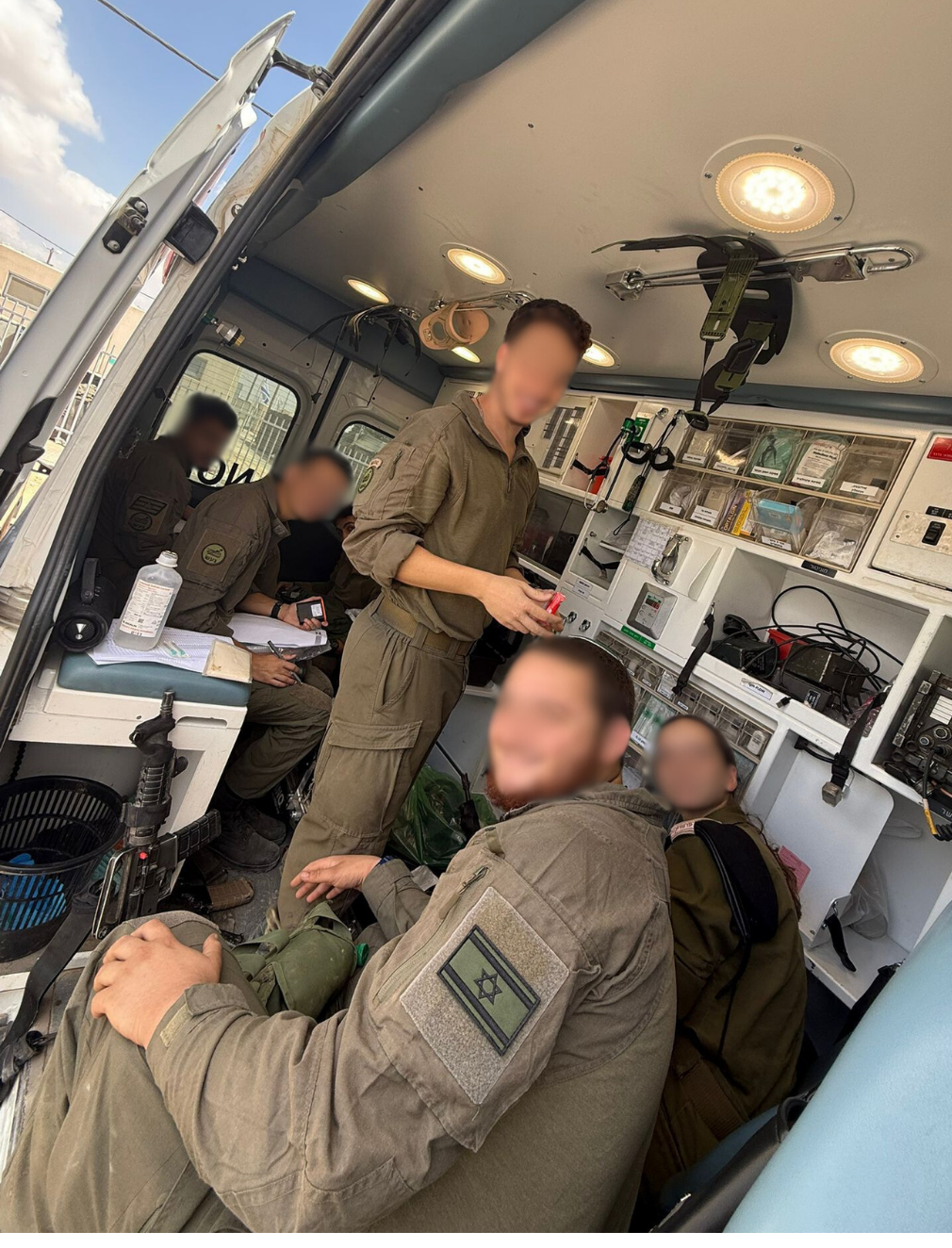
They became close friends, Cpl. G (front) and Sgt. L together with the medical team
(Photo: IDF)
Cpl. G picks up the story. “I tried to fire my weapon and had a malfunction. I took Sgt. L’s weapon, and in the meantime the terrorist was killed by another force. I saw that the doctor with us was wounded and put a tourniquet on him. Only then did I realize I was wounded too. I didn’t feel anything. I put a tourniquet on my left leg that didn’t really work. I lost a lot of blood and started to lose consciousness.” He continues: “At that point I saw through the Namer cameras a force approaching us. I identified them as our battalion and opened the ramp. From there we were evacuated from the Namer.”
From the moment they were wounded until they arrived at the hospital, about 55 minutes passed. During that time, the two went through a rapid but complex chain of treatment, evacuation and organization under pressure. They were first evacuated to a protected area, where they received immediate initial care from a battalion paramedic who was a friend and teammate. The fact that the evacuation Namer itself had been hit created moments of disorder and confusion, but even in the chaos, the team kept its composure. After initial stabilization, they were returned to the Namer, transferred to the helicopter landing zone and evacuated by helicopter to Soroka Medical Center.
The two arrived with very different levels of experience. Sgt. L enlisted in March 2024 and began his service in an academic reserve track before transferring to the Armored Corps. He completed basic training with the 178th Battalion, attended combat medic training and was assigned to the 7th Brigade. A day after joining the battalion, the force deployed to the north, and about a month later entered Lebanon. He later served along the northern border and then returned to Gaza, where he participated in several incursions. Cpl. G enlisted in March 2025, completed combat medic training and joined the battalion only about two months before he was wounded. The week he was injured was his first week in Gaza, his first days in active combat territory, during which he had just begun to learn the routine. Despite the gap in seniority, the two became close friends. Only upon arriving at the hospital did the full extent of their injuries become clear, along with the long road that still lay ahead.
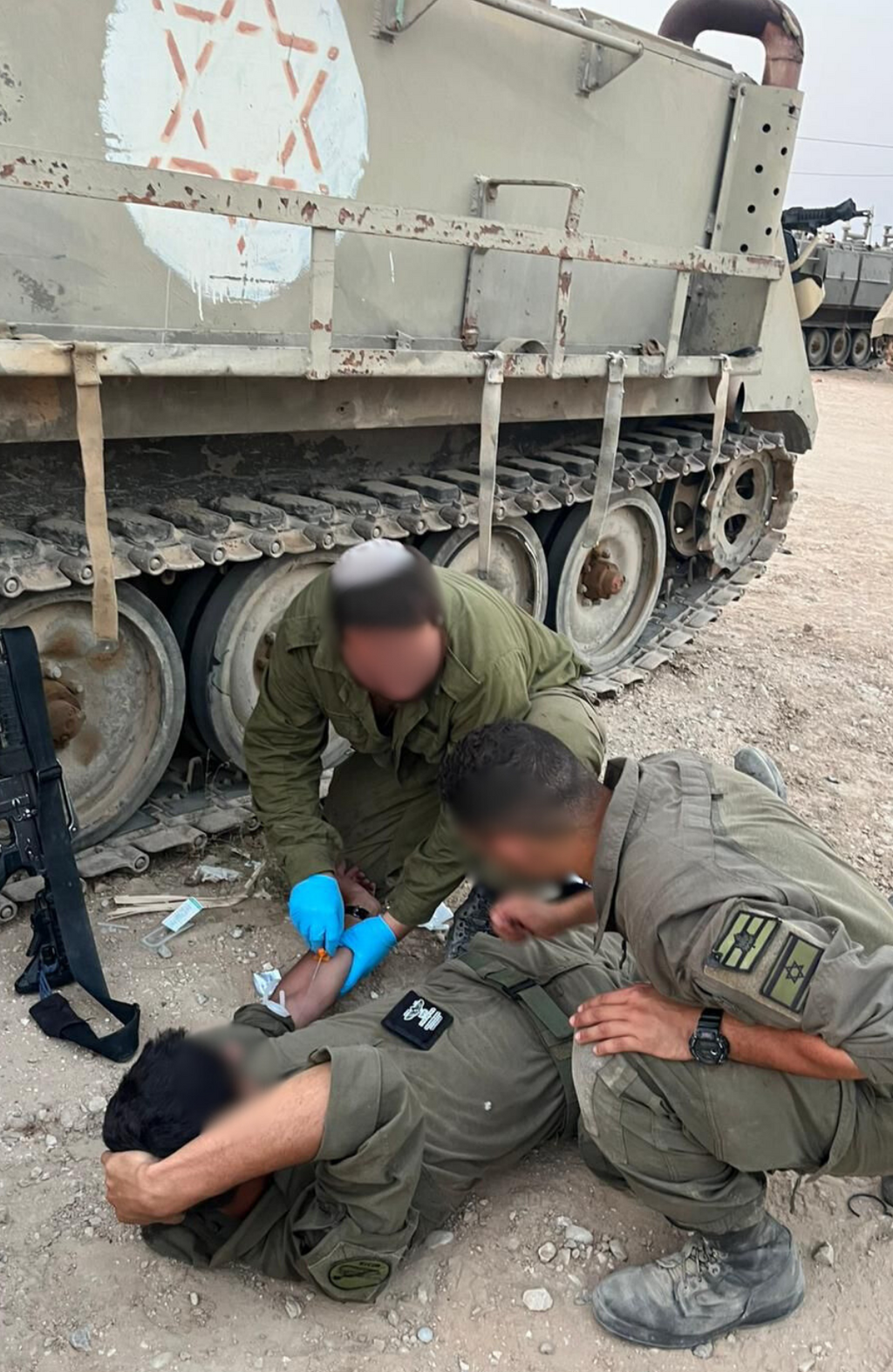
The injury occurred during his first week in Gaza, Cpl. G
(Photo: IDF)
A different kind of battle
“The first thing I did when they took me off the helicopter was ask to call my family,” Sgt. L says. “I called my father, but my mother answered. They took me to the trauma room, gave me painkillers, removed the tourniquets, I had three of them, and after about an hour they took me to surgery. They removed one bullet that was stuck in my hand and three bullets from my legs that had entered and exited.” The leg injuries, he says, were less complex, but the wounded hand required more significant treatment. “I had a fracture in my hand and they put in plates. I had a more serious injury in my left shin and right hand.”
Cpl. G’s condition was even more severe. “I arrived at the hospital, they took me into the trauma room and I have no idea what happened after that,” he says. Multiple gunshot wounds were identified throughout his body. “I had bullet holes in my leg from rounds that went in and out. A huge hole on the left side of my abdomen that had to be treated with a skin graft taken from my leg. An entry wound or abrasion on the left side of my chest,” he continues. “On the right side a bullet entered and traveled up to my shoulder, and it’s still lodged there.” An additional extensive injury to his right hip completed an especially severe injury profile. At that stage, in the hospital, it became clear how an incident that lasted only minutes had turned into a long medical and rehabilitation journey. From there, a new and limiting routine began for both of them.
Sgt. L: 'At first I couldn’t move my left leg at all. It was stuck at about a 45-degree angle. I was in a wheelchair. I could barely move; I couldn’t go to the bathroom, hold my phone, call friends or shower on my own. Nothing'
“At first, when I was at Soroka, I couldn’t move my left leg at all. It was stuck at about a 45-degree angle,” Sgt. L says. “I was in a wheelchair. I could barely move. I couldn’t go to the bathroom, hold my phone, call friends, shower by myself. Nothing.” After 10 days, he was transferred to the ‘Returning to Life’ ward at Sheba Medical Center at Tel Hashomer. “It was also very difficult there. I had really serious pain, and every time in physiotherapy they tried, but it hurt terribly. At first I couldn’t make progress.”
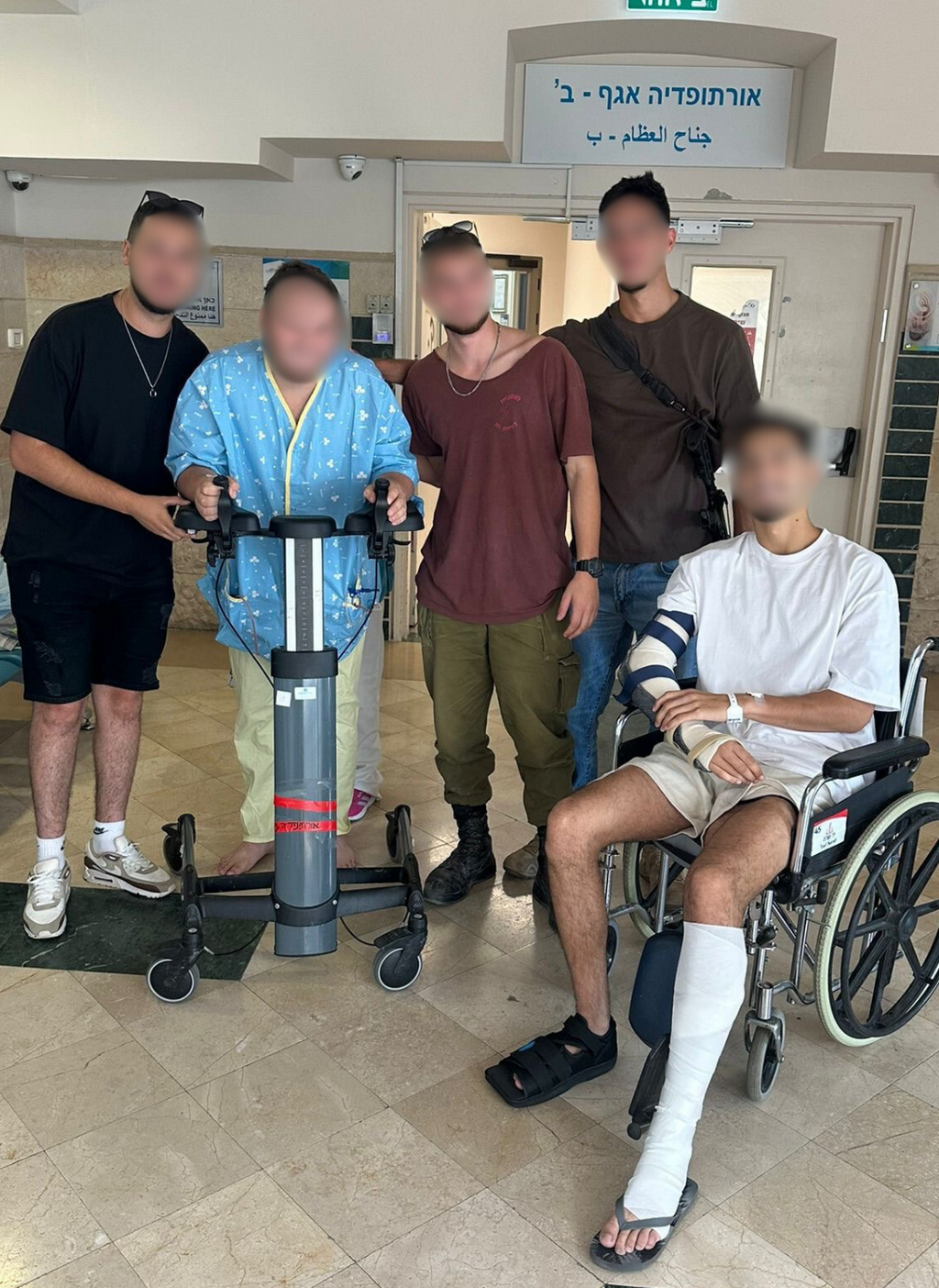
A difficult period; Sgt. L on the right and Cpl. G. on the left in the rehabilitation ward
(Photo: IDF)
After a week at Tel Hashomer, he went home for the first weekend and set his first small goal. “I said, OK, let’s try to walk a bit, to stand on my legs. It didn’t work very well, but at least I tried and managed to stand a little. Later they said they would put a brace on my leg to straighten it, but somehow before that I managed to straighten my leg and walk a bit,” he recalls. “About 20 days after the injury, I was already walking reasonably well. From there I progressed very quickly. From the moment I could walk a little, about a week later I was almost walking normally, going up and down stairs. Everything moved much faster.” But not everything was simple. The progress was not linear. “After two weeks at Tel Hashomer, I developed a pretty serious infection in my leg. A bacterium ate away at my leg and created a hole much deeper than the original wound. They treated me with a device connected to my leg that prevented me from leaving the hospital for three weeks. It really helped. To this day the wound hasn’t fully closed, but that’s OK.”
About two months after the injury came a particularly meaningful moment. “My brothers planned to run a marathon in Eilat. On the very day I was injured, I joked that I would join them for the last kilometer, and I didn’t really mean it. In the end I returned a bit to running and ran the last six kilometers with them. It was very emotional and pretty crazy.”
For Cpl. G, the road to discharge from the hospital and into rehabilitation was slower and more complex. “It took me a long time to get to rehab because I had a significant tissue deficit on the left side near my leg,” he says. “I had to use a vacuum device on my leg for three weeks. I underwent four debridement surgeries from the first day. Until I was discharged, I couldn’t really walk. Every time I started, I had to undergo another surgery. I was in pain. At first it was very hard, and later I improved.”
The physical difficulty was accompanied by loneliness. “I was alone in the hospital after L was discharged,” he says. “I was hospitalized in the plastic surgery department because most of my injuries were to the skin. There were five patients hospitalized with me. Almost every day they were discharged, and I stayed alone for several days. After three weeks I also arrived at Sheba, and L. was already there. There I wasn’t alone. There were others from the battalion too. Overall it was good at Sheba.”
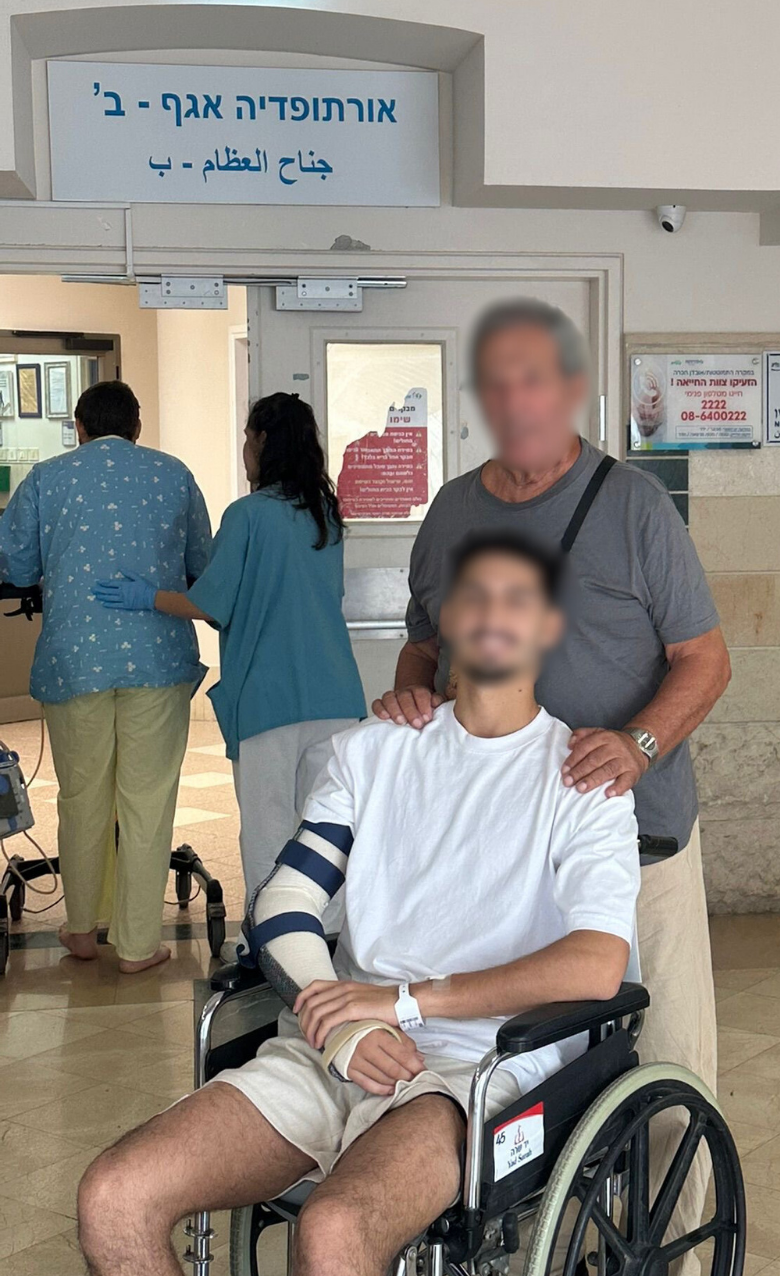
Sgt. L in the rehabilitation ward
(Photo: IDF)
The struggle you don’t see
Alongside physical progress, rehabilitation is also a far more demanding process than it appears. It is not just about the ability to walk, lift an arm or return to basic functioning, but about daily coping. The two describe the less visible struggles that wounded IDF soldiers face on their path back to normal life. Not every moment is a success. Sometimes it is precisely the small moments that frustrate and destabilize.
Cpl. G: 'Everything is harder than it used to be; it takes a lot more thought or more time; you work on something and succeed, and then you find another, smaller thing you can’t do; those small things are what’s hard.”
“Everything is harder than it used to be. It takes a lot more thought or more time,” G says. “You work on something and succeed, and then you find another, smaller thing you can’t do. Those small things are what’s hard.” L recognizes the same feeling. “I used to surf a lot, play basketball, do a lot of sports, and suddenly in one second you can’t stand on your legs, hold things with your hands, urinate or shower on your own. At first I needed help with everything from my girlfriend or my father. All the critical things you can’t do. Everything you used to do before, you now do less well.” “Slowly you learn to do all those things again, to walk, to shower, to type on your phone again,” he says.
He explains that the rapid progress at the beginning gives strength, but later also creates disappointment. “At the beginning it’s very encouraging, because rehab at first is fast. All the critical things, like walking, were relatively quick for me,” he says. “What’s more frustrating are the smaller things, like cooking. I used to cook a lot, and now it’s hard for me to cut a tomato because my hand doesn’t function properly. Those are things that take a long time to rehabilitate.” “Every time you run into something you can’t do. I can’t pick up a coin from a table. It sounds stupid, but it’s frustrating. You deal with it and move forward.”
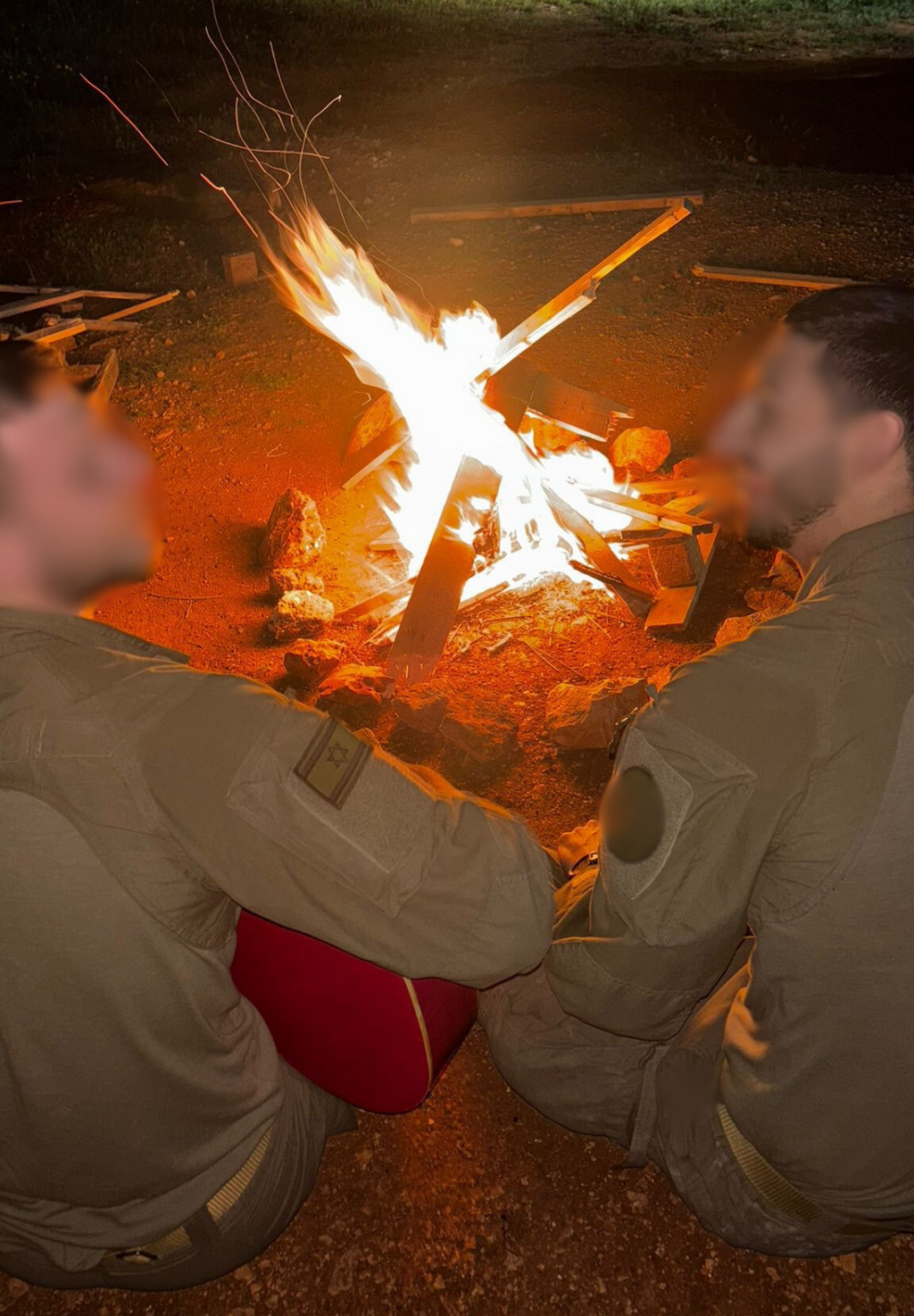
Waiting to return and complete his service, Sgt. L on the right
(Photo: IDF)
Today, months after their injuries, both are focused on full rehabilitation. “I rehabilitated well at Tel Hashomer and moved to day rehabilitation at the Loewenstein Rehabilitation Medical Center about two weeks ago,” L says. “I go there three times a week and get physiotherapy, occupational therapy, a psychologist and everything I need. It’s very different because you’re already at home, managing your time differently. It’s a significant change.”
He admits that returning home also required adjustment. “I had been in the army for two years, always with a schedule, hardly ever at home, and suddenly I’m home a lot with my family, with my parents, with my brother. It’s a completely different feeling. It’s also learning how to live at home again, to live with the family, with your parents. There are some issues here and there, but overall it’s fine. I’ve started working a bit again. I do some renovation jobs here and there, not too much.”
For G, life after the injury is also being rebuilt slowly, between physical rehabilitation and an attempt to create a new, meaningful routine. “I moved to day rehabilitation at Hadassah twice a week, and besides that I volunteer at a yeshiva for people with special needs,” he says. “There’s a chance I’ll need another surgery on my shoulder. It’s not 100 percent yet. These things take time.”
And what comes next? The answer is already clear. “Returning to the IDF,” G declares confidently. “With God’s help,” L adds immediately, “I plan to return as quickly as possible, already in another month or month and a half.”